
Compare Amazon KDP and IngramSpark to Find the Best Book Distributor
At some point in the publishing process, every author faces a decision that feels deceptively simple: where should my book be available, and how do I get it there? The answer shapes everything that follows, from how many readers can find your book to how much you earn on every sale to whether your title ever reaches a physical bookstore shelf.
Amazon KDP and IngramSpark are the two platforms that dominate this conversation for independent authors. Each one has genuine strengths, significant limitations, and a specific type of author it serves best. Choosing between them, or deciding how to use both together, is one of the most consequential publishing decisions you will make.
The amazon kdp vs ingramspark debate is not about which platform is objectively better. It is about which one aligns with what you are actually trying to accomplish. An author who wants to move quickly, maximize Amazon sales, and keep setup costs at zero will have a very different answer than an author who wants their book in independent bookstores, school libraries, and international retail chains.
What follows is a thorough, honest comparison of both platforms covering every factor that matters to a serious publishing decision.
What Is Book Distribution?
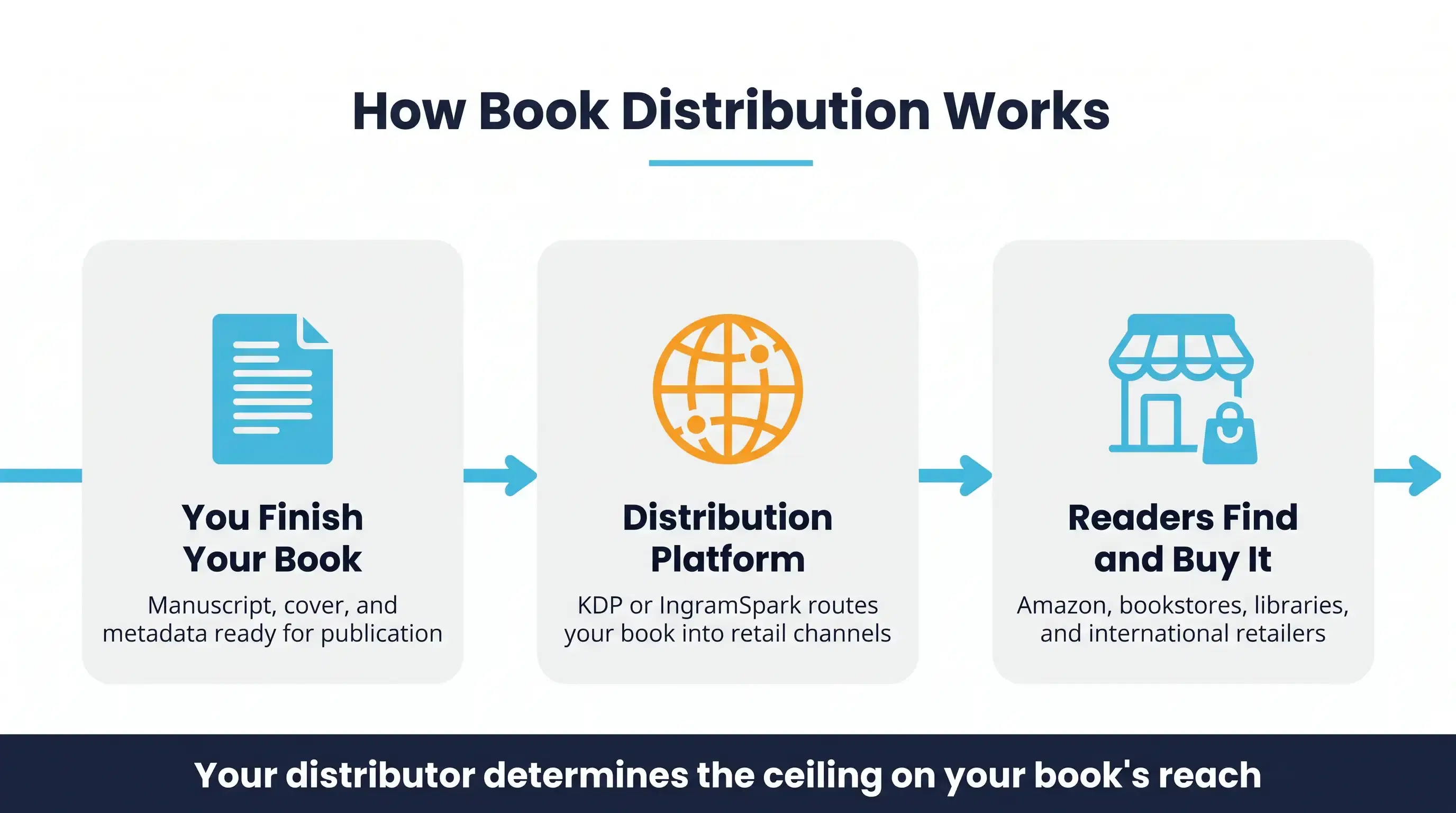
Book distribution is the process of making a published title available for purchase through retail channels, whether those channels are online marketplaces, physical bookstores, library systems, or wholesale networks. Distribution determines not just where your book can be found, but how retailers order it, what discount they receive, whether it is returnable, and ultimately how discoverable it is to readers who are not already looking for you specifically.
For independent authors, distribution has historically been one of the most significant barriers to reaching a broad audience. Traditional publishing houses have established wholesale relationships with distributors who supply thousands of retailers worldwide. Self publishing services and platforms like KDP and IngramSpark exist specifically to give independent authors access to distribution infrastructure that was previously available only through those traditional channels.
Why Choosing the Right Distributor Matters
The distributor you choose determines the ceiling on your book's reach. A title available only through Amazon's direct marketplace is invisible to the independent bookstore buyer who places weekly Ingram orders. A title published exclusively through IngramSpark without KDP enrollment is disadvantaged on the world's largest book retail platform. Neither limitation is fatal, but both are real, and understanding them before you publish is far preferable to discovering them after.
Distribution choices also affect pricing flexibility, royalty calculations, print quality options, and the speed at which you can make updates to your book after publication. Every one of those factors has downstream effects on your marketing options, your reader experience, and your long-term publishing economics.
What Is Amazon KDP?
Amazon Kindle Direct Publishing, universally known as KDP, is Amazon's self-publishing platform. It was launched to give authors direct access to the Amazon marketplace without a traditional publisher, and it has grown into the largest self-publishing platform in the world by both title count and sales volume.
How Amazon KDP Works
Authors upload manuscript files and cover art directly to the KDP dashboard, set their pricing and royalty preferences, choose distribution options, and publish. Upload and submission can be completed in a single sitting, but Amazon's review then takes roughly 24 to 72 hours before the listing goes live, and KDP allows up to 3 business days for eBooks and up to 5 days on non-US marketplaces. KDP handles printing, order fulfillment, and payment processing automatically.
For print books, KDP operates on a print-on-demand model. No inventory is held, and no upfront print run is required. When a reader orders a copy, Amazon prints and ships it. For ebooks, delivery is instant through the Kindle ecosystem. Royalties are calculated and paid monthly, typically 60 days after the end of the sales month.
Key Features of KDP
KDP's most commercially significant feature is direct integration with Amazon's retail and recommendation infrastructure. KDP titles appear in Amazon search results, are eligible for Amazon advertising, can participate in Kindle Unlimited, and benefit from Amazon's product recommendation algorithms. For authors whose primary sales channel is Amazon, that integration is enormously valuable.
KDP Select enrollment, which requires 90-day exclusivity for the ebook edition, unlocks additional features including Kindle Countdown Deals, free promotion days, and higher Kindle Unlimited royalty rates. These features can meaningfully accelerate sales for authors with the right marketing strategy.
Types of Books You Can Publish
KDP supports ebook publication in Kindle format, paperback print-on-demand with multiple trim sizes, and hardcover print-on-demand for eligible titles. Low-content books such as journals, notebooks, and planners are also supported. Large print editions, children's picture books with full-bleed interior color, and certain specialty formats have limitations on KDP that authors should verify before committing to the platform for complex projects.
What Is IngramSpark?
IngramSpark is the self-publishing arm of Ingram Content Group, which describes itself as one of the largest wholesale book distributors in the world. Where KDP is built around Amazon, IngramSpark is built around the global wholesale distribution network that supplies bookstores, libraries, and retailers in more than 40,000 locations worldwide.
How IngramSpark Works
Authors upload print-ready PDF files and cover files to the IngramSpark platform, set their retail pricing, choose their wholesale discount rate, and select distribution territories. IngramSpark then makes the title available to every retailer and library system connected to the Ingram distribution network, which includes independent bookstores, chain retailers, library wholesalers, and international distributors.
The setup process is more technically demanding than KDP. IngramSpark requires print-ready files that meet specific technical specifications, and titles without an assigned ISBN cannot be distributed through the platform. The workflow assumes a level of publishing literacy that KDP does not require, which is part of why IngramSpark is often characterized as the more professional but less beginner-friendly option.
Global Distribution Network
IngramSpark's distribution reach is its defining competitive advantage. Through the Ingram wholesale network, a title uploaded to IngramSpark becomes orderable by any of the tens of thousands of retailers worldwide who use Ingram as their primary book supplier. This includes Barnes and Noble, Books-A-Million, independent bookstores across North America and the UK, library systems that order through Ingram Library Services, and international retailers in dozens of countries. Note that Baker & Taylor, for decades the other major library wholesaler, wound down during 2026 and filed for Chapter 11 in March of that year, so guides that still list it as a route to libraries are out of date (Publishers Weekly on the Baker & Taylor filing, checked 14 August 2026).
For authors whose goal is global book distribution services that extend meaningfully beyond Amazon, IngramSpark provides access to distribution infrastructure that no other self-publishing platform currently matches.
Print-on-Demand Capabilities
IngramSpark's print-on-demand operation is widely regarded as producing higher quality output than KDP for most title types, particularly for hardcover editions, books with complex interior layouts, and titles with color interior pages. IngramSpark supports a wider range of trim sizes, paper types, and binding options than KDP, which matters significantly for illustrated books, textbooks, and specialty publications.
Amazon KDP vs IngramSpark: Side-by-Side Comparison
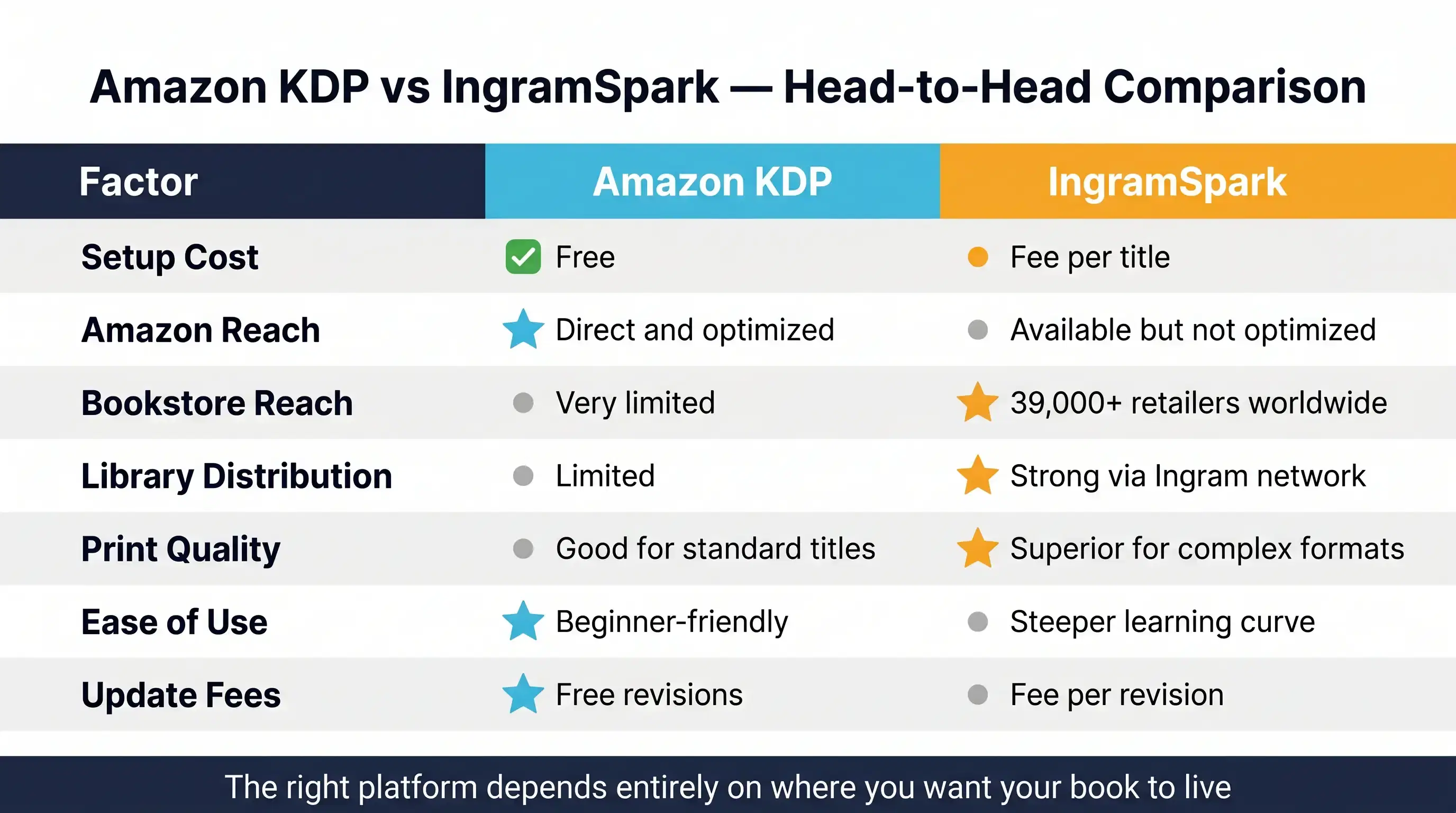
Before we examine each factor in detail, here is a structured overview of how kdp vs ingramspark comparison plays out across the dimensions that matter most to publishing decisions.
| Factor | Amazon KDP | IngramSpark |
|---|---|---|
| Setup Cost | Free | Free |
| ISBN | Free KDP ISBN (Amazon only) or own | Own ISBN required |
| Amazon Reach | Direct, optimized | Available but not optimized |
| Bookstore Reach | Very limited | Extensive (39,000+ retailers) |
| Library Distribution | Limited | Strong via Ingram network |
| Global Distribution | Moderate | Extensive international reach |
| Print Quality | Good for most titles | Superior for complex titles |
| Hardcover Options | Available | More options and better quality |
| Ease of Use | Very beginner-friendly | Steeper learning curve |
| Royalty Structure | Fixed percentage of list price | List price minus print cost minus discount |
| Ebook Distribution | Kindle ecosystem focus | Wide ebook distribution |
| Returns Policy | Non-returnable default | Returnable option available |
| Update Fees | Free | Fee per revision |
Distribution Reach: Where Your Book Will Be Available
Amazon KDP Distribution
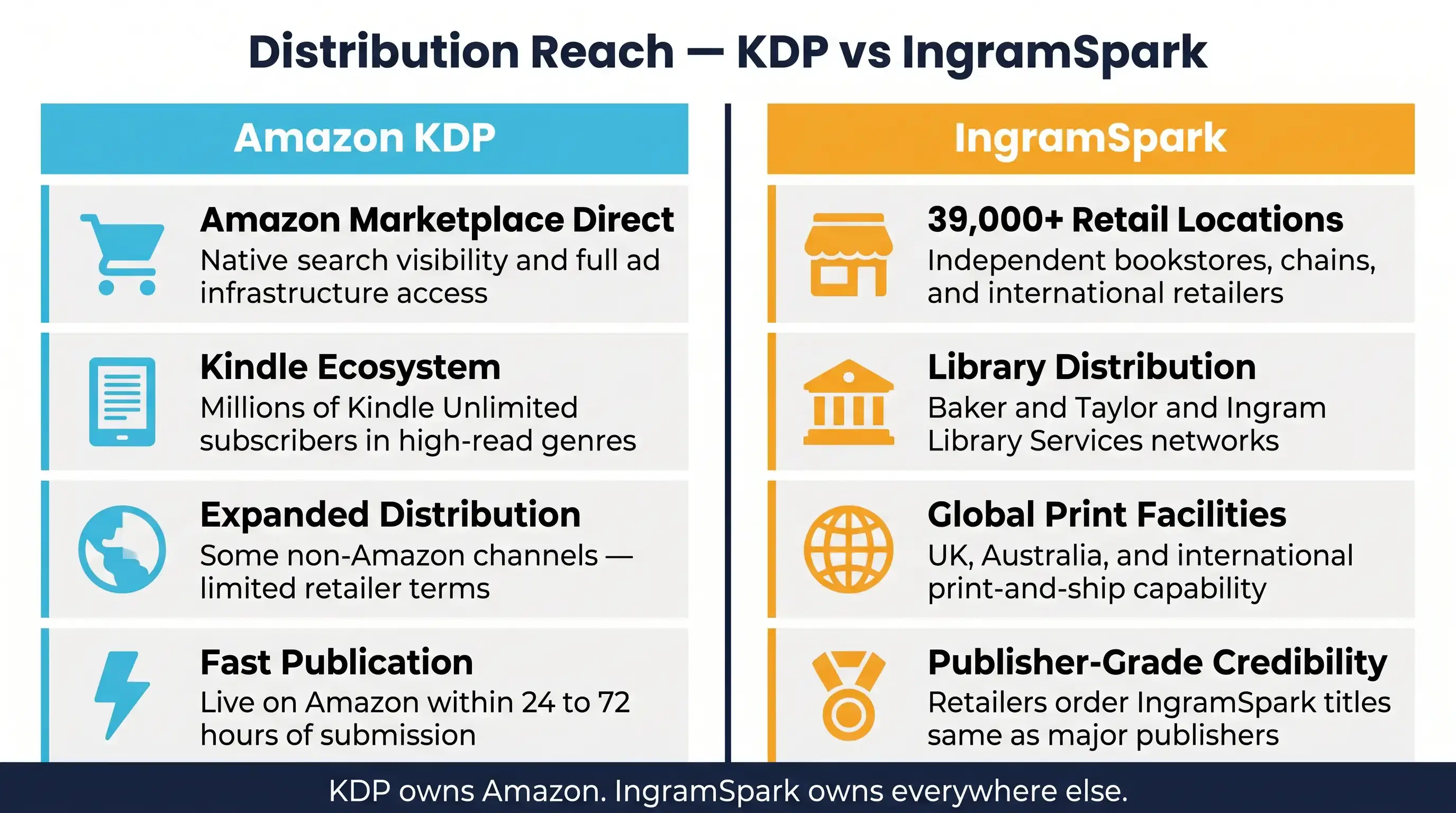
Amazon marketplace dominance: KDP's primary distribution advantage is its direct integration with Amazon, which accounts for a majority of all ebook sales in the United States and a substantial share of print book sales as well. A KDP title is natively visible in Amazon search results, eligible for all Amazon advertising formats, and positioned favorably in Amazon's recommendation algorithms compared to third-party titles that reach Amazon through IngramSpark or other aggregators.
Kindle ecosystem: For ebook authors, the Kindle ecosystem represents the largest single market in digital publishing. Kindle Unlimited alone has millions of subscribers who consume enormous quantities of content monthly. KDP authors who enroll in KDP Select gain access to this audience in a way that IngramSpark ebook distribution cannot replicate.
KDP's expanded distribution option does make titles available through some non-Amazon channels, but the coverage is limited compared to IngramSpark's wholesale network, and the discount structures offered through KDP's expanded distribution are generally less favorable to retailers than Ingram's standard terms.
IngramSpark Distribution
Bookstores, libraries, retailers: IngramSpark's connection to the Ingram wholesale network is the reason independent bookstores, chain retailers, and library systems can order your title the same way they order titles from major publishers. When a bookstore buyer searches Ingram's catalog, IngramSpark titles appear alongside traditionally published titles without distinction. That visibility is something KDP cannot provide.
Global print network: IngramSpark's print network includes facilities in the United States, the United Kingdom, Australia, and other international locations. This means that when a reader in the UK orders your book, it is printed and shipped from a UK facility rather than shipped internationally from the US. Faster delivery and lower shipping costs for international customers directly improve the reader experience and make your title more competitive in those markets.
Cost Comparison: KDP vs IngramSpark
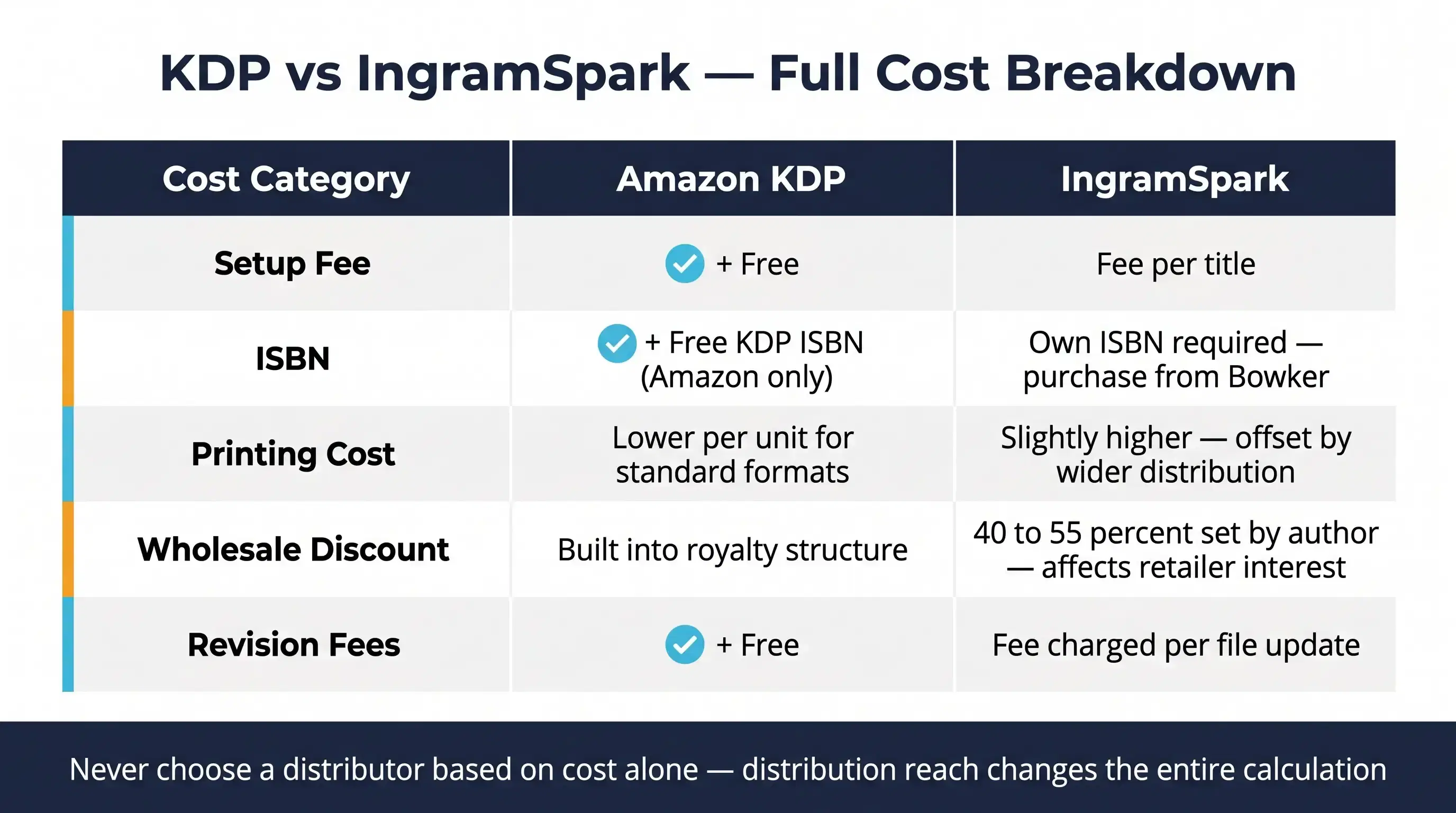
Cost is often the first factor authors consider and sometimes the only factor. A more complete analysis looks at total cost in the context of the sales environment each platform enables.
Setup Fees
KDP charges no setup fees. Creating an account, uploading a title, and publishing it are all free. This is a genuine advantage for authors who are cost-conscious, publishing a high volume of titles, or testing the market before committing to professional services.
IngramSpark no longer charges a title setup fee. It removed the fee in 2023, and its current price sheet lists print, ebook and combined title setup as free. This is a permanent change rather than a promotional waiver, so older guides telling authors to budget a per-title setup cost are out of date. Revisions to a title after publication can still carry a fee.
Printing Costs
Both platforms calculate print costs based on page count, trim size, color vs black-and-white interior, and binding type. IngramSpark's per-unit print costs are generally slightly higher than KDP's for comparable specifications, though the gap has narrowed in recent years. For most standard trade paperback formats, the difference per unit is modest and often offset by IngramSpark's distribution capabilities if the author is actively selling through non-Amazon channels.
Distribution Fees
KDP does not charge a distribution fee on top of printing costs. The royalty structure accounts for Amazon's margin within the calculation. IngramSpark's wholesale discount requirement, typically 40 to 55 percent of retail price for print books, functions as the distribution cost. A higher wholesale discount makes your book more attractive to retailers and libraries, but it reduces your per-unit earnings. Setting the discount too low may make retailers unwilling to stock the title.
Profit Margins
KDP's royalty structure is straightforward: 70% of list price for ebooks priced between $2.99 and $12.99 (an upper limit raised from $9.99 on 7 July 2026), 35% outside that range, and for paperbacks 60% of list minus print cost at $9.99 and above, 50% below that, and 40% through Expanded Distribution. IngramSpark's earnings are calculated as list price minus print cost minus the wholesale discount. At a 40% wholesale discount the two are closer than they look: on a $15.99 paperback both start from the same $9.59 before print costs, and IngramSpark nets roughly fifty cents less once its slightly higher print cost and its market access fee are applied. The real gap opens at IngramSpark's recommended 53-55% discount, where the gross falls to about $7.20-$7.52 - which is the price of reaching retail channels KDP cannot.
Authors using both platforms typically price their IngramSpark edition at a slightly higher list price to maintain acceptable per-unit margins while offering the wholesale discount retailers require.
Print Quality and Book Options
Paperback and Hardcover Options
KDP supports paperback and hardcover print-on-demand in a range of standard trim sizes. Hardcover options on KDP have expanded significantly in recent years and are now available for most title types. IngramSpark supports a wider range of trim sizes for both formats and has historically been preferred for hardcover quality, particularly for illustrated books, titles with complex interior formatting, and any publication where print quality is a visible differentiator in the market.
Paper Quality and Trim Sizes
Both platforms offer cream and white paper options for standard trade paperback formats. IngramSpark's paper quality is generally considered superior, particularly for titles with heavy text density or fine typography where paper weight and opacity affect the reading experience. IngramSpark also supports a broader range of specialty trim sizes that may be important for textbooks, illustrated guides, gift books, and other formats that fall outside the standard trade dimensions.
Color Printing Capabilities
For books with color interior pages, children's picture books, illustrated guides, and any title where color accuracy matters commercially, IngramSpark's color printing capabilities and quality standards are consistently rated higher than KDP's. The cost difference per page for color printing is significant on both platforms, but authors working with color-critical content typically find IngramSpark's output more consistent and closer to professional printing standards.
Royalties and Earnings Breakdown
Amazon KDP Royalty Model
KDP's ebook royalty is 70% of list price for titles in the $2.99 to $12.99 range, minus a small delivery fee calculated on file size. Titles priced outside that range earn 35%. For print books, KDP pays 60% of the list price minus the printing cost at $9.99 and above and 50% below that, with 40% through Expanded Distribution. KDP Select enrollment is what puts a title into Kindle Unlimited in the first place; it does not buy a better rate within it. Amazon operates a single KDP Select Global Fund and every enrolled title is paid from it at the same per-page rate, which Amazon sets month by month.
The amazon kdp publishing model is straightforward to calculate and predict. An author who sets their pricing and understands the royalty structure knows exactly what they will earn per sale before publishing.
IngramSpark Pricing and Discounts
IngramSpark earnings are determined by the formula: list price minus print cost minus wholesale discount. The wholesale discount is set by the author and determines how attractive the title is to retailers. A 55% discount makes the title attractive to most retailers and library wholesalers. A 40% discount is acceptable to some retailers but may reduce stocking interest. You cannot go lower than that in practice: IngramSpark's minimum wholesale discount is 40% in the US and Canada and 35% internationally, raised from the old 30% US minimum in 2023.
Authors also choose whether to make their title returnable. Returnability is a requirement for most physical bookstore stocking and for library system consideration, but it introduces the risk of returned inventory that has been read, damaged, or simply not sold. Non-returnable titles face fewer stocking opportunities in physical retail but eliminate the financial and logistical risk of returns.
Ease of Use and Publishing Experience
Beginner-Friendliness of KDP
KDP was built with accessibility as a core design principle. The dashboard guides authors through each step of the publishing process, accepts Word document manuscripts directly without requiring pre-formatted print-ready PDFs, provides an interior previewer that identifies common formatting problems before submission, and offers extensive documentation and community support for authors encountering issues.
For authors publishing their first book with no prior publishing experience, KDP's learning curve is genuinely manageable. Most authors can navigate from account creation to published title within a few hours for a straightforward manuscript.
Learning Curve of IngramSpark
IngramSpark requires print-ready PDF files that meet specific technical specifications for bleed, margins, and file structure. Authors who submit Word documents or improperly formatted PDFs will have their files rejected. The platform's interface is more complex than KDP's, and the setup process involves more decisions with less guidance for authors who are unfamiliar with professional publishing terminology.
Authors who have worked with a professional formatter or who have prior desktop publishing experience will find IngramSpark manageable. Authors with no formatting experience will likely need either professional preparation support or a significant investment of time in learning the platform's technical requirements before their first successful submission.
Dashboard and User Experience
KDP's dashboard provides clear sales reporting, straightforward royalty statements, and accessible advertising tools within a single interface. IngramSpark's reporting is more detailed in some respects but less intuitive in its presentation. Both platforms have improved their user interfaces significantly in recent years, but KDP's overall experience remains more accessible for authors who are not professionally trained in publishing.
Pros and Cons of Amazon KDP
Advantages
- No upfront cost: KDP charges nothing to set up and publish a title, making it the lowest-barrier entry point into self-publishing.
- Direct Amazon audience: Native integration with Amazon's search, recommendation, and advertising ecosystem puts KDP titles in front of the world's largest book-buying audience without additional distribution steps.
- Simple royalty structure: Straightforward earnings calculation makes it easy to price strategically and forecast revenue.
- Fast publication: Titles can go live within 24 to 72 hours of submission, making KDP the fastest route from finished manuscript to available-for-sale.
- Kindle Unlimited access: KDP Select enrollment provides access to the Kindle Unlimited subscriber base, which can dramatically increase readership for certain genres.
Disadvantages
- Limited bookstore distribution: KDP titles have minimal presence in physical bookstores and are rarely stocked by independent retailers or library systems.
- Amazon ecosystem dependence: Relying on a single platform for the majority of distribution creates vulnerability to algorithm changes, policy updates, and platform decisions outside the author's control.
- ISBN limitations: The free KDP ISBN cannot be used to publish on other platforms, which limits flexibility for authors who later want to expand distribution.
- Expanded distribution underperformance: KDP's non-Amazon distribution option does not provide the retailer relationships or wholesale terms that IngramSpark's network delivers.
Pros and Cons of IngramSpark
Advantages
- Extensive bookstore and library distribution: IngramSpark's connection to the Ingram wholesale network is the most direct path for an independent author to achieve genuine bookstore and library availability.
- Professional publishing options: Wider trim size range, superior hardcover quality, returnable options, and compatibility with professional publishing workflows make IngramSpark the preferred platform for authors with serious retail distribution ambitions.
- Global reach: International print facilities and distribution partnerships give IngramSpark titles genuine availability in markets where Amazon has less retail dominance.
- Publisher-grade credibility: Titles distributed through Ingram are treated by retailers the same as traditionally published titles in terms of ordering and stocking workflow.
Disadvantages
- Setup fees: Per-title costs add up for authors publishing multiple books or testing multiple cover and edition variations.
- Complex interface: The technical requirements for file preparation and the less intuitive dashboard create barriers for authors without publishing experience.
- ISBN requirement: Authors must purchase their own ISBN, which adds cost and a step that KDP eliminates with its free ISBN option.
- Revision fees: Unlike KDP, IngramSpark charges a fee each time you upload revised files, which increases the cost of correcting errors after publication.
When Should You Choose Amazon KDP?
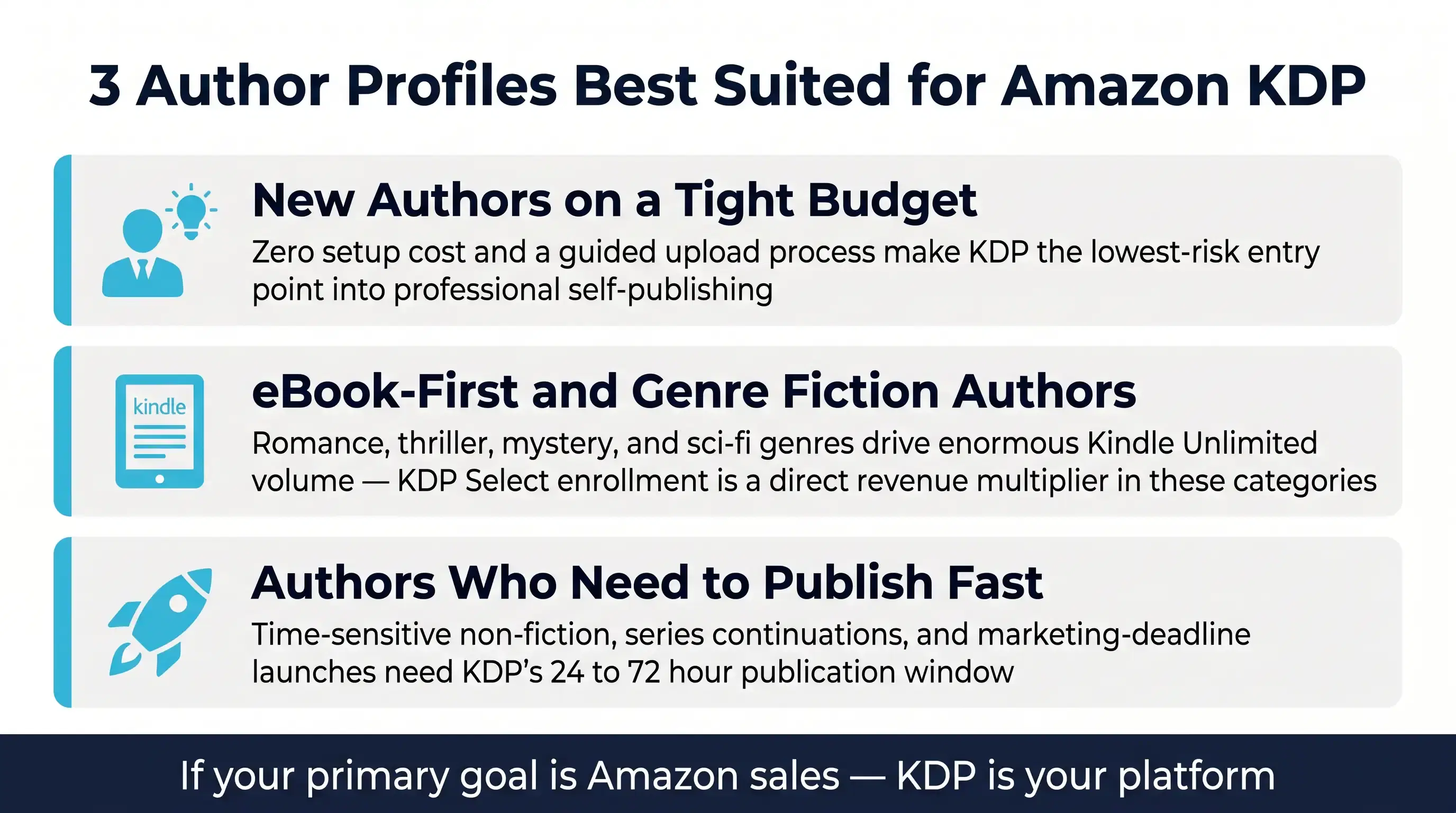
Best for New Authors
For authors publishing their first book with limited budget and no established platform, KDP's zero upfront cost, beginner-friendly interface, and immediate access to the Amazon marketplace make it the most practical starting point. The learning curve is manageable, the financial risk is minimal, and the path from manuscript to published book is faster than any alternative.
Best for eBook-First Strategy
Authors whose primary format is ebook and whose genre performs strongly on Amazon, including romance, thriller, mystery, and science fiction, will find that KDP's Kindle ecosystem integration provides advantages that IngramSpark's ebook distribution cannot match. KDP Select's Kindle Unlimited enrollment is particularly valuable in genres with high subscription reading rates.
Best for Quick Publishing
When speed matters, whether for a time-sensitive non-fiction topic, a series continuation for an impatient readership, or a title being launched to a marketing deadline, KDP's rapid review and publication timeline is the most reliable option. IngramSpark's review process and technical requirements add time that KDP's streamlined upload process does not.
When Should You Choose IngramSpark?
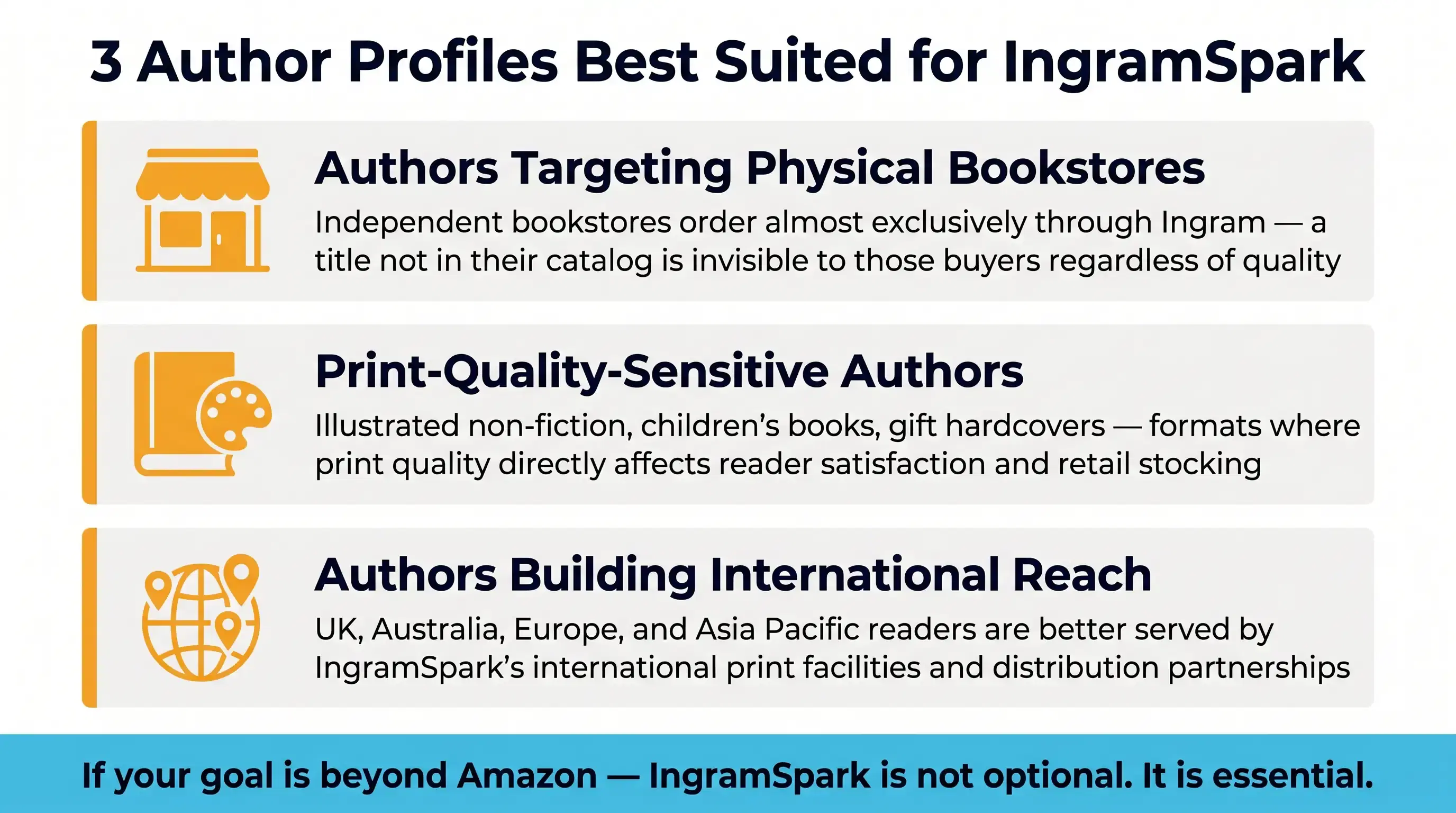
Best for Bookstore Distribution
Any author whose publishing goals include physical bookstore availability should be on IngramSpark. Independent bookstores in particular depend almost entirely on Ingram for their ordering, and a title that is not in the Ingram catalog is effectively invisible to those buyers regardless of its quality or commercial potential. For authors pursuing book distribution services that reach beyond online retail, IngramSpark is not optional. It is essential.
Best for Print-Focused Authors
Authors for whom print quality is a significant commercial factor, including illustrated non-fiction, children's books, gift books, and hardcover literary fiction, will consistently find IngramSpark's output superior to KDP's for the formats where quality differences are most visible. The per-title setup cost is justified when print quality directly affects reader satisfaction and retailer stocking decisions.
Best for Global Reach
Authors targeting international markets outside the United States, particularly the United Kingdom, Australia, Europe, and Asia Pacific, will find IngramSpark's international print facilities and distribution partnerships far more effective than KDP's international reach. For authors building an international readership, IngramSpark's global book distribution services represent the most practical path to genuine international availability.
Can You Use Amazon KDP and IngramSpark Together?
Yes, and for many authors the most effective publishing strategy involves both platforms operating in parallel. Understanding how to structure that combination without creating conflicts is essential.
Hybrid Distribution Strategy
The most common hybrid approach is to use KDP for Amazon print sales and ebook distribution while using IngramSpark for all non-Amazon distribution, including bookstores, libraries, and international retailers. This gives the author KDP's Amazon optimization and IngramSpark's wholesale network access simultaneously.
The rule that actually governs this is KDP's Expanded Distribution: switch it off, or Amazon and Ingram compete to supply the same retailers with the same title. IngramSpark's own User Guide permits the same title in both accounts once that is done. Using a separate ISBN for each edition is a defensible strategy choice rather than a requirement, but you do need your own ISBN from Bowker (in the US) or your national agency for anything distributed through IngramSpark, because a free KDP ISBN cannot be used elsewhere. A distinct ISBN for each format - paperback, hardcover, ebook - is separately required.
Avoiding Channel Conflicts
The primary conflict to avoid is price discrepancy between platforms. If your book is priced at $14.99 on KDP and $16.99 on IngramSpark, Amazon may match the lower price it finds elsewhere and pay your royalty on that reduced price. KDP documents no listing suppression for price mismatches, so the risk is to your margin rather than your visibility. Maintaining consistent pricing across all channels, or understanding Amazon's price-matching behavior before setting channel-specific prices, prevents this problem.
Authors using KDP Select for ebook exclusivity must ensure their ebook is not simultaneously distributed through IngramSpark's ebook distribution during the exclusivity period. Print editions are not affected by KDP Select exclusivity, which applies only to the ebook format.
Best Practices for Using Both
Disable KDP's expanded distribution for print books if you are using IngramSpark for non-Amazon distribution. KDP's expanded distribution and IngramSpark will sometimes offer the same title to the same retailers at different terms, and IngramSpark's terms are generally more favorable to retailers. Allowing KDP expanded distribution to compete with your IngramSpark listing can create confusion and undermine your non-Amazon sales.
Use IngramSpark's returnability option if you are actively pursuing physical bookstore placement. Non-returnable titles are a significant barrier to stocking for most independent bookstores, and enabling returnability, while it introduces some risk, is often necessary to achieve the retail presence that justifies an IngramSpark setup in the first place.
Common Mistakes Authors Make When Choosing a Distributor
Choosing based on cost only: The zero setup cost of KDP is genuinely attractive, but making a distribution decision based solely on upfront costs without evaluating distribution reach, print quality, and long-term publishing goals is how authors end up with books that are invisible to the bookstore market they were hoping to reach. Cost is one input into the decision, not the decision itself.
Ignoring distribution goals: Authors who have not clearly defined where they want their book to be available are in no position to evaluate which platform serves them best. Defining specific distribution goals before platform selection, including target retailers, library systems, international markets, and format priorities, produces a much more useful comparison than reviewing features in the abstract.
Misunderstanding royalties: Per-unit royalty comparisons between KDP and IngramSpark are only meaningful in the context of what each platform enables. Earning more per unit on KDP is not an advantage if IngramSpark would open distribution channels that generate more total revenue despite a lower per-unit rate. Royalty analysis needs to account for total potential sales across all channels, not just the earnings per transaction.
Not considering long-term strategy: A platform that works perfectly for a first book may create constraints for a second book, a series, or an expansion into new formats. Authors building a long-term publishing catalog benefit from thinking about platform infrastructure as a system rather than a one-time decision. Book publishing and distribution company relationships, ISBNs, and distribution terms all carry implications beyond the immediate publication.
Expert Tips to Maximize Book Distribution Success
Optimize Metadata and Keywords
Your book's discoverability on both platforms is driven by metadata. Title, subtitle, categories, keywords, and book description all influence how your title surfaces in search results both on platform and on external search engines. Invest the same level of care in your metadata that you invest in your cover and your manuscript. Poor metadata on a strong book produces the same commercial outcome as a weak cover on strong content: invisibility.
Set Competitive Pricing
Research the pricing of comparable titles in your specific subcategory before setting your price. Price too low and you signal lower quality while undermining your royalty margin. Price too high and you lose conversions to competitively priced alternatives. For IngramSpark titles targeting physical retail, remember that your list price must support both your profit margin and a 40 to 55 percent wholesale discount to retailers. That math needs to work before you finalize pricing.
Build a Marketing Strategy
Distribution gets your book into channels. Book marketing servicesand a deliberate marketing strategy are what create demand within those channels. A title available through IngramSpark's entire retailer network with no marketing support will generate minimal sales from that distribution. The same title with an active marketing strategy, author platform, and promotional campaign will generate sales that justify every element of the distribution investment.
Use Multiple Distribution Channels
Authors who achieve sustainable long-term sales are rarely dependent on a single platform. The hybrid KDP plus IngramSpark strategy, supplemented by direct sales through an author website, presence on library platforms, and engagement with international distribution partners, creates a sales ecosystem that is resilient to changes on any individual platform and reaches the broadest possible reader audience.
How Best Selling Publisher Helps You Choose the Right Distributor
The self publishing platforms comparison above covers the technical landscape, but applying that knowledge to a specific author's situation requires understanding the book's genre, target audience, format strategy, and publishing goals in context. That is where working with experienced professional publishing servicesmakes a meaningful difference.
Personalized Publishing Strategy
We do not apply a one-size-fits-all distribution recommendation. Every author we work with receives a distribution strategy built around their specific publishing goals, whether that means KDP-only for a fast-moving series author, IngramSpark-only for an illustrated non-fiction title targeting library acquisition, or a carefully structured hybrid strategy that uses both platforms for their respective strengths.
Our book publishing services include a publishing strategy consultation that covers distribution, pricing, metadata, and launch planning before any setup work begins, ensuring that every decision made in the platform setup phase aligns with the author's long-term commercial goals.
Setup and Distribution Support
Our team handles the technical setup process on both KDP and IngramSpark, including file preparation, metadata entry, category and keyword selection, pricing configuration, and distribution territory selection. Authors who have struggled with IngramSpark's file requirements or KDP's formatting specifications can hand off that work to professionals who handle these platforms daily.
For authors pursuing amazon kdp publishing services or IngramSpark setup, our technical team ensures files are prepared to platform specifications before submission, eliminating the rejection and revision cycles that delay publication for authors navigating these requirements for the first time.
Metadata and SEO Optimization
Our metadata optimization process covers category selection strategy, keyword research specific to your book's genre and topic, book description copywriting optimized for both reader conversion and search visibility, and BISAC subject code selection that positions your title correctly within retailer and library catalog systems. These elements directly affect discoverability on both platforms and on external search engines that drive readers to retail listings.
Marketing and Launch Services
Getting your book into distribution channels is only the beginning. Our book marketing services cover launch strategy, advertising setup and management on Amazon and other platforms, social media and email marketing, reviewer outreach, and ongoing sales optimization. Authors who publish well but market poorly leave the majority of their book's commercial potential unrealized.
Our ebook publishing services extend the same strategic approach to digital distribution, ensuring that ebook metadata, pricing, and platform selection are as carefully optimized as the print distribution strategy.
Ready to Publish and Distribute Your Book the Right Way?
The decision between Amazon KDP and IngramSpark is not a technical question with a universal correct answer. It is a strategic question that depends entirely on where you want your book to be available, who you want to reach, and what you are willing to invest to achieve those goals.
Authors who understand that difference, and who make their distribution decision based on publishing goals rather than platform familiarity or upfront cost, consistently build more successful publishing careers than those who default to the path of least resistance without examining where it leads.
Full-Service Publishing Support
Best Selling Publisher works with authors at every stage of this process, from initial strategy through technical setup, metadata optimization, and launch marketing. Whether you need IngramSpark setup service support, KDP publishing assistance, or a complete distribution strategy built from scratch, our team provides the expertise and execution to get your book into the right channels the right way.
Start Your Publishing Journey
When you are ready to make a distribution decision you can build a publishing career on, we are ready to help you make it.
FAQs
Neither platform is universally better. KDP is better for Amazon-focused distribution, ebook sales, Kindle Unlimited enrollment, and authors who prioritize speed and zero upfront cost. IngramSpark is better for bookstore distribution, library availability, global retail reach, and print quality in complex formats.
The right answer depends entirely on your specific publishing goals, and many authors benefit from using both platforms in a structured hybrid strategy.
Yes, and it is a strategy many experienced independent authors use successfully. The key requirements include using a separate ISBN for each edition, maintaining consistent pricing across channels, and ensuring platform settings do not conflict.
For example, avoid enabling overlapping distribution programs that may cause fulfillment conflicts or pricing issues between Amazon and IngramSpark.
KDP typically pays higher per-unit royalties for direct Amazon sales because there is no wholesale discount involved, allowing authors to retain more of the list price.
IngramSpark offers lower per-unit earnings due to wholesale discounts, but it provides access to bookstores, libraries, and global retail channels that can increase overall revenue potential.
IngramSpark is worth the setup fee for authors targeting bookstores, libraries, international distribution, or high-quality print formats.
It may be less necessary for Amazon-only strategies or for authors testing early market demand before committing to full distribution investment.
Not every author needs both platforms, but authors aiming for broad distribution typically benefit from using KDP and IngramSpark together.
The hybrid approach requires more setup and management, but it combines Amazon reach with global retail and library access, creating a stronger overall distribution foundation.