
Audiobook Publishing in 2026: Platforms, Costs & Best Practices
The way people consume books has changed permanently. Millions of listeners now prefer to experience a story or absorb information through their earphones rather than their eyes, and the authors who understand this shift are capturing audiences that purely print-and-ebook strategies simply cannot reach.
Audiobook sales have grown faster than any other publishing format over the past several years, and that trajectory is not slowing down in 2026. Subscription services have made audiobooks accessible to a wider audience than ever before, smart speaker adoption keeps expanding, and commuter culture has turned every car ride and gym session into potential listening time.
For authors, the question is no longer whether to publish an audiobook. It's how to do it right. The audiobook publishing platforms available today offer more flexibility, reach, and earning potential than at any point in publishing history. But navigating those platforms, understanding production costs, and building a distribution strategy that actually works requires more than a quick search and a guess.
Everything you need to make a confident, informed decision about your audiobook is laid out below.
What Is Audiobook Publishing?
Definition of Audiobook Publishing
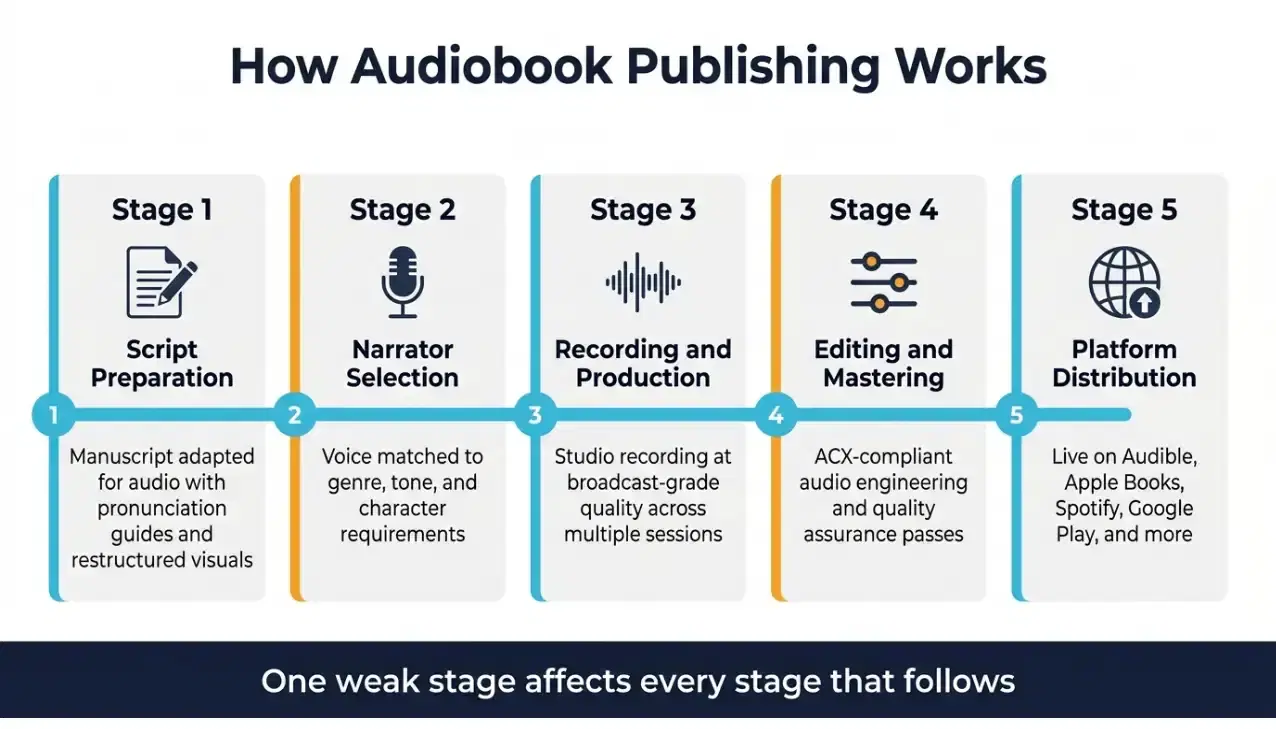
Audiobook publishing is the process of converting a written manuscript into a professionally narrated audio format and making it available for sale or streaming across digital platforms. Unlike uploading an ebook, which is primarily a formatting and metadata exercise, audiobook publishing involves a full production pipeline: script preparation, voice casting, studio recording, audio engineering, quality control, and platform distribution.
Each of those stages has a direct impact on the final product that listeners hear. A weak link anywhere in the chain, whether that's a poorly prepared script, an ill-matched narrator, or substandard mastering, will show up in your reviews and your sales.
Growth of the Audiobook Industry in 2026
The numbers behind audiobook growth are hard to ignore. Consumer spending on audiobooks has posted double-digit percentage growth in multiple consecutive years. Subscription services like Audible, Everand (formerly Scribd) and Audiobooks.com have brought in massive new listener bases, particularly among younger audiences who grew up with on-demand digital content.
Smart speaker households are now in the hundreds of millions globally. Podcast listening has trained an entire generation of consumers to engage with long-form audio content on a daily basis. The infrastructure for audiobook discovery and consumption has never been stronger, and it keeps improving.
For authors, this represents a genuine and growing opportunity. Not a trend to chase, but a durable shift in how readers engage with books.
Why Authors Are Turning to Audiobooks
The practical case for adding an audiobook to your publishing strategy is straightforward. Audiobooks reach listeners who do not read print or digital books at all. They command higher per-unit prices in most genres. They generate royalty income that compounds over time from subscription page reads and individual sales. And they give your book a second, third, and fourth life with audiences who discovered your work through an entirely different channel than traditional book marketing.
Authors who publish in all three formats consistently outperform single-format authors. The audiobook is not a bonus. It's a core part of a complete publishing strategy in 2026.
How Audiobook Publishing Works (Step-by-Step Overview)
Understanding the production process before you commit to it helps you budget accurately, set realistic timelines, and make better decisions at every stage. Whether you handle parts of it yourself or work with professional audiobook production services, knowing what each stage involves prevents the surprises that derail timelines and budgets.
Script Preparation
Your written manuscript is the foundation, but it needs preparation before a narrator can work with it effectively. Audio scripts require clearer punctuation to guide pacing and emphasis. Sections that rely on visual formatting, like charts, footnotes, or tables, need to be rewritten or restructured so they make sense when heard rather than read.
Pronunciation guides are essential for any book that contains unusual names, foreign language passages, technical terminology, or invented words. A single mispronounced character name repeated hundreds of times across a twelve-hour audiobook is the kind of thing that gets mentioned in every single review. Prepare for it before recording begins, not after.
Narration and Voice Talent Selection
Narrator selection is the single most important production decision you will make. The right voice elevates your book. The wrong voice creates a friction between listener and story that no amount of good writing can overcome.
The matching process should be deliberate. Literary fiction benefits from narrators with subtlety and emotional range. Thrillers need someone who can build tension through pacing and delivery. Romance narrators need to handle emotional intimacy convincingly. Business and self-help titles call for authority and clarity. Fantasy and science fiction often require a narrator who can manage multiple distinct character voices while also handling invented terminology consistently.
Request audition samples from multiple candidates. Listen to each sample while following along with a passage from your own manuscript, not a generic sample. You're not just evaluating a voice in the abstract. You're evaluating how that voice will interpret your specific words.
Recording and Audio Production
Professional recording takes place in soundproofed studio environments using broadcast-grade microphones and monitoring equipment. Recording runs slower than real time: one finished hour of audio typically takes two to four hours in the studio once retakes, breaks and pickups are counted. A 90,000-word novel will require ten to twelve finished hours of audio, so budget for multiple weeks of sessions before editing even begins.
Session management matters. Each chapter should be recorded and filed separately to make the editing process more efficient and to allow for targeted reshoots if specific passages need to be rerecorded.
Editing, Mastering and Quality Control
Raw recording files go through an editing pass to remove breath pops, mouth clicks, background noise, false starts, and inconsistencies in pacing or volume between sessions. After editing, the mastering engineer applies compression, equalization, and normalization to bring the audio up to platform technical standards.
ACX, which powers Audible, specifies its levels in RMS rather than LUFS: each file must sit between -23dB and -18dB RMS, peak below -3dB, with a noise floor under -60dB RMS, and be delivered as 192 kbps or higher constant-bitrate MP3 at 44.1 kHz (ACX audio submission requirements, checked 18 August 2026). Guides that quote a LUFS target or a 128 kbps file are describing something ACX does not ask for, and 128 kbps is below its floor. Submitting files that don't meet these specifications results in rejection and delays your launch. Professional audio engineers know these standards and work to them as a baseline, not an afterthought.
Quality assurance involves multiple listening passes, often split between the editor, a QC reviewer, and ideally the author, to catch anything that survived the technical checks.
Distribution Across Platforms
Once your audiobook passes quality control, you face the distribution decision that shapes your long-term earning potential: exclusive or wide. We cover this in detail below, but the key point at the production stage is that your decision about distribution should be made before you finalize your metadata.
Top Audiobook Publishing Platforms in 2026
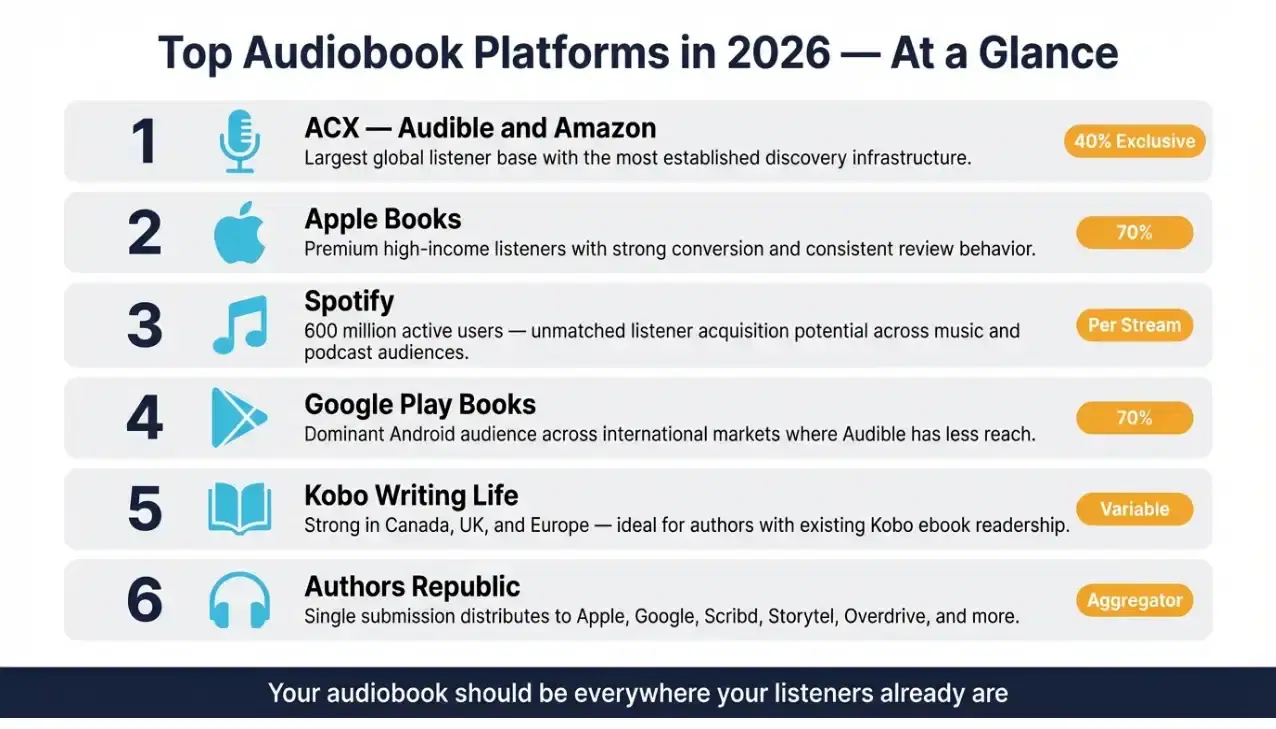
The landscape of audiobook publishing platforms has expanded significantly over the past few years. Here's what you need to know about the major options and what each one offers.
ACX (Audible / Amazon)
ACX, the Audible Creation Exchange, is Amazon's audiobook production and distribution arm. It remains the dominant platform in the global audiobook market, with the largest listener base, the most established discovery infrastructure, and the widest range of royalty options.
Publishing through ACX means your audiobook will be available on Audible, Amazon, and Apple Books through the ACX distribution pathway. For exclusive titles, ACX offers a 50% royalty rate. Non-exclusive titles earn 30%. DIY titles claimed after 26 May 2026 are enrolled in this model automatically; ACX says the older 40% / 25% legacy model will be discontinued by the end of the year (ACX royalty model, checked 3 September 2026). The trade-off between those two rates is one of the most important strategic decisions in audiobook publishing, and the right answer depends entirely on your specific situation and goals.
ACX also allows authors to connect with narrators and producers directly through its marketplace, which makes it possible to cast your audiobook without a separate talent search if you choose to use the platform's built-in tools.
Authors Republic
Authors Republic is a distribution aggregator that sends your audiobook to a wide network of retail and library platforms from a single submission. Their distribution network includes Apple Books, Google Play Books, Everand, Audiobooks.com, Storytel, Overdrive, and more.
For authors pursuing wide distribution, Authors Republic eliminates the need to submit separately to each platform. They keep 20 percent of earned royalties as their distribution fee, passing the remaining 80 percent through to the author based on each platform's own royalty structure.
Authors Republic is particularly well-suited for authors who want broad international reach without being tied to an exclusive arrangement with a single platform.
Spotify
Spotify entered the audiobook market aggressively and has been expanding its catalog and listener base at pace. With more than 770 million active users globally already on the platform for music and podcasts, Spotify represents a listener acquisition opportunity that no other audiobook platform can match in terms of raw audience size.
Spotify runs two parallel royalty streams: a la carte royalties when a listener buys the audiobook outright, and streaming royalties based on listening time when a Premium subscriber consumes it from their included hours. The streaming half pays less per listener than a direct sale on ACX or Apple Books. But the volume potential is significant, particularly for authors whose genres overlap with Spotify's existing listener demographics, such as self-help, business, romance, and thriller.
Apple Books
Apple Books has a premium audience profile. Apple device users tend to have higher disposable income and spend more on digital content per capita than the average digital content consumer. For audiobooks priced at the higher end of the standard range, Apple Books listeners convert well and leave reviews regularly.
Apple's published 70% rate is its eBook rate; it does not publish a royalty percentage for audiobooks, which move through a wholesale arrangement instead, so treat any specific audiobook figure you see quoted for Apple as an estimate. Apple Books is one of the platforms included in ACX's non-exclusive distribution, meaning authors who choose the non-exclusive ACX path automatically get Apple Books distribution through that arrangement.
Google Play Books
Google Play Books provides access to Android users worldwide. Given Android's dominant global market share, particularly outside North America, Google Play Books is the strongest platform for reaching listeners in markets where Audible has historically had less penetration.
Google Play pays 70% royalties and supports flexible pricing strategies. For authors targeting international audiences or building readership in emerging markets, Google Play is a channel worth prioritizing.
Kobo Writing Life
Kobo operates one of the most author-friendly platforms in publishing, both for ebooks and audiobooks. Their Writing Life portal allows direct uploads without an aggregator, and Kobo has strong market presence in Canada, the United Kingdom, Australia, and several European markets.
For authors whose existing ebook audience is strong on Kobo, adding an audiobook through the same platform simplifies the process and maximizes visibility within an already engaged reader base.
INaudio
INaudio is a distributor rather than a storefront: it is the successor to Findaway Voices, and it pushes your audiobook out to retailers and libraries instead of selling to listeners itself. It supports self-published authors with transparent earnings reporting and both exclusive and non-exclusive options.
Because it is a distribution network rather than a shop, INaudio has no listener base of its own; what it offers is reach into retailers and library systems in one step, which is useful for authors pursuing wide strategies and wanting to maximize their platform count without significant additional effort.
Exclusive vs Wide Distribution for Audiobooks
What Is Exclusive Distribution
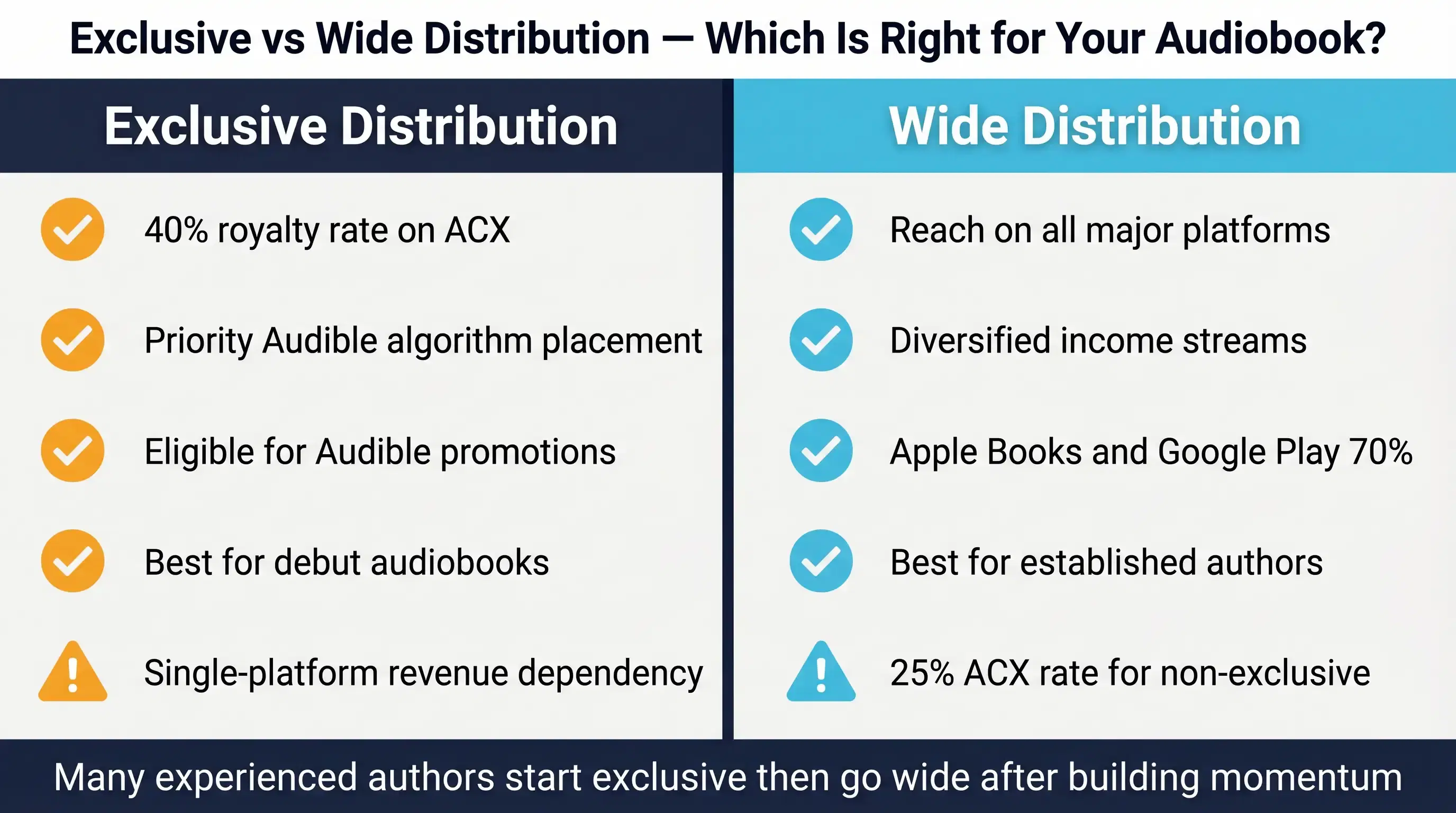
Exclusive distribution means your audiobook is sold only through ACX's own retail channels - Audible, Amazon and Apple Books - and nowhere else, for a contractually defined period. In exchange for that exclusivity, ACX pays a 50% royalty rate instead of the 30% non-exclusive rate. Exclusive titles also benefit from priority placement in Audible's recommendation engine and eligibility for promotional programs that non-exclusive titles cannot access.
What Is Wide Distribution
Wide distribution means making your audiobook available across multiple platforms simultaneously. You reach listeners on Apple Books, Google Play, Spotify, Kobo, Everand, and other platforms in addition to Audible, dramatically expanding your potential audience.
The trade-off is a lower per-unit royalty rate on ACX and, if you use an aggregator, a distribution fee on earnings from the non-ACX platforms.
Pros and Cons of Each Strategy
Exclusive distribution offers stronger visibility within a single dominant marketplace, simplified marketing focus, and access to platform-specific promotional tools that can significantly increase early momentum. It is often most effective for authors whose audience already overlaps heavily with Audible’s ecosystem.
Wide distribution prioritizes reach and long-term discoverability across multiple listener ecosystems. It reduces dependence on a single platform’s algorithm and allows your audiobook to accumulate revenue from multiple sources simultaneously. However, it requires more coordination across platforms and typically results in lower per-unit earnings on individual sales through ACX.
The right choice depends on your genre, audience behavior, and whether your strategy prioritizes concentrated visibility or diversified reach.
| Factor | Exclusive (ACX) | Wide Distribution |
|---|---|---|
| Royalty Rate on ACX | 50% per sale | 30% per sale |
| Platform Reach | Audible, Amazon, Apple via ACX | All major platforms |
| Algorithm Placement | Priority on Audible | Standard on each platform |
| Promotional Access | Eligible for Audible promos | Limited Audible promos |
| Risk Level | Single-platform dependency | Diversified across platforms |
| Marketing Complexity | Focused on one platform | Spread across multiple platforms |
| Ideal For | Debut authors, momentum building | Established authors, series |
Which Model Is Best for You
Exclusive publishing tends to produce better early momentum for debut audiobooks and first titles in a series. The higher royalty rate, combined with algorithmic preference on the world's largest audiobook platform, can generate a faster initial sales spike that compounds through reviews and discovery.
Wide distribution becomes more strategically valuable once you have an established author platform, an email list, or a series where book one has already built an audience. At that stage, the income diversification and the ability to reach listeners who never visit Audible outweigh the royalty rate difference.
Many experienced audiobook authors use a hybrid approach: launch exclusive to build initial Audible momentum, then transition to wide distribution after the exclusivity window closes.
Cost of Publishing an Audiobook in 2026

Understanding the Cost to Publish Audiobook Content
Understanding the cost to publish audiobook content clearly, before you commit to a production budget, prevents the financial surprises that derail audiobook projects midway through production.
Narration Costs
Professional narration is billed per finished hour of audio, commonly abbreviated as PFH. One finished hour of audio typically requires two to four hours of studio recording time, depending on the complexity of the script and the narrator's efficiency.
A 90,000-word novel will produce approximately ten to twelve finished hours of audio. That word-to-hour ratio is the most important factor in estimating your narration budget before you approach any narrator.
Narrator rates vary significantly based on experience level. Emerging narrators with limited but solid track records charge considerably less than established professionals with extensive credits. Celebrity narrators or award-winning voice actors represent the top end of the market. Genre also plays a role: romance and literary fiction often command higher narrator rates than nonfiction categories because they require more performance range.
Production and Editing Costs
Audio editing and mastering are typically billed either per finished hour or as a flat project fee. The editing pass handles artifact removal, consistency checking, and chapter transitions. The mastering pass applies the final technical processing to bring the audio to platform specifications.
Some narrators work out of professional studios that include engineering in their rates. Others record and deliver raw files, leaving engineering to a separate contractor. Clarify what is included in any narration quote before you agree to terms.
Distribution Costs
Direct publication through ACX is free. Amazon absorbs the platform costs in exchange for their royalty share. Publishing through an aggregator carries a commission instead of an upfront fee. Authors Republic keeps 20 percent, passing 80 percent of earned royalties to the author; other aggregators set their own rates, so check the current figure rather than assuming a 10 to 15 percent norm.
Cover artwork for the audiobook square format is an additional consideration. If your ebook cover is already professionally designed, adapting it to the audiobook square format is usually a minor cost. If you're creating cover art from scratch, budget accordingly.
Total Cost Overview
| Cost Category | Typical Structure | Notes |
|---|---|---|
| Narration | Per finished hour (PFH) | Largest expense. Rates vary by narrator tier and genre |
| Audio Editing | Per finished hour or flat fee | Sometimes included in narration packages |
| Mastering & QA | Per finished hour or flat fee | Often bundled with editing |
| Cover Art (Square Format) | One-time design fee | May be adapted from existing book cover |
| Distribution (Aggregator) | About 20% of earnings (Authors Republic) | ACX direct is free; aggregators charge commission |
The honest budget reality: narration is by far your largest line item, and it scales directly with your book's length. A 10-hour audiobook with a mid-tier professional narrator represents a significant investment. That investment is directly reflected in audio quality, and audio quality is directly reflected in your reviews. Cutting corners on narration to reduce upfront costs is one of the most reliably poor decisions in audiobook publishing.
Audiobook Royalties Explained
ACX Royalty Models
ACX operates two royalty tracks, and as of September 2026 it is mid transition between two rate models. ACX opened enrolment in the new model to all creators in an announcement posted 28 April 2026: exclusive titles earn 50% of the retail sale price on an individual purchase and non-exclusive titles earn 30%. DIY titles claimed after 26 May 2026 are enrolled automatically, while titles already on the legacy 40% and 25% rates stay there until you enrol them yourself from the dashboard. ACX says the legacy model will be discontinued by the end of the year, so check which model your title is on before projecting income (ACX on the new royalty model, checked 3 September 2026). Membership sales are paid separately. Audible takes each member's own subscription revenue and divides it across the titles that member engaged with, weighted by each title's a la carte price, rather than paying from a single pool shared by listening time across all subscribers.
Membership payments tend to be lower per listener than individual sale royalties, but they represent a consistent passive income stream that accumulates regardless of whether a listener is actively buying audiobooks or consuming them through their subscription credit.
Earnings Across Other Platforms
Apple Books and Google Play Books both publish a 70% rate for eBooks, and neither publishes an audiobook revenue split, so the 70% figure that circulates for audio on both platforms is not something either company states. Spotify pays both a la carte royalties on outright purchases and streaming royalties on Premium listening, the latter paying less per listener but reaching a substantially larger audience. Everand and Audiobooks.com pay through their subscription arrangements.
Wide distribution authors typically see more fragmented earnings across multiple platforms, but the aggregate can exceed what a single-platform exclusive strategy produces once a back catalog is built and multiple titles are accumulating streams and sales simultaneously.
Revenue Share vs Upfront Payment
The vast majority of independent audiobook publishing operates on a revenue share model where you earn a percentage of each sale or subscription stream with no upfront payment from the platform. This is structurally similar to how ebook royalties work and aligns platform incentives with author incentives: platforms earn more when books sell more.
Upfront advances exist in traditional publishing and in some hybrid publishing arrangements, but they are not a standard feature of independent audiobook distribution. If you're working with a full-service audiobook publisher, clarify how production costs are structured relative to royalty splits, since some services bundle production into revenue share arrangements.
Best Practices for Successful Audiobook Publishing
Choose the Right Narrator
Spend more time on narrator selection than any other single production decision. Listen to complete sample chapters rather than highlight reels. Evaluate whether the narrator's natural voice and performance style match the emotional tone of your book, not just whether the voice sounds pleasant in isolation.
For fiction with multiple points of view or a large cast of characters, test whether the narrator can differentiate voices clearly and consistently. Listeners lose immersion quickly when characters who should sound distinct become indistinguishable from one another across a long audiobook.
Focus on Audio Quality
Platform technical specifications are not suggestions. ACX will reject files that fall outside its loudness normalization requirements, and correcting rejected files after the fact adds weeks and costs to your timeline. Work with audio engineers who produce ACX-compliant files as a standard output, not as a special request.
Beyond technical compliance, audio quality means consistency. Volume levels should not shift noticeably between chapters. Background noise should be inaudible. Pacing should match the material: action sequences move faster, reflective passages breathe. These are things that professional narrators and engineers handle as part of their craft, which is why professional production reliably outperforms DIY approaches in listener satisfaction ratings.
Optimize Your Metadata
Audiobook discoverability on every platform depends on metadata quality. Your title, subtitle, description, categories, and keywords all influence whether your book surfaces in relevant searches and recommendations.
Write your description specifically for audio listeners. Lead with a hook that captures the story or the value proposition in the first two sentences, since most platforms truncate descriptions after a short preview. Mention the narrator by name, as some listeners actively follow specific narrators and search by narrator. Use your genre categories precisely and avoid the temptation to categorize broadly in hopes of catching more traffic.
Pricing Strategy
Audiobook pricing follows genre conventions just as ebook pricing does. Research the pricing of the top twenty audiobooks in your specific subcategory before setting your price. Pricing at a significant discount to comparable titles signals lower quality to browsers who haven't yet read your reviews. Pricing significantly above the category norm reduces conversion even if the quality justifies it.
Launch pricing slightly below your long-term target price is a common tactic for generating early sales velocity and review accumulation. Once your review count provides social proof, adjusting upward to your full price is straightforward on most platforms.
Common Mistakes to Avoid in Audiobook Publishing
Choosing a narrator based on cost alone: The price difference between an emerging narrator and an experienced professional represents a fraction of what poor reviews will cost you in long-term sales. Listeners are unforgiving about narration quality, and negative reviews that specifically call out narration performance will follow your title indefinitely.
Ignoring platform technical specifications: Every major audiobook publishing platform has specific requirements for file format, loudness normalization, noise floor, and metadata structure. Submitting files that don't meet these specs results in rejection and delays your launch. Review platform requirements before you begin production, not after.
Defaulting to exclusivity without a strategy: Choosing exclusive distribution because it seems simpler is not a strategy. Exclusive publishing makes sense under specific conditions, primarily when you have the marketing commitment to make the most of Audible's promotional infrastructure. If you don't have that plan in place, the royalty rate advantage may not justify the reach limitation.
Publishing without a launch plan: An audiobook that goes live without any coordinated marketing activity gets no algorithmic lift on any platform. Early sales velocity, review accumulation, and listener engagement in the first two to four weeks after launch have a disproportionate impact on where platforms place your title in search results and recommendations.
How to Market Your Audiobook
Launch Strategy
The launch window is the highest-leverage period in your audiobook's commercial life. Platform algorithms reward new releases that show immediate traction, which means the activity you drive in the first two to four weeks has an outsized impact on long-term discoverability.
Start building awareness before your launch date. Announce the audiobook to your email list and social media followers at least two weeks before release. Share production content, such as short clips of the recording process or samples of the narrator's voice on your manuscript, to build anticipation. Recruit advanced listeners who will leave reviews on release day.
Using Social Media and Email Marketing
Email is your most reliable channel for converting awareness into sales. A well-timed sequence of three or four emails around your launch, building anticipation, announcing release, sharing early reviews, and following up with a reminder, consistently outperforms social media for direct sales conversion.
Social media works best for audiobooks when you're sharing audio content rather than text. Short clips of the narrator reading a compelling passage, posted to platforms that support audio, give potential listeners a direct sample of what they're buying. This kind of content has substantially higher engagement and conversion rates than text announcements or static graphics.
Leveraging Reviews and Influencers
Reviews are the primary social proof mechanism in audiobook discovery. Listeners browsing in your category make purchase decisions based on review counts and ratings before they read a single word of your description. Building a review base early is not optional if you want your audiobook to gain momentum.
Provide review codes to audiobook bloggers, bookstagrammers, and podcast hosts in your genre before launch. Follow up with purchasers via email two to three weeks after launch with a direct, low-pressure request for a review. Include a brief review request at the end of the audiobook itself, voiced by the narrator, since listeners who reach the end are your most satisfied customers.
Running Paid Ads
ACX has no advertising product. What it offers rights holders is Promo Codes for free copies and the Bounty Program, which pays a referral fee when a new Audible member's first purchase is your title. Sponsored placement on Amazon is bought through Amazon Ads against the book, not through ACX. Facebook and Instagram ads let you target readers of similar authors with short audio samples. For non-fiction categories, LinkedIn can reach professional audiences who are already predisposed to audiobook consumption during commutes and workouts.
Start your paid advertising budget conservatively and measure cost per sale before scaling. Audiobook advertising has a longer conversion cycle than ebook advertising because the higher price point means more consideration before purchase. Give campaigns at least two to three weeks before drawing conclusions about performance.
Audiobook vs eBook vs Print: Which Format Is Best?
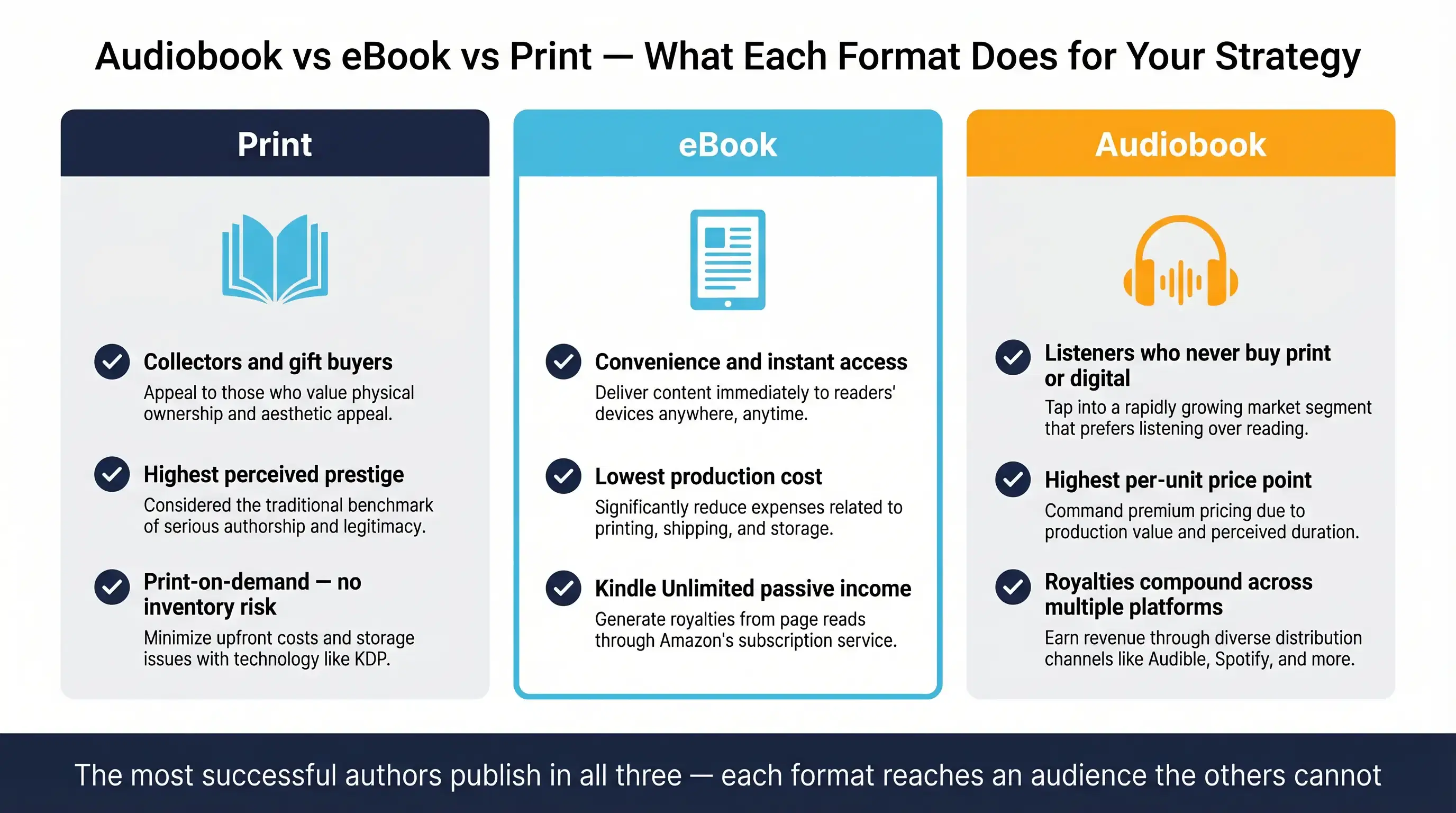
The short answer is that no single format is best. Each one reaches a different audience, serves a different use case, and generates revenue through a different mechanism. Authors who understand this build strategies that leverage all three rather than treating them as alternatives.
Audience Preferences by Format
Print readers include collectors, serious literary readers, gift buyers, and readers who prefer the physical experience of a book. eBook readers tend to prioritize convenience, cost, and instant availability. Audiobook listeners are specifically people who want to consume content while doing something else, or who simply prefer the performed experience of a story or a lesson delivered by a skilled narrator.
A significant portion of audiobook listeners do not regularly buy print or digital books. They are not being pulled away from your other formats. They are an additional audience you would not reach otherwise.
Cost vs ROI by Format
Print has the highest upfront production cost if you're considering physical inventory, but print-on-demand options have largely eliminated that barrier. eBooks have minimal production costs relative to their earnings potential. Audiobooks have the highest production costs of the three formats, driven by narration and engineering, but they also command the highest per-unit prices and generate royalty income across multiple platforms simultaneously.
The ROI calculation for audiobooks improves significantly over time. A well-produced audiobook continues generating income for years. The production cost is paid once. The royalties accumulate indefinitely.
Multi-Format Publishing Strategy
The most commercially successful independent authors operate in all three formats. Each format reinforces the others. A reader who encounters your ebook may later buy the audiobook for a relisten. A listener who discovers your audiobook on Spotify may buy the print edition as a gift. Cross-format publishing multiplies your discoverability across different discovery ecosystems and creates multiple points of entry for new readers.
Is Audiobook Publishing Worth It in 2026?
Market Demand
Audiobook consumption is growing faster than any other book format. The audience is not niche. It is mainstream, growing, and increasingly global. Subscription services have removed the price barrier that once limited audiobook purchasing to dedicated enthusiasts. In 2026, anyone with a smartphone and a free app can access an enormous audiobook library, and millions of new listeners are joining those platforms every quarter.
Long-Term Revenue Potential
A professionally produced audiobook generates passive income from the moment it goes live and continues doing so for as long as the platforms distribute it. There is no expiration date, no inventory to manage, and no reprint cost. Every finished hour of audio you put into the market is an asset that earns royalties regardless of what you're working on next.
Authors with a catalog of multiple audiobooks benefit from a compounding effect: each new title promotes the back catalog, and each back catalog sale promotes the new title. The long-term revenue potential of a well-built audiobook catalog is substantially higher than a single title in isolation.
Best Genres for Audiobooks
While audiobooks work across almost every genre, some categories have particularly strong listener cultures and high consumption rates. Mystery and thriller audiobooks have some of the most dedicated listener bases in the format. Romance audiobooks command large audiences and high listening frequency. Science fiction and fantasy listeners have a strong tradition of enjoying performed storytelling. Self-help and business audiobooks are ideal for commuter listening and have grown significantly as the professional development audience has migrated to audio.
Even genres that have historically been considered primarily visual or text-dependent, like cookbooks, have found audiobook audiences when the content is adapted thoughtfully for the format.
How Best Selling Publisher Helps You Launch Audiobooks
Producing and publishing an audiobook involves more decisions, more specialists, and more technical requirements than any other publishing format. Getting each stage right compounds into a finished product that earns strong reviews and consistent sales. Getting any stage wrong is expensive to fix after the fact. That's the core reason authors turn to professional audiobook publishing services rather than navigating the process alone.
Professional Narration Services
We match each audiobook with a narrator whose voice, performance style, and genre experience fit the specific manuscript. Our vetting process evaluates technical ability, consistency, professional availability, and track record with comparable titles. Authors don't navigate the narrator casting process alone or make decisions without experienced guidance.
Audio Production and Editing
Our production team handles recording coordination, editing, mastering, and quality assurance. Every audiobook we produce is checked against the platform's published technical specifications - for ACX that means RMS level, peak level, noise floor and file format - before it is submitted for distribution. We don't submit files and hope. We verify before we submit.
Multi-Platform Distribution
We distribute across all major audiobook publishing platforms including ACX/Audible, Apple Books, Google Play, Spotify, Kobo, and the broader aggregator network. Distribution includes metadata optimization, category selection, and platform-specific formatting for each destination. One submission process, full platform reach.
Marketing and Launch Strategy
We build coordinated launch plans that include email marketing, social media content, reviewer outreach, and paid advertising where appropriate. Launch week activity is planned and executed as a campaign, not an afterthought. Post-launch monitoring tracks performance and informs ongoing optimization.
End-to-End Publishing Support
From manuscript to live on the platforms you choose, we manage the full production and distribution process. Authors who work with us know what's happening at every stage, receive regular updates, and don't have to become audio production experts to get a professionally produced audiobook to market.
Ready to turn your manuscript into a professionally produced audiobook that reaches listeners across every major platform? Best Selling Publisher handles everything from narrator casting to launch marketing so your audiobook enters the market ready to perform. Start the conversation today.
FAQs
The cost to publish audiobook content is driven primarily by narration, which is billed per finished hour of audio. A 90,000-word novel produces approximately ten to twelve finished hours. Narrator rates vary significantly based on experience level and genre. Audio editing, mastering, and quality assurance are additional line items, though they are sometimes bundled into narration packages. Distribution is free through ACX direct or costs ten to fifteen percent of earnings through aggregators.
ACX pays 50% for exclusive titles and 30% for non-exclusive titles; titles claimed after 26 May 2026 are enrolled in this model automatically. Apple Books pays 70% of the retail price. Google Play publishes a 70% revenue share for partners who have accepted its updated Partner Center terms in eligible countries, with a lower default share otherwise, so confirm your own rate in Partner Center rather than assuming 70%. The platform that pays the highest total royalties depends on your distribution strategy, your price point, and where your listeners are concentrated.
Technically yes. Practically, it depends on your voice, your recording environment, your technical knowledge of audio production, and the genre of your book. Authors who narrate their own memoirs or nonfiction titles can work well because the first-person authenticity adds genuine value. Fiction narration, particularly anything with multiple characters or significant emotional range, is considerably more challenging. If you go the DIY route, invest in professional audio engineering even if you record yourself, and have the finished files reviewed by someone who knows ACX compliance standards before you submit.
A typical ten-to-twelve-hour audiobook takes four to eight weeks of recording sessions followed by two to four weeks of editing, mastering, and quality control. Total production time from script-ready manuscript to distribution-ready files is typically two to three months for a professionally managed project. Platform review and approval after submission adds another one to two weeks. Plan your launch date with that full timeline in mind, not just the recording phase.
Exclusive publishing on ACX is the better starting point for most debut audiobooks and first titles in a series. The higher royalty rate and algorithmic preference on Audible generate faster initial momentum than you're likely to achieve through fragmented wide distribution when starting from zero. Once you have a track record, reviews, and an author platform that can drive traffic to multiple destinations, wide distribution becomes the better long-term strategy for maximizing total revenue and reducing single-platform risk.