
How First Time Authors Succeed with Best Selling Publisher Over Traditional Publishing
Publishing your first book represents one of the most transformative decisions a writer can make. If you're searching for information on how to publish a book for the first time or exploring publishing options for new authors, you've likely encountered conflicting advice about which path leads to success. The traditional publishing industry has long positioned itself as the only legitimate route to becoming a published author, yet the reality facing first-time authors today is dramatically different from the narrative publishers promote.
The challenges are real and substantial. First-time authors face devastating rejection rates from agents and publishers, often 95% or higher. The timelines are punishing: the journey from finished manuscript to published book typically spans 24-36 months. The creative control is minimal: publishers dictate everything from your cover design to your title to your marketing strategy. And perhaps most frustrating, the marketing support for debut authors is virtually nonexistent. Publishers invest resources in established authors; new authors are expected to build their own visibility.
This is why an increasing number of first-time authors are choosing best selling publisher vs traditional publishing alternatives. The emergence of professional best selling publisher services and sophisticated self publishing vs traditional publishing options has created a paradigm shift in how new writers approach publication. Today's question isn't whether you can get published modern book publishing services for first time authors make this entirely feasible. The real question is: what publishing path aligns with your goals, timeline, and financial objectives?
This comprehensive guide explores why the best publishing option for first time authors often means choosing a best-selling publisher over traditional gatekeepers. We'll compare the financial implications, timeline differences, creative control advantages, and long-term earning potential. Whether you're an entrepreneur building authority, a coach expanding your reach, or a new writer with a compelling story, this analysis will help you understand which publishing method is better for new authors in your specific situation.
Why First Time Authors Struggle with Traditional Publishing
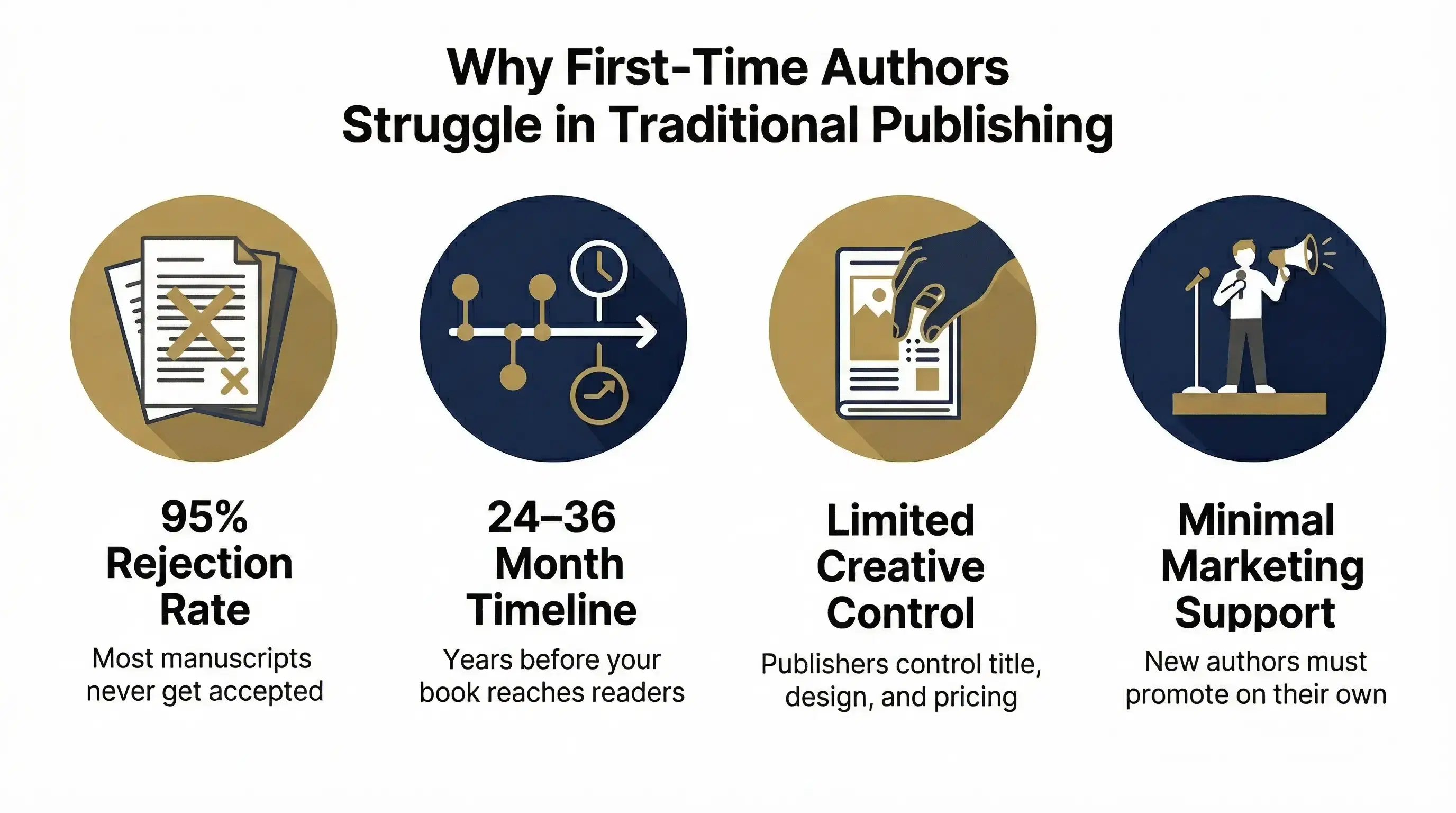
Understanding the genuine obstacles within traditional publishing is essential before considering alternatives. These aren't imagined problems; they're systemic limitations that affect thousands of writers annually.
Long Submission and Approval Timelines
The traditional publishing timeline is notoriously glacial. The publishing timeline comparison reveals why so many first-time authors abandon this path. The process unfolds like this: You spend months researching agents, crafting query letters, and submitting your work. Then you wait. Agents receive thousands of queries annually and typically respond to only 1-5% of them. If you're fortunate, this response phase consumes 6-12 weeks. Many queries disappear into the void entirely, receiving no response whatsoever.
If an agent takes interest (and this is statistically unlikely for first-time authors without established platforms), they enter the submission phase. Your agent shops your manuscript to publishers, a process that routinely takes 6-12 months or longer. Publishers move slowly by design; they receive hundreds of submissions monthly and prioritize established authors. During this period, you're in limbo, unable to pursue alternative publishing options because most agents request exclusive submission rights.
Should a publisher finally accept your manuscript, you're just beginning. Contract negotiations follow, often extending several months. Then comes the developmental editing phase, the copyediting phase, the design phase, the pre-production phase, and finally publication. From acceptance to bookshelf typically requires another 12-24 months.
The cumulative effect is staggering. A book completed in 2024 might not reach readers until 2027 or 2028. For entrepreneurs, subject matter experts, and authors in rapidly evolving fields, this timeline is prohibitive. Market trends shift, platforms evolve, and your competitive advantage evaporates during these years of waiting.
High Rejection Rates for New Authors
Traditional publishing gatekeeping is brutally selective. Agents receive approximately 50,000 queries annually but represent perhaps 2,000 new clients, a 4% acceptance rate. These agents then submit to publishers, who accept perhaps 1% of incoming submissions. For new authors without celebrity status, book platform, or prior published works, the mathematics are devastating. You might query 100 agents and receive 100 rejections. This isn't a reflection on your book's quality; it's simply the function of an exclusive system designed to process enormous volume while accepting almost nothing.
These high rejection rates create psychological barriers that prevent many talented writers from ever attempting publication. The emotional toll of repeated rejection, combined with the months spent waiting for responses, creates a barrier that feels insurmountable. Many potentially successful authors never reach publication because traditional publishing's rejection mechanisms discourage them before they've exhausted all options.
Limited Creative Control in Publishing
When you sign a traditional publishing contract, you're not simply trading your manuscript for publication. You're ceding significant control over virtually every aspect of your book's presentation and positioning. Publishers decide your cover design (and most authors report that publishers frequently ignore their preferences and professional feedback). Publishers determine your title and subtitle, often changing author-selected titles they believe will perform better commercially. Publishers dictate your book's interior design, layout, and typography. Publishers set your price point, typically pricing books higher than indie alternatives to maximize publisher margin. Publishers control your distribution channels, often prioritizing traditional bookstores over online retailers where modern readers actually discover books.
This loss of creative control in publishing extends beyond initial publication. Want to update your book with new information six months after launch? You need publisher approval. Want to create a companion workbook or bundle your book with a course? The licensing restrictions may prevent this. Want to revise the book substantially for a new edition? You'll need to negotiate a new contract. Your book becomes a product owned and controlled by someone else, not a strategic asset you control and can adapt as circumstances evolve.
For authors with clear visions of how their books should look, feel, and function within their broader personal brands, this loss of control is deeply frustrating and professionally limiting.
Minimal Marketing Support for Unknown Writers
Perhaps the most damaging myth about traditional publishing is that publishers will handle marketing. Publishers themselves have fostered this misconception, yet the reality contradicts the narrative entirely. Publishers invest marketing resources strategically, which means heavily established authors receive substantial support while debut authors receive minimal attention.
Industry research consistently demonstrates that publishers allocate 80% of marketing budgets to 20% of titles. These are typically bestselling authors, celebrity authors, and high-advance acquisitions that justify substantial marketing investment. First-time authors with no existing platform receive minimal resources. Publishers expect authors to generate their own publicity, arrange their own media appearances, build their own social media presence, and generate their own reviews.
You do the marketing work; the publisher keeps the marketing revenue. For a first-time author already overwhelmed with the writing process, this additional burden is enormous. Without a coordinated marketing strategy and without a budget to hire professional marketers, many traditionally published debut books simply languish. The book gets published, the initial promotional window closes, and then silence. No promotions, no coordinated launches, no professional marketing support.
How Best Selling Publisher Helps First Time Authors Succeed Faster

The best selling publisher services model addresses virtually every pain point that first-time authors experience with traditional publishing. This approach combines self publishing vs traditional publishing flexibility with professional services quality, creating an efficient path to successful book publication that delivers both speed and professionalism.
Streamlined Publishing Process and Speed
Professional best selling publisher services operate on accelerated timelines that seem impossible to those accustomed to traditional publishing delays. Instead of the 24-36 month traditional timeline, these publishers compress the process dramatically. Depending on your manuscript's readiness, you can have a professionally published book in as little as 90 days. More typically, the timeline spans 3-6 months from manuscript submission to publication.
This acceleration is possible because best-selling publishers have streamlined, established processes without the bureaucratic layers inherent in large publishing corporations. There's no committee reviewing your manuscript. There's no protracted acquisition process. There's no uncertainty about whether your book will be accepted. You progress directly from decision to execution, following a defined timeline that keeps momentum building toward publication.
End-to-End Support: Writing, Editing, Publishing, and Marketing
What distinguishes premium book publishing services for first time authors is the comprehensive support across the entire author journey. This isn't limited to getting your manuscript into print; it encompasses supporting you through professional development, refinement, and strategic promotion.
Writing and Manuscript Development: Many best-selling publishers offer writing coaching, developmental editing, and manuscript consulting to strengthen your work before production. This support is particularly valuable for first-time authors who may lack experience organizing thoughts into book-length form or understanding what makes content compelling to readers. How to build an author brand as a beginner often begins with this developmental support, helping you clarify your unique voice and positioning.
Professional Editing Services: Your manuscript proceeds through multiple editing layers, developmental editing for structure and flow, copy editing for language refinement, and proofreading for technical accuracy. These services ensure your book achieves professional standards comparable to traditionally published works.
Design and Production: Professional cover design, interior layout, and formatting are included or available as straightforward add-ons. Unlike traditional publishing, where input is limited, you collaborate with designers to create covers that align with your vision and build author brand with self publishing positioning. The result is a book that looks and feels professionally published.
Marketing and Launch Coordination: Best-selling publishers recognize that book success depends on reaching readers. Services typically include book launch strategies, Amazon book publishing optimization, ISBN ownership support, distribution setup, and sometimes professional PR guidance. Some packages include social media strategy and email marketing coordination services that traditional publishers rarely extend to debut authors.
Personalized Publishing Strategies
Every author's situation is unique, and the best professional book publishing company approaches recognize this reality. Rather than offering one-size-fits-all services, they develop personalized publishing strategies aligned with your specific goals and circumstances.
Are you an entrepreneur leveraging your book as a business development tool? Your strategy might emphasize ISBN ownership, Amazon book publishing optimization, and positioning for media and speaking opportunities. Are you a coach building a practice? The strategy might focus on audience building and client attraction. Are you publishing multiple books? The approach would emphasize series positioning and long-term SEO value. This personalized approach means you're not paying for services you don't need while simultaneously having access to expertise that directly supports your specific author objectives.
Professional Book Cover Design and Visual Branding
Your book cover is far more than decoration, it's a critical marketing asset influencing purchasing decisions within seconds. Covers matter, but it is worth being accurate about how much: NielsenIQ's Books and Consumers survey found the front cover influenced about 13% of book purchases, and its influence is highest in physical shops rather than online. Treat the cover as one significant signal among several rather than the deciding factor, and note that a poor cover can still undercut excellent content.
Best-selling publishers include professional cover design that balances aesthetics with strategic positioning. Designers with experience in your genre understand what works, which colors trigger emotional responses, what typography communicates professionalism or creativity, and what imagery resonates with target audiences. Your cover is designed to sell, not just to look pretty. This is particularly important for first-time authors who might otherwise choose covers that feel amateurish or misaligned with their content and audience expectations.
Grow Your Author Brand with Best Selling Publisher Instead of Traditional Publishing

Content Rights and Licensing Terms
The distinction between traditional publishing vs self publishing earnings begins with fundamental rights ownership. With assisted-publishing arrangements, the signed agreement identifies the copyright owner, licensed uses, formats, territories, and any limits on translation, adaptation, or republication. Traditional and assisted agreements vary, so authors should compare the actual contract terms rather than assume a standard allocation.
This ownership has profound long-term implications. Five years after publication, if traditional publishers take your book out of print, you may have limited recourse and cannot simply republish with another company due to lingering rights restrictions. With best-selling publishers focused on how to retain book rights as an author, you maintain these rights and can adapt your book strategy as circumstances change. You can update content, reformat for new platforms, create audiobook versions, or republish with different companies without seeking permission.
For authors building long-term brands and careers, this ownership model is invaluable. Your books become perpetual assets generating revenue and authority indefinitely, not temporary products controlled by publishing corporations.
Personal Branding Strategies for Authors
Best-selling publishers understand that your book is a branding tool, not just a product. They help you position your book within your broader author and personal brand strategy. This might include:
- Author Platform Development: Creating and optimizing author websites that position you as an authority in your niche. Your author platform becomes the hub connecting your books, speaking engagements, consulting services, and audience community.
- Bio Positioning: Crafting author bios that emphasize your expertise and unique value proposition. Your bio becomes a strategic positioning statement, not merely a descriptive summary.
- Niche Clarity: Helping you identify and articulate your specific audience and subject matter expertise. Clear niche positioning dramatically improves marketing effectiveness and audience attraction.
- Consistent Messaging: Ensuring your book's positioning aligns with your professional brand, social media presence, and business offerings. Consistency across all touchpoints creates a coherent author identity.
- Authority Positioning: Leveraging your book to strengthen your positioning as a thought leader in your field. Your published book becomes your credential, differentiating you from competitors and establishing expertise.
Social Media and PR Support
Building awareness for first-time authors requires a coordinated social media strategy and public relations efforts. Best-selling publishers provide support across these channels:
- Book Launch Coordination: Developing multi-channel launch campaigns that build awareness before, during, and after publication. Launch strategy is critical to initial sales momentum and reader acquisition.
- Social Media Strategy: Creating shareable content calendars that maintain promotion momentum throughout your launch window and beyond. Strategic content keeps your book visible without requiring constant personal effort.
- Press Release Distribution: Professional press releases sent to relevant media outlets and blogger networks. Press distribution amplifies reach to journalists and influencers who might feature your book.
- Interview Coordination: Facilitating podcast, blog, and media interviews that amplify your author platform. Media appearances position you as an expert while promoting your book.
- Review Management: Encouraging reviews, managing reader feedback, and leveraging social proof. Book reviews influence purchasing decisions and improve algorithmic ranking on retail platforms.
- Ongoing Content Creation: Supporting author marketing through guest blogs, articles, and multimedia content. Ongoing content keeps your author brand visible long after launch.
Traditional publishers rarely offer these services to first-time authors. Best-selling publishers recognize that book marketing strategies for authors are essential to success and provide the infrastructure and expertise to execute effectively.
Long-Term Audience Building vs. One-Time Book Launch
Traditional publishing often treats book release as a one-time event. Marketing is concentrated in the launch window; after that, support fades, and momentum dissipates. With best-selling publishers, the focus is on sustainable audience building. Your book becomes a permanent gateway to your authority and platform. You're building an audience that will support not just your first book, but your entire author career.
This long-term perspective changes strategy entirely. Instead of maximizing immediate sales, you're optimizing for sustainable reader engagement, email list building, and audience development. Readers who discover your book today might become loyal followers who purchase your next book, recommend you for speaking opportunities, hire you for consulting, or enroll in your courses. Long-term audience building creates compounding value.
Positioning as an Authority in Your Niche
There's genuine authority conferred by being a published author. This is particularly powerful when you're a first-time author establishing credibility in a competitive field. Best-selling publishers help you leverage your book as a credential that establishes expertise and differentiates you from competitors.
Whether you're a coach, consultant, entrepreneur, or subject matter expert, your published book becomes your most powerful business development tool. It positions you as someone with sufficient expertise, commitment, and credibility to author a comprehensive resource. This positioning translates into speaking opportunities, media mentions, professional credibility, and customer trust. In competitive markets, this authority advantage can be the difference between building a thriving practice and struggling for visibility.
Compare Costs and Royalties Between Best Selling Publisher and Traditional Publishing
Understanding the Financial Implications of Your Publishing Choice
Understanding the financial implications of your publishing choice is critical for first-time authors. The best selling publisher vs traditional publishers cost comparison reveals why many new authors are reconsidering traditional publishing as their exclusive option.
Traditional Publishing Cost & Earnings Model
No Upfront Cost (In Most Cases)
The primary appeal of traditional publishing is that authors don't pay money upfront to get their book published. From a first-time author's perspective, this seems like a significant advantage. You don't need to invest capital; the publisher assumes the financial risk. However, this apparent advantage masks hidden costs and trade-offs that substantially reduce the actual benefit.
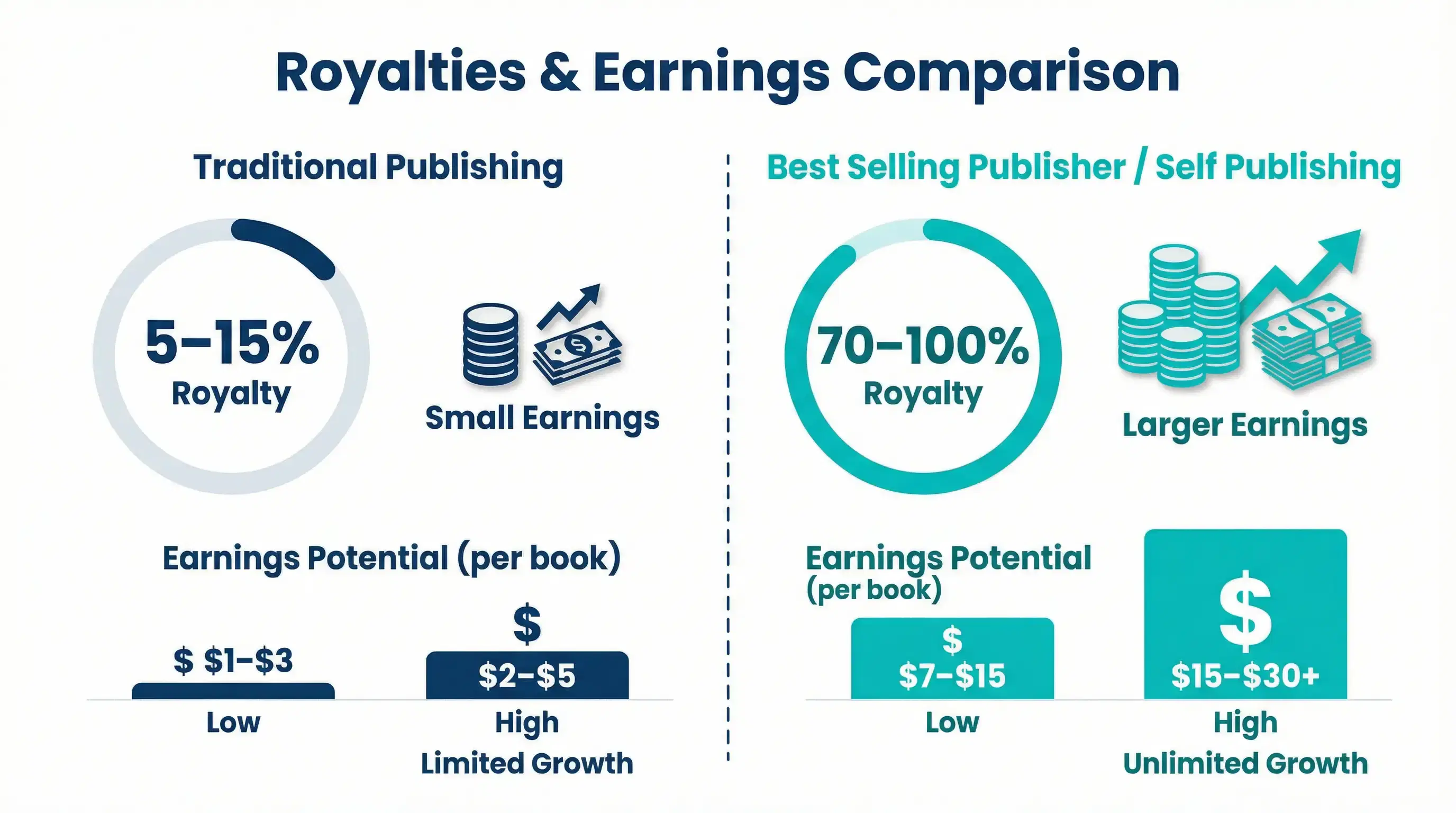
Lower Royalty Percentages (Typically 5–15%)
In traditional publishing, book royalties explained reveal disappointingly low percentages, particularly for print books. Standard contracts offer approximately:
- 10% of the retail price for hardcover books on the first 5,000 copies, rising to 12.5% on the next 5,000 and 15% above 10,000
- 7.5% of the retail price for paperback books
- 25% of net receipts for ebook versions
This means that if your book sells for $25 in hardcover, you earn $2.50 per sale. For a $16 paperback, you earn $1.20 per sale. To earn a modest $30,000 from your book, you'd need to sell 12,000 hardcover copies or 25,000 paperback copies. These sales numbers are ambitious for debut authors with limited marketing support from publishers who allocate minimal resources to unknown writers.
Advance Payments (Not Guaranteed)
Traditional publishers sometimes offer advances against future royalties, but these are by no means guaranteed, particularly for first-time authors. Advances range from a few thousand dollars to tens of thousands for established authors with proven sales histories. For debut authors, advances are often modest or nonexistent. When offered, advances are recouped against future royalties, so you don't begin earning royalties until the advance is paid back through actual book sales. This delayed royalty onset can take years.
Hidden Trade-Offs: Loss of Rights and Control
Beyond the low royalty rates, traditional publishing contracts involve significant opportunity costs:
- Rights restrictions: You grant the publisher exclusive rights to publish your book in specified formats and territories for extended periods (often the lifetime of the copyright). You cannot republish your content elsewhere or adapt it for other media without explicit permission.
- Loss of creative control: You sacrifice decision-making power over cover, title, content, pricing, and distribution. Publishers make these decisions unilaterally.
- Reversion challenges: Even if the book goes out of print, rights sometimes revert slowly or not at all, leaving you unable to republish.
- Limited revenue streams: You cannot directly monetize related products like audiobooks, translations, or bundled offerings without publisher approval.
These hidden trade-offs mean the financial benefit of "free" publishing is largely illusory. You're trading low upfront costs for substantially reduced long-term earning potential and creative constraints.
Compare the Written Commercial Terms
Compare each proposal by its listed services, revision rounds, schedule, platform fees, royalty allocation, licensed rights, termination terms, and payment milestones. These terms vary by provider and project, so the signed agreement must control.
Model Outcomes Before Signing
Use your own list price, retailer deductions, printing costs, expected sales range, and marketing budget when evaluating a proposal. Do not treat example earnings or bestseller projections as guaranteed results.
Financial Comparison for First-Time Authors
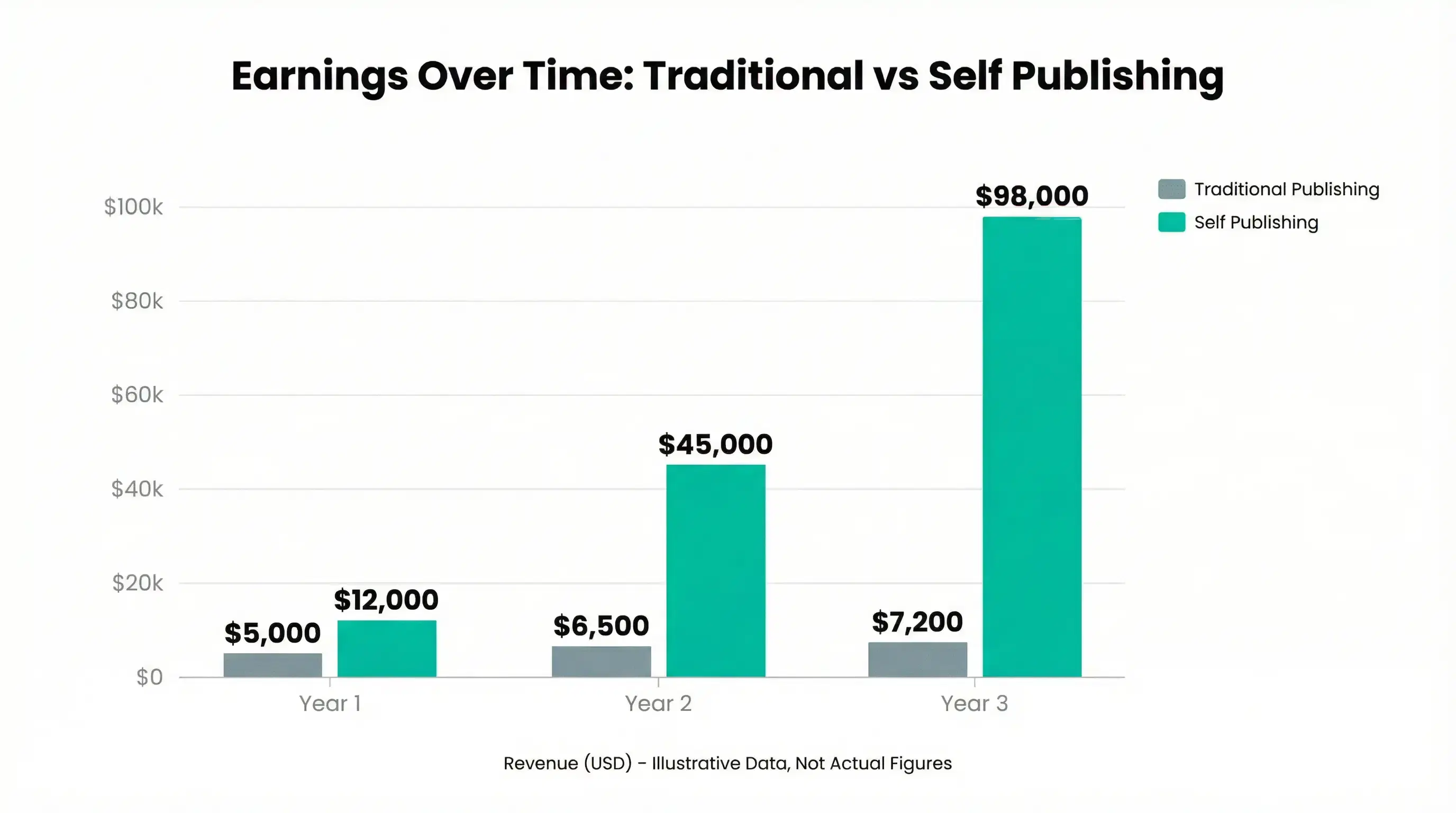
Request written assumptions for every comparison and test them against conservative, moderate, and optimistic sales scenarios. No provider can guarantee earnings, sales, rankings, or business impact.
Creative Control and Ownership: A Game Changer for New Authors
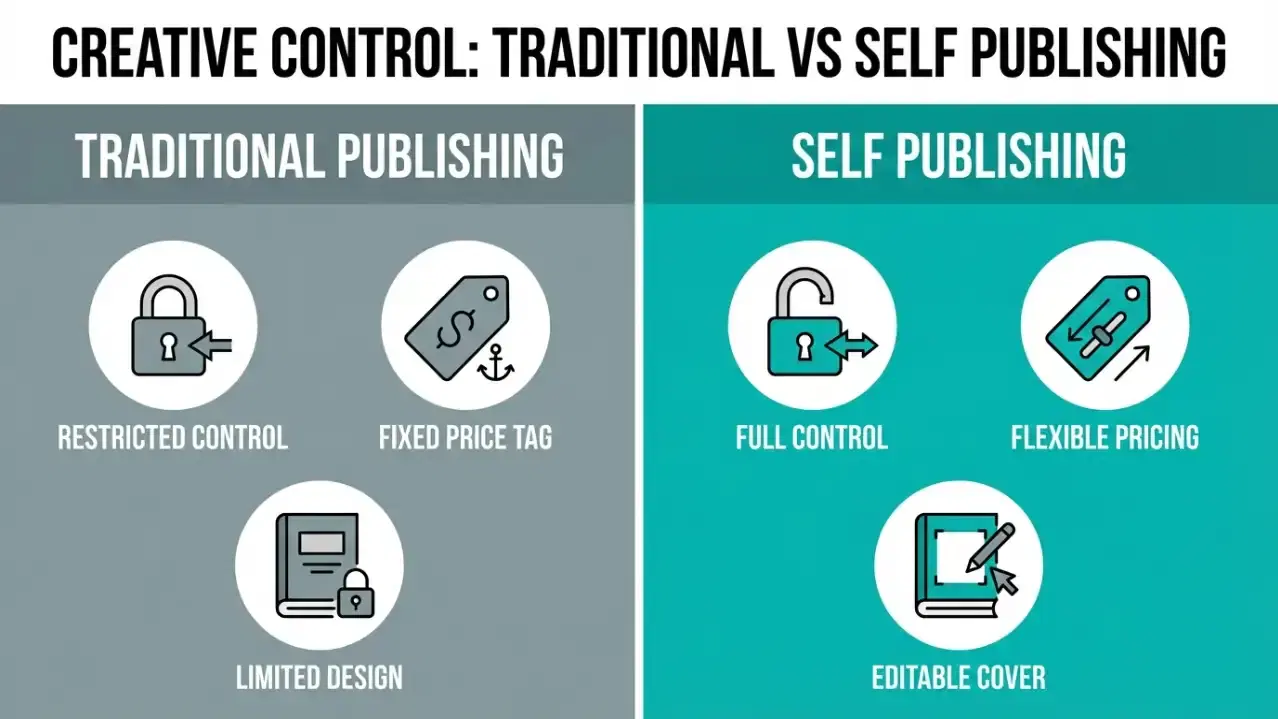
For many first-time authors, especially entrepreneurs and subject matter experts, creative control is as important as financial returns. This is an area where best-selling publishers fundamentally outperform traditional publishers. How to retain book rights as an author becomes a central question that best-selling publishers answer definitively: you retain them.
Rights Ownership Explained
When you publish with a best-selling publisher, you own the copyright and all associated intellectual property. This comprehensive ownership enables you to:
- Republish your book independently if desired
- Create derivative works, including workbooks, guides, and courses, based on your book content
- License your book to third parties for expanded distribution
- Translate and publish in multiple languages without publisher approval
- Adapt your content for different formats, including audiobooks, video series, and webinar content
- Maintain revenue streams indefinitely
Traditional publishing restricts these possibilities substantially. You cannot create a companion workbook without publisher approval. You cannot bundle your book with a course without seeking permission. You cannot publish a substantially revised edition without negotiating new contracts and sharing potential gains.
Flexibility in Content Updates and Revisions
Markets change. Your industry evolves. You gain new insights and experiences. Your book represents your thinking at a moment in time, but that moment inevitably passes. Information becomes outdated. Examples lose relevance. Your professional understanding deepens.
With best-selling publisher ownership, you can update your book as your expertise grows and markets evolve. You can add new chapters addressing emerging trends, revise outdated information, and improve examples based on reader feedback. This flexibility keeps your book perpetually current and relevant, maximizing its value and longevity.
Traditional publishers rarely allow meaningful revisions beyond a second edition, and even second editions involve complex contractual negotiations and potential royalty disputes. Most traditionally published books become static documents frozen in time, with no mechanism to reflect your evolving understanding or the marketplace's evolution.
Control Over Design, Pricing, and Distribution
Your book's cover is its primary marketing asset. Its price determines its accessibility and revenue potential. Its distribution channels determine how and where readers discover it.
With best-selling publishers, you control all three elements (or control them collaboratively with professional guidance). You can test different covers to optimize conversions. You can adjust pricing based on market conditions and your strategic goals. You can distribute through multiple channels, Amazon, IngramSpark for print, your own website, and bundle offers without restrictions.
Traditional publishers make these decisions unilaterally. They choose your cover (often against your preferences). They set your price (usually higher, to maximize their margin). They control distribution (often favoring traditional bookstores over online channels where new authors find most readers).
Importance of Creative Freedom for Brand Growth
For authors building brands and platforms, creative freedom is essential. Your book should align seamlessly with your brand identity, voice, and strategic positioning. You should control the visual presentation, the content emphasis, the promotional angle, and the audience targeting.
This creative freedom enables you to use your book as a strategic brand asset rather than a commodity product. Your book becomes an extension of your personal brand, reinforcing your unique voice and authority. This consistency across all brand touchpoints-website, social media, speaking, consulting-creates a coherent author identity that attracts and retains audience loyalty. This cohesion is impossible to achieve when others control your book's presentation.
Speed to Market: Publish Your Book Without Delays
In today's rapidly evolving marketplace, timing matters profoundly. Publishing timeline comparison reveals why best-selling publishers offer such dramatic advantages. Best-selling publishers understand this marketplace reality; traditional publishing fundamentally does not.
Traditional Publishing Timelines (12–24 Months Plus Pre-Publication Wait)
The traditional publishing timeline is notoriously extended. From agent acceptance to publication, expect the following phases:
- Agent research and query process: 6-12 months
- Agent consideration and response: 1-3 months
- Agent shopping manuscript: 12 months
- Publisher acquisition decision: 6-12 months
- Contract negotiation: 2-3 months
- Developmental editing: 3-6 months
- Copy editing: 1-2 months
- Design and layout: 2-3 months
- Production and pre-press: 2-3 months
- Printing and distribution: 1-2 months
Added up, that is roughly 36 to 58 months. In practice the phases overlap and the realistic range is nearer two to four years, with Penguin Random House's own published timeline starting more than nine months before publication once a book is under contract.
For trending topics, business books, and expertise-driven content, this timeline is catastrophic. Your book about emerging AI applications in healthcare, written 40 months ago, is likely outdated before it reaches shelves. Your insights about disrupting your industry are less timely by the time publication occurs. The business opportunity your book was meant to amplify has evolved or passed entirely.
Best Selling Publisher Timelines (Weeks/Months)
Professional best-selling publishers compress this timeline dramatically through streamlined processes:
- Manuscript submission and review: 2-4 weeks
- Contract and planning: 1-2 weeks
- Professional editing and revision: 4-8 weeks
- Cover design and interior layout: 3-4 weeks
- Production and distribution setup: 2-3 weeks
- Publication: 3-6 months total
This acceleration is possible because best-selling publishers have established processes without the bureaucratic delays inherent in large publishing corporations. There's no committee reviewing your manuscript. There's no uncertainty about the acquisition. You progress directly from decision to execution along a defined timeline.
Importance of Speed in Competitive Markets
Speed delivers tangible competitive advantages that accumulate over time:
- Content Currency: Your book remains relevant to current market conditions and audience interests. Timing-sensitive insights maintain their value.
- Platform Leverage: You can capitalize on speaking engagements, media mentions, and social media momentum while they're active. Your book reinforces trending visibility.
- Business Impact: For entrepreneurs and coaches, your book can begin generating business results, client acquisition, speaking opportunities, and course enrollment immediately rather than years later.
- Authority Timing: First-mover advantage in your niche means establishing authority while fewer competitors have published on the topic.
- Audience Engagement: Your audience is engaged now, interested now, and ready to purchase and promote your book now, not after a 3-year delay.
Marketing Support: Why It Matters More Than Publishing
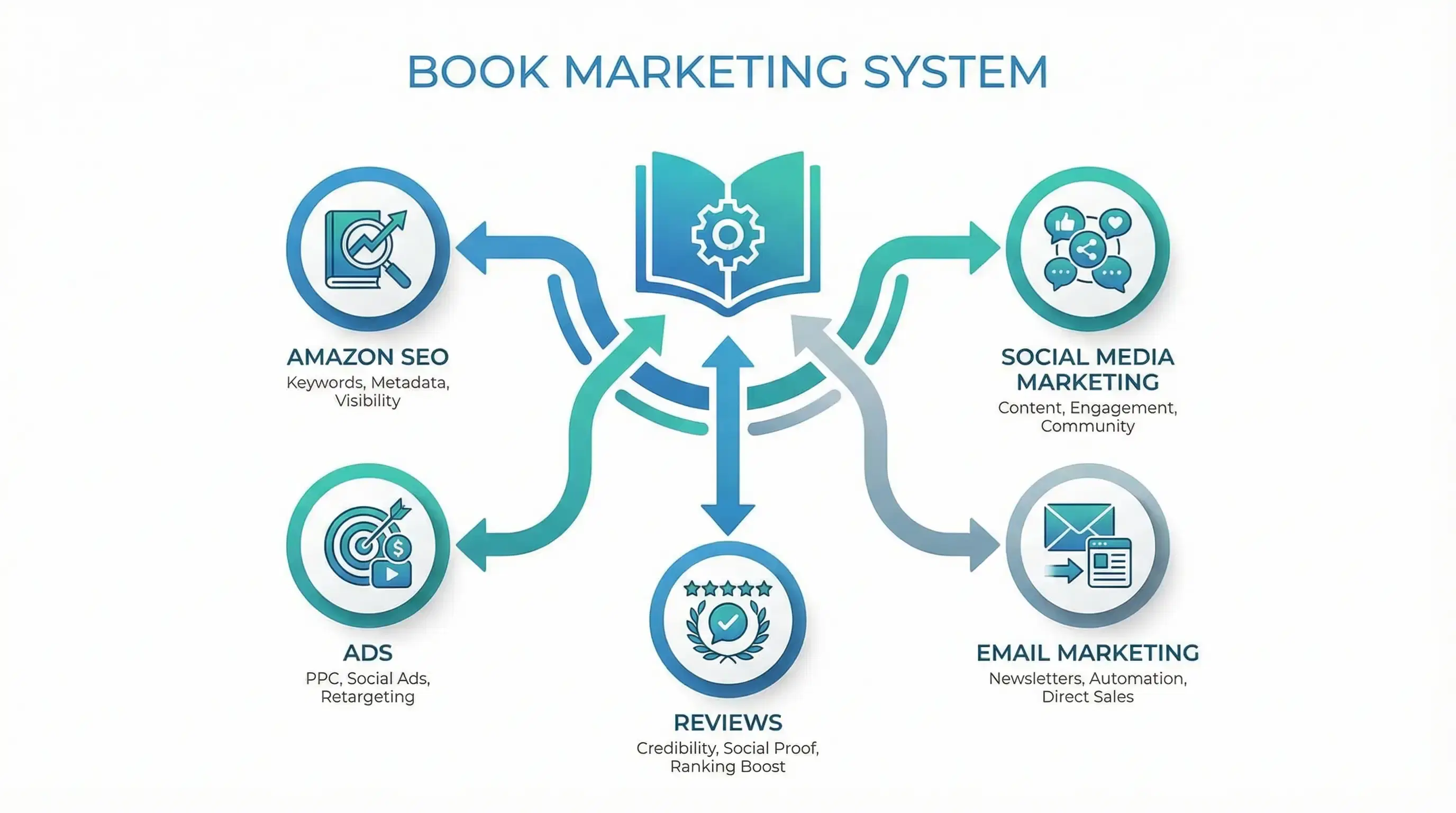
A critical misconception among first-time authors is that traditional publishers will market their books. The reality contradicts this expectation starkly. Effective marketing support is rare, particularly for debut authors. This gap between expectation and reality is one of the primary reasons many traditionally published books fail to reach their potential audiences.
Lack of Marketing in Traditional Publishing
Traditional publishers allocate marketing budgets strategically, which means heavily established authors receive substantial support while debut authors receive minimal attention. Industry research indicates that publishers spend 80% of marketing budgets on 20% of titles (typically bestselling authors with existing platforms). Debut authors with no audience or media connections receive minimal support-often just a press release and perhaps some limited social media promotion that any author could execute independently.
The expectation that "the publisher will handle marketing" is a myth that leaves many first-time authors devastated after publication. Your book is released into the marketplace with little promotional support, limited visibility, and no coordinated book marketing strategies for authors. Success depends entirely on your personal efforts, for which you often lack expertise, time, and resources.
Built-In Marketing Services with Best Selling Publisher
Best-selling publishers approach marketing as integral to publication success, not as optional or secondary. Best-selling publisher services include comprehensive marketing support:
- Pre-Launch Strategy: Developing comprehensive launch plans that build anticipation and awareness before publication. Strategic planning maximizes the critical launch window when readers are most receptive.
- Amazon Book Publishing Optimization: Strategic keyword research, category positioning, and listing optimization that improve discoverability and algorithmic ranking. Amazon book publishing optimization is essential since most readers discover books through Amazon search.
- Review Generation: Coordinated campaigns that encourage early reviews, recognizing that the Amazon algorithm favors books with numerous, recent reviews. Reviews improve visibility exponentially.
- Email Marketing: Building reader lists and executing email campaigns that drive initial sales momentum. Email remains the most effective direct communication channel.
- Social Media Strategy: Creating content calendars and shareable assets that maintain promotion throughout the launch window and beyond. Strategic content keeps your book visible without requiring constant personal effort.
- Paid Advertising Coordination: Guidance on Amazon ads, Facebook ads, and other paid promotion strategies (often with author investment but professional guidance).
- Press Release Distribution: Professional press releases sent to relevant media databases and journalist networks. Press distribution amplifies reach to journalists and influencers who might feature your book.
- Media Relations: Facilitating podcast interviews, blog features, and media coverage opportunities. Media appearances position you as an expert while promoting your book.
- Author Platform Support: Helping you establish and optimize author websites, email lists, and social media presence. Your author platform becomes the hub for reader connection.
This comprehensive approach recognizes that books succeed when actively promoted and that marketing is not a burden authors should shoulder entirely alone.
Book Launch Strategies and Execution
Professional launch strategies recognize that books have a critical window for gaining visibility and momentum. Effective launches involve:
- Pre-order campaigns that generate initial sales and reviews before official publication
- Multi-channel promotion coordinated across email, social media, paid advertising, and public relations
- Tiered outreach that targets different audience segments with customized messaging
- Influencer and media engagement that amplifies reach beyond your immediate audience
- Limited-time offers that create urgency and drive conversion during the crucial launch window
A campaign team can document the selected channels, assets, schedule, budget, and reporting checkpoints. Market response, rankings, and sales remain outside the team's control.
SEO, Amazon Optimization, and Digital Visibility
Digital visibility determines whether potential readers discover your book. This requires strategic SEO, Amazon optimization, and digital visibility efforts:
- Amazon SEO: Keyword research and optimization ensure your book appears in Amazon searches when potential readers look for content related to your topic. Keywords are critical to discoverability.
- Author Platform SEO: Website and author bio optimization help readers find you through Google searches related to your expertise. Search visibility drives qualified traffic.
- Metadata Optimization: Strategic keywords, categories, and descriptions improve algorithmic ranking across multiple platforms. Metadata directly influences visibility.
- Content Integration: Strategy for integrating your book into your broader content marketing efforts (blog posts, articles, videos) drives readers toward your book. Integrated content marketing amplifies book visibility.
Traditional publishers rarely invest in this optimization for debut authors. Best-selling publishers recognize that effective digital discovery is essential to book success and provide strategic guidance and support.
Is Best Selling Publisher the Right Choice for You?

Best-selling publishers are ideal for certain author profiles and goals, though not universally. Understanding whether this model aligns with your situation is critical for making an informed publishing decision.
Ideal For: Entrepreneurs, Coaches, New Writers, and Niche Experts
Best-selling publishers serve authors who want to leverage their book strategically. This model is ideal for:
- Entrepreneurs: If you're using your book as a business development tool to establish authority, attract clients, and differentiate yourself in competitive markets, best-selling publishers provide speed to market, marketing support, and creative control.
- Coaches and Consultants: Books establish credibility and attract clients. Best-selling publishers support the business-building aspect of your book, not just publication.
- Niche Experts: If you're establishing authority in a specific field or community, best-selling publishers help you reach your precise audience with targeted strategies, focusing on strategic visibility rather than mass distribution.
- New Writers Building Careers: If you plan to write multiple books and build a long-term author career, best-selling publishers offer scalability and infrastructure to support multiple books.
- Content Creators: If your book is part of a broader content and audience-building strategy, best-selling publishers integrate seamlessly with your ecosystem.
When Traditional Publishing Might Still Work
Traditional publishing has advantages in certain scenarios, though these are increasingly rare:
- Literary Fiction: For literary fiction targeting major literary recognition or prestigious prizes, traditional publishing may carry cultural weight and prestige.
- Significant Advance Requirements: If you require substantial upfront capital to fund the writing process, traditional advances may be necessary.
- Mainstream Bookstore Placement: If physical bookstore visibility is critical, traditional distribution channels may be required.
- Celebrity or Platform Status: If you already have a significant media platform, traditional publishers can amplify your reach.
Even in these cases, hybrid or alternative publishing strategies are often viable and increasingly popular.
Decision Checklist for Authors
Consider the following factors when choosing your publishing path:
- Timeline: Do you need your book published within 6 months? (Best-selling publisher advantage) Or are you willing to wait 2+ years? (Traditional publishing feasible)
- Creative Control: Is controlling your cover, title, pricing, and distribution important? (Best-selling publisher advantage)
- Financial Goals: Do you want to maximize long-term earnings and retain ownership? (Best-selling publisher advantage) Or is receiving an advance your primary goal? (Traditional publishing potential)
- Marketing Support: Do you need comprehensive marketing support beyond what you can provide yourself? (Best-selling publisher advantage)
- Business Use: Are you using your book as a business development tool? (Best-selling publisher advantage)
- Multiple Books: Do you plan to publish multiple books? (Best-selling publisher advantage due to scalability)
- Niche Audience: Is your audience specific and well-defined rather than mainstream? (Best-selling publisher advantage)
- Platform: Do you already have a significant audience and media platform? (Either model can work)
- Genre: Is your genre primarily sold through online retailers rather than physical bookstores? (Best-selling publisher advantage)
If most of your answers align with best-selling publisher characteristics, this model is likely the right choice for you.
Common Mistakes First-Time Authors Should Avoid
First-time authors frequently make decisions that compromise their success. Understanding these pitfalls helps you avoid them and accelerate your path to publication.
Waiting Too Long to Publish
The most common mistake is perpetual procrastination. Authors spend years perfecting manuscripts, waiting for "the right time," or hesitating to invest in publication. This delay costs everything: momentum, market timing, competitive advantage, and professional opportunity.
Your book doesn't need to be perfect. It needs to be good, professionally edited, and published. Readers care about content value and credibility, not perfection. Publishing establishes your authority; perfection is unnecessary and often prevents publication entirely.
The longer you wait, the more likely your book's content becomes dated, your motivation wanes, or circumstances change entirely. Commit to publication timelines and execute rather than perpetually refining.
Ignoring Marketing as Optional
Some authors believe that books "sell themselves" or that "good content rises to the top." This is demonstrably false. Even exceptional books with professional publishing fail if not actively marketed. Your book is one of millions in publication. Without strategic visibility and promotion, it will be discovered by virtually nobody.
Marketing is not optional or secondary. It's integral to book success. Allocate time, energy, and budget to promotion proportionally to your publication investment.
Choosing the Wrong Publishing Model Without Research
First-time authors sometimes pursue traditional publishing when best-selling publisher models would serve them better. They're influenced by outdated notions of what constitutes "real" publishing or by misunderstanding traditional publishing's actual advantages and disadvantages.
Conversely, some authors self-publish without professional services, resulting in low-quality books that damage their brand and authority.
Choose your publishing model based on your specific situation, goals, timeline, and financial circumstances-not based on what feels prestigious or conventional.
Not Investing in Professional Services
Authors sometimes minimize costs on professional editing, cover design, or marketing, attempting to reduce expenses by handling these services themselves. This false economy typically results in lower-quality books, reduced discoverability, and decreased earnings.
Professional services exist because quality matters. Investing in professional editing, design, and marketing typically returns multiples of the investment through improved sales and reader satisfaction.
Final Thoughts: Choosing the Smarter Publishing Path

The publishing landscape has fundamentally transformed. First-time authors no longer face a binary choice between traditional publishing gatekeeping or no publication at all. Best selling publisher vs traditional publishing alternatives offer a superior path that combines professional quality with speed, creative control, and financial advantage.
Recap of Key Advantages
Best-selling publishers deliver:
- Speed: Publish within months rather than years
- Creative control: Maintain ownership and decision-making authority
- Financial advantage: Earn higher royalties and retain perpetual rights
- Marketing support: Access comprehensive promotion and visibility strategies
- Scalability: Build an author career through multiple books efficiently
- Brand alignment: Leverage your book as an integral part of your personal or business brand
- Flexibility: Update, adapt, and leverage your content across multiple formats and purposes
- Rights ownership: Maintain complete intellectual property control
These advantages compound over time. Your first book succeeds faster and generates more revenue. This success and platform enable your second book to succeed even more quickly. By your third or fourth book, you're operating at a completely different scale and earning potential than you would through traditional publishing. The cumulative advantage becomes exponential rather than linear.
Emphasize Control, Speed, and Profitability
The most important distinction is that best-selling publishers position you as the decision-maker and business owner of your book. You control timing, creative direction, marketing strategy, and financial outcomes. This agency is empowering and profitable.
Speed advantages translate into real business results, client acquisition, speaking opportunities, course enrollment, and authority establishment, all of which compound and multiply over time.
Profitability is no longer a matter of "if" but "when" and "how much." With reasonable marketing and audience engagement, best-selling publisher books reach profitability within the first year or two and continue generating revenue indefinitely. Your book becomes a perpetual asset rather than a one-time product.
Encourage Action and Next Steps
If you've been considering publishing your book, this is your moment. The infrastructure exists. Professional book publishing services are accessible and affordable. The timeline is achievable. The financial potential is genuine and substantial.
The only thing standing between you and published author status is your decision to move forward. Not perfection, not waiting for the right moment, not hoping traditional publishers will notice. Your decision to take action.
Your book matters. Your expertise deserves to reach readers. Your authority is waiting to be established. Your audience is ready to discover you. Take action today.
Conclusion
The decision to publish your first book is not a choice between traditional gatekeeping and obscurity. A superior third-party best-selling publisher services combines professional quality, creative control, financial advantage, and rapid execution. For first-time authors, this path has become the smarter choice across virtually every meaningful dimension.
Best selling publisher vs traditional publishing comparisons consistently demonstrate that new authors achieve faster publication, greater earnings, complete rights ownership, superior marketing support, and more creative freedom through best-selling publishers. Publishing options for new authors have expanded exponentially, making publication more accessible than ever before.
Your book awaits publication. The infrastructure exists. The timeline is achievable. The financial potential is real. The only question is whether you'll seize this opportunity and take action today. Your expertise deserves to reach readers. Your authority is waiting to be established. Your audience is ready to discover you.
How to publish a book for the first time is no longer a mystery. Choose the best-selling publisher services, take action, and transform yourself from an aspiring author to a published expert. Your journey begins now.
With our publishing model, authors are not just creators - they are full owners of their income. Every royalty your book generates belongs entirely to you. We simply provide the professional services needed to bring your book to market successfully.
Types of Books You Can Publish on KDP
Fiction Books
Self-publish fiction Amazon across every genre: romance, thriller, science fiction, fantasy, literary fiction, mystery, horror, and more. Fiction ebook titles titles make up a large portion of Amazon's bestselling books. The platform is particularly strong for series authors, where each book in a series drives readers back to the others.
Understanding the fiction genres KDP readers are actively buying is an important first step. Niche genres often outperform broad categories because the competition is lower and the readers are more loyal.
Non-Fiction Books
Non-fiction performs strongly on KDP across categories like self-help, business, health, personal finance, history, and memoir. Non-fiction authors often benefit from higher price points than fiction, and a well-positioned non-fiction title can generate consistent sales for years without requiring the same volume of titles a fiction author might need.
Children's Books
Publish children's books on Amazon through KDP, but be aware that illustrated books have specific formatting requirements. KDP kids books are published as fixed-layout eBooks to preserve the relationship between text and images. Illustrated children's books KDP also have higher printing costs than text-only books, which affects how you price the print edition.
Low-Content Books (Journals, Planners)
Journals, planners, notebooks, and activity books are a category of their own on KDP. They require minimal written content and are primarily designed for interior pages. Many authors publish large volumes of low-content books as a passive income strategy, though this segment of the market has become increasingly competitive.
Business and Educational Books
Business books, textbooks, workbooks, and training materials all do well on KDP, particularly for authors with an existing professional audience or platform. These titles typically command higher price points and generate strong royalties on smaller sales volumes.
What Is KDP Select and How Does It Work?
Definition of KDP Select
KDP Select is a voluntary program within Kindle Direct Publishing that gives authors access to exclusive promotional tools and expanded royalty benefits. In exchange, you agree to make your eBook available exclusively through Amazon for a 90-day enrollment period.
Think of it as a focused partnership with Amazon. You give them exclusivity on your digital book, and in return, they give you better tools, higher visibility, and access to their massive subscription reader base.
How KDP Select Differs from Regular KDP
With standard Kindle Direct Publishing, you can publish your eBook on Amazon while also listing it on Apple Books, Kobo, Barnes and Noble, Google Play, and other platforms. You keep full distribution control but miss out on KDP Select's exclusive features.
KDP Select adds a layer on top of regular KDP. Your book stays on the same platform, but you unlock Kindle Unlimited access, promotional tools, and higher royalty rates in select global markets, all tied to that 90-day exclusive window.
FAQs
For most first-time authors, yes. Best-selling publishers deliver speed to market, creative control, marketing support, and superior long-term earnings. Traditional publishing's primary advantages - prestige and large advances - are largely myths for debut authors. Best-selling publisher models align more closely with how modern readers discover books and how entrepreneurs leverage books for business development.
The exception would be literary fiction authors seeking major literary prizes or authors with existing massive media platforms who can negotiate substantial traditional advances. For the vast majority of first-time authors, best-selling publishers offer superior outcomes.
Earnings depend entirely on book quality, marketing effectiveness, and audience size. A professionally published book marketed to a modest platform might generate $5,000–$20,000 annually. A book serving a larger audience with strong marketing could generate $30,000–$100,000+ annually. Multiple books in a catalog dramatically increase earning potential, with established author platforms generating six-figure annual income from backlist royalties.
The key factor is that earnings are directly proportional to marketing effort and audience engagement. Books with stronger promotional support and larger audiences consistently outperform books published without coordinated marketing.
Yes, with best-selling publisher services emphasizing self-publishing and author rights, you maintain complete ownership of your intellectual property. You own the copyright, can republish independently, can create derivative works, and maintain all subsidiary rights. This is a fundamental advantage over traditional publishing, where publishers retain rights for extended periods.
Always verify your publishing agreement's specific rights provisions, as some hybrid publishing models involve limited rights sharing. However, the best best-selling publishers emphasize full author rights ownership as a core principle.
Publishing schedules depend on manuscript readiness, editing needs, design complexity, review rounds, selected formats, and platform processing. Compare a written schedule for each option before signing an agreement.
Yes. Best-selling publishers distribute through Amazon and other global retailers, enabling worldwide visibility and sales. Your book is available internationally through multiple channels. Global marketing strategies can target specific countries or regions, expanding your potential readership and earnings substantially beyond domestic markets.
Many authors find that specific regions outside their home country show strong interest in their expertise and book content. Global distribution enables you to capitalize on these international opportunities and reach readers worldwide.