
Book Cover Design That Sells: Visual Marketing Secrets for Authors

A reader lands on your book page. They have not read a single word of your description yet. In the fraction of a second before they decide whether to click or scroll past, your cover has already made its case for or against you.
That is not an exaggeration. Research on online shopping behavior consistently shows that visual judgments happen faster than conscious thought, and in a marketplace like Amazon where dozens of thumbnails compete for attention simultaneously, your book cover design is doing the selling before your words ever get the chance.
The problem is that most authors treat the cover as the final step rather than one of the most strategically important decisions in the entire publishing process. They focus intensely on the writing, the editing, the formatting, and then rush or underspend on the one element readers see first. The result is a book that competes on content quality but loses on visibility before the content ever gets read.
What actually makes a cover sell is not about personal taste or artistic preference. It is about understanding how readers in your specific genre make purchase decisions, what visual signals build trust, and how to engineer a cover that earns clicks. Everything below is built around that goal.
Why Book Cover Design Matters More Than Ever
The shift to online book discovery has completely changed the stakes of cover design
When readers browsed physical bookstores, a cover had to work at full size on a shelf. Today, it has to work at thumbnail size on a screen, competing with hundreds of other covers in the same search results, often viewed on a phone at arm’s length.
First Impressions and Buying Decisions
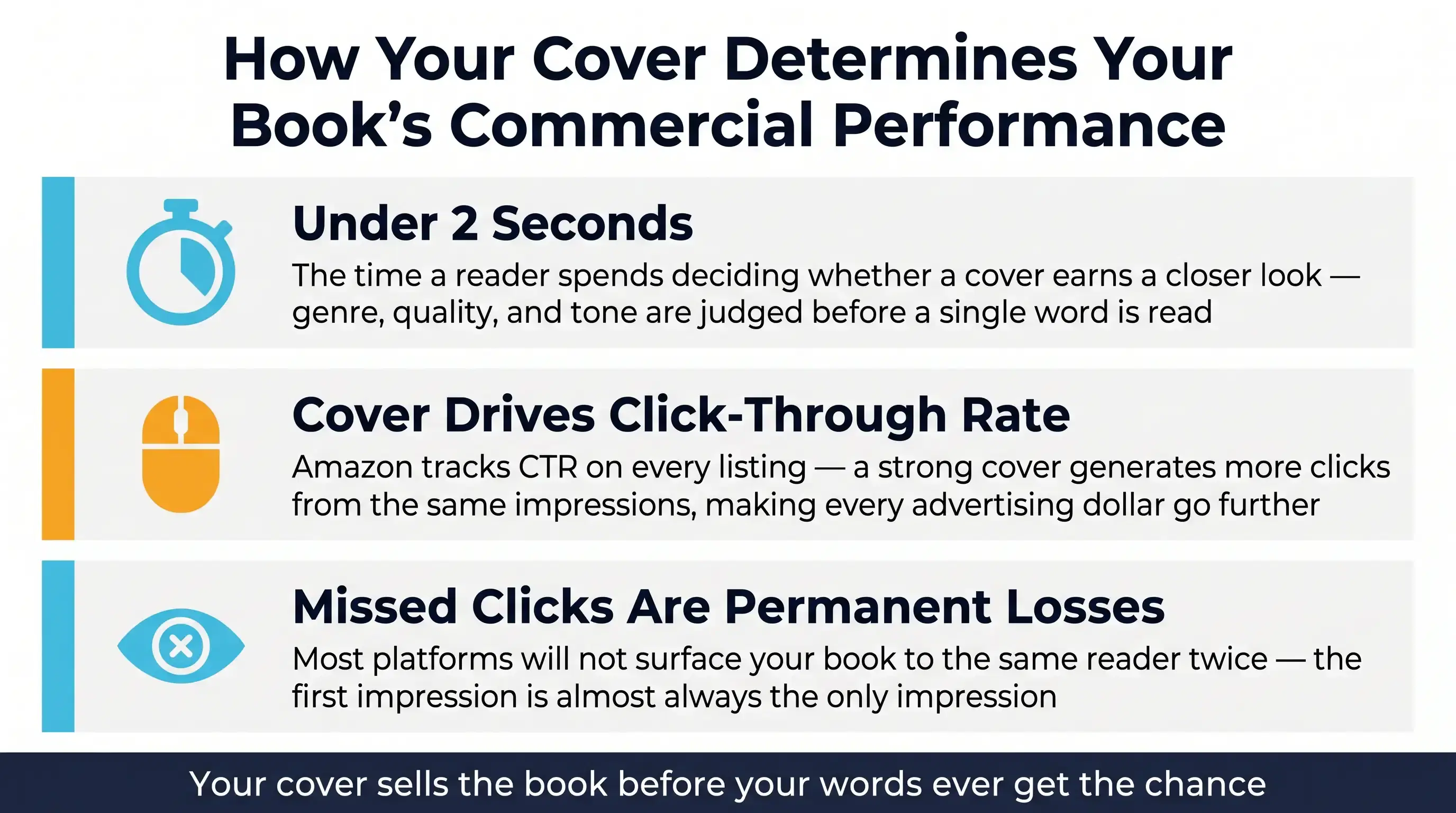
The average reader spends less than two seconds deciding whether a book cover warrants a closer look. In that window, the cover communicates genre, tone, quality, and whether the book is worth the reader’s time and money. A cover that fails to communicate any of those things clearly in two seconds loses the reader permanently.
What makes this especially consequential is that readers rarely revisit. If your cover does not earn a click the first time, most platforms will not surface your book to the same reader again. The cover is not just a first impression. In most cases, it is the only impression.
The Psychology Behind Visual Attraction
Visual attraction in book cover design is not random. It follows well-documented psychological patterns. Human brains are wired to process faces, recognize familiar patterns, and assign trust based on visual signals that have been culturally conditioned over decades of genre publishing.
Romance readers have been trained by thousands of covers to recognize certain color palettes, typography styles, and image treatments as signals of the genre they love. Thriller readers recognize tension and drama in specific design choices. This conditioning works in your favor when your cover meets expectations, and sharply against you when it does not.
The most commercially successful covers do not reinvent genre visual language. They speak it fluently while finding the small distinguishing detail that makes one book stand out within a familiar framework.
How Covers Impact Click-Through and Sales
Amazon tracks click-through rate on every product listing, and covers are the primary driver of that metric for books. A strong cover generates more clicks from the same number of impressions. More clicks mean more readers reaching your description, more people reading your sample, and ultimately more sales from the same advertising spend or organic search placement.
The compounding effect is significant. An author with a professionally designed cover running Amazon ads at the same budget as an author with a weak cover will consistently generate more sales per dollar spent, not because the algorithm favors them, but because more people click before the algorithm even gets involved.
What Makes a Book Cover "Sell"?
Selling covers share a set of characteristics that have nothing to do with how much was spent on design and everything to do with how well the design does its job. Understanding these characteristics is the foundation of every good cover decision
Clarity and Instant Genre Recognition
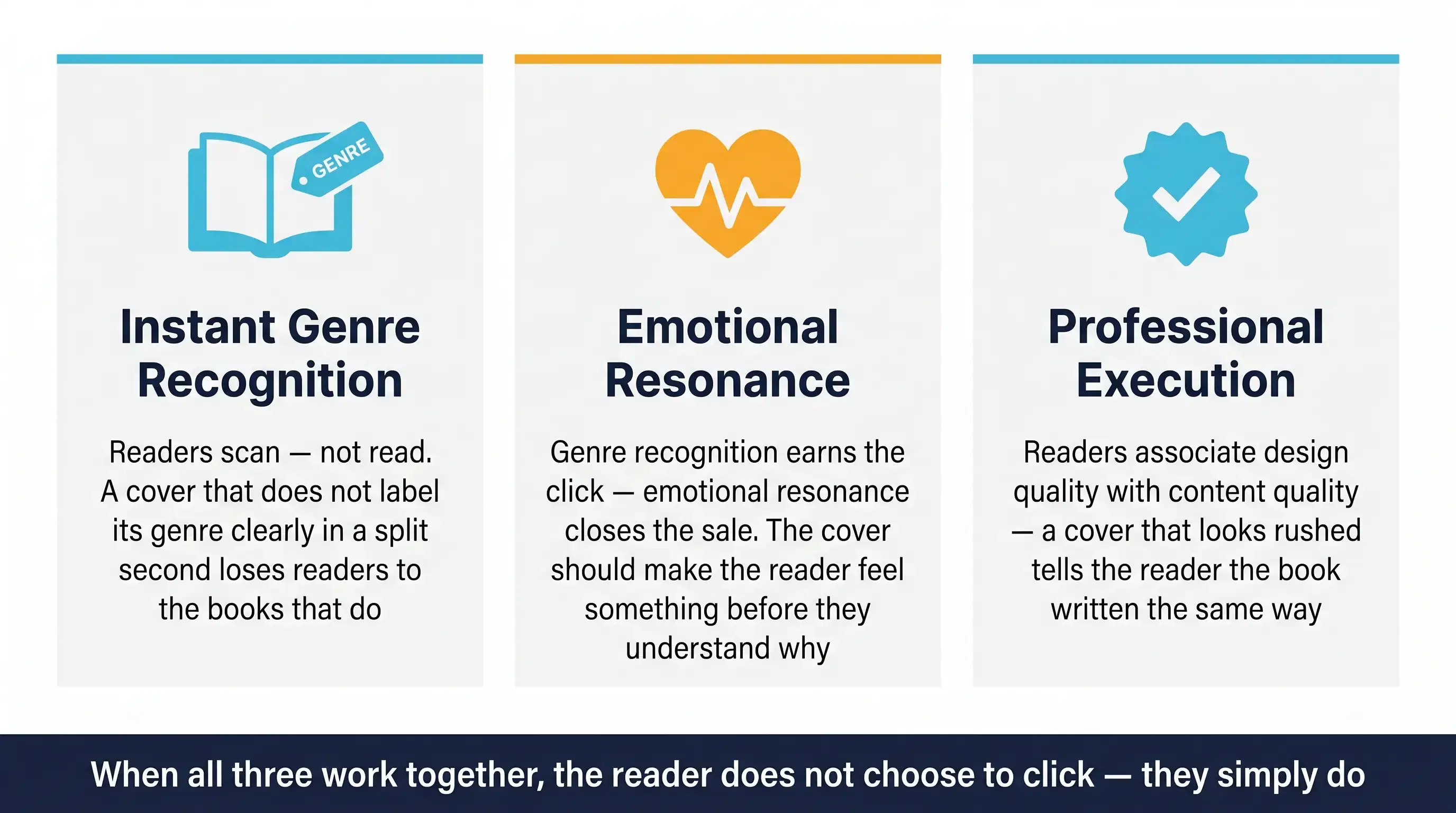
The single most important function of a book cover design that sells is instant genre communication. A reader scanning search results should be able to identify your genre without reading your title or description. The cover alone should signal romance, thriller, literary fiction, business, self-help, or whatever category your book occupies.
When genre recognition is unclear, readers hesitate. Hesitation in online shopping almost always resolves as a no. Readers who are unsure what they are looking at move to the next option. There are always more options.
Emotional Connection with Readers
Genre recognition gets the click. Emotional resonance closes the sale. The best covers do not just label a genre. They evoke the feeling the book delivers. A thriller cover should create unease or urgency. A romance cover should stir anticipation or warmth. A self-help cover should communicate the possibility of transformation.
This emotional work happens through imagery, color, typography style, and compositional choices working together. When those elements are aligned and intentional, readers feel something before they understand why. That feeling is what drives them to read the description and ultimately to buy.
Professional vs Amateur Design Differences
The gap between professional book cover design and amateur design is visible immediately to anyone who has spent time browsing book categories, and readers recognize it even when they cannot articulate what they are seeing.
Professional design demonstrates control: fonts are paired deliberately, spacing is precise, image treatment is consistent, and every element on the cover serves a clear purpose. Amateur design reveals itself through inconsistency: mismatched fonts, unintentional clutter, colors that fight each other, and images that have been cropped or scaled without attention to how they read at small sizes.
Readers associate design quality with content quality. A book that looks like it was put together quickly reads to potential buyers as a book that was written quickly. That association may be unfair, but it is real, and it affects purchasing decisions.
The Core Elements of a High-Converting Book Cover
Every element of a book cover contributes to its effectiveness. Understanding how each element works individually, and how they work together, is what separates covers built on strategy from covers built on aesthetics alone.
Title and Typography
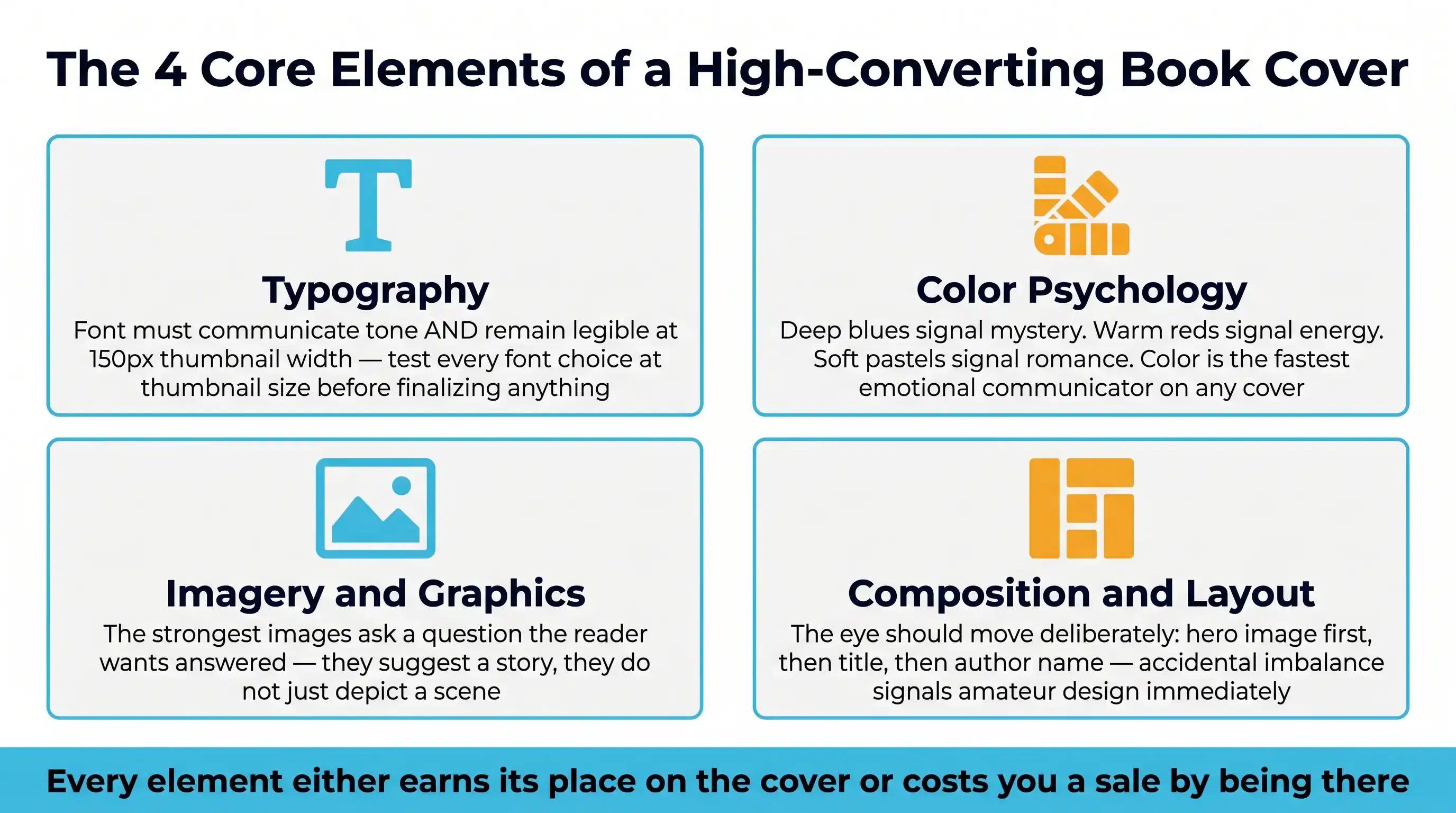
Font selection and readability: Your title font needs to accomplish two things simultaneously: communicate the tone of your book and remain legible at thumbnail size. A font that reads beautifully at full size but becomes illegible when reduced to a 150-pixel thumbnail has failed its most important test. Test every font choice at thumbnail size before committing to it.
Hierarchy and spacing: Visual hierarchy on a book cover tells the eye where to look and in what order. Title first, then author name, then any series information or tagline. When the hierarchy is clear, readers absorb the cover's information in seconds. When everything competes for equal attention, nothing gets absorbed. Spacing between elements is not empty space. It is breathing room that makes each element more readable and the overall composition more professional.
Color Psychology
Colors that trigger emotions: Color is the fastest emotional communicator on a book cover. Deep blues and blacks signal sophistication, mystery, or threat. Warm reds and oranges signal energy, romance, or danger. Soft pastels signal lightness, romance, or hope. Earth tones signal authenticity, nature, or memoir. These associations are not universal, but they are strong enough within Western publishing markets to be reliable guides for genre-specific color decisions.
Genre-specific color usage: Every genre has developed color conventions that readers recognize subconsciously. Romance covers frequently use warm, sensual tones. Thrillers use dark palettes punctuated by high-contrast elements. Fantasy covers often use rich, saturated jewel tones. Business and self-help covers frequently use clean, authoritative blues, whites, and grays. Stepping outside these conventions is possible, but it requires a deliberate strategy and usually works best when the departure is striking rather than simply different.
Imagery and Graphics
Stock vs custom illustrations: Stock photography offers a massive library of professional images at accessible price points, but it comes with a significant risk: other authors are using the same images. A reader who has seen the same stock photograph on three different book covers in their favorite genre will notice, and the association undermines the uniqueness of your title. Custom illustration and bespoke photography eliminate this risk entirely and give your cover a visual identity that cannot be replicated.
Visual storytelling through images: The strongest cover images do not just depict something. They suggest a story. A lone figure standing at the edge of a dark city suggests isolation, danger, or mystery. Two people almost touching suggests tension or romance. A child looking at something the viewer cannot see suggests wonder or danger. The best book cover design ideas use imagery that asks a question the reader wants answered, which is the most compelling reason to open a book.
Layout and Composition
Balance and alignment: Composition determines how the eye moves across the cover. Strong covers direct the eye deliberately, usually from the most compelling visual element to the title and then to the author name. Balanced compositions feel stable and professional. Intentionally unbalanced compositions can create tension or energy that suits certain genres. What always fails is accidental imbalance, where elements feel placed rather than composed.
Thumbnail optimization for online stores: Every cover design decision should be evaluated at 150 pixels wide, which is approximately how your cover appears in Amazon search results on a desktop browser and smaller on mobile. At that size, fine details disappear, subtle textures become noise, and any text smaller than the title becomes unreadable. Covers that work beautifully at full size but lose all their impact at thumbnail size are not optimized for the primary sales environment they will live in.
Book Cover Design by Genre (What Actually Works)
Genre conventions in cover design are not arbitrary restrictions. They are accumulated market intelligence about what makes readers in each category reach for their wallets. Understanding and working within these conventions, while finding room for differentiation, is the foundation of a cover strategy that actually sells.
Fiction Covers
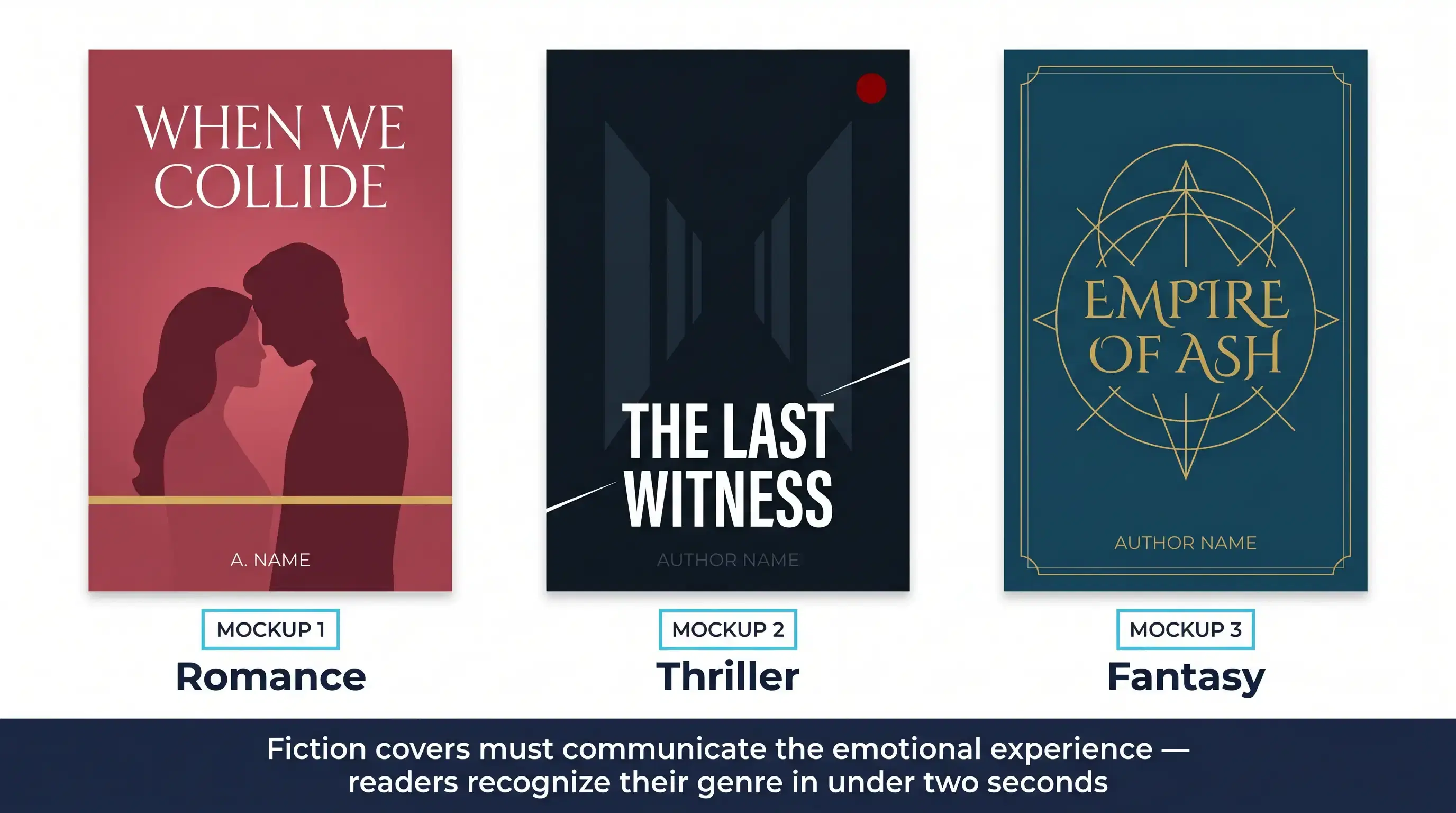
Fiction cover design varies enormously across subgenres, but the underlying principle is consistent: the cover must immediately communicate the emotional experience the book delivers.
Romance: Romance covers are among the most convention-driven in publishing. Readers in this category make rapid purchase decisions based on cover signals they have been trained to recognize. Couples in various states of proximity and emotion, specific color palettes ranging from warm and golden to cool and passionate, and typography styles that range from script-elegant to bold-modern all communicate subgenres clearly. A paranormal romance cover looks different from a contemporary romance cover, and readers expect that distinction to be visible immediately.
Thriller: Thriller covers build unease. Dark color palettes, high-contrast design, solitary figures, architectural elements that suggest isolation, and typography that feels urgent or fractured all contribute to the genre signal. The best thriller covers create a specific feeling of dread or anticipation that makes the reader want to know what happens. That desire to know is exactly what leads to a purchase.
Fantasy: Fantasy covers have more visual freedom than almost any other genre, but they use that freedom within a clear set of genre signals. Rich color, epic scale, magical elements, and world-building imagery all communicate the genre. Series consistency matters enormously in fantasy, where readers often commit to multiple books and visual branding across a series drives back-catalog sales.
Non-Fiction Covers

Non-fiction covers operate on different principles than fiction. Where fiction covers evoke emotion, non-fiction covers establish authority and communicate a clear value proposition. The reader needs to understand immediately what problem the book solves or what knowledge it delivers.
Clean design, authoritative typography, and restrained color palettes dominate the category. White space is used intentionally to suggest clarity and precision. Author credentials and endorsements are often incorporated into the cover design itself rather than left to the back cover. A professional book cover design for non-fiction signals competence before the reader reads a single word of the description.
Self-Help and Business Books
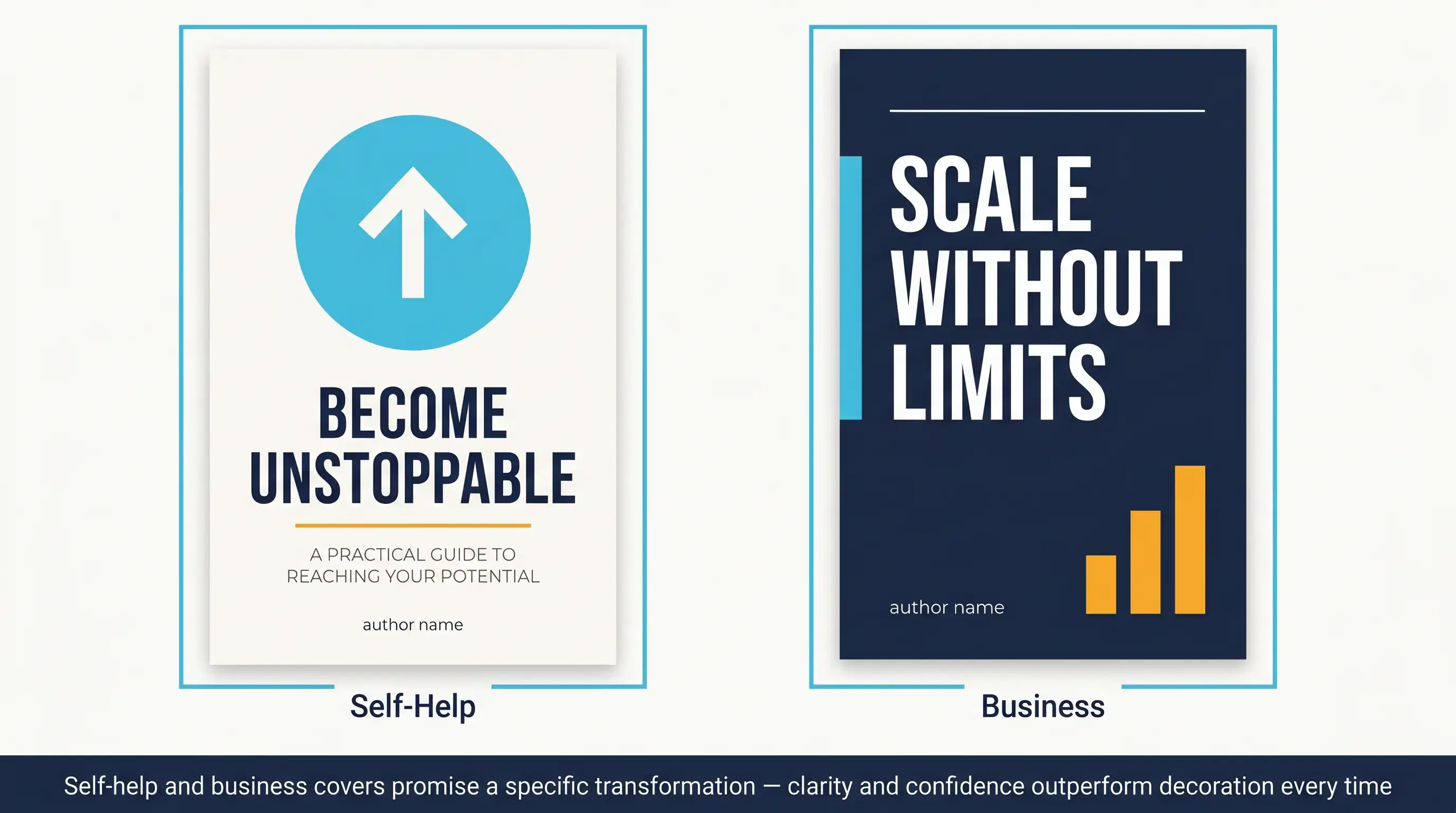
Self-help and business book covers share a visual language of clarity, ambition, and transformation. Minimalist design with bold typography is the dominant approach in both categories. The cover needs to promise something specific and believable: a skill learned, a problem solved, a mindset shifted.
Color psychology matters significantly here. Blues communicate trust and authority. Greens communicate growth and possibility. Oranges and yellows communicate energy and optimism. The most successful covers in these categories use one dominant color with high-contrast typography and a clean, uncluttered layout that reads as confident rather than busy.
Children's Books
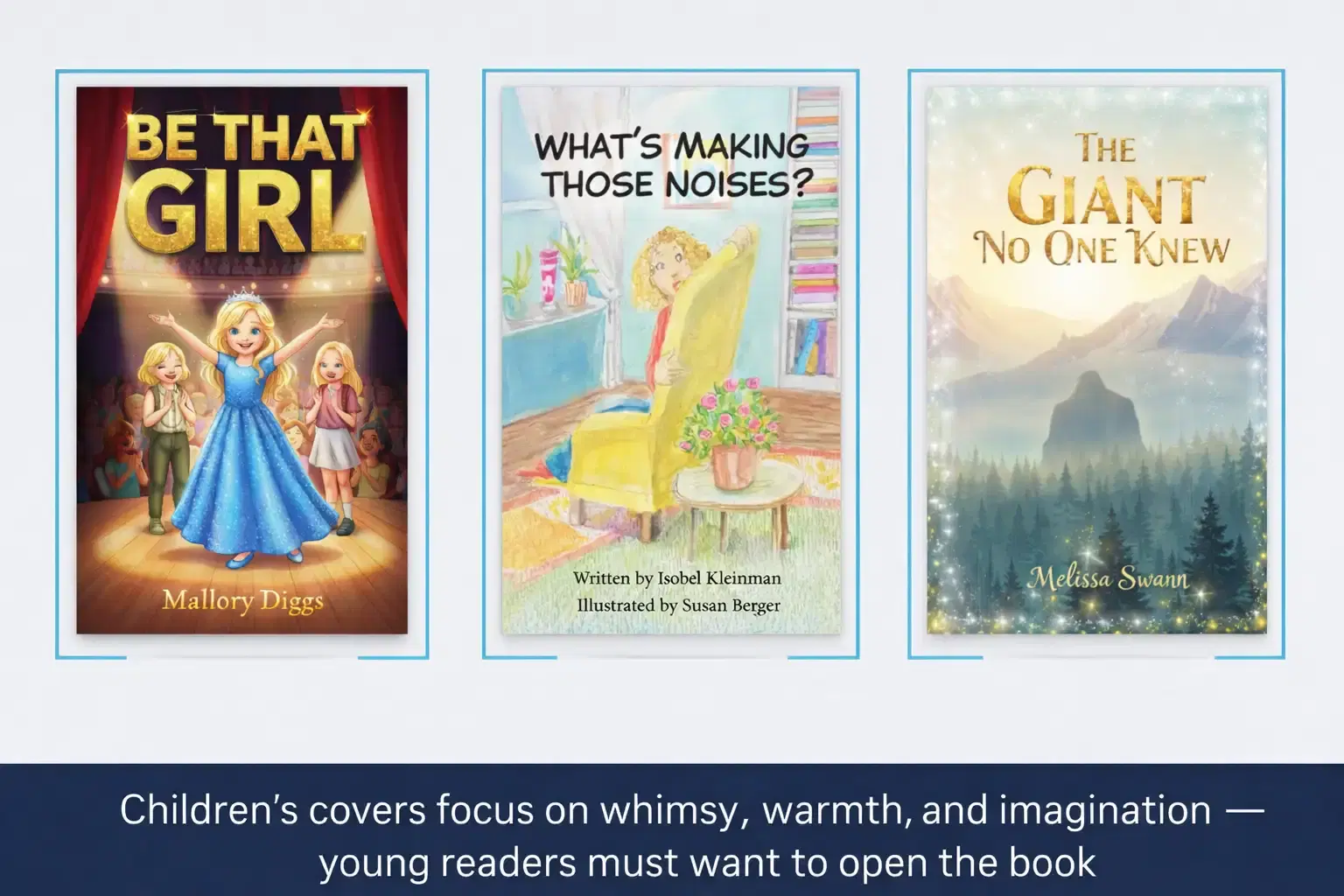
Children's book covers operate in a completely different visual register. The primary audience for the cover is actually parents and caregivers rather than the child reader, which means the cover needs to communicate appropriate age range, tone, and subject matter to adults while also being visually engaging enough to catch a child's attention when browsed together.
Bright, saturated colors, playful and expressive illustration styles, and large, clear typography characterize strong children's book covers. The illustration style signals the book's visual world and sets expectations for the interior. A mismatch between cover illustration style and interior art creates a jarring experience that experienced parents and educators notice immediately.
Book Cover Design Trends in 2026
Staying current with design trends is not about chasing novelty. It is about ensuring your cover looks contemporary enough to signal that your book is current and relevant, not a title that was published years ago and never updated.
Minimalist vs detailed designs: The tension between minimalism and detailed illustration continues in 2026, with both approaches finding strong audiences depending on genre. Minimalism dominates in literary fiction, business, and self-help categories, where restraint reads as sophistication and confidence. Detailed illustration dominates in fantasy, children's books, and certain romance subgenres, where visual richness is part of the genre promise. The mistake is applying minimalism where readers expect richness, or visual complexity where readers expect clarity.
Bold typography trends: Typography has become increasingly dominant as a design element in its own right rather than simply a vehicle for title information. Oversized, layered, and textured typography treatments are appearing across multiple genres, particularly in literary fiction, thriller, and certain self-help categories. When typography is the hero of the design, it needs to be executed with exceptional precision, because any inconsistency or technical weakness becomes the most visible element on the cover.
Dark mode-friendly covers: As readers increasingly browse and read on devices with dark mode enabled, covers that maintain their visual impact against dark backgrounds have gained strategic importance. High-contrast designs, covers with dark or neutral backgrounds, and typography with strong contrast ratios perform consistently well across both light and dark viewing environments. Covers that rely heavily on white backgrounds for their visual impact can appear less distinctive in dark mode browsing contexts.
Common Book Cover Design Mistakes to Avoid
Understanding what not to do is as valuable as understanding best practices, because the most damaging cover mistakes are often not obvious to authors who are too close to their own work.
Overcrowded design: The instinct to include every relevant element-the title, subtitle, series name, author name, tagline, multiple images, and decorative borders-produces covers that communicate nothing because everything is competing for attention simultaneously. Strong covers are built on restraint. Every element that is not essential to the cover's primary message should be removed or minimized.
Poor font choices: Font mismatches are one of the most common and most visible mistakes in amateur book cover design. Using a decorative script font for a thriller title, a blocky sans-serif for a romance novel, or mixing three different font families on a single cover all signal that the designer made choices based on personal preference rather than genre knowledge. Typography on a book cover is not decoration. It is communication.
Low-quality images: Pixelated images, poorly lit photographs, images that have been stretched beyond their native resolution, and stock images that have been used too many times all undermine the professional impression a cover needs to create. Every image on a cover should be high resolution, appropriately licensed, and chosen for how it serves the cover's visual strategy rather than simply because it was available or affordable.
Misleading genre signals: A cover that signals the wrong genre creates a specific and damaging problem: it attracts readers who are not the right audience for the book, who then leave negative reviews because the book did not deliver what the cover promised. A thriller cover on a literary fiction novel, or a literary fiction cover on a genre thriller, produces the same outcome. The mismatch between cover promise and content delivery is one of the most reliable paths to poor reviews and poor sales simultaneously.
DIY vs Professional Book Cover Design
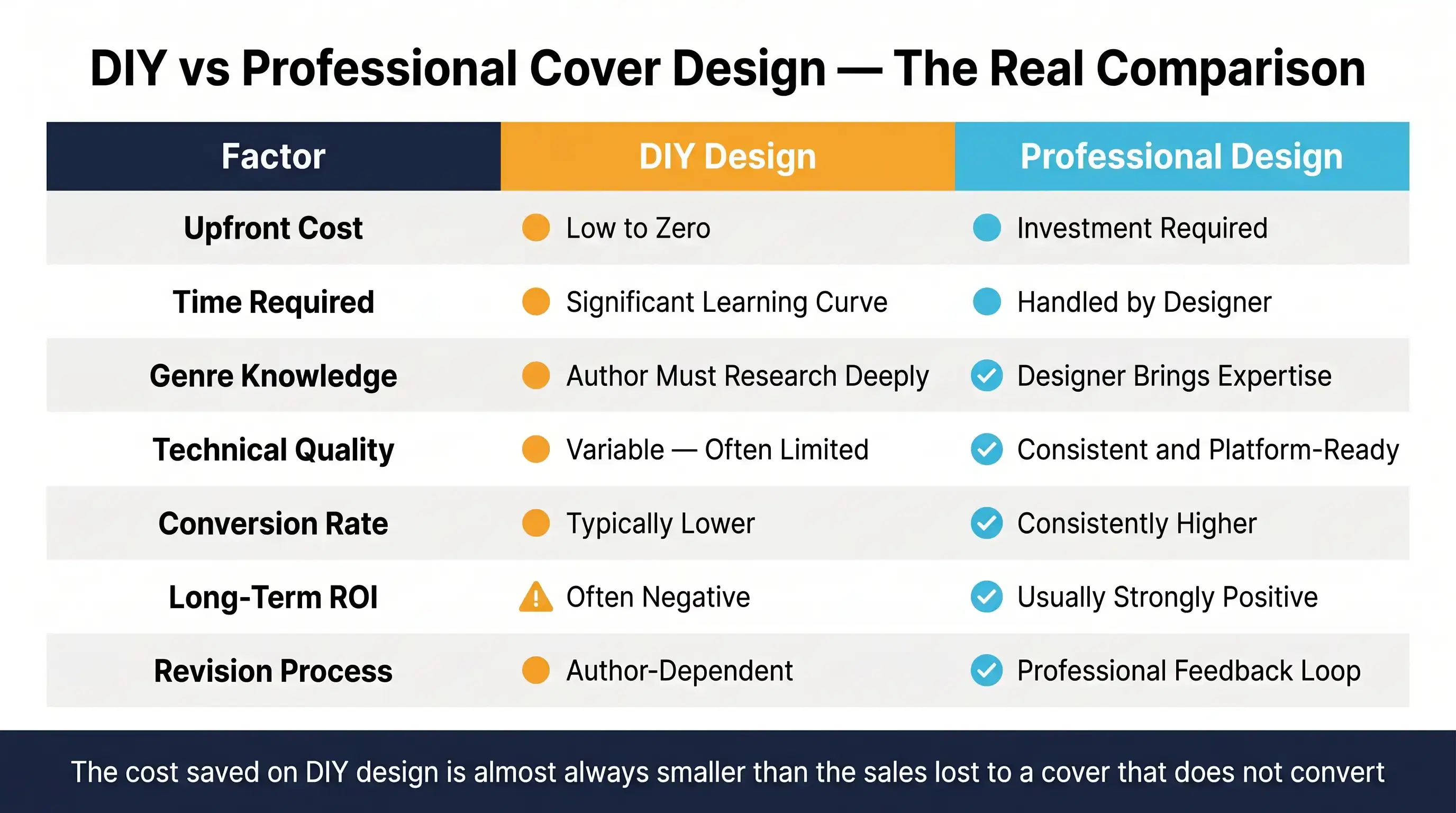
The question of whether to design your own cover or hire a professional comes down to a realistic assessment of your skills, your tools, your knowledge of genre conventions, and what you are willing to risk on the outcome.
DIY Design Tools
The most commonly used DIY tools are Canva, Adobe Photoshop, and an expanding range of AI-assisted design platforms. Canva offers pre-built templates that can produce acceptable results for certain non-fiction categories where design conventions are simpler. Photoshop provides professional-grade control but requires substantial skill investment to use effectively. AI design tools are improving rapidly but currently struggle with genre-specific nuance and the fine compositional judgment that separates good covers from great ones.
Pros and Cons of DIY Design
The primary advantage of DIY design is cost. The primary risk is that cost savings on design often produce revenue losses in sales that far exceed what professional design would have cost. A cover that converts at half the rate of a professionally designed cover costs far more than the design fee over the lifetime of the book.
| Factor | DIY Design | Professional Design |
|---|---|---|
| Upfront Cost | Low to zero | Investment required |
| Time Required | Significant learning curve | Handled by designer |
| Genre Knowledge | Author must research deeply | Designer brings expertise |
| Technical Quality | Variable, often limited | Consistent and platform-ready |
| Conversion Rate | Typically lower | Consistently higher |
| Long-term ROI | Often negative | Usually strongly positive |
| Revision Process | Author-dependent | Professional feedback loop |
Why Professional Design Wins
Professional designers who specialize in book cover design services bring three things that DIY tools cannot provide: deep genre knowledge developed across hundreds of covers, technical skill that produces clean and platform-optimized files, and an objective eye that is not emotionally attached to the manuscript.
The emotional attachment problem is underestimated. Authors who design their own covers make decisions based on what feels meaningful about the book rather than what will attract the right readers. A professional designer has no attachment to the story and therefore designs purely for the reader's response. That distance consistently produces better commercial outcomes.
Higher conversion rates and better branding and positioning are the direct results. An author who invests in professional cover design for authors is not paying for aesthetics. They are paying for a measurable improvement in the commercial performance of everything they publish.
How Book Cover Design Impacts Marketing and Sales
Cover design and marketing are not separate disciplines. Every marketing channel your book appears in is affected by your cover, and the cover's performance in those channels directly determines your return on every marketing dollar you spend.
Amazon Click-Through Rate (CTR)
Amazon advertising works on a cost-per-click model. You pay every time someone clicks your ad, not when it is shown, so a low click-through rate does not directly raise what you pay per sale - cost per sale is your cost per click divided by your conversion rate, and click-through rate is not a term in that calculation. What a weak cover does is subtler and still expensive: your cover is the primary visual in every ad format, so it drives whether anyone clicks at all, and Amazon's auction factors ad relevance, which means poorly performing creative tends to win fewer impressions and pay more for the ones it does win. The cover also has to survive the click, because the same image is what greets the reader on the product page.
This relationship between cover quality and advertising efficiency is the most direct financial argument for investing in professional book cover design. The cover does not just affect organic discovery. It affects the cost efficiency of every paid marketing campaign you run for the life of the book.
Conversion Rate Optimization (CRO)
Getting a reader to click your cover is only the first step. Once on your book page, the reader sees your cover again, now at a larger size alongside your description, reviews, and sample. A cover that looks acceptable as a thumbnail but loses quality or impact at larger sizes undermines the conversion that the click initiated.
Covers that work across all display sizes, from tiny search result thumbnails to full-size product page images, consistently outperform covers optimized for only one context. This multi-size effectiveness is a hallmark of genuinely professional design and one of the clearest differences between professional book cover design and work produced by less experienced designers.
Branding and Author Authority
For authors building a catalog, cover design is also author branding services in practice. The visual consistency across your covers, the design language that readers associate with your name, and the immediate recognition your covers generate in series readers are all functions of deliberate branding through design.
Authors who treat each cover as an isolated design decision miss the compounding benefit of visual brand equity. When a reader who loved your first book sees your second book in search results, the visual similarity to the first cover is an instant trust signal that bypasses all the skepticism a new author faces. That recognition accelerates the purchase decision from minutes to seconds.
Step-by-Step Process to Create a Selling Book Cover
A cover that sells is not the product of inspiration. It is the product of a deliberate process that starts with market research and ends with tested, optimized design.
Research Your Market
Before any design work begins, spend time in your book's specific subcategory on Amazon. Look at the top twenty bestselling titles. Study their covers systematically: what color palettes dominate, what imagery approaches are common, how typography is handled, what the cover hierarchy looks like. You are building a visual vocabulary for your genre that will inform every design decision that follows.
Also look at the covers of books that are similar in content to yours but performing below expectations. Understanding what the underperforming covers have in common is as valuable as understanding what the successful ones share.
Define Your Audience
Your cover needs to speak directly to the specific reader most likely to buy your book, not the broadest possible audience. A thriller reader who loves psychological suspense has slightly different visual expectations than one who prefers action-driven plots. A romance reader who gravitates toward historical settings responds to different visual signals than one who reads contemporary romance exclusively.
The more precisely you define your ideal reader, the more precisely you can design a cover that speaks to them. A cover that resonates strongly with a specific reader type will consistently outperform a cover trying to appeal to everyone.
Choose Design Direction
Based on your market research and audience definition, establish a clear design brief before any design work begins. This brief should specify color palette direction, imagery approach, typography style, and the emotional response the cover should produce. A clear brief produces better design faster, whether you are working with a professional designer or attempting the work yourself.
Create and Test Variations
Develop multiple concepts against your brief and test them with your target audience before committing to a final direction. The testing phase is where assumptions get corrected and insights emerge that no amount of research produces in advance. Budget time and resources for at least two rounds of variation and testing before finalizing.
Finalize and Optimize
The final cover needs to be optimized for every format it will appear in. For ebook cover design, this means ensuring the design reads clearly at thumbnail dimensions. For amazon kdp publishing, this means meeting technical specifications for file format, color mode, and resolution. For print editions, it means adapting the design to spine and back cover dimensions while maintaining visual consistency across all surfaces.
Tools and Resources for Book Cover Design
Design Software
Adobe Photoshop and Illustrator remain the industry-standard tools for professional cover design, offering the control and output quality that platform specifications require. Affinity Designer and Affinity Photo are lower-cost alternatives with comparable capabilities for most cover design applications. Canva Pro offers template-based design that works adequately for certain non-fiction categories but lacks the precision control needed for complex cover compositions.
Stock Image Platforms
Shutterstock, Adobe Stock, and Getty Images are the primary sources for licensed photography and illustration used in commercial book cover design. For more distinctive or affordable options, Depositphotos and Dreamstime offer large libraries at lower price points. Authors using any stock imagery should carefully review licensing terms, particularly regarding commercial use, print run limits, and exclusivity, before incorporating images into published book covers.
Font Libraries
Adobe Fonts (included with Creative Cloud subscriptions) and Google Fonts (free) offer extensive libraries of professional typefaces suitable for book cover design. MyFonts and FontShop provide access to premium and specialty typefaces that offer more distinctive options for covers where typography is the primary design element. Any font used on a commercial book cover requires an appropriate commercial license, and authors should verify licensing terms before publication.
How Best Selling Publisher Develops a Book Cover Brief
Best Selling Publisher can base a book-cover scope on category research, genre conventions, technical specifications, concept review, and author approval. A cover cannot guarantee sales or other commercial outcomes.
Market Research-Driven Design
Every cover project begins with a category analysis of the specific genre and subcategory the book will compete in. We study current bestsellers, identify the visual conventions readers in that category recognize and respond to, and build a design brief that positions the cover to compete effectively within the market rather than simply stand apart from it.
Our approach to custom book cover design services means no two covers are identical and no design decision is made without a commercial rationale rooted in current market data.
Genre-Specific Expertise
Our design team has produced covers across fiction, non-fiction, self-help, business, children's books, and memoir. That breadth of genre experience means we bring specific knowledge of what works in your category to every project, rather than applying a generic design philosophy that ignores the distinct visual cultures that different reader audiences have developed.
Whether you need ebook cover design services for a digital-first release or a full print and digital package, our genre expertise ensures your cover speaks the visual language your readers already understand and trust.
Conversion-Focused Approach
Every design decision we make is evaluated against one primary question: will this produce more clicks and more sales? Our amazon book cover design service is specifically optimized for how covers perform in Amazon's search and recommendation environment, where thumbnail performance determines discoverability and click-through rate determines advertising efficiency.
We test covers at thumbnail size as a standard part of our process, not as an afterthought. We evaluate typography legibility at small sizes, color performance against Amazon's white and dark backgrounds, and composition effectiveness when reduced to search result dimensions before any cover is finalized.
Professional Design Team
Our team includes designers who have worked with both traditionally published and independently published authors, bringing an understanding of publishing industry standards alongside the specific knowledge of what drives sales in the self-publishing market. For authors looking for the best book cover designers for self publishing, our team combines creative skill with commercial knowledge and genre expertise that generic design agencies rarely provide.
We work as a book cover design agency that understands publishing, not a general design studio that occasionally works on books. That distinction matters in the quality and commercial effectiveness of every cover we produce.
Ready to Design a Book Cover That Sells?
Your book has earned readers. The cover is what gets them there. Every week a strong manuscript sits behind an underperforming cover is a week of sales, reviews, and reader relationships lost to a problem that has a straightforward solution.
Whether you are preparing to publish for the first time, relaunching an existing title with a new cover, or building a series visual identity from scratch, the investment in affordable book cover design services that are built around commercial performance rather than aesthetic preference is one of the highest-return decisions in publishing.
Best Selling Publisher offers end-to-end book publishing servicesthat include market-researched, genre-specific, conversion-optimized cover design as part of a complete publishing strategy. When you are ready to give your book the cover it deserves, we are ready to build it.
FAQs
Attraction in book cover design is not a matter of taste. It is a matter of how effectively a cover communicates genre, evokes the emotional experience the book delivers, and establishes trust through professional execution. A cover that does all three clearly and quickly is attractive to the right readers for that book, which is the only measure that matters commercially.
The range for professional book cover design is wide, from a few hundred dollars for a straightforward non-fiction design to several thousand for a complex illustrated fantasy cover with custom artwork. The more relevant question is what a strong cover is worth relative to what a weak one costs in lost sales. For most titles, the investment in professional design pays for itself within the first few months of publication if the book is marketed at all.
You can, and some authors produce effective DIY covers, particularly in non-fiction categories where design conventions are simpler. The honest assessment is that most authors who attempt their own book cover design work produce covers that signal self-publishing in ways that undermine reader confidence. If you choose the DIY route, research your genre deeply, test your cover with real readers before publishing, and be willing to update it if early sales data suggests it is underperforming.
For ebook publishing on Amazon KDP, the recommended cover size is 2560 × 1600 pixels at 72 dpi with a 1.6:1 height-to-width ratio. For print editions through amazon kdp publishing, the cover must include front, back, and spine dimensions calculated based on your trim size and page count. Covers submitted at lower resolution than platform requirements will display poorly and may be rejected. All professional cover files should be delivered at the highest resolution available to allow for use across all formats.
Yes, directly and measurably. Cover quality affects click-through rate in search results and advertising, conversion rate on product pages, review sentiment from readers whose expectations were set by the cover, and the efficiency of every marketing dollar spent on the book. Book cover design tips that focus purely on aesthetics miss this commercial dimension. A cover is not decoration. It is the primary sales tool for every book it represents, and its performance determines the ceiling on everything else you do to market the title.