
eBook Word Count Guidelines by Genre: How Long Should Your Book Be?
You've been writing for weeks. The story is coming together, the ideas are flowing, and then suddenly one question stops you cold: how long does this actually need to be?
It sounds simple, but the ebook word count is one of those decisions that carries real weight. Get it wrong in either direction, and you risk disappointing readers, hurting your reviews, and leaving money on the table. Write too little and readers feel cheated. Write too much padding, and they abandon the book halfway through.
The publishing world has clear benchmarks for this, and they vary significantly depending on your genre, your audience, and what you're trying to accomplish. Whether you're working on a sweeping fantasy epic, a tight business guide, or a short lead magnet, there's a range that works for you. The key is knowing what it is before you hit publish.
What Is the Ideal eBook Word Count?
Definition of eBook Length
When publishers and authors talk about book length vs word count, they're usually referring to the total number of words in a finished manuscript, not page count. Pages vary depending on font size, margins, and formatting. Word count is the consistent, platform-neutral way to measure a book's length, and it is what most editors quote against. Note that Amazon KDP itself does not record a word count anywhere: it works in printed page count and, for Kindle Unlimited, in Kindle Edition Normalized Pages.
Why Word Count Matters in Publishing
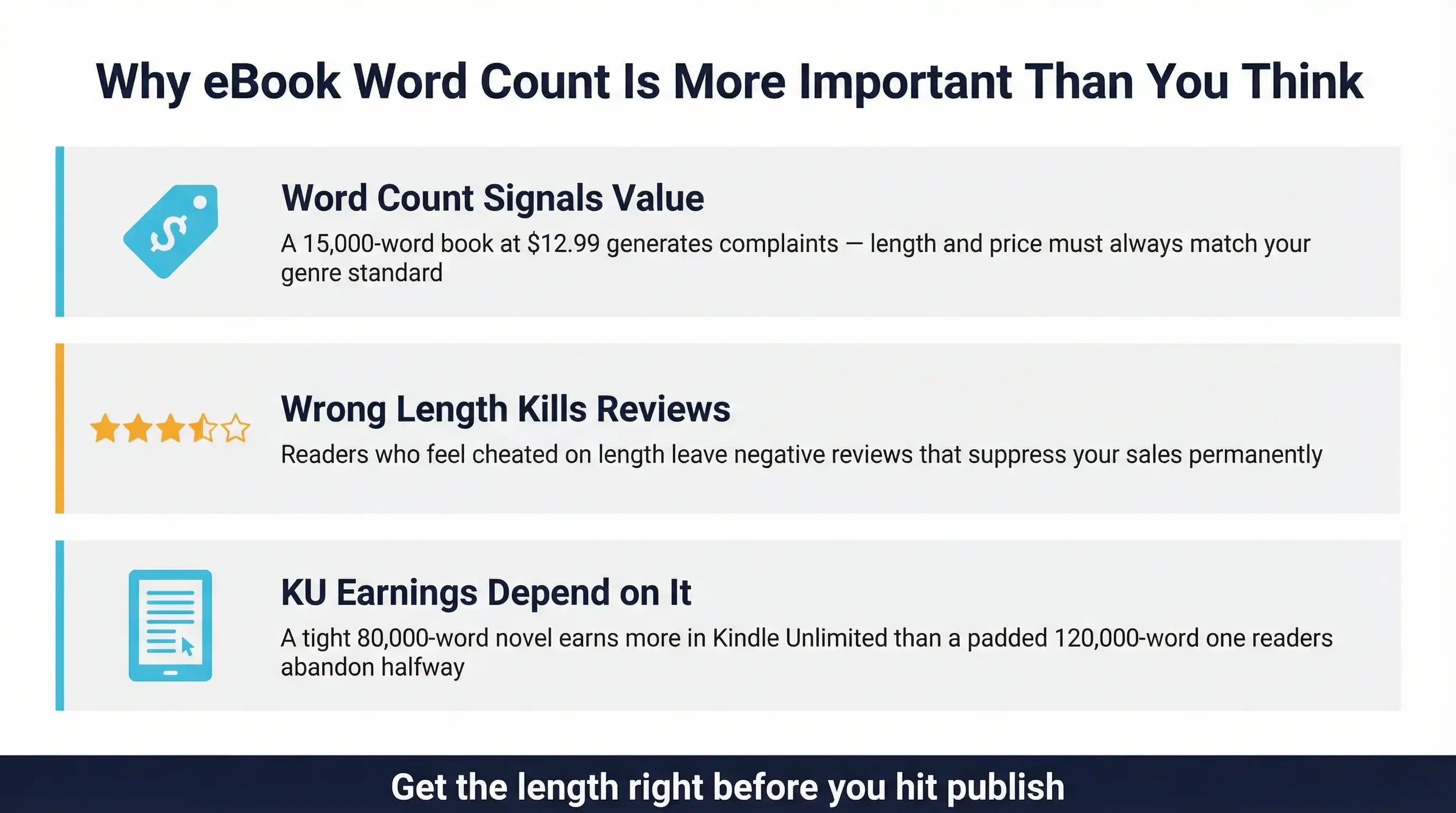
Word count in publishing isn't just an arbitrary measurement. It signals to readers what kind of experience they're buying. A 15,000-word business ebook priced at $12.99 will generate complaints. A 100,000-word romance novel priced at $0.99 will raise eyebrows. Word count and price need to align, and both need to match what's standard in your genre.
From an SEO and discoverability standpoint, publishing standards for book length also affect where your book shows up in Amazon search results. Books that fall dramatically outside genre norms can struggle to rank because they don't match the behavioral patterns Amazon uses to surface recommendations.
How Word Count Impacts Sales and Readability
Why ebook length matters becomes very clear when you look at reader behavior data. Readers who feel a book was too short leave reviews mentioning it, which can negatively impact star ratings and conversion. Readers who wade through an overlong book with unnecessary filler content do the same. The sweet spot is a book that delivers exactly what readers in your genre expect, no more and no less.
On Kindle Unlimited specifically, longer books have higher earnings potential because KU pays per page read. But only if readers actually finish the book. A tightly written 80,000-word novel earns far more than a padded 120,000-word one where readers drop off at the 60% mark.
Average eBook Word Count by Genre (Quick Overview)
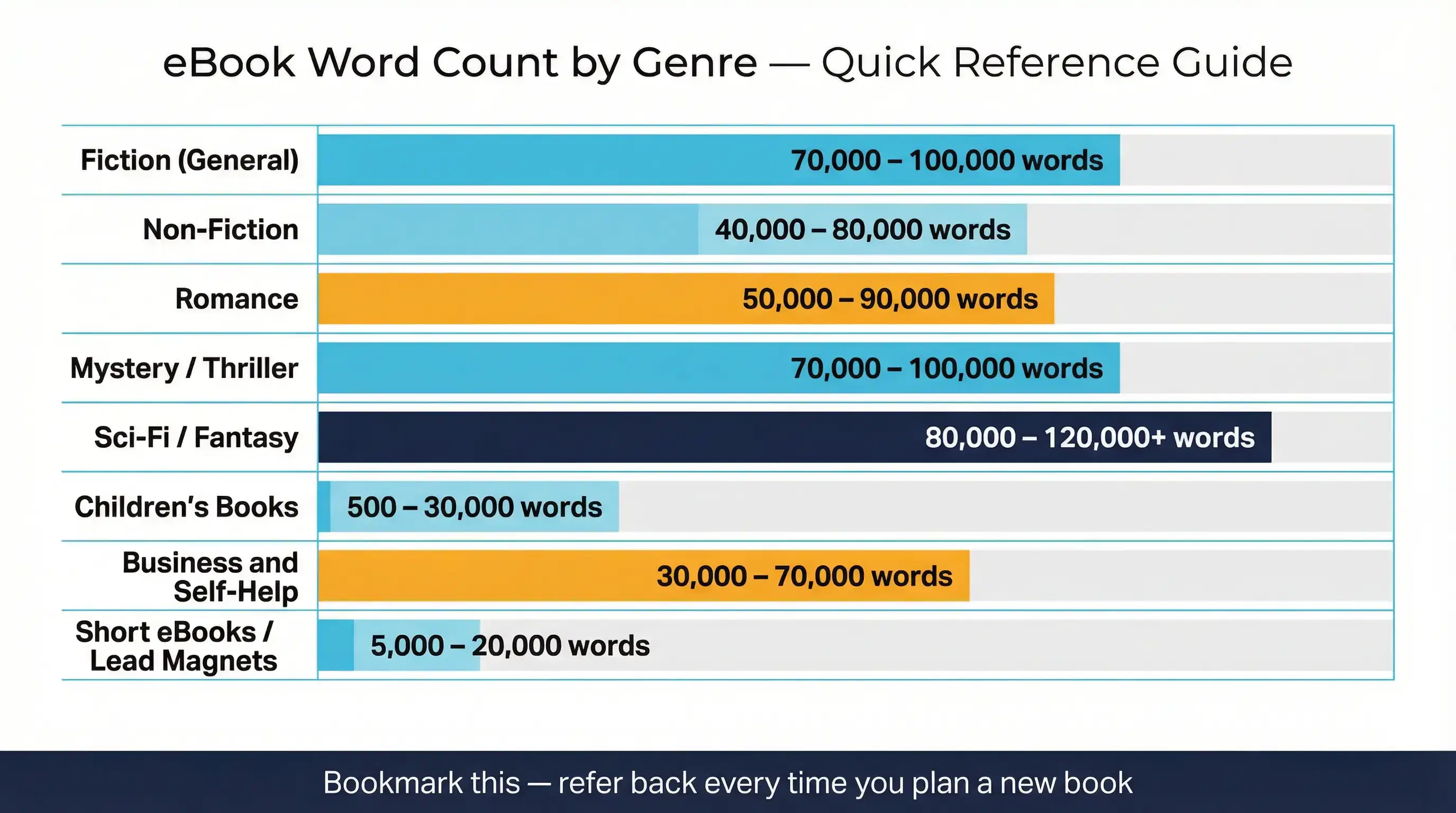
Before we break each genre down in detail, here's a quick reference table covering the standard average ebook word count by genre. Bookmark this and refer back whenever you need a fast answer.
| Genre / Type | Word Count Range |
|---|---|
| Fiction (General) | 70,000 – 100,000 words |
| Non-Fiction (General) | 40,000 – 80,000 words |
| Romance | 50,000 – 90,000 words |
| Mystery / Thriller | 70,000 – 100,000 words |
| Sci-Fi / Fantasy | 80,000 – 120,000+ words |
| Children's Books | 500 - 55,000 words (picture book to upper middle grade) |
| Business & Self-Help | 30,000 – 70,000 words |
| Short eBooks / Lead Magnets | 5,000 – 20,000 words |
These ranges reflect what's currently performing well on Amazon and other major platforms. They're not rigid rules, but stepping too far outside them without a deliberate strategy is a risk most first-time authors can't afford to take.
eBook Word Count Guidelines by Genre (Detailed Breakdown)
Every genre has its own reader culture, and that culture has strong opinions about length. Here's what you need to know before you start writing or before you decide whether your draft is ready to publish.
Fiction eBooks
The typical range for fiction ebook word count sits between 70,000 and 100,000 words. This is broad enough to accommodate most story types while keeping you within a range that readers recognize as a full, satisfying novel.
The ideal fiction book length depends heavily on the complexity of your story. A contemporary coming-of-age novel can work beautifully at 75,000 words. A multi-POV literary novel with layered subplots needs room to breathe and may push toward or past 100,000. The key question isn't how many words you have. It's whether every scene is earning its place.
Storytelling depth word count is the phrase editors use when they talk about whether a manuscript has enough space to develop characters, build tension, and deliver a satisfying resolution. Books that rush through these elements because they're trying to hit a shorter word count almost always feel hollow to readers, regardless of how good the core idea is.
The average novel word count across traditionally published fiction is right around 90,000 words. That's a useful benchmark when you're deciding whether your draft is complete or whether it needs another pass of development.
Non-Fiction eBooks
Non-fiction readers have a very different relationship with length. They're reading to solve a problem, learn a skill, or gain a specific perspective. They don't want padding. They want value delivered as efficiently as possible.
Fiction vs non-fiction word count expectations are almost mirror opposites in this regard. Where fiction readers often feel cheated by shorter books, non-fiction readers regularly complain that books are too long. The standard range of 40,000 to 80,000 words gives you enough space to cover a topic with real depth without overstaying your welcome.
The most successful non-fiction ebooks tend to be structured around a clear problem-solution framework. Every chapter should answer a specific question or deliver a specific outcome for the reader. If a chapter isn't doing that, it probably shouldn't be in the book.
Romance eBooks
Romance novel word count typically ranges from 50,000 to 90,000 words, though this varies by subgenre. Contemporary romance tends to sit toward the lower end of that range. Historical romance and paranormal romance often run longer because of the additional worldbuilding and period detail required.
Romance readers are among the most voracious and loyal in publishing. They read multiple books per month, and they have clearly defined expectations about pacing, emotional arc, and satisfying resolution. A romance that hits all those beats at 60,000 words will outperform a longer one that drags in the middle. Length should serve the emotional journey of the story, not the other way around.
Mystery and Thriller eBooks
Thriller novel word count and mystery word counts follow similar patterns, generally running between 70,000 and 100,000 words. The tension-driven nature of these genres means that pacing decisions are tightly linked to length. Too short and you haven't built enough suspense. Too long and the momentum collapses.
Thrillers in particular benefit from a tight structure. Chapters should end on unresolved tension. Every scene should either raise the stakes or reveal information that changes how the reader understands the story. When thriller writers pad their word count with unnecessary scenes, readers feel it almost immediately, and not in a good way.
Sci-Fi and Fantasy eBooks
The fantasy novel word count is the category where longer books are most accepted and often expected. The standard range runs from 80,000 to 120,000 words, and established authors in epic fantasy regularly publish books well beyond that.
The reason is simple: worldbuilding takes space. You can't establish a fully realized alternate world, a magic system, a political landscape, and a cast of complex characters in 60,000 words without making everything feel rushed and underdeveloped. Readers who pick up a fantasy epic are signing up for immersion. Give them the room to get lost in your world.
That said, word count should never be used as a substitute for plotting. Sci-fi and fantasy readers are sophisticated, and they'll notice if a book is long simply because the author couldn't edit. Every chapter needs to serve the larger story.
Children's eBooks
Children's book word count varies dramatically depending on the age group you're writing for, and getting this right is especially important because the gap between categories is huge.
- Picture books (ages 4 to 8): around 500 words, with 1,000 the ceiling most publishers will accept. The text is minimal because illustrations carry most of the story.
- Early readers (ages 6 to 8): 2,000 to 10,000 words. Short chapters, large type, and simple vocabulary.
- Middle grade (ages 8 to 12): 20,000 to 50,000 words. More complex plots and characters, but still shorter than adult fiction.
Writing outside these ranges for children's books is a significant red flag for parents and educators, who are the actual buyers. A picture book at 5,000 words or a middle-grade novel at 80,000 words will face immediate rejection from agents and skepticism from self-publishing customers.
Business and Self-Help eBooks
Self-help ebook word count tends to fall between 30,000 and 70,000 words. Business books are similar, though they can push toward the higher end when covering complex frameworks or case studies.
The self-help genre is particularly sensitive to filler content. Readers in this space are paying for transformation, not word count. A 35,000-word self-help book that genuinely changes how someone thinks or behaves will get five-star reviews. An 80,000-word one that keeps restating the same point in different ways will not.
Educational ebook word count follows similar principles. Clarity and structure are far more important than length. Use case studies, frameworks, and actionable exercises to add depth rather than simply adding more text.
Short eBooks and Lead Magnets
Short ebook word count ranges from 5,000 to 20,000 words. These books serve a different purpose than full-length titles. They're used as lead magnets, low-cost entry points into an author's catalog, or focused deep dives on very specific topics.
Short ebooks work well when the scope is tightly defined. A 10,000-word guide on a single, specific topic can deliver enormous value. A 10,000-word attempt at a full business framework will feel rushed and incomplete. The format rewards precision over breadth.
Factors That Influence eBook Length
Target Audience Expectations
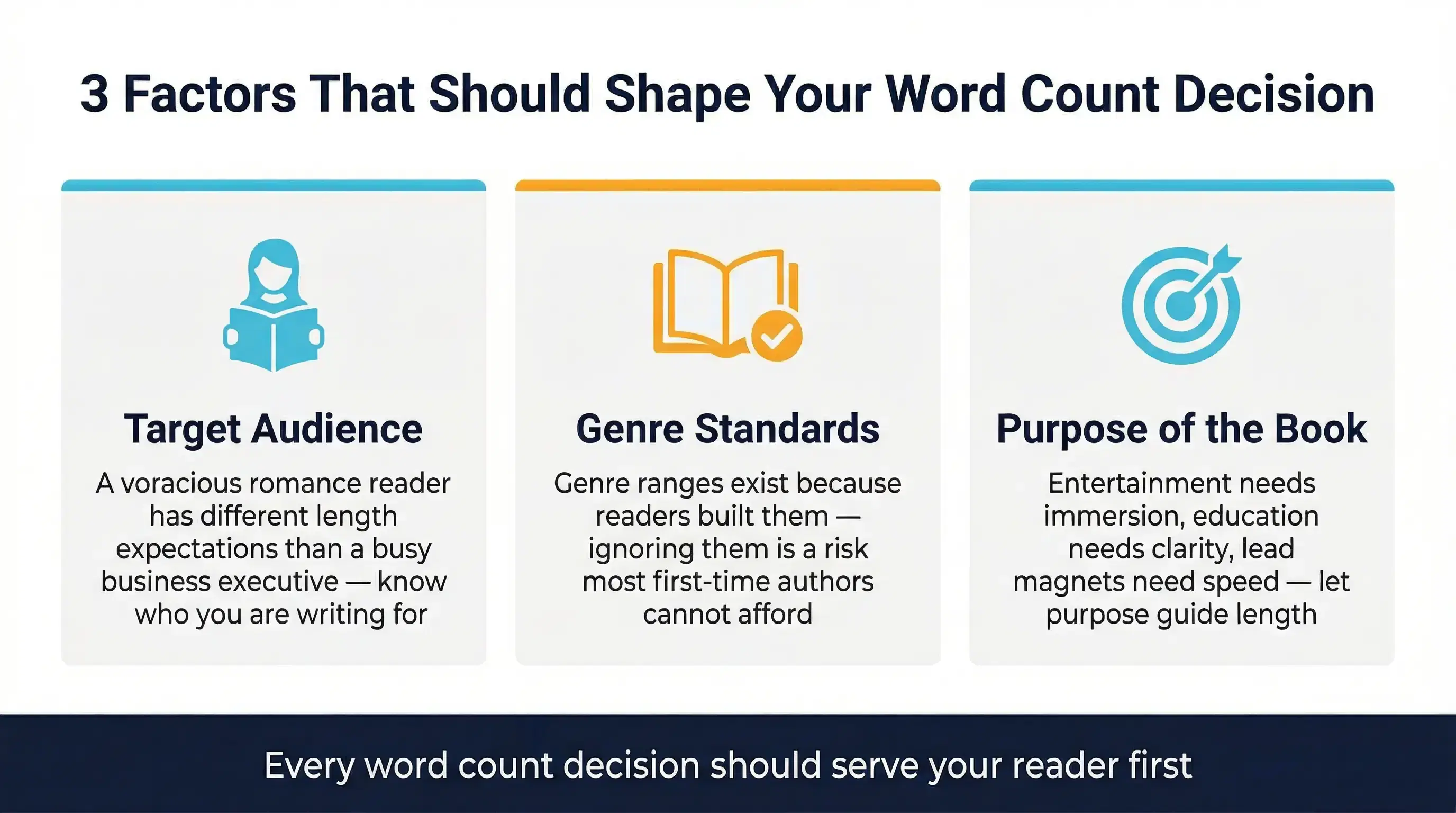
Audience-based word count decisions start with understanding who you're writing for and what they're used to reading. A reader who consumes ten romance novels a month has a deeply calibrated sense of what feels right. A business executive who reads two nonfiction books a year has a very different tolerance for length and density.
Look at the reviews of bestselling books in your genre and pay attention to what readers say about length. You'll find the patterns quickly. Comments like "could have been shorter" or "I wanted more" are direct signals about where the genre standard sits.
Genre Standards
Genre standards aren't arbitrary. They've evolved over decades based on what readers actually finish and enjoy. Ignoring them isn't bold or innovative; it's just risky. First-time authors, in particular, benefit from staying within established ranges because it removes one variable from a process that already has many.
Purpose of the Book
A book designed for entertainment has different length requirements than one designed to educate or one being used as a lead generation tool. Entertainment-focused books need enough length to build immersion. Educational books need enough length to cover the topic thoroughly, but not so much that they become overwhelming. Lead magnets need to be short enough to be consumed quickly but substantial enough to demonstrate real value.
Platform Requirements
Amazon KDP doesn't have a strict minimum word count for ebooks, but books that fall below roughly 10,000 words are often flagged or receive poor reception in certain categories. Word count for self-publishing on KDP also affects your KENP page count in Kindle Unlimited, which directly impacts your earnings if you're enrolled in that program.
Short vs Long eBooks: Which Is Better?
Neither short nor long is inherently better. The right length is the one that serves your reader and your publishing goals. But understanding the tradeoffs helps you make a more intentional decision.
Pros of Short eBooks
Faster to write, edit, and publish, which means you can release more frequently and build your catalog faster.
Lower production costs for editing, formatting, and cover design.
Easier for busy readers to finish, which can lead to better completion rates and more reviews.
Effective as lead magnets, free incentives, or low-cost entry points into a series.
Pros of Long eBooks
More immersive experience, which is what readers in fantasy, thriller, and literary fiction actively seek out.
Higher perceived value, which supports stronger pricing and better royalty margins.
More opportunities for Kindle Unlimited page read earnings if the content keeps readers engaged.
Stronger platform for complex topics that require thorough explanation and multiple frameworks.
Choosing the Right Length for Your Goals
Match your length to your reader's commitment level and your content's actual needs. Don't write 80,000 words because you think longer feels more professional. Don't stop at 30,000 words because you ran out of steam. Write until the story is told or the concept is fully explained, then stop.
How to Decide the Right Word Count for Your eBook
Making a deliberate decision about length before you start writing saves significant time and prevents the frustration of finishing a draft that's either underdeveloped or bloated.
Define Your Reader's Needs
Start by asking what your reader is looking for when they pick up a book in your category. Are they looking for escape and immersion? They want a longer book. Are they looking for a quick answer to a specific problem? They want a shorter one. Building your word count target around reader needs rather than personal preference is the foundation of a book that actually sells.
Analyze Competitor Books
Search the top ten bestselling books in your exact subcategory on Amazon. Look at their page counts and, where available, their word counts. Read their reviews and note any comments about length. This takes about thirty minutes and gives you a data-driven baseline that's far more reliable than any general guideline.
Match Content Depth with Topic
Some topics need more space than others. A book about overcoming procrastination probably doesn't need 80,000 words. A book covering a complete system for building a business from scratch probably does. Let the complexity and scope of your topic guide your length rather than forcing a predetermined word count onto content that either doesn't need it or can't fill it.
Avoid Fluff and Overwriting
Padding word count with repetitive content, unnecessary recaps, or filler examples is one of the fastest ways to generate negative reviews. Readers know when they're being given substance and when they're being given volume. Every paragraph should earn its place. If you're adding content just to reach a number, cut it.
Common Mistakes Authors Make with Word Count
Understanding what not to do is just as valuable as knowing the right targets. These are the patterns that consistently hurt self-published authors.
Writing too short without delivering value: A 12,000-word book priced at $9.99 in a genre where readers expect 60,000 words will generate refund requests and negative reviews within days of launch. Short is fine when the scope justifies it. Short is not fine when it feels like a shortcut.
Overwriting with unnecessary content: The opposite problem is just as damaging. Books that repeat the same ideas across multiple chapters, include long tangents that don't serve the core argument, or pad out scenes with redundant description, create frustrated readers who feel their time was wasted.
Ignoring genre expectations: Writing a 40,000-word epic fantasy or a 120,000-word self-help book signals to readers that the author either doesn't understand their genre or didn't care enough to research it. Both impressions are hard to recover from.
Not editing for clarity and structure: Word count decisions made without an editorial perspective often result in books that are the right length on paper but wrong in execution. A book can hit 80,000 words and still feel unfinished if the structure is loose and the pacing is off.
How Professional Editing Helps Optimize Your eBook Length
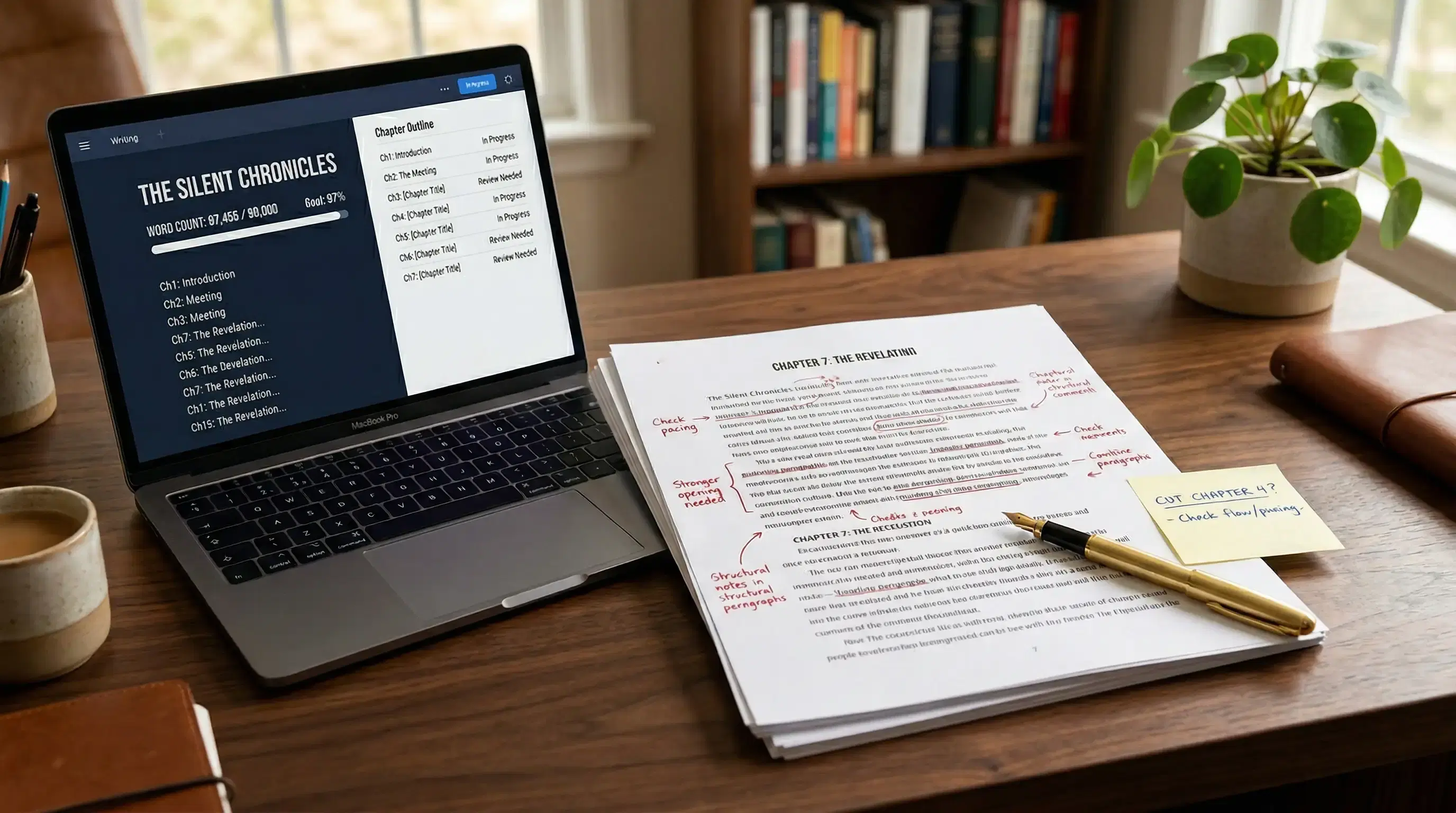
This is where many self-published authors leave significant value on the table. Ebook editing services aren't just about fixing grammar. Professional editors actively shape your book's length and structure in ways that directly impact reader experience and sales.
Removing Unnecessary Content
A developmental editor's job includes identifying everything in your manuscript that isn't pulling its weight. Scenes that don't advance the plot, arguments that repeat points already made, and chapters that exist because the author liked them but don't serve the reader's journey. Removing this content almost always makes a book better, even when it reduces the word count.
Improving Clarity and Flow
Books that are difficult to read feel longer than they are. Books that flow naturally feel shorter. A skilled copy editor improves sentence-level clarity, eliminates clunky transitions, and ensures that each chapter moves naturally into the next. This work doesn't add or remove many words, but it dramatically changes how readers experience the length of a book.
Ensuring Proper Pacing
Pacing is the relationship between what's happening in the story or argument and how quickly the book moves through it. A thriller that slows down in the middle third loses readers. A business book that rushes through its core framework in a single chapter leaves readers feeling underprepared to apply it. Professional editors identify and fix these structural issues so that every section of your book moves at exactly the right speed.
Ebook Word Count and Amazon KDP Guidelines
Amazon doesn't publish a strict official word count requirement, but there are practical guidelines that any author using the platform needs to understand before publishing.
Minimum and Recommended Lengths
KDP will technically accept books with very few pages, but books under 2,500 words are often categorized as short reads and receive different treatment in search and recommendations. For most genres, aiming for at least 10,000 words is a practical minimum if you want your book to be taken seriously. Authors targeting Kindle Unlimited should note that KENP page counts are not a word count. Amazon normalizes each book to a standard font, line height and page width and does not publish a words-per-page conversion, so two books of identical length can return different KENP totals. Treat any specific words-per-page figure you see quoted as an estimate rather than an Amazon specification.
Impact on Pricing and Royalties
Amazon's 70% royalty option requires a list price between $2.99 and $12.99 on Amazon.com. KDP raised that upper limit from $9.99 effective 7 July 2026, so older guides still quoting a $9.99 ceiling are out of date (KDP eBook list price requirements, checked 14 August 2026). Titles priced outside that band fall to the 35% option. Word count doesn't directly determine which royalty tier you qualify for, but it influences what price point readers will accept, which in turn affects your royalty earnings. A 10,000-word short read priced at $2.99 earns 70% royalties. The same content priced at $9.99 will likely underperform because the perceived value doesn't match the price.
Page Count vs Word Count Considerations
Book length vs word count becomes particularly relevant on KDP because the platform uses page count rather than word count for Kindle Unlimited calculations. Note what does and does not affect that count: KENP is measured from a normalized rendering, so the font size, line height and margins you choose are standardised away and cannot inflate it. Images and other non-text content do add to it, so an illustrated book will return more KENP pages than a plain text book of the same word count. Understanding this relationship helps you make smarter formatting decisions that maximize your KU earnings without misleading readers.
Why Word Count Matters for Marketing and Sales
The connection between word count and commercial performance is more direct than most authors realize. Getting this right doesn't just make readers happy. It affects your pricing, your reviews, and your conversion rate.
Reader Expectations and Reviews
Amazon reviews are the most powerful form of social proof in self-publishing. A book that consistently meets or exceeds reader expectations for its genre earns four and five-star reviews that compound over time and drive ongoing sales. A book that consistently disappoints readers on length, in either direction, accumulates negative reviews that suppress future sales no matter how much advertising you run.
Pricing Strategy Alignment
Your word count should support your pricing strategy. Short ebooks work best at lower price points ($0.99 to $2.99). Mid-length ebooks support standard pricing ($2.99 to $4.99). Full-length novels and comprehensive nonfiction can justify $4.99 to $9.99 and above. When your price and your length are misaligned, conversion suffers.
Conversion Impact
Look Inside previews on Amazon show potential buyers the first 10% of your book. If your book is 60,000 words, that's 6,000 words of preview. If it's 15,000 words, that's only 1,500 words. Readers browsing in your genre use these previews to gauge whether a book feels complete and worthwhile. A longer, well-written book generally converts better from preview to purchase because it demonstrates more value before the reader has to commit.
How Best Selling Publisher Helps You Get the Perfect eBook Length
Getting your word count right is one piece of a much larger puzzle, and it's one that's much easier to solve when you have experienced people in your corner. At Best Selling Publisher, word count decisions are built into our publishing process from the very beginning, not bolted on as an afterthought.
Professional Editing and Structuring
Our editorial team works with manuscripts across every major genre, and that breadth of experience means we know exactly where your book stands relative to market standards. Whether your draft needs significant development or precise trimming, our ebook editing services will bring it to the right length without sacrificing the quality of your content.
Market Research and Positioning
Before we make any recommendations about length, we analyze what's performing in your specific subcategory right now. That means looking at bestseller word counts, reader review patterns, pricing trends, and competitive positioning. Every length recommendation we make is backed by current market data, not generic guidelines.
Genre-Specific Guidance
Our team includes specialists across fiction, nonfiction, children's publishing, and business writing. When you work with us, you're getting guidance from people who understand the nuances of your specific genre, not just general self-publishing advice. That specificity makes a real difference when it comes to decisions like word count, chapter structure, and pacing.
End-to-End Publishing Support
From your first manuscript review through launch and beyond, ourfull-service ebook publishing service covers every aspect of the publishing process. That includes not just word count guidance but cover design, metadata optimization, Amazon SEO, and marketing strategy. Our professional author support means you never have to figure out the complicated parts alone.
Our book marketing service is built to put your book in front of the readers who are looking for it, once it is the right length and the right quality. Reach and results still depend on the platforms you choose and on market response.
FAQs
It depends on your genre. Fiction generally runs between 70,000 and 100,000 words. Non-fiction typically falls between 40,000 and 80,000. Romance averages 50,000 to 90,000 words. For a genre-specific breakdown, refer to the table in the overview section above.
There's no hard technical minimum on most platforms, but books under 10,000 words are often treated as short reads and face different reader expectations and category placement. For a book to be priced and positioned as a standard ebook in most genres, 15,000 words is a reasonable, practical minimum.
Yes, absolutely. Overlong ebooks that pad their word count with repetitive or low-value content consistently earn negative reviews. Readers in every genre have a calibrated sense of how long a book in their category should be, and exceeding that expectation significantly, without the quality to justify it, is a real commercial risk.
Indirectly, yes. Word count affects what price point readers will accept, which in turn affects which royalty tier your book qualifies for on Amazon. A very short ebook priced aggressively will struggle to convert, even if the content is excellent. Aligning your length, quality, and price is essential for a strong sales performance.
For fiction, aim for the middle of your genre's standard range, around 80,000 to 90,000 words for most categories. For nonfiction, 40,000 to 50,000 words is a solid starting point that gives you enough space to deliver real value without the risk of overwriting. Most importantly, don't add or remove words to hit a target. Write the book that the topic or story requires, then use the genre benchmarks as a sanity check.