
How History Books Take You Inside the Moments That Defined Human Civilization
History books don’t just tell you what happened, they put you in the room where it happened.
Think about what that means for a moment. The decisions made in a tent outside Gettysburg in July 1863 shaped a nation that still exists today. The conversations in a Paris conference room in 1919 drew borders that caused wars a century later. The choices made by a handful of scientists in a laboratory in 1945 changed the nature of human civilization permanently. These moments did not happen in textbooks. They happened to real human beings, people who were afraid, uncertain, ambitious, flawed, and brilliant in ways that feel startlingly familiar when a great history writer brings them to life.
Great history books are the most underrated genre in all of non-fiction, and the decision to publish history books is a decision to contribute to one of the most important forms of storytelling available to any writer. They are underrated because most people’s experience of history is school, dates, names, causes, and effects presented as dry facts to be memorized and forgotten. And because school history felt like that, many people assume that history itself is like that. It is not. Great history writing is as gripping as the best thriller, as emotionally involving as the best memoir, and as intellectually rewarding as the best philosophy. In this guide, we are going to show you exactly why.
Why History Books Read Nothing Like Your School Textbooks
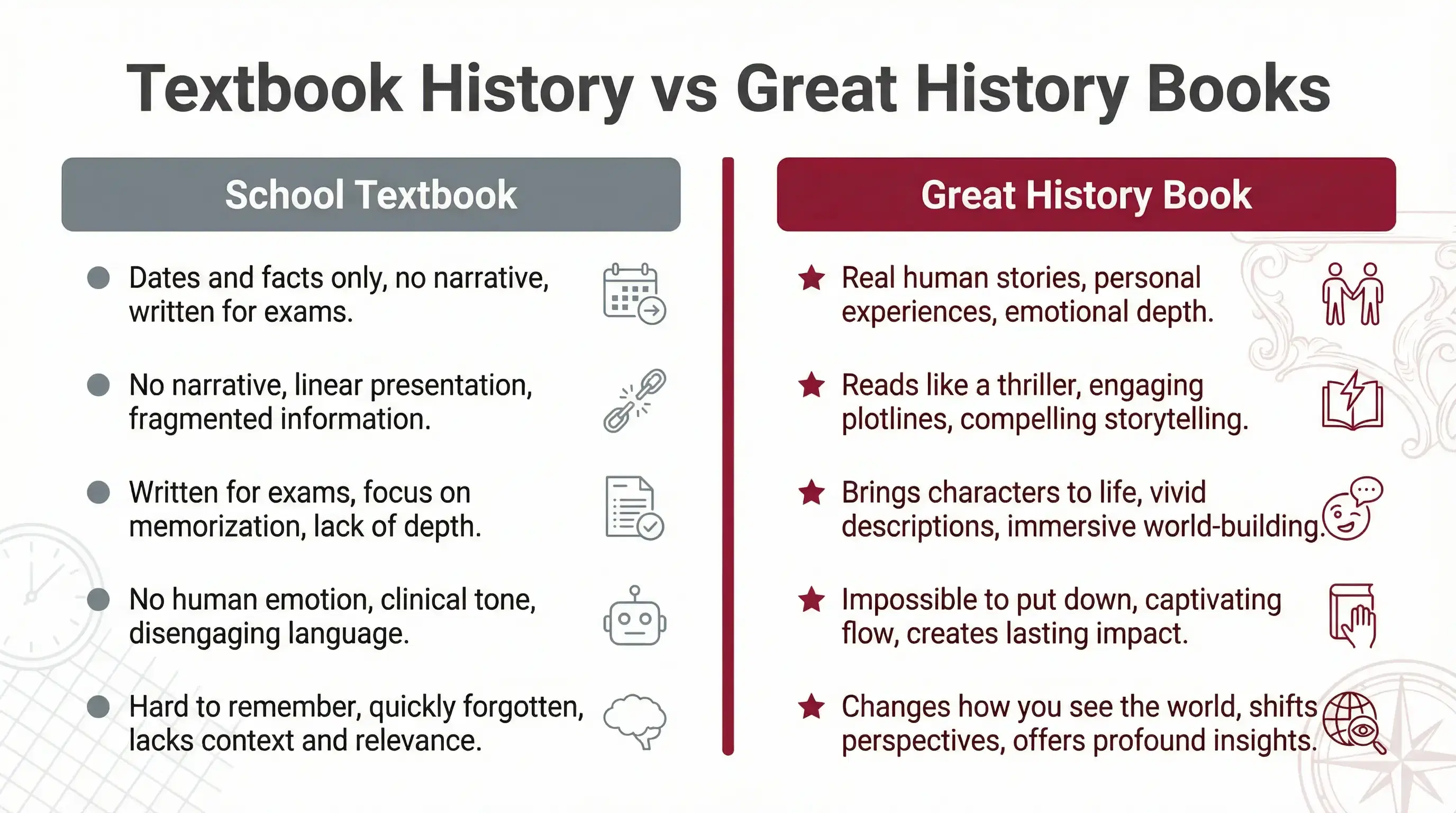
The fundamental difference between a school textbook and a great history book is the difference between a list of facts and a story, and understanding this difference is essential for anyone looking to publish a history book that genuinely reaches readers. Textbooks are written to transfer information efficiently across a broad curriculum. They need to cover everything, which means they can go deep on nothing. They present events in sequence, assign causes and effects, and move on. By design, they cannot afford to stop and show you what it actually felt like to be there.
Great history writers do something completely different. They choose a moment, a person, or an event and they go all the way in. They research not just what happened but what it felt like, the weather on the day of a decisive battle, the words exchanged in a room where history was being made, the fear and exhilaration and moral confusion of the people who were living through it. They write with the narrative craft of novelists, building tension, developing characters, and structuring revelations so that the reader experiences the unfolding of events rather than simply being informed of their outcome.
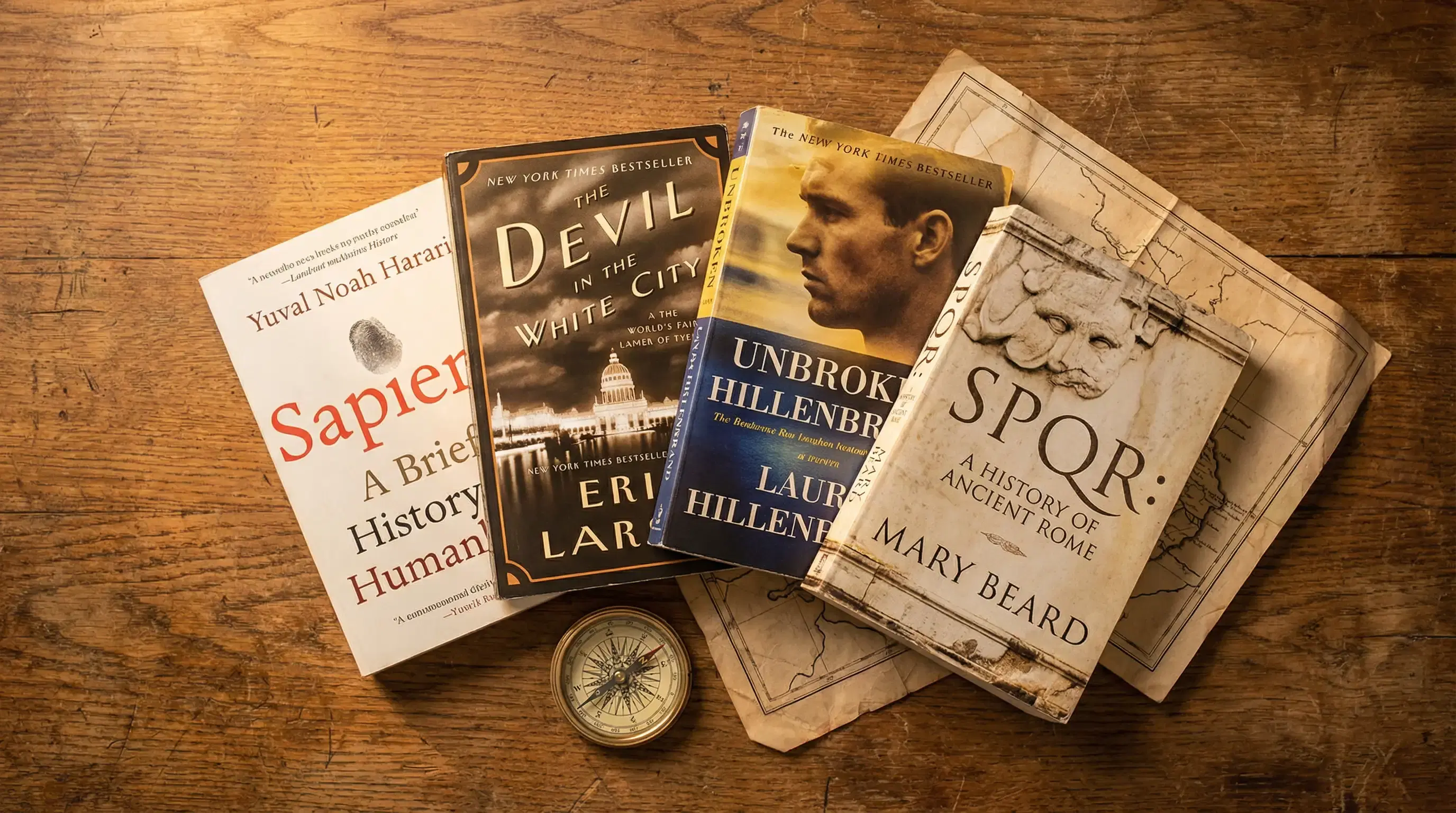
Erik Larson is one of the masters of this form. His book The Devil in the White City weaves together two true stories, the construction of the 1893 World’s Columbian Exposition in Chicago and the murders of a serial killer who used the Fair as his hunting ground, with a narrative skill that makes it read like the most gripping thriller ever written. Every person in the book was real and nothing in quotation marks is invented, though Larson is open in his notes that the chapters reconstructing the killer’s crimes are extrapolated from a thin record. And yet the experience of reading it is completely unlike anything a textbook could deliver. That is the difference. That is what great history writing does that school history never could.
What Great History Books Actually Give You
The most immediate gift of a great history book is a front-row seat to the moments that changed the world. This is not a small thing. Most of us will never be present at a moment of genuine historical significance. But a history book, written with sufficient craft and depth, can make you feel as though you are standing in the room, as though the outcome is not yet determined, as though you are witnessing events unfold in real time rather than reading about their resolution.
But great history books give you something even more valuable than the vicarious experience of being there. They give you the understanding of why the world looks the way it does today. The political borders you take for granted, the economic systems you live within, the cultural assumptions you have inherited without examining, all of these have histories. They were created by specific decisions made by specific people at specific moments. Understanding those decisions and those moments is the only way to truly understand the present.
History books also reveal something that is both humbling and deeply reassuring, the patterns in human behavior that repeat across centuries. The same ambitions, the same fears, the same moral failures and the same moments of extraordinary courage appear again and again across completely different cultures and completely different eras. People who have read widely in history develop a particular kind of perspective, a longer view of events, a greater tolerance for complexity, a recognition that the crises of the present, as urgent as they feel, are part of a much larger story that humanity has been navigating for a very long time.
Studies consistently show that people who read history make better decisions in their own lives, not because history provides direct templates to follow, but because it expands the range of scenarios a person has mentally rehearsed. Seeing how leaders throughout history have handled crisis, opportunity, and moral complexity gives the historically informed reader a richer set of frameworks for navigating their own.
The Different Ways History Books Tell Their Stories
One of the revelations for readers who are new to narrative history is how varied the genre actually is. History books do not all tell their stories the same way, and the different approaches offer completely different reading experiences, each with its own particular pleasures.
The Single Person Story
Some of the most gripping history books follow one real human being through a defining historical moment, using their life as a lens through which the entire era becomes visible. Laura Hillenbrand’s Unbroken is perhaps the supreme example, the story of Louis Zamperini, an Olympic athlete who survived as a prisoner of war in Japan during World War II, told with such narrative intensity that readers regularly describe it as the most gripping book they have ever read. The historical forces of the 20th century, the Depression, the war, the brutality of the Pacific theatre, all become viscerally real through the experience of one man.
The Big Picture Story
Other history books zoom out to cover entire civilizations, centuries, or sweeping eras, trading the intimacy of the single-person story for the extraordinary intellectual satisfaction of seeing the large patterns of human history clearly. Yuval Noah Harari’s Sapiens is the defining example of this form in the modern era, a book that covers the entire history of the human species from the cognitive revolution to the present day, and does so with such clarity and such audacious confidence that readers finish it feeling as though they have genuinely understood something fundamental about the human story for the first time.
The Deep Dive
Some history books take a single event and go extraordinarily deep, examining every angle, every participant, every decision point, until the reader understands that event with a completeness that feels almost like having been there. The same instinct can be turned on a whole society rather than a single event: Mary Beard’s SPQR sweeps across nearly a thousand years of Rome and gives as much weight to class, citizenship and the lives of ordinary Romans as to emperors and battles, and it is scholarly and rewarding in exactly the same way.
History Meets Today
The most urgent history books are those that connect what happened in the past to what is happening in the world right now, books that use historical analysis to illuminate present-day politics, economics, or culture in ways that make the contemporary world suddenly comprehensible in a new way. These books do not just teach history. They teach you how to read the present through a historical lens, which is one of the most powerful intellectual skills any person can develop.
The History Books That Every Curious Person Should Read
The Single Person Story
Some of the most gripping history books follow one real human being through a defining historical moment, using their life as a lens through which the entire era becomes visible. Laura Hillenbrand’s Unbroken is perhaps the supreme example, the story of Louis Zamperini, an Olympic athlete who survived as a prisoner of war in Japan during World War II, told with such narrative intensity that readers regularly describe it as the most gripping book they have ever read. The historical forces of the 20th century, the Depression, the war, the brutality of the Pacific theatre, all become viscerally real through the experience of one man.
The Big Picture Story
Other history books zoom out to cover entire civilizations, centuries, or sweeping eras, trading the intimacy of the single-person story for the extraordinary intellectual satisfaction of seeing the large patterns of human history clearly. Yuval Noah Harari’s Sapiens is the defining example of this form in the modern era, a book that covers the entire history of the human species from the cognitive revolution to the present day, and does so with such clarity and such audacious confidence that readers finish it feeling as though they have genuinely understood something fundamental about the human story for the first time.
The Deep Dive
Some history books take a single event and go extraordinarily deep, examining every angle, every participant, every decision point, until the reader understands that event with a completeness that feels almost like having been there. The same instinct can be turned on a whole society rather than a single event: Mary Beard’s SPQR sweeps across nearly a thousand years of Rome and gives as much weight to class, citizenship and the lives of ordinary Romans as to emperors and battles, and it is scholarly and rewarding in exactly the same way.
History Meets Today
The most urgent history books are those that connect what happened in the past to what is happening in the world right now, books that use historical analysis to illuminate present-day politics, economics, or culture in ways that make the contemporary world suddenly comprehensible in a new way. These books do not just teach history. They teach you how to read the present through a historical lens, which is one of the most powerful intellectual skills any person can develop.
The People Who Make History Books Impossible to Put Down
Here is something that most people do not fully appreciate until they have read widely in history: real historical figures are more fascinating than any fictional character ever invented. This is not simply because their stories are true, though that matters. It is because the constraints of reality, the pressures, the contradictions, the consequences they could not escape, produce characters of a complexity and a vividness that fiction rarely achieves.
Alexander Hamilton was an illegitimate immigrant orphan who became the most influential figure in the creation of the American financial system, and who died in a duel with the sitting Vice President of the United States. Marie Curie won two Nobel Prizes in two different sciences, was denied membership in the French Academy of Sciences because she was a woman, and died of the radiation that her own discoveries had made possible. Winston Churchill spent the 1930s written off as a spent force, out of office and ignored on rearmament, after three decades of senior posts including the Admiralty and the Exchequer, before becoming the leader who arguably saved Western civilization during its most dangerous hour.
The great history writers understand that their subjects are not icons or symbols, they are human beings with all the complexity that implies. The best historical biographies show you the ambition and the self-doubt, the brilliant decisions and the catastrophic mistakes, the private vulnerabilities behind the public achievements. And because these people were real, because their choices had consequences that ripple forward to the present day, learning about them does something that purely fictional characters cannot do. It changes how you see yourself in relation to history, and how you think about your own capacity to do something that matters.
How History Books Are Reaching a Whole New Generation of Readers
Something significant is happening in history publishing in 2026. The demand for history book publishing services has grown alongside a cultural moment in which history is reaching a new generation of readers after decades of being perceived as the preserve of older, traditionally bookish audiences. A new generation of readers, younger, more diverse, and more digitally native than any previous history-reading audience, is discovering the genre through channels that simply did not exist a decade ago.
History podcasts have been enormously influential in this shift. Shows like Hardcore History by Dan Carlin, which presents history in long-form, deeply researched, passionately delivered episodes that can run to six hours or more, have built audiences of millions of listeners who then go looking for the books that go even deeper into the stories they have just discovered. The Revolutions podcast by Mike Duncan, which covers the major political revolutions in Western history in careful detail, has similarly driven readers to the history books that cover the same ground.
History content on YouTube has brought the genre to audiences who might never have walked into a bookshop looking for a history book. Channels that dramatize historical events, present historical debates in accessible formats, or explore the hidden stories behind familiar history have collectively built audiences of tens of millions of viewers, and those viewers are hungry for more depth than a fifteen-minute video can provide. The book is still the place where history lives most fully, and the new digital history audiences are discovering this rapidly.
How to Find the Right History Book for You
The best way to find the right history book is to start with what already fascinates you, because the most powerful entry point into the genre is a subject that you already have a personal connection to, however small.
If you are fascinated by questions about why human civilization developed the way it did, why some societies became dominant while others did not, why we live in the world we live in rather than some completely different one, start with Sapiens by Yuval Noah Harari. It is the most ambitious and most rewarding starting point available for the reader who wants to understand the big picture of the human story.
If you want the experience of being completely inside a story, of reading history that feels as urgent and as immediate as the best thriller, start with Unbroken by Laura Hillenbrand or The Devil in the White City by Erik Larson. Both are accessible to readers with no previous history reading experience and both have converted more people to the genre than almost any other books in recent memory.
And if you have a specific period, place, or figure that you already find interesting, a chapter of history that you know you want to understand more deeply, start there. The specific always leads to the general in history reading. One great book about the Roman Empire leads to another and another, and before long you find yourself with a rich understanding of how a civilization builds itself, sustains itself, and eventually falls, and why it still matters.
How Best Selling Publisher Publishes History Books
History books present a particular set of publishing challenges, and opportunities, that require a specific kind of expertise to handle well.
The most important challenge for any author who decides to publish a history book is accuracy. History readers are knowledgeable, and they hold history authors to a high standard of factual reliability. A history book that contains errors, even minor ones, loses credibility with its audience immediately, and that lost credibility is nearly impossible to recover. Our editing process for history manuscripts includes rigorous fact-checking and consistency review to ensure that your research is presented accurately and that your argument is built on a foundation that readers can trust completely.
Cover design for history books requires understanding the visual language of the genre, how to signal the specific period, place, or approach of a history book through imagery, typography, and color in ways that immediately communicate to the right reader that this is the book they have been looking for. Our design team brings genuine genre knowledge to this challenge.
We also handle Amazon KDP setup and keyword optimization specifically for history titles, because history is a broad category and positioning your book correctly within it is the difference between reaching your specific audience and being lost in the noise. Authors work with Best Selling Publisher with their stories. We would love to help your history reach the readers who are waiting for it.
Conclusion
Understanding history is one of the most valuable things a person can do, not as an academic exercise, but as a practical tool for navigating the present. The patterns of human behavior, the dynamics of power and resistance, the way that decisions compound over decades and centuries into outcomes no one intended, all of this becomes visible to the person who reads widely in history. And that visibility is genuinely useful in a world that often feels chaotic and unpredictable, because it reveals that the chaos has structure, that the patterns have precedents, and that human beings have navigated moments this complex before.
There is also a particular feeling that comes from finishing a great history book, the feeling of seeing the present differently. The street you walk down every day, the political debate you hear on the radio, the economic forces that shape your choices, all of these look different when you understand the history that produced them. That shift in perspective is the unique gift of history reading, and it accumulates with every book you read.
FAQs
Working with a professional publishing partner who offers dedicated history book publishing services is the most effective route for most authors who want to publish a history book. Best Selling Publisher provides complete history book publishing services, from manuscript editing and fact-checking support to cover design, Amazon KDP publishing, and targeted marketing that reaches readers who are already passionate about the period or subject your book covers. Contact our team to learn how we can help your history reach its audience.
A textbook is designed to transfer broad factual information efficiently across a curriculum. A history book written for general readers prioritizes narrative, character, and the human experience of historical events. Where a textbook tells you that something happened and why it mattered, a great history book makes you feel as though you are witnessing it unfold, through the eyes of real people who were living through events they did not fully understand, just as we live through our own historical moment without fully understanding it.
Narrative non-fiction is the term used for factually accurate writing that employs the structural techniques of storytelling, character development, scene-setting, tension, pacing, and revelation. In history writing, it describes books that present real events with the narrative craft of a novelist while maintaining the factual accuracy of a journalist or scholar. Erik Larson, Laura Hillenbrand, David McCullough, and Ron Chernow are among the most celebrated practitioners of this form. The result is history that reads like a page-turner rather than an academic text.
History books vary considerably in length depending on their scope and approach. Narrative history books focused on a single event or person typically run between 80,000 and 120,000 words. Broader sweeping histories, like Sapiens, can run longer, while shorter, more focused works can be considerably briefer. The appropriate length is determined entirely by the scope of the subject and the depth of the research; a history book should be as long as it needs to be to tell its story completely and no longer.