
How Fantasy Books Build Entire Worlds That Readers Never Want to Leave
No other genre asks its readers to believe in the impossible, and no other genre makes it so easy.
Think about that for a moment. When you open a fantasy novel, you are being asked to accept things that cannot exist, dragons that breathe fire, magic systems governed by laws no physicist would recognize, kingdoms built on lands that appear on no map. And yet within a few pages, readers do not just accept these things. They believe in them completely. They worry about the characters who live in these worlds. They feel the cold of the dungeons and the heat of the dragon’s breath and the ache of a love that spans centuries. They finish the last page and sit quietly for a moment, grieving that it is over.
This is what fantasy books do that no other genre quite manages. They do not just tell you a story. They build you an entire world and invite you to live inside it for a while. And the worlds they build, from the rolling green hills of the Shire to the deadly politics of King’s Landing to the glittering courts of the fae, have a way of staying with readers long after the book is finished. Sometimes for years. Sometimes forever.
In this guide, we are going to explore everything that makes fantasy the most imaginatively powerful genre in publishing, including what it means to publish fantasy book in a market where reader demand has never been higher, its history, its extraordinary variety, the books that have defined it, and exactly where to start if you want to discover it for yourself. Whether you have been reading fantasy your entire life or you have never picked up a fantasy novel, by the end of this you will understand why hundreds of millions of readers around the world keep disappearing into these impossible worlds again and again.
Why Fantasy Books Pull You In Like Nothing Else
There is a word that critics of fantasy fiction like to use when they want to dismiss the genre: escapism. As if escaping is something to be ashamed of. As if the desire to leave your ordinary world for a few hours and inhabit a completely different one is a weakness rather than one of the most deeply human impulses in existence.
Human beings have always needed stories that take them somewhere else. Long before books existed, people sat around fires and listened to tales of gods and monsters, heroes and quests, magical objects and impossible journeys. These were not stories about the world as it was. They were stories about the world as it could be, or as it was feared to be, or as it was hoped to be. Fantasy is simply the modern continuation of that ancient, essential tradition.
What makes fantasy books so uniquely powerful as a form of escapism is the totality of the world they create. A contemporary novel takes you to a different city or a different life, but you are still operating within the same physical reality, the same laws of nature, the same basic social structures, the same fundamental constraints. A fantasy novel builds reality from scratch. The rules of physics may not apply. The political structures may be entirely alien. The moral landscape may be completely different from anything you have encountered before. And somehow, through the craft of the author and the willing imagination of the reader, this invented reality becomes as vivid and as emotionally real as anything in the reader’s own life.
This is why fantasy readers feel genuine grief when a beloved series ends. They are not mourning the loss of a story. They are mourning the loss of a world, a place they have been visiting regularly, a place where they have friends, a place that has felt, while they were inside it, as real as anywhere they have ever been.
How Fantasy Went From Fairy Tales to a Global Publishing Force
Fantasy fiction has the longest history of any genre in literature, because human beings have been telling fantasy stories since before literature existed. The myths of ancient Greece, the Norse sagas, the tales of King Arthur and his knights, the stories of Scheherazade in One Thousand and One Nights, all of these are fantasy, in the sense that they describe worlds where magic is real, where gods walk among mortals, where the impossible is simply another Tuesday.
But modern fantasy as a published genre really begins with one man: J.R.R. Tolkien. When The Hobbit was published in 1937 and The Lord of the Rings followed between 1954 and 1955, Tolkien did something that had never quite been done before. He did not just write a fantasy story. He built an entire world, with its own history stretching back thousands of years, its own languages complete with grammar and vocabulary, its own geography mapped to the last river and mountain range, its own mythology and cosmology and cultures. Middle-earth was not a backdrop for a story. It was a world in which a story happened to take place.
Tolkien established a template for what epic fantasy could be, and the writers who came after him, Ursula K. Le Guin, Terry Brooks, Robert Jordan, George R.R. Martin, each took that template and pushed it in new directions. Le Guin brought anthropological depth and feminist consciousness to fantasy with her Earthsea series. Martin brought moral complexity and political realism to the genre with A Song of Ice and Fire, proving that fantasy could hold the same weight and darkness as the greatest literary fiction.
Then came Harry Potter. When J.K. Rowling’s series began in 1997, it did something that even Tolkien had not quite managed, it introduced an entire generation to the joy of fantasy reading simultaneously, across the entire world, with a speed and intensity that publishing had never seen before. Children who had never been readers became readers for Harry Potter. Adults who had dismissed fantasy as children’s entertainment found themselves queuing at midnight for the next installment. The cultural impact of Harry Potter on fantasy publishing is almost impossible to overstate.
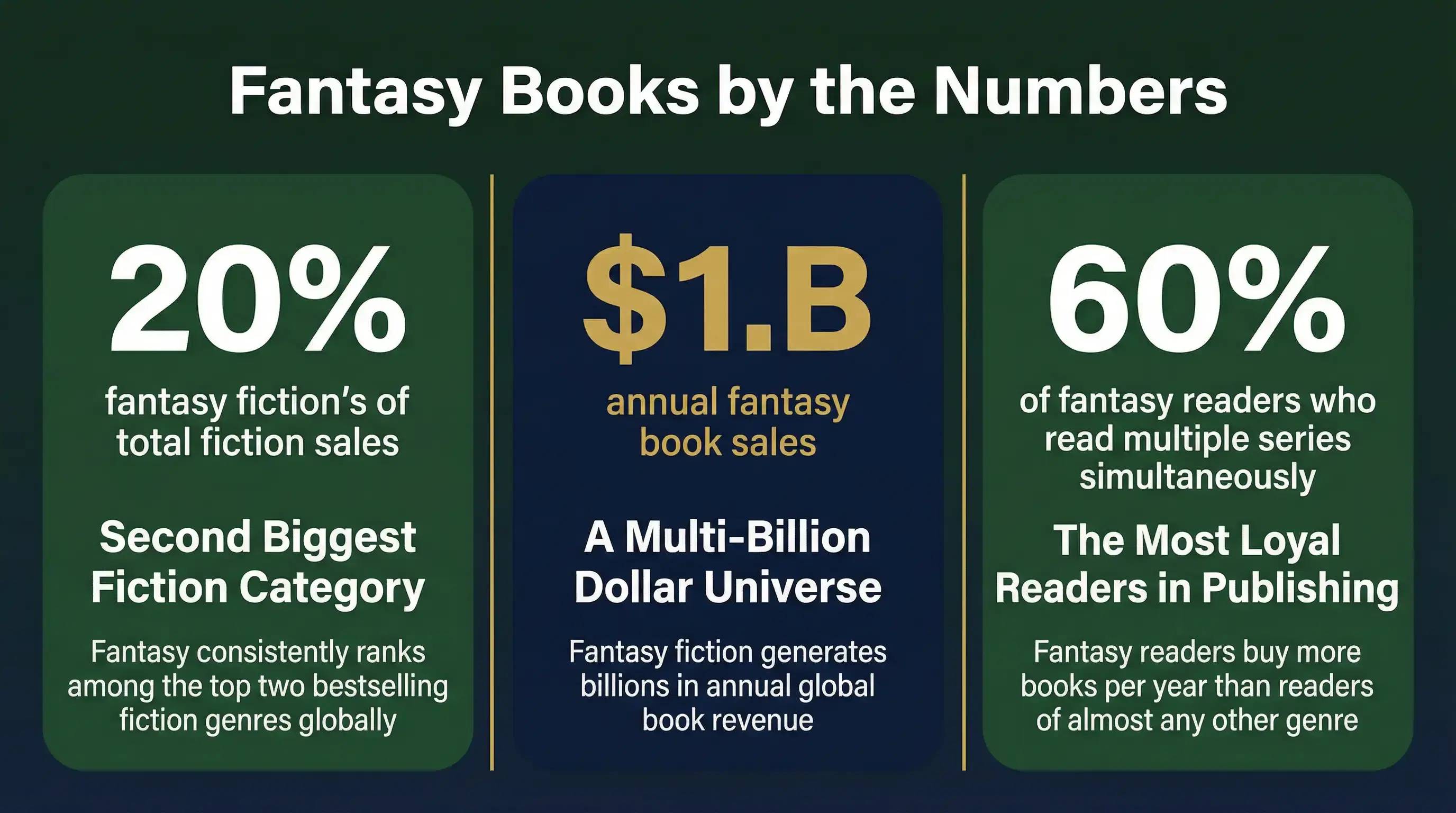
Today, fantasy is one of the biggest and fastest growing genres in global publishing, and authors seeking fantasy book publishing services are entering a market with some of the most passionate and loyal readers in all of fiction. The rise of romantasy, the combination of epic fantasy world-building with emotionally satisfying romance, has brought millions of new readers into the genre in the 2020s. Authors like Sarah J. Maas, Brandon Sanderson, and Rebecca Yarros are regularly appearing at the very top of global bestseller lists. Fantasy is no longer a niche. It is a juggernaut.
The Many Different Worlds Fantasy Takes You To
One of the things that surprises people who are new to fantasy fiction is just how much variety lives inside this one genre. Fantasy is not one kind of story, it is a vast landscape of different worlds, different tones, different emotional experiences, each with its own devoted community of readers.
Epic Fantasy
This is the grand, sweeping fantasy of Tolkien and Martin, stories set in fully realized secondary worlds with complex histories, multiple cultures, political intrigue, and stakes that involve the fate of entire civilizations. Epic fantasy tends to be long and series-based, because the worlds it builds are too large and too rich to fit into a single volume. J.R.R. Tolkien’s The Lord of the Rings is the founding text. George R.R. Martin’s A Song of Ice and Fire is its greatest modern heir. Brandon Sanderson’s Stormlight Archive series is the current gold standard of epic world-building.
Urban Fantasy
Urban fantasy brings magic into the real world, usually a contemporary city where vampires, werewolves, witches, and fae exist alongside ordinary human beings, sometimes hidden, sometimes not. Neil Gaiman’s American Gods, which imagines the old gods of human mythology surviving in modern America, is perhaps the most celebrated example of the form. Cassandra Clare’s The Mortal Instruments series brought urban fantasy to a new generation of younger readers, creating one of the most devoted fan communities in the history of the genre.
Romantasy
Romantasy, the combination of fantasy world-building and deeply satisfying romance, is arguably the most talked-about development in all of publishing right now. Sarah J. Maas’s A Court of Thorns and Roses series essentially created the modern romantasy phenomenon, proving that epic fantasy and deeply felt romance are not just compatible, they make each other better. Rebecca Yarros’s Fourth Wing has become one of the fastest-selling fantasy novels in publishing history, demonstrating the explosive commercial power of romantasy done right.
Dark Fantasy and Grimdark
Dark fantasy and its close cousin grimdark take the genre into morally complex, often brutal territory. Heroes are not always heroic. Good and evil are not always clearly defined. Violence has real consequences. Joe Abercrombie’s The First Law series is the defining text of grimdark, a fantasy world where the characters you root for are deeply flawed and the world rewards neither virtue nor courage with any particular consistency. It is uncomfortable reading. It is also some of the most gripping and honest fantasy fiction ever written.
Middle Grade and Young Adult Fantasy
Fantasy has always had a particularly powerful relationship with younger readers, and the young adult and middle grade categories contain some of the genre’s most beloved books. Harry Potter is the obvious example, but Philip Pullman’s His Dark Materials trilogy, Rick Riordan’s Percy Jackson series, and Leigh Bardugo’s Six of Crows duology have each created enormous readerships and introduced millions of young people to the lifelong pleasure of fantasy fiction. What is notable about the best YA fantasy is that it tends to be enjoyed just as enthusiastically by adult readers as by the younger audience it was written for.
The Fantasy Books That Built an Entire Generation of Readers
Fantasy fiction has produced some of the most beloved and widely read books in the history of publishing. The titles below represent the very best of what this genre can deliver, from the foundational classics that built the genre to the modern novels that are creating a new generation of devoted readers right now.
The Lord of the Rings by J.R.R. Tolkien
The book that created modern fantasy as we know it. Frodo Baggins inherits a ring that turns out to be the most dangerous object in the world, and is tasked with destroying it in the one place where it can be unmade. The journey across Middle-earth, through ancient forests, underground kingdoms, cities under siege, and finally the volcanic heart of darkness itself, is one of the great narrative achievements in all of literature. Everything in fantasy that came after owes something to Tolkien.
Harry Potter and the Philosopher’s Stone by J.K. Rowling
An orphan boy discovers on his eleventh birthday that he is a wizard, and that there is an entire magical world hidden inside the ordinary one. What follows, across seven books, is one of the most complete, most emotionally satisfying reading experiences in the history of the genre. Hogwarts is arguably the most vividly realized fictional institution ever created, and the series’ exploration of friendship, loss, courage, and the nature of evil has shaped the moral imagination of an entire generation.
A Game of Thrones by George R.R. Martin
Seven noble families fight for control of the Iron Throne while an ancient enemy stirs beyond the northern border. Martin’s decision to kill characters the reader loves, heroes, protagonists, characters who in any other fantasy would have been guaranteed to survive, was genuinely shocking when the series began and remains one of the most powerful tools in his storytelling arsenal. A Game of Thrones proved that fantasy could be as morally complex, as politically sophisticated, and as emotionally devastating as any literary fiction.
A Court of Thorns and Roses by Sarah J. Maas
When mortal huntress Feyre kills a wolf in the woods, she is taken prisoner into the magical land of the fae. What begins as a retelling of Beauty and the Beast becomes something far darker, more complex, and more emotionally consuming. Sarah J. Maas essentially launched the modern romantasy genre with this series, and its combination of lush world-building, morally complicated characters, and deeply felt romance has made it one of the defining reading phenomena of the 2020s.
The Name of the Wind by Patrick Rothfuss
The story of Kvothe, the most famous wizard, musician, and warrior of his age, told in his own words from a quiet inn where he is hiding from his own legend. The Name of the Wind has prose of an almost musical beauty, a magic system of extraordinary elegance, and a protagonist whose voice is so distinctive and so compelling that readers who have finished the book describe missing him the way you miss a person. It is widely considered one of the finest fantasy novels of the 21st century.
Fourth Wing by Rebecca Yarros
Violet Sorrengail was supposed to join the Scribes. Instead she is assigned to the Riders, the most elite and most dangerous division of the war college, where students bond with dragons or die trying. Fourth Wing became one of the fastest-selling fantasy novels in publishing history and introduced the romantasy genre to millions of readers who might otherwise never have discovered it. It is compulsively readable, emotionally intense, and genuinely impossible to put down.
American Gods by Neil Gaiman
Shadow Moon is released from prison to find his wife has died, and is hired as a bodyguard by the mysterious Mr. Wednesday, who turns out to be the Norse god Odin in disguise, gathering the old gods of human mythology for a war against the new gods of technology, media, and celebrity. A novel about belief, identity, and the America that exists beneath the America you think you know. Haunting, strange, and completely unlike anything else in fantasy fiction.
Six of Crows by Leigh Bardugo
A criminal genius assembles a crew of six misfits for an impossible heist in a fantasy world of extraordinary depth and detail. Six of Crows has a plot of genuinely brilliant construction, characters that readers fall completely and irrevocably in love with, and a magic system rooted in the physical laws of its world. It is also one of the most diverse fantasy novels ever written, a book that reflects the full breadth of human experience in a way that makes its world feel richer and more real.
What Makes a Fantasy World Feel Real to Its Readers
This is the central mystery of great fantasy fiction, the question of how an author takes something that is entirely invented and makes it feel entirely real. How does Tolkien’s Middle-earth feel more solid and more present than many real places? How does Brandon Sanderson make readers care desperately about the laws of a magic system that he invented from nothing? How does Sarah J. Maas make the political intrigues of a fae court feel as urgent and as consequential as anything in the real world?
The first answer is internal consistency. A fantasy world feels real when it operates by rules, when the magic system has limitations as well as powers, when the political structures have logical origins, when the geography shapes the culture and the culture shapes the characters. Tolkien spent decades building the history and languages of Middle-earth before he wrote a word of The Lord of the Rings. That accumulated depth shows through on every page, even the pages that never explicitly describe it. Readers feel the weight of a world that has existed for a very long time.
The second answer is small details. Great fantasy authors understand that the grand elements, the epic battles, the ancient prophecies, the world-ending stakes, do not make a world feel real. The small things do. The way the bread tastes in a particular city. The specific sound of the market in a fantasy port town. The way a character’s hands move when they are nervous. The details that serve no plot purpose, that are simply there because they are true about this world. These are the details that make a reader feel they could live there.
The third answer is emotional truth. The greatest paradox of fantasy fiction is that the most convincing imaginary worlds are convincing not because of how imaginatively different they are from our world, but because of how emotionally true they are. The friendships in Harry Potter feel real because friendship in all its forms, loyalty, jealousy, courage, forgiveness, is real. The grief in The Lord of the Rings feels real because loss is real, regardless of whether what has been lost is a ring or a world. Fantasy uses the impossible to tell the most universal human truths, and it is those truths that make the impossible feel like somewhere you could actually live.
What separates a forgettable fantasy world from one that readers talk about for decades is precisely this combination: consistent internal rules, vivid specific details, and emotional truths that resonate beyond the boundaries of the imaginary world that contains them. When all three are present together, the result is a world that readers do not just visit. They inhabit.
The Magic Ingredient That Makes Fantasy Characters Unforgettable
Ask any devoted fantasy reader about the books they love most and they will almost always begin by talking about characters. Not the magic systems. Not the maps. Not the world-building, impressive as it may be. The characters. Frodo and Sam. Harry and Hermione and Ron. Kaz Brekker. Feyre Archeron. Kvothe. Jon Snow.
This is what makes fantasy characters so uniquely powerful, the fact that they are encountered against a backdrop of the extraordinary makes the very human things about them feel even more vivid. When a character’s love for their friend is tested by the presence of a dragon, or a dark lord, or a magical object of terrible power, the love itself becomes more visible. When a character’s courage is tested by genuinely impossible odds, the courage itself is revealed more clearly than it could ever be in the context of ordinary life.
The best fantasy authors understand that they are using dragons and magic and impossible quests the way a painter uses light, not as the subject itself, but as the medium that reveals the subject. The subject is always the human being. What does a person do when the cost of doing the right thing is everything? What does love look like when it has to survive the end of the world? Who do you become when you are given power? Who do you remain when you are stripped of everything?
These are the questions that fantasy characters answer, not by solving them, but by living through them. And because the stakes are so much higher than anything in ordinary fiction, the answers feel correspondingly weightier. When Frodo chooses to carry the Ring despite knowing what it will cost him, that choice reverberates with every reader who has ever been asked to do something right at enormous personal cost. The impossible context makes the human truth universal.
Fantasy Trends That Are Taking Over in 2026
Fantasy has always evolved with the times, reflecting the desires and anxieties of the readers who love it. In 2026, several clear trends are shaping what fantasy fiction looks like and where it is going.
Romantasy is the most dominant force in fantasy publishing right now, and shows no signs of slowing. The success of Sarah J. Maas, Rebecca Yarros, and a growing wave of authors working in this space has demonstrated conclusively that the combination of epic fantasy world-building and deeply emotionally satisfying romance is not a niche appeal, it is a mass market phenomenon. Publishers are actively seeking romantasy manuscripts, readers are devouring them faster than they can be published, and the BookTok community has made romantasy the most talked-about sub-genre in all of fiction.
Diverse fantasy voices are transforming the genre in ways that are making it richer, more complex, and more reflective of the full breadth of human experience. Authors like N.K. Jemisin, whose Broken Earth trilogy won the Hugo Award for Best Novel three consecutive years, Nnedi Okorafor, Tomi Adeyemi, and Shelley Parker-Chan are bringing entirely new mythologies, entirely new cultural contexts, and entirely new moral frameworks to fantasy fiction. The genre is expanding what it can imagine and who it speaks to.
Cozy fantasy, a growing sub-genre that takes the world-building and magic of fantasy but delivers it in a gentler, warmer, lower-stakes package, is attracting readers who love the genre’s imaginative freedom but prefer their reading without epic battles and world-ending stakes. Travis Baldree’s Legends and Lattes, a novel about an orc who retires from adventuring and opens a coffee shop, became a surprise phenomenon and demonstrated that there is a significant and underserved audience for fantasy that prioritizes warmth, community, and small-scale joy over epic conflict.
How Best Selling Publisher Brings Fantasy Worlds to Life
Fantasy is a genre that demands an extraordinary level of publishing expertise, because the challenges of publishing a fantasy novel well are genuinely different from the challenges of publishing any other kind of book.
A fantasy cover needs to do several things simultaneously: it needs to signal the specific corner of a very broad genre, the minimalist elegance of literary fantasy looks completely different from the epic grandeur of high fantasy, which looks completely different from the lush, romantic aesthetic of romantasy. Getting the cover right means understanding not just design principles but the specific visual language that fantasy readers use to identify the kind of book they are looking for. Get it wrong and even a brilliant fantasy novel becomes invisible to its intended audience.
Fantasy manuscripts also present unique editing challenges. World-building consistency, ensuring that the rules of your magic system hold together from chapter one to the finale, that the geography makes sense, that the history you have established does not contradict itself in the later chapters, requires editors who understand the genre deeply enough to see the whole picture. This is a specialist skill, and it makes an enormous difference to the quality and credibility of the finished book.
Amazon positioning for fantasy requires genre-specific keyword knowledge, understanding how fantasy readers search, what sub-genre categories exist on Amazon’s marketplace, and how to place your book in exactly the right position to be discovered by the readers most likely to love it. And marketing a fantasy novel means knowing which communities, BookTok, Goodreads groups, Reddit fantasy communities, fantasy conventions, reach the readers who are most likely to become your most passionate advocates.
At Best Selling Publisher, we have the expertise to handle all of it. Whether you are looking to publish a fantasy book for the first time or you are a returning author, our team understands fantasy fiction from the inside, the genre’s history, its conventions, its sub-genre distinctions, its reader expectations, and the specific craft challenges that fantasy manuscripts present. We offer complete fantasy publishing support, professional editing that preserves your world-building vision while sharpening every sentence, cover design that places your book exactly where it belongs in the genre, Amazon KDP setup and keyword optimization that puts your story in front of the readers who have been looking for precisely what you have written, and marketing strategies built around the communities where fantasy readers actually live.
Authors work with Best Selling Publisher with their stories. We would love to help your world find the readers who have been waiting for it.
Conclusion
Fantasy fiction has been with us since the first human being looked up at the stars and imagined what might live among them. It has survived every shift in the publishing industry, every change in reading habits, every critical dismissal, and every prediction of its own decline. It has emerged in the 21st century as one of the most commercially powerful, most culturally significant, and most beloved genres in all of publishing. Because it gives its readers something that no other genre can quite provide, an entire world to disappear into, entirely different from their own, and yet emotionally truer than almost anything they will encounter in their ordinary lives.
Whether you are drawn to the epic grandeur of Tolkien, the political darkness of Martin, the romantic intensity of Maas, or the warm and gentle joy of cozy fantasy, there is a world in this genre that was built for exactly the reader you are. The map is waiting. The dragon is waiting. The story that will stay with you for the rest of your life is waiting on a shelf or a screen right now, ready to be opened.
And if you are a writer with a world inside you, a world you have been building in your imagination, a story that has been demanding to be told, characters who feel as real to you as the people in your actual life, Best Selling Publisher is here to help you give it the existence it deserves. Your world deserves to exist. Your readers are out there, waiting to lose themselves in it. Let us help you build the bridge between your imagination and theirs.
FAQs
Fantasy uses magic, supernatural forces, and elements that operate outside any scientific framework. Science fiction grounds its speculative elements in science and technology - even when the science is imaginary, it follows internal rules that feel plausible within the world of the story. The simplest shorthand: fantasy asks “what if magic made this possible?” and science fiction asks “what if technology made this possible?” In practice, the two genres borrow from each other constantly, and many of the most exciting books being published today exist in the space between them.
For someone new to fantasy, the entry point depends on what kind of reading experience you are looking for. If you want an immersive world that feels like somewhere you could actually live, start with Harry Potter and the Philosopher’s Stone by J.K. Rowling - it is the most accessible and most purely joyful introduction to the genre ever written. If you want something more emotionally intense with a powerful romantic element, A Court of Thorns and Roses by Sarah J. Maas is the perfect starting point. And if you want to understand why fantasy fiction is considered a serious literary form, American Gods by Neil Gaiman is a beautiful introduction to what the genre can achieve at its most ambitious.
Romantasy is the combination of fantasy world-building - magic systems, invented worlds, supernatural beings - with a central romantic relationship that drives the emotional core of the narrative. It blends the escapism of epic fantasy with the emotional satisfaction of romance fiction, creating a reading experience that delivers both the wonder of an imaginary world and the deeply human pleasure of a love story. Sarah J. Maas’s A Court of Thorns and Roses series is widely credited with launching the modern romantasy phenomenon, and Rebecca Yarros’s Fourth Wing has brought it to even wider audiences. It is the fastest growing category in all of publishing right now because it delivers two of the most powerful reading experiences simultaneously.
Fantasy novels tend to run longer than most other genres because world-building requires space. Most epic fantasy novels fall between 100,000 and 150,000 words, with the longer and more complex entries in popular series running considerably more. However, the appropriate length depends entirely on what kind of fantasy you are writing. Urban fantasy and romantasy tend to be somewhat tighter - typically 90,000 to 120,000 words. Cozy fantasy often runs shorter still. The key principle is that every word should be earning its place - fantasy readers are not intimidated by length, but they notice padding and they do not forgive it.
A fantasy world feels believable when it operates by consistent internal rules, when its small details are as vivid and specific as its grand elements, and when the emotional experiences of its characters are recognizably human. Internal consistency is the foundation - if the rules of your magic system change between chapters, readers will feel it immediately. Specific detail is what transforms consistency into presence - the texture of a world that has clearly existed before the story started and will exist after it ends. And emotional truth is what makes readers care - because readers ultimately believe in a fantasy world not because its dragons are well-researched but because the people who live in it feel real.
Working with a professional publishing partner who understands the fantasy genre is the most effective route for most fantasy authors. Best Selling Publisher offers complete fantasy publishing services - from manuscript editing and world-building consistency checks to genre-specific cover design, Amazon KDP publishing, keyword optimization, and targeted marketing that reaches the communities where fantasy readers actually spend their time. Contact our team to learn how we can help your world reach its readers.