
Global Book Market Growth: Where Real Readers Are (2026 Data & Forecasts)

Publishing has always been a global industry in theory. In practice, most authors still think of their market as wherever Amazon ships to. That thinking leaves a significant amount of money, readership, and long-term career growth on the table.
The global book market in 2026 is larger, more fragmented, and more accessible to independent authors than at any point in history. Digital infrastructure has opened up markets that were previously inaccessible without a traditional publisher and a physical distribution network. Readers in Southeast Asia, Latin America, the Middle East, and Eastern Europe are buying more books than ever before, and they are doing it on devices and platforms that did not exist a decade ago.
Understanding where those readers are, what they are reading, and how they prefer to consume content is not just interesting data. It is the foundation of a publishing strategy that actually reaches a global audience rather than hoping one finds you.
Overview of the Global Book Publishing Market
What Is the Global Book Market?
The global publishing market encompasses every segment of the book industry worldwide: trade publishing, educational publishing, professional and academic publishing, self-publishing, and digital publishing across all formats. It includes everything from major traditional publishers releasing hardcovers through physical retail chains to independent authors uploading EPUB files directly to digital storefronts in markets they have never visited.
For practical purposes, when authors ask about the global book market, they are typically asking about the trade publishing segment, meaning books written for general consumer audiences across fiction, nonfiction, and children's categories. This segment is the one most directly affected by trends in digital reading, self-publishing platform growth, and shifting reader habits across regions.
Market Size in 2026 (Latest Data)
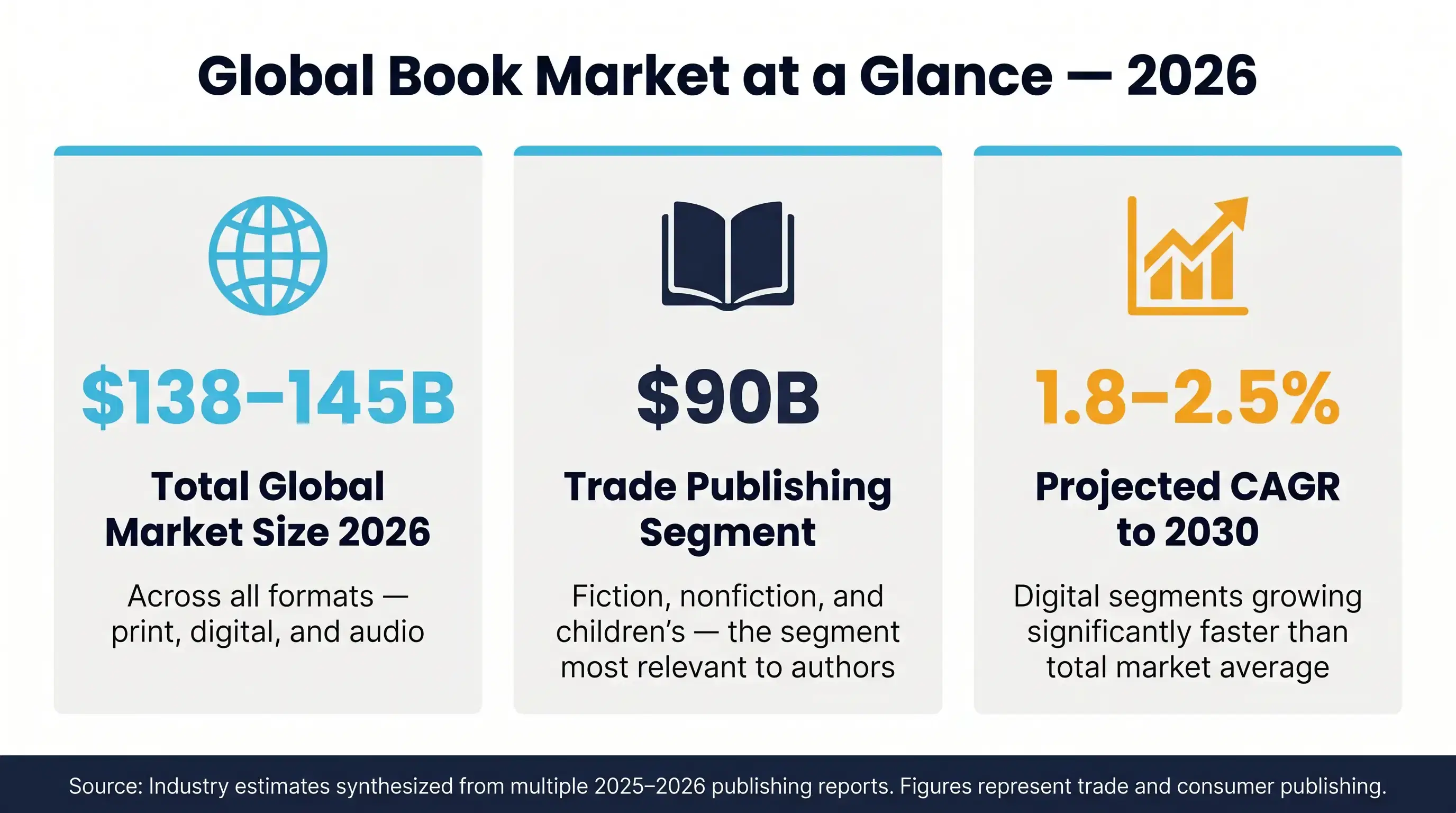
The global book market size in 2026 is estimated at approximately $138 to $145 billion across all formats and segments, including print, digital, and audio. This figure represents consistent recovery and growth from the disruptions of the early 2020s, driven primarily by strong audiobook expansion, continued digital adoption in developing markets, and the sustained resilience of print in established reading cultures.
The trade publishing segment, which is most relevant to authors, accounts for roughly $90 billion of that total. Within trade publishing, digital formats now represent a larger combined share than at any previous point, with audiobooks alone accounting for a growing double-digit percentage of total trade revenue in key markets.
Growth Trends Over the Last Decade
The past decade in publishing industry trends has been defined by three overlapping forces. The first is the consolidation and stabilization of the ebook market after the initial explosive growth of the early 2010s, which plateaued and then found a steady growth lane rather than the parabolic trajectory early forecasters predicted.
The second is the rise of audiobooks as a genuinely mainstream format rather than a niche supplement to print. The third, and arguably most consequential for independent authors, is the global expansion of self-publishing infrastructure that has made it possible for a single author to publish and sell their work in over 190 countries without a publisher, a literary agent, or a physical distribution deal.
Key Drivers of Book Market Growth
Rise of Digital Publishing (eBooks and Audiobooks)
Digital publishing has fundamentally changed the economics of reaching a global readership. eBook publishing services and audiobook platforms have eliminated the logistics costs, inventory risks, and geographic limitations that previously made international publishing the exclusive domain of well-funded traditional publishers.
For authors, the practical consequence is that a book published through Amazon KDP, Apple Books, Kobo, and Google Play is immediately available to readers in markets from South Korea to South Africa. No shipping, no customs, no local distribution partner required. The marginal cost of reaching an additional market is essentially zero once the digital files exist.
Increased Smartphone and Internet Penetration
The single most consequential factor behind the expansion of book markets in developing regions is the smartphone. In markets where desktop computer ownership is low and physical bookstores are sparse, the smartphone is the primary, and often the only, device through which people access digital content of all kinds.
Global internet penetration reached about 74 percent of the world population in 2025, with mobile accounting for the vast majority of new connections in Asia Pacific, Sub-Saharan Africa, and Latin America. Each new connected smartphone user is a potential reader who now has access to the same digital storefronts and reading apps that readers in New York and London have used for years.
Growth of Self-Publishing Platforms
The best self-publishing platforms have grown from novelty to infrastructure. Amazon KDP, Kobo Writing Life, and their equivalents have collectively onboarded millions of authors over the past decade and have built the distribution networks, payment systems, and discovery algorithms that make global self-publishing viable at scale.
The volume of titles entering the market through self-publishing platforms now substantially exceeds the output of traditional publishers. This has created both an opportunity and a challenge: the opportunity is that any author can reach any market, and the challenge is that doing so requires deliberate strategy rather than just uploading a file.
Expansion of Global Distribution Channels
Beyond the major platforms, the expansion of international book distribution services through aggregators, library networks, and regional retailers has deepened the infrastructure available to independent authors. Services like OverDrive and Bibliotheca supply public libraries in dozens of countries. Regional platforms like Everand, Storytel, and Bookmate have built subscription reading audiences in markets where Amazon's penetration is lower.
Together, these channels mean that a well-distributed book is genuinely available everywhere readers are looking, not just on the one or two platforms that dominate English-language markets.
Global Book Market Size & Forecast (2026 to 2030)
Current Market Valuation
The current global book market forecast places the total publishing industry value at approximately $138 to $145 billion in 2026. North America and Europe together account for roughly 60 percent of that value, with Asia Pacific representing the fastest-growing regional share. The United States remains the single largest national market, followed by China, Germany, the United Kingdom, Japan, and France.
Projected Growth Rate (CAGR)
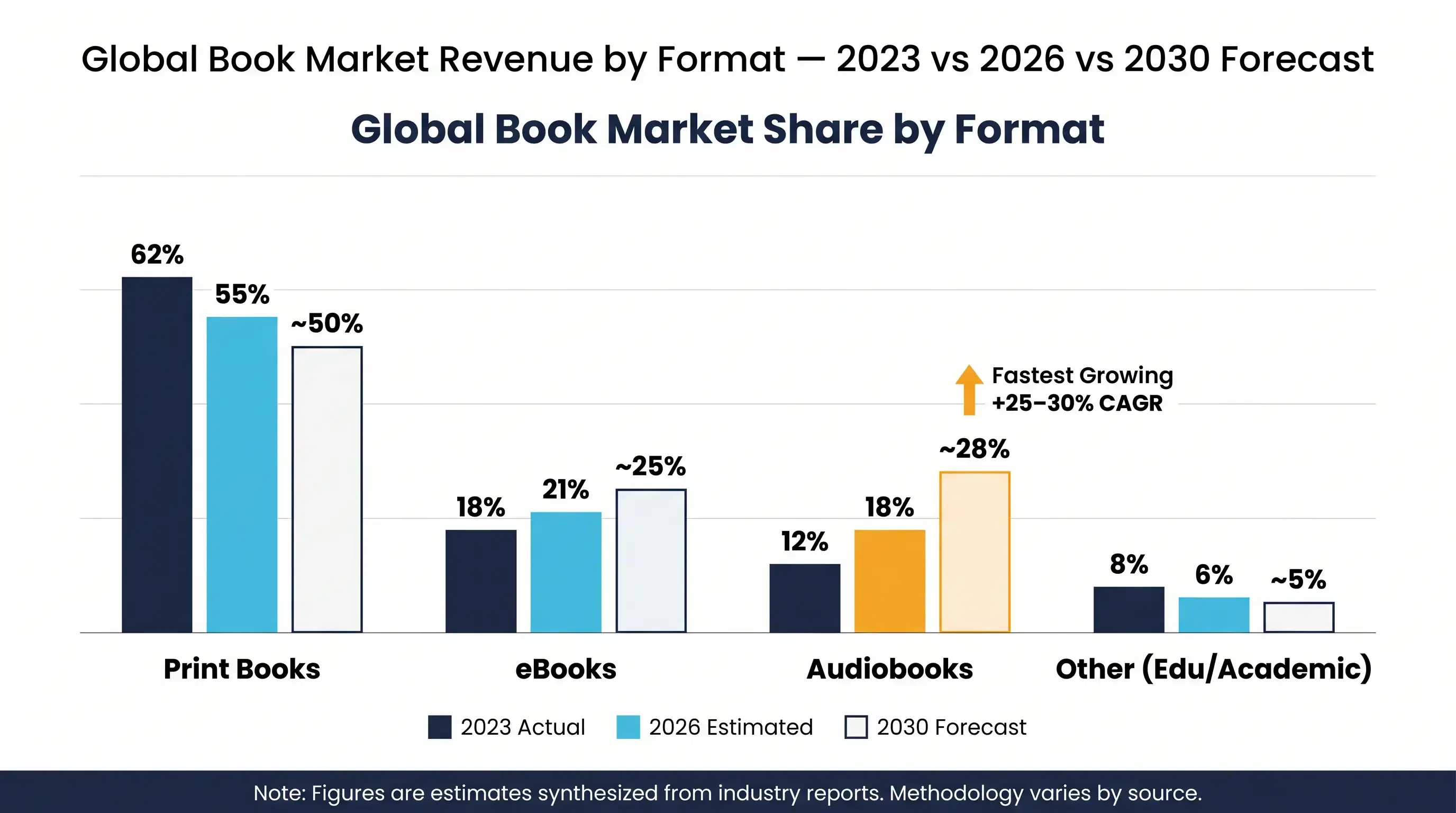
The compound annual growth rate for the global publishing market is projected at approximately 1.8 to 2.5 percent through 2030 for total market value, with digital segments growing considerably faster. Audiobooks are projected to grow at a CAGR of 25 to 30 percent in some regional forecasts. The ebook segment is expected to grow at 4 to 6 percent annually, driven primarily by emerging market adoption and continued self-publishing expansion.
Revenue Breakdown by Format (Print, eBook, Audiobook)
| Format | 2023 Global Share | 2026 Estimated Share | Projected CAGR to 2030 |
|---|---|---|---|
| Print Books | ~62% | ~55% | 0.5% – 1% |
| eBooks / ebook publishing services | ~18% | ~21% | 4% – 6% |
| Audiobooks / audiobook publishing | ~12% | ~18% | 25% – 30% |
| Other (Edu, Academic) | ~8% | ~6% | 1% – 2% |
Note on these figures: The market sizes, format shares and growth rates on this page are trade and consumer publishing estimates synthesized from multiple industry reports. They are ranges, not audited totals, and published figures vary widely by source depending on whether education, academic and export revenue are included. We have not independently verified them and they should not be relied on for investment or contractual decisions. Last reviewed August 2026.
Where Real Readers Are: Top Book Markets by Region
North America (U.S. and Canada)
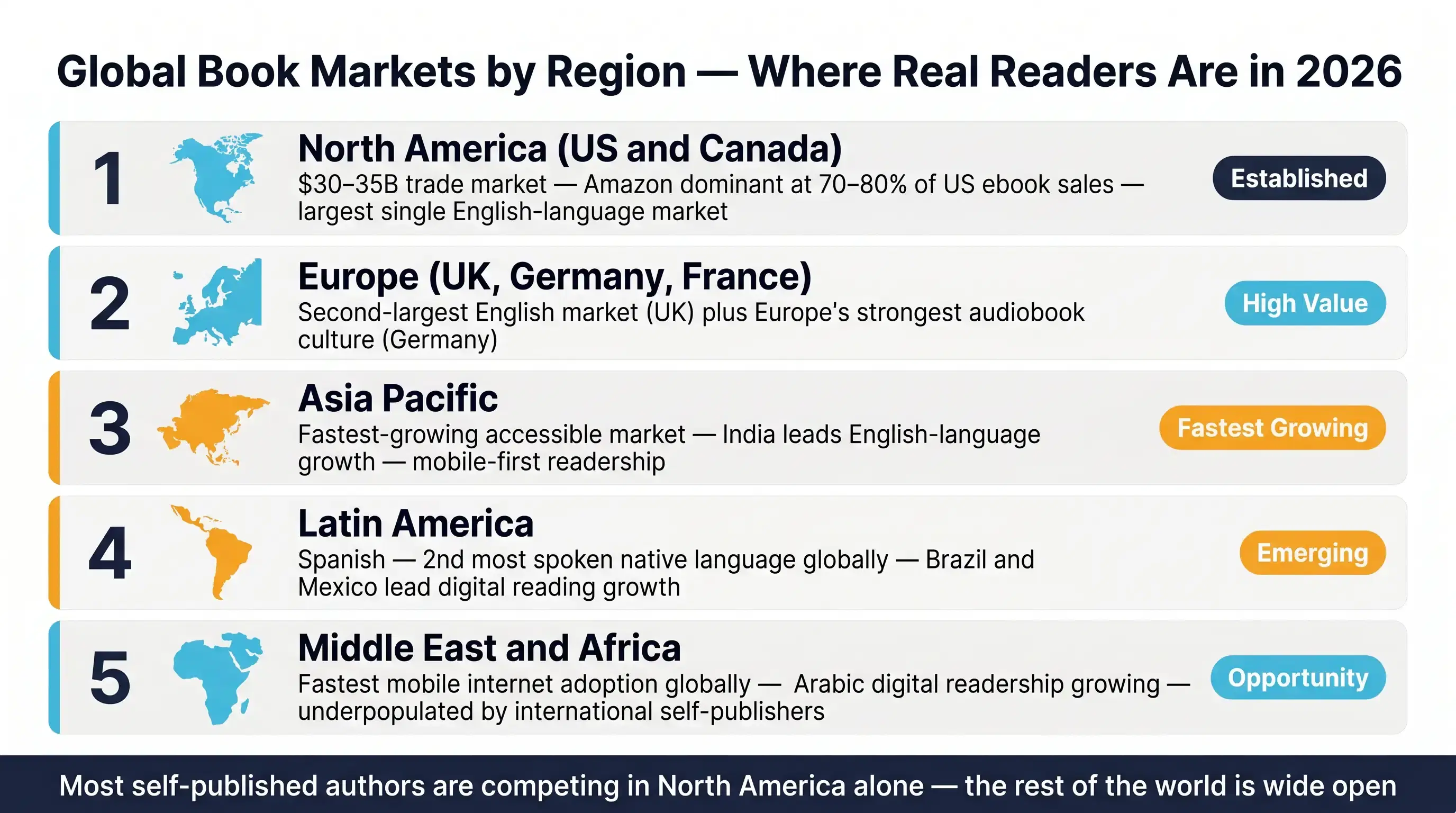
The book market in the USA remains the dominant single market for English-language books, representing about $21.7 billion in annual trade publishing revenue in 2025. Higher figures around $33 billion that circulate for the US usually cover the whole publishing industry including educational and professional titles, not trade alone. The US market is characterized by deep Amazon penetration, a large and active Kindle Unlimited readership, strong audiobook consumption driven by Audible, and a mature self-publishing ecosystem that generates millions of titles annually.
For authors targeting North America, the Amazon ecosystem is unavoidable. Amazon captures an estimated 70 to 80 percent of US ebook sales and a commanding share of print-on-demand self-published titles. Canada follows broadly similar patterns with slightly stronger Kobo penetration, helped by Kobo's Canadian roots and its partnerships with Indigo, Canada's largest bookstore chain. Kobo itself has been owned by Japan's Rakuten since 2012, though its head office remains in Toronto.
Europe (UK, Germany, France)
Europe represents one of the most valuable and most diverse book markets in the world. The Europe publishing industry trends show a strong and durable print culture alongside rapidly growing digital adoption, particularly in ebooks and audiobooks for commuter and leisure reading.
The UK is the second-largest English-language book market globally and operates with deep Amazon penetration similar to the US. Germany is the largest book market in continental Europe and is characterized by a particularly strong audiobook culture, with Audible Germany generating substantial revenue alongside a competitive local market that includes Storytel and Bookbeat. France has a strong state-supported reading culture, a large library system, and a publishing industry that takes its intellectual heritage seriously.
For self-published English-language authors, the UK and Germany represent the clearest European opportunities, with established platform infrastructure and readers actively seeking English-language content.
Asia Pacific
The Asia Pacific book market growth is the most dynamic story in global publishing right now. China has the largest book market in the region by volume, though its regulatory environment and the dominance of local platforms like WeChat Reading and iReader make it effectively inaccessible to most international self-publishers without a local partner.
India is the fastest-growing accessible market for English-language books in Asia Pacific, with a large English-reading population, growing middle-class spending, strong smartphone penetration, and increasing access to global digital platforms. Australia and New Zealand operate similarly to the UK market and represent straightforward additions to any wide distribution strategy.
Southeast Asia, particularly Indonesia, the Philippines, and Vietnam, is emerging as a meaningful digital reading market driven by mobile-first internet access and growing English proficiency among younger demographics.
Latin America
Latin America is one of the most compelling emerging publishing markets for authors willing to think beyond English-language publishing. Spanish is the second most spoken native language in the world, and the Spanish-language book market is growing rapidly as digital reading infrastructure catches up with the region's large literate population.
Brazil, with Portuguese as its national language, is a particularly significant market with a large reading population and growing Amazon Brazil and Kobo Brazil presence. Mexico, Colombia, and Argentina lead the Spanish-language digital reading market in the region. Authors who invest in quality translation of their works into Spanish and Portuguese have access to a combined market of hundreds of millions of potential readers.
Middle East and Africa
The Middle East and Africa region represents genuine long-term opportunity for authors thinking about where the next wave of global readers is coming from. Mobile internet adoption rates in Sub-Saharan Africa are among the fastest in the world, and smartphone ownership among young urban populations is creating a new generation of digital readers.
Arabic is a major world language with a large and growing digital reading audience. Several Gulf states have made significant investments in reading culture, literacy programs, and digital library infrastructure. Authors with content relevant to Middle Eastern or African audiences, or those whose work translates well culturally, are entering markets that remain substantially underpopulated by international self-publishers.
Format Trends: Where Readers Are Shifting
Print Books
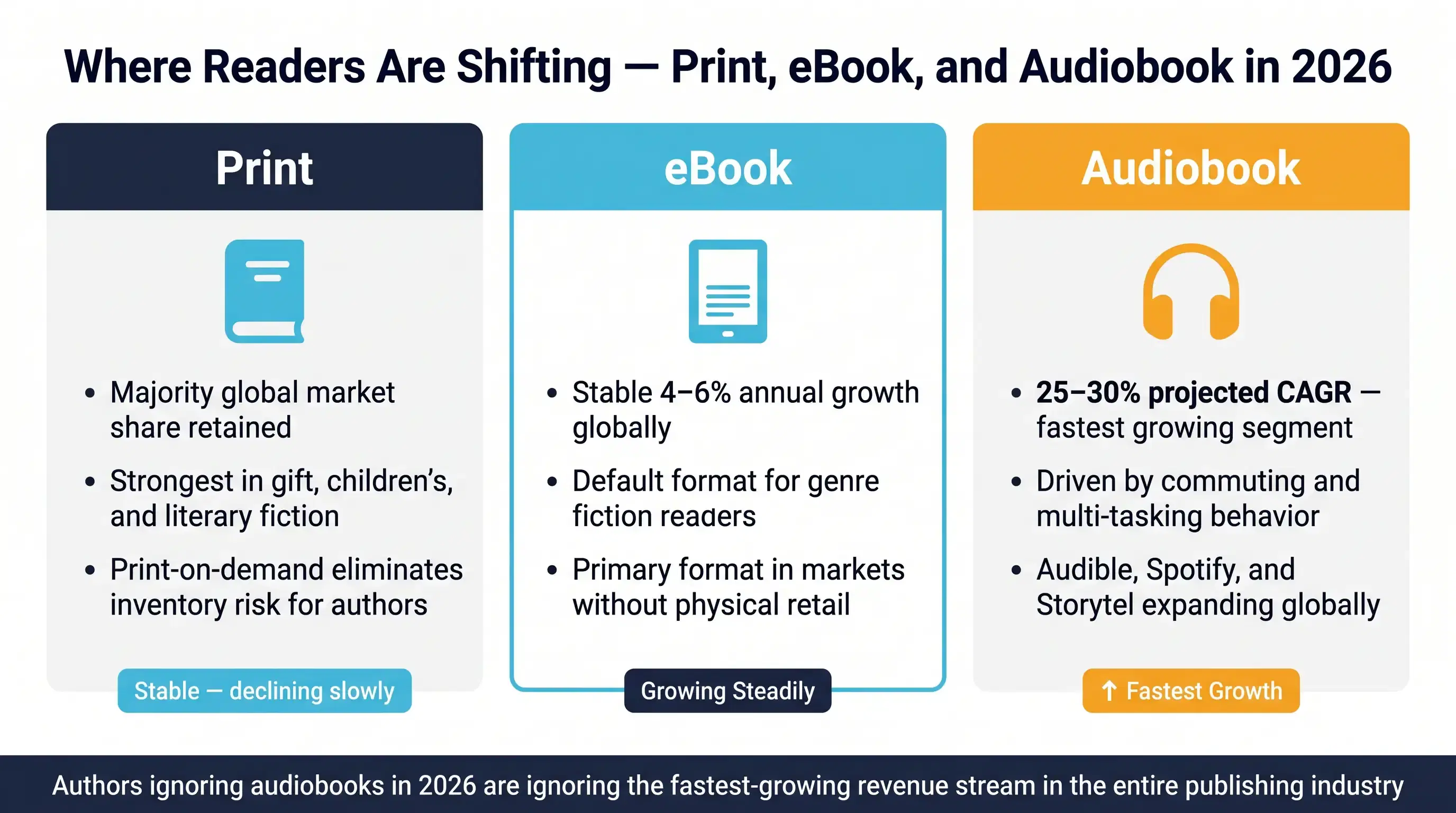
Print's obituary has been written many times and continues to be premature. Despite decades of digital disruption, print books retain majority market share globally and show no signs of imminent collapse. The global book format picture in 2026 shows print declining slowly as a share of total market value while remaining the dominant format in most regions outside the most advanced digital markets.
Print's resilience is strongest in gift purchasing, children's books, illustrated titles, and literary fiction, categories where the physical object has aesthetic and emotional value that digital formats do not replicate. For self-published authors, print-on-demand through KDP and IngramSpark makes print distribution accessible without inventory costs.
eBooks
The ebook market has settled into a stable growth pattern after the volatility of its early years. eBook publishing services now serve a global readership that treats digital books as the default format for certain genres and reading contexts. Genre fiction, romance, science fiction, thriller, and fantasy readers in particular skew heavily digital, and the Kindle Unlimited subscription model has reinforced that behavior in those categories.
In developing markets, ebooks are often the primary format for accessing international content because there is no physical retail distribution infrastructure and no cost-effective print-on-demand equivalent. This makes ebook distribution a genuine priority for authors targeting emerging markets rather than an afterthought.
Audiobooks
Audiobooks are the most important growth story in publishing right now, and most self-published authors are still underinvesting in the format. Global audiobook publishing revenue is growing at a rate that makes it the fastest-expanding segment by a significant margin, driven by commuting, exercise, and multi-tasking behavior that makes audio consumption compatible with parts of the day where reading a physical or digital text is impractical.
The US and Germany are the most developed audiobook markets, but adoption is accelerating rapidly across the UK, Scandinavia, and Australia. Audible, Google Play Books Audio, Spotify Audiobooks, and regional services like Storytel and Bookbeat together reach a combined subscription audience in the tens of millions. For authors with compelling narratives and strong prose voices, audiobook production is increasingly difficult to justify skipping.
Platform Ecosystem: Where Books Are Being Consumed
Amazon (Kindle and Audible)
Amazon dominates English-language digital book consumption more thoroughly than any single company dominates any other major media category. Amazon KDP publishing gives authors access to Kindle Direct Publishing for ebooks and paperbacks, and ACX or Voices by INaudio (formerly Findaway Voices) for audiobook distribution through Audible. The combination of Amazon's marketplace, its Kindle Unlimited subscription program, and Audible's audiobook platform makes Amazon the single most important platform decision any self-publishing author makes.
Amazon sells Kindle titles through thirteen localized Kindle stores as of August 2026 - fourteen less China, where the Kindle store closed in June 2023 - reaching customers in far more countries than that, with storefronts, and its recommendation and ranking algorithms generate a disproportionate share of book discovery for readers who shop primarily through Amazon-owned properties.
Apple Books
Apple Books occupies a specific and valuable niche in the global platform ecosystem. Its audience skews toward higher earners, purchases rather than borrows, and readers who are less price-sensitive than average ebook consumers. Apple Books distribution reaches iOS users across the US, UK, Australia, Canada, and a large number of international markets, many of which overlap only partially with Amazon's strongest territories.
Google Play Books
Google Play Books offers something no other major ebook platform can match: access to the Android user base across every market where Google services operate. In many emerging markets, particularly in Southeast Asia, Sub-Saharan Africa, and Latin America, Android devices are the dominant smartphone platform, and Google Play is the primary digital content storefront.
For authors pursuing global book publishing services, Google Play Books is the clearest path to readers in markets where Amazon and Apple have limited infrastructure.
Spotify (Audiobooks Expansion)
Spotify's entry into audiobooks represents a significant structural shift in how audio content reaches listeners. With more than 770 million users globally and existing infrastructure for music and podcast consumption, Spotify has the potential to introduce audiobooks to a large audience of listeners who were never Audible subscribers and may never have purchased an audiobook directly.
Its audiobook catalogue now runs to more than 700,000 titles across 22 markets, and self-published authors can publish to it directly through Spotify for Authors rather than needing an intermediary, though distribution is also available through aggregators including Voices by INaudio and others. Its impact on the audiobook market is still developing, but the scale of its user base makes it impossible to ignore for authors thinking about audio distribution.
Kobo and Global Retailers
Kobo remains the most important alternative to Amazon for ebook distribution, particularly in Canada, the Netherlands, Belgium, and several other European markets where it competes effectively. Kobo's parent company Rakuten also operates in Japan, giving Kobo indirect access to one of the world's largest and most literate reading populations.
Barnes and Noble, Everand (formerly Scribd's reading service), OverDrive for library distribution, and regional platforms across Europe and Asia collectively represent meaningful additional reach for authors who publish books beyond Amazon.
Self-Publishing vs Traditional Publishing Market Share
Growth of Independent Authors
The growth of independent authorship over the past decade has been one of the most significant structural changes in publishing. Estimates suggest that self-published titles now account for the majority of new books added to major digital platforms each year. The infrastructure that makes this possible, primarily KDP, Kobo Writing Life, Draft2Digital, and IngramSpark, has dramatically lowered the barriers to entry for anyone with a finished manuscript.
The community of professional self-publishing for global audience authors who earn meaningful income from their work has grown substantially, with a larger number of independent authors now earning more from their books than the average traditionally published author receives in advances and royalties combined.
Revenue Comparison
The revenue comparison between self-publishing and traditional publishing is more nuanced than headline figures suggest. Traditional publishing offers advances, editorial and production support, physical retail distribution, and in some cases significant marketing investment. In exchange, the author typically receives 10 to 25 percent of net revenue and surrenders creative control over cover, title, pricing, and timing.
Self-publishing typically offers 35 to 70 percent of digital sales revenue, full creative control, faster time to market, and the ability to price and promote independently. The trade-off is that all the production costs, marketing investment, and distribution management fall on the author or their service provider.
Impact of Platforms Like KDP
The impact of amazon kdp publishing on the publishing industry cannot be overstated. KDP effectively ended traditional publishing's monopoly on mass-market distribution by creating a system where any author could upload a book and have it available to millions of readers within 24 to 72 hours. That single change restructured the economics of publishing for both authors and traditional publishers.
The existence of KDP and equivalent platforms has also created competitive pressure on traditional publishing deals, as authors with strong platforms increasingly have the leverage to negotiate better terms or choose independent publication entirely.
Reader Behavior Insights (2026 Data)
Average Reading Time and Habits
Global reading habits in 2026 reflect the fragmented, multi-format nature of modern media consumption. Average reading time varies significantly by country and demographic, but research consistently shows that regular readers across all markets are reading more total content than a decade ago when audio and short-form digital content were included alongside traditional book reading.
In the US, the average adult reader spends approximately 17 minutes per day reading for pleasure according to recent time-use surveys. That figure rises significantly among dedicated readers and in countries with stronger reading cultures such as India, Finland, and Poland, where reading remains a primary leisure activity.
Preferred Formats by Age Group
Format preferences segment clearly by age group across most markets. Readers under 35 show the strongest preference for digital formats, including ebooks and audiobooks, with audio particularly dominant among 18 to 34 year olds who consume it during commuting, exercise, and household tasks. Readers 35 to 55 show the most balanced format preferences, comfortable across print, digital, and audio.
Readers over 55 skew most heavily toward print, though large-print ebooks on devices with adjustable font sizes have meaningfully increased digital adoption in this demographic over the past decade.
Mobile vs Desktop Consumption
Mobile devices now account for the majority of ebook reading time in most markets when smartphone reading apps are included alongside dedicated e-ink readers. In emerging markets where dedicated e-readers are less common, virtually all digital reading happens on smartphones. This has significant implications for cover design, metadata presentation, and the first-screen experience that determines whether a browser becomes a buyer.
Subscription vs One-Time Purchase Trends
The subscription model for book consumption has grown significantly, driven primarily by Kindle Unlimited and the expansion of audiobook subscriptions through Audible, Everand, and newer entrants. Reader behavior data suggests that subscribers read more books per month on average than one-time purchasers, which generates more total author income per subscriber than individual sales in categories where KU page read rates are competitive.
For authors, the relevant strategic question is whether their genre and audience profile aligns with the subscription-heavy KU readership, or whether their readers are more likely to be individual purchasers spread across multiple platforms.
Emerging Trends Shaping the Future of Publishing
AI in Writing and Publishing
Artificial intelligence is affecting every stage of the publishing process, from writing assistance and developmental editing tools to cover design generation, metadata optimization, and marketing copy. The impact on the industry is contested, with legitimate debates about authorship, quality, and market saturation playing out simultaneously across the publishing community.
What is clear is that AI tools are reducing the production costs for certain publishing tasks, which is accelerating the volume of titles entering the market. For authors, the more important trend is the use of AI in reader discovery algorithms, which are becoming increasingly sophisticated in their ability to match books with readers who are genuinely likely to enjoy them.
Subscription-Based Reading Models
Subscription reading is expanding beyond Kindle Unlimited. Everand, Storytel, Bookbeat, and Bookmate each operate subscription models with meaningful subscriber bases in their respective markets. The growth of these services is creating a reader expectation in some demographics that books should be accessible through a fixed monthly fee rather than purchased individually.
For authors, the subscription trend creates both an opportunity, access to readers who would not pay per-book prices at full retail, and a challenge, the potential for per-read royalties to compress per-reader income compared to direct sales models.
Globalization of Content
The publishing industry trends around content globalization reflect a growing reader appetite for stories and perspectives from outside the author's home country. International readers are increasingly accessible to authors who write with global themes or who invest in translation and cultural adaptation of their work for non-English markets.
Rise of Multilingual Publishing
The practical barriers to multilingual publishing have fallen substantially. Machine translation tools, while imperfect, have made first-pass translations more affordable. Professional literary translators remain essential for quality results, but the market infrastructure for distributing translated works, both through major platforms and regional retailers, is better than it has ever been.
Authors who invest in Spanish, Portuguese, German, French, or Hindi translations of successful English titles are opening access to hundreds of millions of additional readers who prefer to read in their native language.
Opportunities for Authors in the Global Market
Choosing the Right Market for Your Book
Not every book has equal global appeal, and trying to reach every market simultaneously without strategy is less effective than choosing the two or three markets most likely to respond to your specific content. Genre fiction with universal themes, practical nonfiction in business or self-improvement, and personal development content travel well across English-speaking markets. Content with strong cultural specificity may perform better in targeted regional markets where that specificity resonates.
Leveraging Multi-Platform Distribution
The most consistent advice from authors who successfully publish your book worldwide is to distribute across as many platforms as possible and then invest marketing effort based on where return is strongest. Going wide, meaning distributing to all major platforms rather than staying exclusive to Amazon, ensures that readers in markets where Amazon is not dominant can still find and purchase the book.
Targeting High-Growth Genres
Genre choice has meaningful global implications. Romance, fantasy, and thriller are the strongest-performing genres across both Amazon's Kindle Unlimited program and wide distribution markets internationally. Nonfiction in business, health, personal finance, and self-improvement performs consistently well across English-speaking markets and translates effectively into other languages. Crime fiction is particularly strong in Scandinavia and Germany. Understanding which genres are growing in which markets allows authors to position new projects for maximum global opportunity.
Building a Global Author Brand
A global book publishing company or professional publishing service can help authors build the kind of platform presence that sustains discovery across markets. A professional author website, consistent social media presence, and a growing email list together create the infrastructure for reaching readers internationally without depending entirely on platform algorithms.
Authors with recognizable brands and engaged audiences can build readership in new markets faster than those starting from scratch with each title.
Challenges in the Global Book Market
Market Saturation
The volume of titles entering the global book market each year has created meaningful discoverability challenges. Millions of new titles are published annually across all platforms, and the competition for reader attention is intense in popular genres. Market saturation does not mean opportunity is gone. It means that books without professional production quality, strategic metadata, and active marketing support are increasingly unlikely to find their audience through organic discovery alone.
Discoverability Issues
Platform algorithms are the primary discovery mechanism for most readers, and those algorithms reward specific behaviors: purchase velocity, review accumulation, click-through rates, and in the case of Kindle Unlimited, page read engagement. Authors who publish without a launch strategy, without reviews at release, and without early sales momentum are starting with a significant algorithmic disadvantage that compounds over time.
Pricing Competition
The self-publishing market has created downward pressure on ebook pricing in popular genres. Reader expectations in romance, fantasy, and thriller have been shaped by the availability of full-length novels at $2.99 to $4.99 price points, and pricing significantly above market norms in those genres requires either an established author brand or exceptional review volume to justify. Pricing strategy that accounts for genre norms, platform royalty tiers, and market-specific currency effects is increasingly necessary for maximizing revenue per sale.
Platform Dependency
Any author whose entire income depends on a single platform is carrying concentrated risk. Amazon has changed its KU payout structure, altered its ranking algorithms, updated its metadata requirements, and modified its advertising platform multiple times. Each change creates winners and losers, and authors with no distribution outside of Amazon have no buffer when changes affect their specific situation. Diversifying across platforms is not just a revenue strategy. It is a business continuity strategy.
How to Position Your Book for Global Success
Market Research and Localization
Positioning a book for global success starts with understanding which markets your book is most likely to resonate in and what those markets expect from your category. Cover design conventions vary by market. Pricing norms differ by currency and regional purchasing power. Genre expectations are shaped by local reading culture. A thriller cover that performs well in the US market may look wrong to UK readers accustomed to different design conventions.
SEO Optimization for Platforms
Platform SEO is one of the highest-return investments an author can make. On Amazon, the keywords in your title, subtitle, book description, and seven backend keyword slots directly determine which search queries your book appears in. The same principle applies on Apple Books, Kobo, and Google Play, each of which has its own search and categorization logic.
Well-optimized metadata does not just improve search visibility. It signals to platform algorithms that the book is correctly categorized and should be recommended to readers whose behavior matches your target reader profile.
Distribution Strategy (Wide vs Exclusive)
The wide versus exclusive decision is the most consequential distribution choice an author makes. Staying exclusive to Amazon through KDP Select maximizes access to Kindle Unlimited readers and the platform's promotional tools, but surrenders non-Amazon markets for the duration of enrollment. Note that this applies to the digital edition only: print and audio can be sold anywhere throughout the term, and Amazon permits library distribution. Going wide reaches readers on every platform but requires building marketing momentum on multiple storefronts simultaneously.
For authors with global ambitions and content that appeals to readers outside the Amazon ecosystem, book marketing servicesworldwide that support multi-platform launch strategies provide the clearest path to sustainable international readership.
Marketing Across Regions
Effective global marketing does not mean running the same campaign in every market. It means understanding where your readers are, what platforms they use for book discovery, and what kind of content or messaging resonates with them. A BookBub featured deal reaches a heavily English-speaking international audience. Facebook and Instagram ads can be geographically targeted to reach readers in specific countries. ARC (advance review copy) programs can be used to build reviews on regional Amazon storefronts before launch.
How Best Selling Publisher Helps You Reach Global Readers
Multi-Platform Publishing Strategy
Best Selling Publisher's global book publishing services include strategic guidance on whether wide distribution or Amazon exclusivity is right for your specific book, genre, and readership goals. Rather than applying a one-size-fits-all answer, the team evaluates your situation and builds a distribution strategy that maximizes reach in the markets most likely to respond to your work.
Global Distribution Setup
Setting up correctly on all major global platforms, with proper metadata, competitive pricing, and correct categorization on each storefront, is a process that requires both technical knowledge and platform-specific expertise. Best Selling Publisher handles the complete international book distribution services setup process, from account creation to final submission, ensuring your book is positioned for discovery from day one in every market you want to reach.
Localization and Market Positioning
Reaching global readers goes beyond uploading an English file to every available platform. Best Selling Publisher advises on cover adaptation for non-English markets, metadata localization for platform-specific search, and pricing strategy adjusted for regional purchasing power and market norms. These details separate books that find international audiences from those that are technically available everywhere but discovered nowhere.
Marketing and Promotion
Our book marketing services are planned around the platforms and channels selected for your target markets. From Amazon metadata and launch strategy to cross-platform advertising and email list development, the team executes marketing plans calibrated to where your readers actually are rather than where the loudest marketing advice assumes they are.
Ready to Reach a Global Audience with Your Book?
The global book market has never been more accessible to independent authors. The infrastructure exists, the readers are there, and the platforms to reach them are available to anyone with a well-produced book and a thoughtful publishing strategy. What makes the difference is not luck or timing. It is the quality of the execution.
Best Selling Publisher offers end-to-end book publishing services designed to take your book from manuscript to global market with the production quality, distribution strategy, and marketing support it needs to find its audience worldwide. Get in touch today and find out how we can help your book reach the readers who are already looking for it.
FAQs
The global book market in 2026 is estimated at approximately $138 to $145 billion across all formats and segments. The trade publishing segment, which covers books written for general consumer audiences, accounts for roughly $90 billion of that total.
Digital formats including ebooks and audiobooks represent a growing share, with audiobooks showing the fastest growth rate of any segment.
By reading frequency, India, Finland, and Poland consistently rank among the highest in global surveys measuring how often adults read for pleasure. China has one of the highest absolute volumes of book consumption given its population size.
The US and UK lead in per-capita book spending in English-language markets. Reading culture varies significantly by country and is influenced by education systems, literacy rates, public libraries, and cultural attitudes toward reading.
No, and the evidence increasingly suggests they will not. Print books retain majority global market share and continue to show strong resilience across demographics and regions.
Ebooks have stabilized as a strong digital segment, especially in genre fiction and mobile-first markets. The reality is that print, ebooks, and audiobooks now coexist, each serving different reading contexts.
New authors typically start with Amazon KDP to build early sales, reviews, and ranking history. This helps establish initial momentum and visibility within the largest ebook marketplace.
After that, expanding to Kobo Writing Life, Apple Books, and Google Play Books helps reach readers outside Amazon’s ecosystem. Aggregators like Draft2Digital can simplify multi-platform distribution.
Audiobooks are the fastest-growing segment in global publishing, with projected growth rates of 25% to 30% in key markets.
Growth is driven by commuting, exercise, and multitasking habits that make audio content easier to consume than text. Adoption is expanding rapidly across both developed and emerging markets.