
How Business and Finance Books Turn Ordinary Readers Into Extraordinary Thinkers
The most successful people in the world share one habit, they read business books.
Warren Buffett reads five to six hours a day. Bill Gates reads fifty books a year. Elon Musk taught himself rocket science from books before he built a rocket company. Oprah Winfrey has said that books were the foundation of everything she became. This is not a coincidence. These are not people who read because they have time. These are people who make time to read because they understand something that most people never fully grasp, that the right book at the right moment can compress decades of hard-won experience into a few hours of reading, and hand you the insights directly.
Business and finance books are the closest thing to a shortcut that exists in professional and financial life, and the decision topublish a business book of your own is one of the most powerful ways to establish credibility in your field. Not because they make things easy, they do not, but because they give you access to the thinking of the people who have already done what you are trying to do, already made the mistakes you are trying to avoid, and already figured out what works. In this guide, we are going to explore what makes this genre so uniquely powerful, which books you absolutely need to read, and how to get the most out of every page.
Why Business Books Change the Way You Think About Money and Success
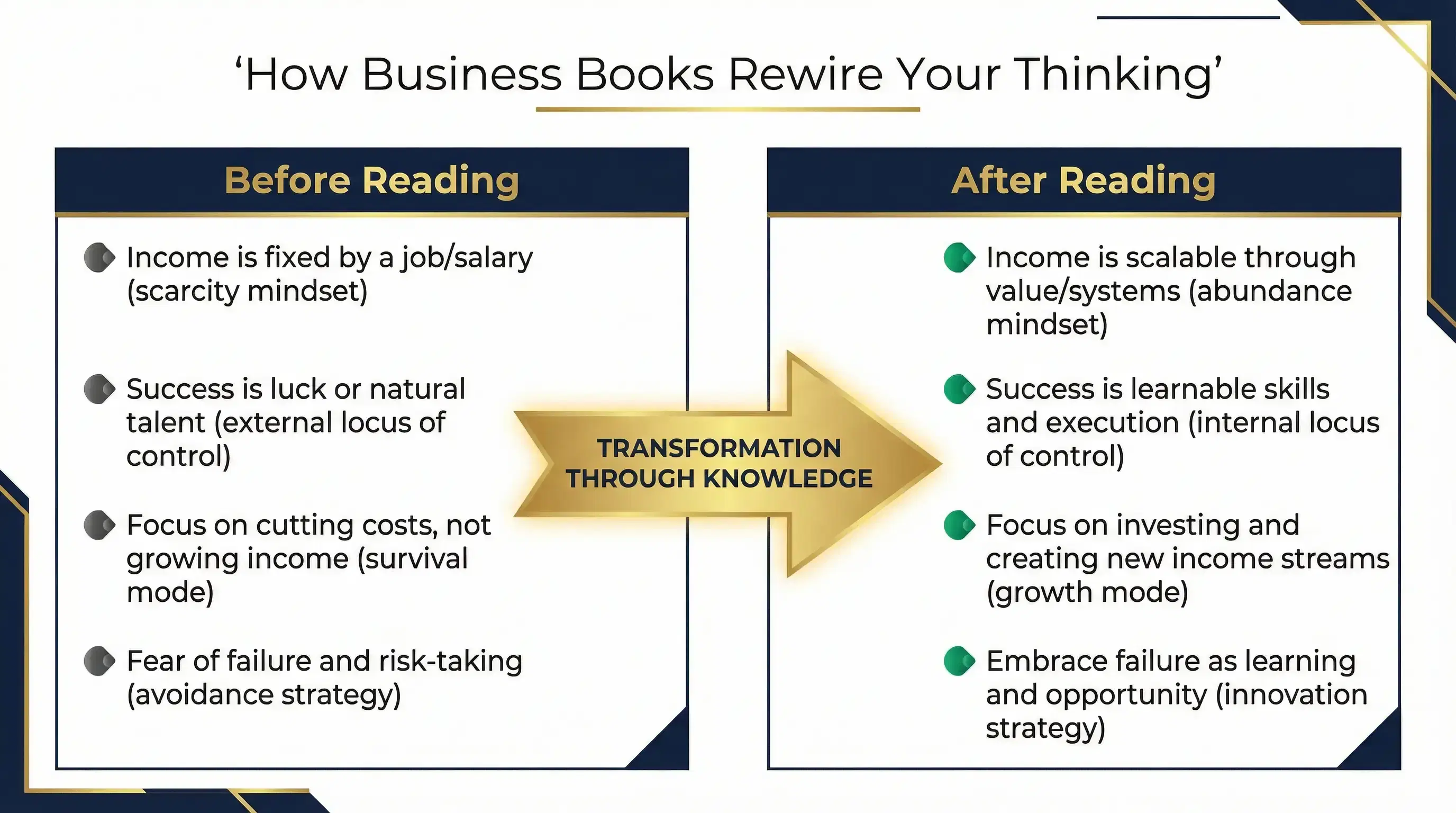
There is a particular experience that happens when you read a great business or finance book for the first time, and an equally powerful experience awaits anyone who decides to publish business books and share their own hard-won expertise. It is the experience of having something you already half-knew, something you had felt but never been able to articulate, suddenly explained with complete clarity. And the moment it is explained clearly, you realize that you are never going to see money, work, or opportunity the same way again.
Robert Kiyosaki’s Rich Dad Poor Dad did this for millions of readers by introducing the simple but radical idea that the wealthy do not work for money, they make money work for them. Before reading that book, most people had never consciously thought about the difference between an asset and a liability, or why buying a bigger house might not be the financial achievement it feels like. After reading it, they could never look at their financial choices in the same way. That is what a great business book does. It does not just add information. It rewires your operating system.
The lessons in great business books also have a compounding effect that mirrors the very financial principles they teach. Each book builds on the last. The mindset shift from Rich Dad Poor Dad makes the strategic thinking in Zero to One easier to absorb. The understanding of human psychology in How to Win Friends and Influence People makes the leadership lessons in The Hard Thing About Hard Things land more deeply. Over time, the reader who consistently engages with great business literature develops a way of thinking about problems, opportunities, and decisions that is genuinely different from someone who has not, and that difference shows up in real outcomes.
The Difference Between Business Books and Finance Books
When people say “business and finance books,” they are actually describing two distinct and equally valuable categories of reading, and understanding the difference between them helps you know which one you need at any given point in your journey.
Business books are primarily about building, leading, and scaling, how to start a company, how to manage people, how to develop a strategy, how to grow from nothing into something significant. They tend to be written by founders, CEOs, and operators who have built real things and want to share what they learned along the way. Ben Horowitz’s The Hard Thing About Hard Things is a business book, a brutally honest account of what it actually feels like to lead a company through crisis, written by someone who has done exactly that. Peter Thiel’s Zero to One is a business book, a philosophical exploration of what it takes to build something genuinely new rather than simply copying what already exists.
Finance books, by contrast, are primarily about money, how to manage it, how to grow it, how to use it to build long-term security and freedom. They cover personal budgeting, investing, understanding markets, and the principles that separate people who build lasting wealth from those who earn well but remain financially vulnerable. The Intelligent Investor by Benjamin Graham is a finance book, the foundational text of value investing, which Warren Buffett has described as the best book about investing ever written. I Will Teach You to Be Rich by Ramit Sethi is a finance book, a practical, no-nonsense system for automating your financial life that has genuinely changed how millions of younger readers relate to money.
The most successful readers in this space read both, because building something requires understanding strategy and leadership, but sustaining and growing what you have built requires understanding money. The two categories are not competing. They are complementary halves of the same complete picture.
The Life Lessons Only Business Books Teach You
There are lessons that take decades to learn from life experience, and that great business books can hand you in an afternoon. This is not an exaggeration. The specific kind of knowledge that lives in the best business writing is knowledge that was forged in the real world, often at enormous personal and professional cost, and is now available to anyone willing to sit down and read.
One of the most important is the shift from employee thinking to owner thinking. Most people are educated and trained to be employees, to show up, do a defined job, and receive a salary. Business books teach a completely different way of engaging with the world. They teach you to see problems as opportunities, to think about systems rather than tasks, to ask not “how do I do this job better” but “how do I build something that does this job without me.” This shift in perspective is transformative regardless of whether you ever start a company, because it changes how you make decisions, how you evaluate opportunities, and how you think about your own time and energy.
Business books also teach a relationship with failure that you will find almost nowhere else in culture. In most contexts, failure is something to be hidden, minimized, and recovered from as quickly as possible. In the best business writing, failure is treated as data, the most valuable information available, the thing that tells you what actually works versus what you merely hoped would work. This reframing is not just philosophical. It is practical. People who have absorbed it from reading are genuinely less afraid to try things, because they understand that a failed attempt is not wasted effort, it is an investment in knowledge.
Perhaps most valuable, business books teach you to play long-term games. This is also why professionals who publish business books consistently report that the process of writing forces them to think more clearly about their own long-term strategy. The world generally rewards and celebrates short-term thinking, the quick win, the immediate result, the visible achievement. The best business authors, from Charlie Munger to Jeff Bezos to James Clear, are emphatic about the extraordinary power of thinking in decades rather than quarters. The habits you build today, compounded over years, produce outcomes that feel almost magical to people who have not been thinking that way. Business books teach you to see this clearly before life teaches you the same lesson the slow and expensive way.
The Business and Finance Books That Actually Changed People’s Lives
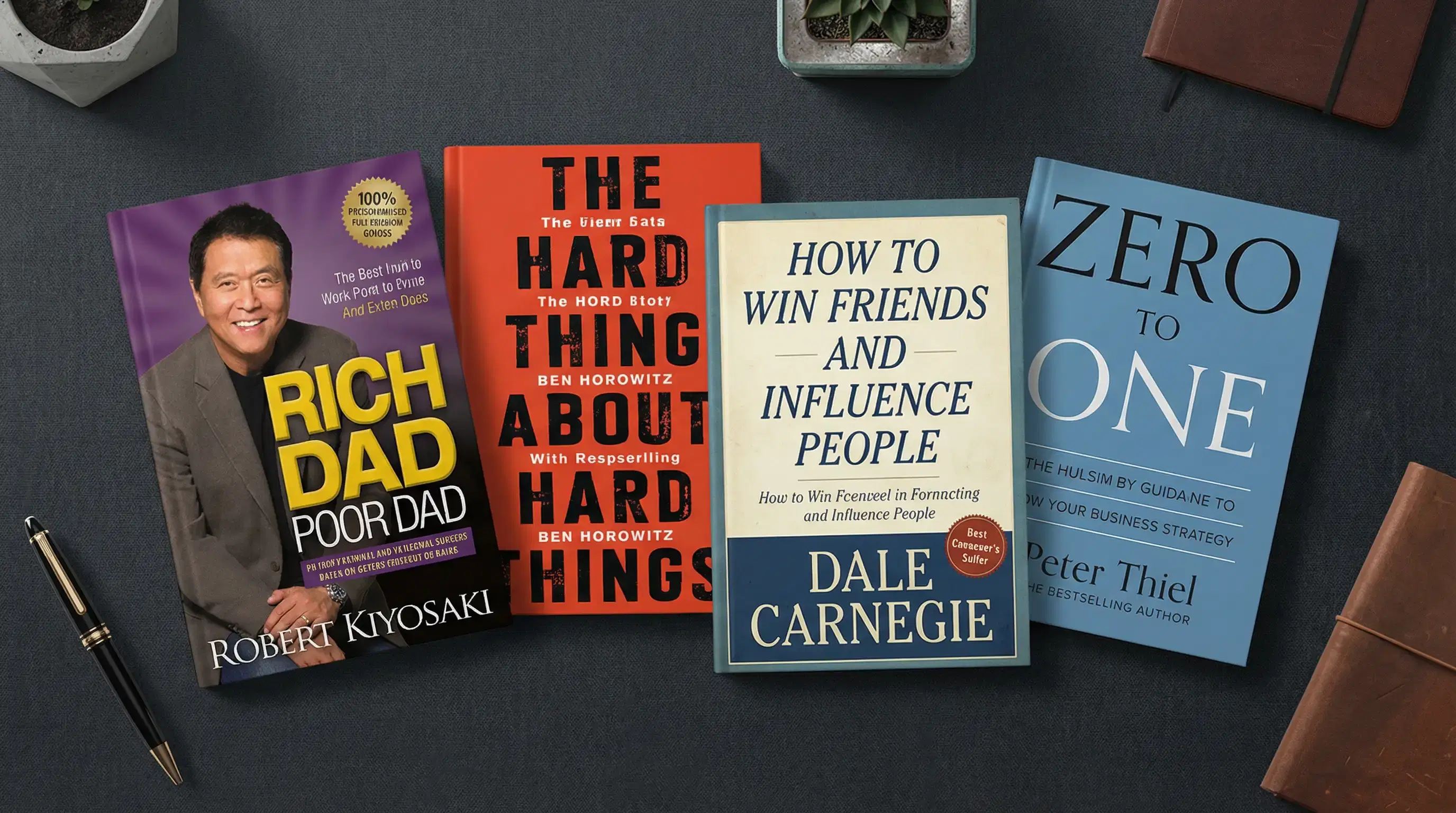
Rich Dad Poor Dad by Robert Kiyosaki
The book that introduced the concept of financial intelligence to mainstream readers. Through the contrast between his biological father, a highly educated man who struggled financially his entire life, and his friend’s father, who built lasting wealth without a formal education, Kiyosaki articulates the mindset differences that separate financial struggle from financial freedom. It has sold over 40 million copies worldwide and remains the starting point for millions of people’s financial education.
Atomic Habits by James Clear
The definitive modern guide to building good habits and breaking bad ones, rooted in the science of behavior change and written with extraordinary clarity. Clear’s central argument, that tiny improvements compounded over time produce remarkable results, applies to every area of life but is particularly powerful in a professional and financial context. One of the most widely implemented books ever written, in the sense that its readers actually do what it suggests.
Think and Grow Rich by Napoleon Hill
Published in 1937 and never out of print, this is one of the bestselling business books of all time. Hill said he had studied the habits and philosophies of the most successful people of his era, including Andrew Carnegie, Henry Ford and Thomas Edison, and distilled what he found into principles of success. That origin story is disputed - Carnegie's principal biographer, David Nasaw, has said he found no evidence the two men ever met - so it is better read as a work of persuasion whose ideas have proved durable than as a report of documented research. Its central insight, that a burning, clearly defined desire, combined with a specific plan and persistent action, is the foundation of achievement, remains as relevant as when it was first published.
Zero to One by Peter Thiel
Co-founder of PayPal and one of Silicon Valley’s most distinctive thinkers, Peter Thiel makes the provocative argument that true progress comes not from copying what works but from creating something genuinely new. Going from zero to one, creating a new thing, is fundamentally different from going from one to n, and most business education focuses on the wrong one. Essential reading for anyone thinking about building a company or developing a genuinely differentiated career.
The Hard Thing About Hard Things by Ben Horowitz
Most business books tell you what to do when things go reasonably well. Ben Horowitz’s book is about what to do when things go terribly wrong, when you have to lay off people, when your company is close to failing, when there is no good option and you have to choose between bad ones. Written with a honesty that most business authors avoid, this is the most realistic account of what leadership actually requires that exists in business literature.
How to Win Friends and Influence People by Dale Carnegie
Published in 1936 and still one of the bestselling books of all time, Carnegie’s guide to human relations is as relevant today as when it was written. Its fundamental insight, that success in business and in life depends on your ability to understand what other people want and to make them feel genuinely valued, is simple but profoundly underappreciated. A book that has launched more successful careers than almost any other ever written.
The Lean Startup by Eric Ries
The book that changed how a generation of entrepreneurs approach building a company. Ries’s core argument, that startups should build minimum viable products, measure real customer responses, and learn fast rather than executing a long plan toward an uncertain goal, has become the foundational methodology of the modern startup world. Even for people who never start a company, the lean approach to testing assumptions before committing fully is one of the most valuable thinking frameworks available.
The Psychology of Money by Morgan Housel
One of the most important finance books of the last decade, Housel’s argument is that financial success has less to do with knowledge than with behavior, and that behavior is driven by psychology. Why do smart, well-informed people make terrible financial decisions? Because they are human. Understanding the emotional and cognitive patterns that drive financial choices is the foundation of changing them, and no book makes this case more clearly or more compellingly than this one.
How to Get the Most Out of Every Business Book You Read
Most people read business books wrong. They read them the way they read novels, beginning to end, once, and then onto the next one. This approach captures perhaps ten percent of the value available in a great business book. The other ninety percent requires a different approach.
The single most important habit for getting real value from business reading is implementing before you finish. When you encounter an idea that applies to your current situation, a framework that could help you make a decision you are currently facing, a principle that challenges a belief you have been operating on, stop and apply it before moving forward. The goal of reading a business book is not to finish it. The goal is to change how you think and act. An idea applied imperfectly is worth infinitely more than an idea read and forgotten.
The second habit is active engagement with the text. Write in the margins. Underline the sentences that hit hardest. Keep a notebook of the ideas that feel most relevant to your specific situation. This is not just a memory aid, it is a way of converting passive reading into active thinking. The physical act of writing down an idea forces you to process it more deeply than simply reading it, and the notes you make during your first read become the starting point for every time you return to the book.
And rereading great business books is one of the most underrated habits a serious reader can develop. A book you read when you were starting out will reveal completely different things when you read it five years into building a company. The book has not changed, but you have. The experience and context you have accumulated means that ideas which once seemed abstract now land with immediate practical force. The best business books are not single-use, they are resources that continue paying dividends for as long as you keep returning to them.
What Business and Finance Readers Are Reading in 2026
The business and finance book category has always reflected the anxieties and ambitions of its moment, and in 2026, that moment is defined by artificial intelligence, economic uncertainty, and a generation of readers who want practical financial knowledge more urgently than ever before.
AI and technology books have become the dominant force in business reading right now. As artificial intelligence transforms every industry simultaneously, business readers are hungry for frameworks that help them understand what is actually happening, what it means for their specific sector, and how to position themselves and their organizations to benefit rather than be displaced. Books that explain the business implications of AI, rather than just the technical mechanics, are currently some of the fastest-selling titles in the entire non-fiction category.
Personal finance content is also experiencing a significant surge, driven partly by economic uncertainty and partly by a generation of younger readers who grew up without meaningful financial education and are now actively seeking to fill that gap. Books that teach the fundamentals of investing, budgeting, and building financial independence, without condescension or unnecessary complexity, are reaching enormous audiences through social media and podcast recommendation.
There is also a clear shift toward books by founders and operators rather than academics and consultants. Readers in 2026 are deeply skeptical of theoretical business advice and are actively seeking out books written by people who have actually built and run real companies, people who have been in the room when the hard decisions were made and can speak to what the experience actually felt like rather than what the textbook says it should feel like.
How to Find the Right Business Book for Where You Are Right Now
The most important thing to understand about business and finance reading is that the right book depends entirely on where you are in your journey. A book that is transformative at one stage can feel obvious at another, and one that feels too advanced today may be exactly what you need in two years. Reading the right book at the right moment is more valuable than reading the most acclaimed book at the wrong one.
If you are at the beginning of your financial education and have never thought seriously about money before, start with Rich Dad Poor Dad by Robert Kiyosaki. It is the most accessible and most fundamentally perspective-shifting entry point into financial literacy available. From there, The Psychology of Money by Morgan Housel will give you the emotional and behavioral foundation that makes all the technical financial knowledge actually useful.
If you are building something, a company, a career, a side business, and you are in the early stages of figuring out what you are doing, start with The Lean Startup by Eric Ries and Zero to One by Peter Thiel. Between them, they give you both a practical methodology and a philosophical framework for creating something new. Add How to Win Friends and Influence People by Dale Carnegie for the human side of building anything, and you have a reading foundation that will serve you for your entire career.
If you are already running something and dealing with the real difficulties of growth, leadership, and execution, The Hard Thing About Hard Things by Ben Horowitz is the book that will make you feel most understood, and most prepared for whatever comes next.
How Best Selling Publisher Publishes Business and Finance Books
Publishing a business or finance book well requires a very specific set of skills, because the readers of these books are sophisticated, skeptical, and extremely good at detecting when something has not been done properly.
Authors who use professional business book publishing servicesunderstand that a cover needs to project credibility and authority immediately. The moment a potential reader sees your book, whether on Amazon, in a bookstore, or shared by someone on LinkedIn, the design needs to communicate that this is a serious book by someone who knows what they are talking about. The wrong cover, one that looks self-published in the negative sense, or that fails to signal the specific professional audience the book is written for, can make an excellent book invisible. Our cover designers understand the specific visual language of business and finance publishing and know how to position your book to command the attention and respect it deserves.
Every author who comes to us to publish business books benefits from an editing team that works to sharpen the clarity and authority of their arguments while preserving their voice and their expertise. Business books succeed when the ideas are clear and the reasoning is airtight, and our editors bring the same analytical rigor to your manuscript that your readers will bring to your arguments. We also handle Amazon KDP setup and keyword optimization specifically for the business and finance category, ensuring your book appears in front of the professional readers who are actively searching for exactly what you have written.
Authors work with Best Selling Publisher with their stories and their expertise. We would love to help your knowledge reach the professional audience it deserves.
Conclusion
Every serious professional owes it to themselves to read great business books. Not because reading is a virtue, but because the return on investment is extraordinary. An afternoon spent with the right book can save you years of expensive mistakes. A single framework absorbed deeply can change how you make decisions for the rest of your career. The accumulated wisdom of the greatest business minds of the last century is sitting on shelves and screens, available to anyone willing to engage with it seriously, and most people are leaving that resource almost entirely untapped.
Whether you are at the very beginning of your financial education, in the middle of building something significant, or ready topublish a business book and share what you have learned, there is a business or finance book that was written for exactly where you are. The only question is which one you are going to read first.
And if you are the person with the experience, if you have lived through something in business or finance that taught you things you wish someone had told you at the beginning, that knowledge deserves to exist as a book. The readers who need what you know are out there, making the same mistakes you have already made and looking for exactly the guidance you are uniquely positioned to give them.
FAQs
Working with a professional publishing partner who understands the business and finance category is the most effective route for most authors. Best Selling Publisher offers complete business book publishing services, including professional editing, cover design, Amazon KDP setup, and targeted marketing, from manuscript editing and cover design to Amazon KDP publishing, keyword optimization, and targeted marketing that reaches the professional communities where business readers actually spend their time. Contact our team to learn how we can help your expertise reach the readers who need it.
Business books focus primarily on professional and financial development, how to build companies, lead teams, manage money, and create value in the marketplace. Self-help books have a broader focus that often includes personal relationships, emotional wellbeing, and life satisfaction more generally. The two categories overlap significantly, and many of the most effective books, like Atomic Habits or The Psychology of Money, contain elements of both. The distinction matters less than finding books that give you the specific knowledge and mindset shifts you are looking for right now.
Most successful business books fall between 50,000 and 80,000 words, shorter than most fiction because business readers tend to be time-conscious and prefer books that deliver their core ideas with efficiency and clarity. The best business books are as long as they need to be and no longer. A business book that could make its case in 60,000 words but stretches to 100,000 will frustrate readers. The goal is density of insight, not volume of pages.
Yes, but only for readers who engage with them actively rather than passively. A business book read once and never thought about again has limited impact. The same book read carefully, with its key ideas written down, discussed with others, and deliberately applied to real decisions, can genuinely change how a person operates. The overwhelming evidence from the reading habits of highly successful people is that consistent engagement with great business literature has a compounding effect on thinking and decision-making that shows up in real outcomes over time.
The business books that reach bestseller status consistently share several characteristics: a single powerful central idea that can be expressed in one clear sentence, practical applications that readers can implement immediately, writing that is clear and direct without being simplistic, and a strong authentic voice that comes from genuine experience rather than theoretical knowledge. They also tend to be released with a strong marketing strategy, including pre-launch relationships with influential readers, podcast appearances, and a clear promotional plan that reaches the specific professional community the book is written for.