
How Long Does It Take to Write a Book with a Ghostwriter?

You have the idea. You have the knowledge, the story, or the expertise that deserves to be in print. What you do not have is the answer to the question that stops most aspiring authors before they even begin: how long does it take to write a book, and is there actually a way to do it without sacrificing the next two years of your life?
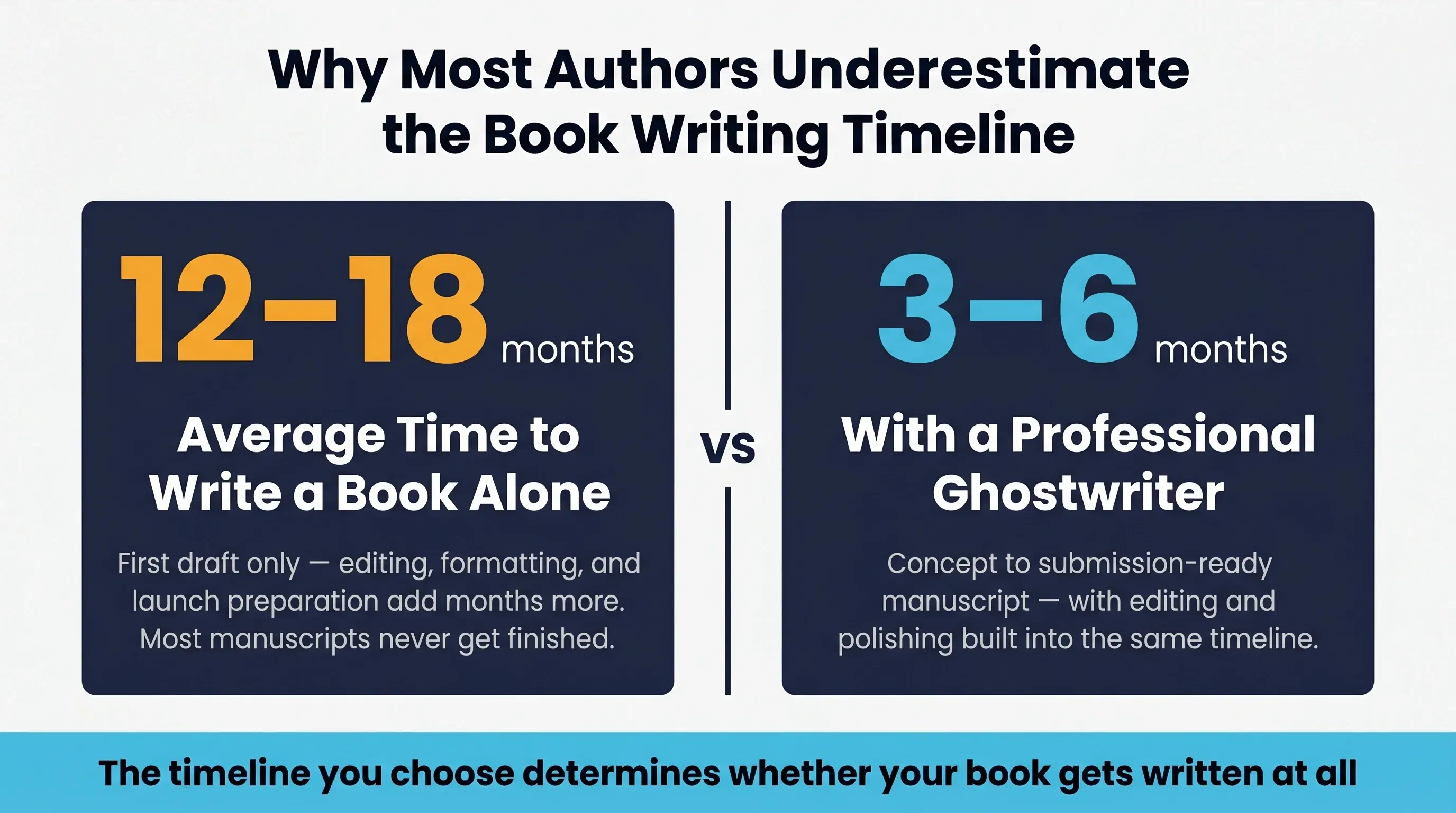
The honest answer is that the timeline depends heavily on how you approach the process. Authors who sit down to write alone, fitting in pages around a full schedule, routinely take 12 to 18 months to produce a first draft, and that is assuming they do not abandon the project entirely, which most do. The statistics on unfinished manuscripts are not encouraging. The majority of books that get started never get finished, not because the ideas were not good but because writing a full-length book without professional support is harder and slower than most people expect.
Working with a professional ghostwriting services team changes that equation completely. A structured ghostwriting timeline moves from concept to submission-ready manuscript in three to six months for most projects, with clear milestones at every stage. You stay in control of your ideas, your voice, and your message. The ghostwriter handles the craft, the consistency, and the word count. The result is a book that sounds like you, built on a timeline that actually works.
This guide breaks down every phase of the book writing timeline, explains what affects how fast or slow a project moves, compares the real-world difference between writing alone and working with a ghostwriter, and shows you exactly what the process looks like behind the scenes. By the time you finish reading, you will know precisely what to expect and how to make it happen.
Understanding the Timeline of Writing a Book
Before diving into phases and durations, it helps to understand why the book writing timeline is something authors so often underestimate. Writing a book is not a single task. It is a sequence of distinct phases, each with its own skill requirements, time demands, and dependencies. Skipping a phase or rushing through it does not save time in the long run. It creates rework, quality problems, and the kind of structural issues that surface in reader reviews months after publication.
Understanding the timeline also matters because it shapes your publishing strategy. An author who knows their manuscript will be ready in four months can coordinate with a cover designer, plan a launch campaign, set up pre-orders, and build anticipation before the book is even live. An author who has no timeline is always reacting, always behind, and rarely launching with the momentum a well-timed release deserves.
Why Timeline Matters for Authors
For professionals using a book to build authority, every month the manuscript sits unfinished is a month that a competitor who published first is collecting the speaking invitations, the media coverage, and the high-value client inquiries. For memoir writers and storytellers, a long uncertain timeline creates fatigue that erodes the emotional energy the writing requires. For entrepreneurs and thought leaders, a book that takes two years to produce has often been overtaken by market changes before it even launches.
A defined ghostwriting timeline breakdown solves all of these problems. It turns a vague aspiration into a managed project with a known endpoint. It creates accountability between the author and the writing team. And it gives everyone involved, from designers to marketers to the author's own network, a date to work toward.
Average Time to Write a Book - With vs Without a Ghostwriter
The average time to write a book on your own, for a first-time author working alongside a full schedule, is typically 12 to 18 months for the first draft alone. Add professional editing, cover design, and formatting, and the full production process stretches to two years or more for most self-publishing authors who go it alone.
With a professional ghostwriter, the same book takes three to six months from initial concept to a submission-ready manuscript. The editing, revision, and polishing phases are built into that timeline. Some projects move faster. Complex books with deep research requirements or extensive source material may run longer. But the range of three to six months is where the vast majority of book ghostwriting services projects land, and it is a timeline that changes what is possible for authors who have been putting the project off for years.
Ghostwriting Timeline at a Glance
The table below shows the full arc of a typical ghostwriting project from first conversation to final manuscript delivery.
| Phase | Duration | What Happens |
|---|---|---|
| Idea Development | 1–2 weeks | Concept clarity, goals, audience definition |
| Research & Outlining | 2–4 weeks | Market research, competitive analysis, chapter outline |
| First Draft Writing | 2–6 months | Chapter-by-chapter drafting with author collaboration |
| Editing & Revisions | 2–4 weeks | Developmental editing, line editing, author feedback rounds |
| Final Delivery | 1–2 weeks | Final polish, formatting, submission-ready manuscript |
Total typical range: 3 to 6 months. The section below walks through each phase in detail.
Step-by-Step Timeline of Writing a Book with a Ghostwriter
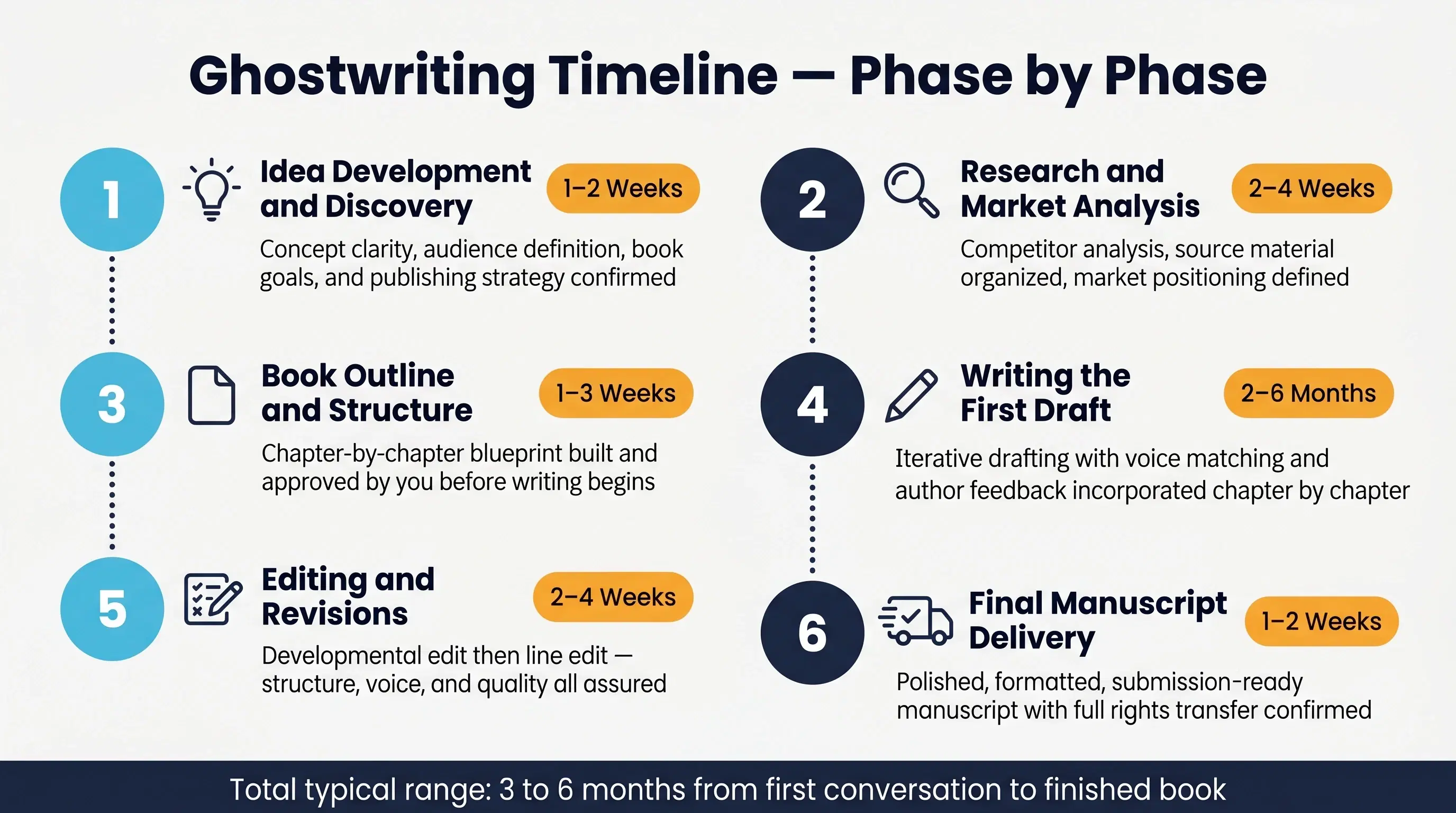
The book writing timeline steps are not arbitrary. Each phase builds on the last, and the sequence exists because shortcuts in the early stages create compounding problems later. Here is exactly what happens at every stage of a professionally managed ghostwriting project.
Phase 1 - Idea Development and Discovery (1 to 2 Weeks)
Every book begins with a conversation, not a word count. The discovery phase is where the ghostwriter and the author work together to move from a general idea to a clear, publishable concept. This means defining the central thesis, the target reader, the tone, and the positioning. What is this book for? Who needs it? What will they know, feel, or be able to do after reading it? What makes it different from the five similar books already on Amazon?
This phase feels like the least tangible because no pages are produced. In reality it is the most important investment of time in the entire project. The clarity that comes out of a strong discovery phase shapes every decision that follows, from the chapter structure to the cover concept to the marketing language. Authors who rush through this stage or skip it entirely tend to end up with manuscripts that work technically but do not connect with readers in any meaningful way.
Phase 2 - Research and Market Analysis (2 to 4 Weeks)
Once the concept is clear, the research phase begins. For nonfiction, this involves reviewing relevant literature, interviewing subject matter experts if needed, analyzing competing titles on Amazon to understand what already exists and where the gaps are, and organizing source material into a reference framework the writing can draw from.
For memoir and narrative nonfiction, research means interviews with the author, review of existing documentation, timelines, and source materials, and the development of a factual foundation that the storytelling can rest on securely. For business books and thought leadership titles, this phase involves synthesizing the author's existing frameworks, case studies, client stories, and intellectual property into material the ghostwriter can work with.
The manuscript development timeline benefits significantly from a well-organized research phase. A ghostwriter who enters the writing phase with solid research in hand writes faster, more confidently, and with fewer gaps that require going back to fill in later.
Phase 3 - Book Outline and Structure Creation (1 to 3 Weeks)
The outline is the architecture of the book. A chapter-by-chapter structure is built, each chapter given a clear purpose, a defined set of points to cover, a logical entry and exit, and a role within the larger narrative arc. The author reviews and approves the outline before writing begins.
This approval step is one of the most important in the entire process. Changing the structure of a book after the manuscript is half-written is expensive in time and often in quality. Getting the author's sign-off on the chapter-level map before the first draft begins ensures that the writing phase moves in the right direction from the start. It also gives the author a clear picture of what the finished book will look like, which builds confidence and enthusiasm for the project.
Phase 4 - Writing the First Draft (2 to 6 Months)
This is the longest phase of the ghostwriting timeline, and it is also the phase where the author's involvement matters most for quality. The ghostwriter produces chapters progressively, submitting them in batches for the author to review. The author's feedback during this phase is not just a quality check. It is part of how the ghostwriter refines their understanding of the author's voice, preferred examples, natural phrasing patterns, and communication style.
Voice matching is a skill that develops across the early chapters and sharpens as the project progresses. By the midpoint of a well-managed project, an experienced ghostwriter is producing chapters that read as if the author wrote them, because the collaboration has built a deep enough model of how that specific author communicates. This is what separates a professional ghostwriter for hire from a generic writing service.
Regular collaboration during this phase also prevents the most common cause of project delays: major structural corrections discovered late. When the author is reviewing chapters as they are produced rather than waiting for the full draft, small course corrections happen in real time and at low cost.
Phase 5 - Editing and Revisions (2 to 4 Weeks)
Once the full first draft is complete, the editing phase begins. A professional book writing services process separates editing into distinct passes. Developmental editing looks at the manuscript as a whole: structure, argument, pacing, chapter flow, and whether the book delivers on the promise it made to the reader in the introduction. Line editing then works sentence by sentence to refine clarity, rhythm, word choice, and consistency of voice. Proofreading catches what everything else missed.
Author feedback is incorporated at the developmental level before line editing begins, which keeps the revision process efficient. A clear round structure, where the author receives the manuscript, provides consolidated notes, and the editor incorporates changes, prevents the revision cycle from becoming an open-ended back-and-forth that stalls the project.
Phase 6 - Final Manuscript Delivery (1 to 2 Weeks)
The final phase covers the last polish pass, formatting the manuscript to publishing standards, and preparing a clean submission-ready file. At this stage, the book is ready to move directly into the production pipeline, whether that means uploading to Amazon KDP, submitting to a traditional publisher, or handing off to a cover designer and interior formatter as part of a full publishing package.
A professionally delivered manuscript at this stage is not just a Word document with chapters. It includes the front matter, back matter, consistent heading structure, author bio, chapter breaks, and any other elements the specific publishing path requires. It is a book, not a draft.
Total Time to Write a Book with a Ghostwriter
The full writing process stages described above produce a total timeline that varies based on the complexity and nature of the project. Here is how the three main timeline categories break down in practice.
Typical Timeline Range - 3 to 6 Months
The majority of professionally ghostwritten books, including most nonfiction, business books, self-help titles, and personal memoirs of moderate length, are completed in three to six months. This assumes an author who is reasonably available for interviews and feedback, a manuscript in the 40,000 to 80,000-word range, and a project that does not require extensive original research beyond what the author can provide. This is the sweet spot of the ghostwriting timeline because it is fast enough to create business momentum and long enough to produce work that does not feel rushed.
Fast-Track Projects - 1 to 3 Months
Some projects genuinely qualify for a faster timeline. Short books in the 20,000 to 35,000-word range, including business manifestos, thought leadership primers, and focused how-to guides, can move from concept to delivery in one to three months with a dedicated writing team. Fast-track timelines require higher author availability, faster feedback turnaround, and often a larger team to maintain output quality under the accelerated schedule. Fast ghostwriting services at this pace are genuinely possible, but they work best when the author comes in with a clear concept, organized materials, and the bandwidth to stay closely involved.
Long-Term Projects - 6 to 12 Months
Some books are simply more complex than the average project. Multi-part narrative nonfiction, comprehensive industry guides, books requiring extensive original research or expert interviews, and ambitious fiction projects often run six to twelve months. This is not a sign of inefficiency. It is a reflection of the depth the project demands. A book production timeline that respects the complexity of a project produces a better book than one that forces a complex manuscript into a standard-length window.
What Affects the Ghostwriting Timeline?
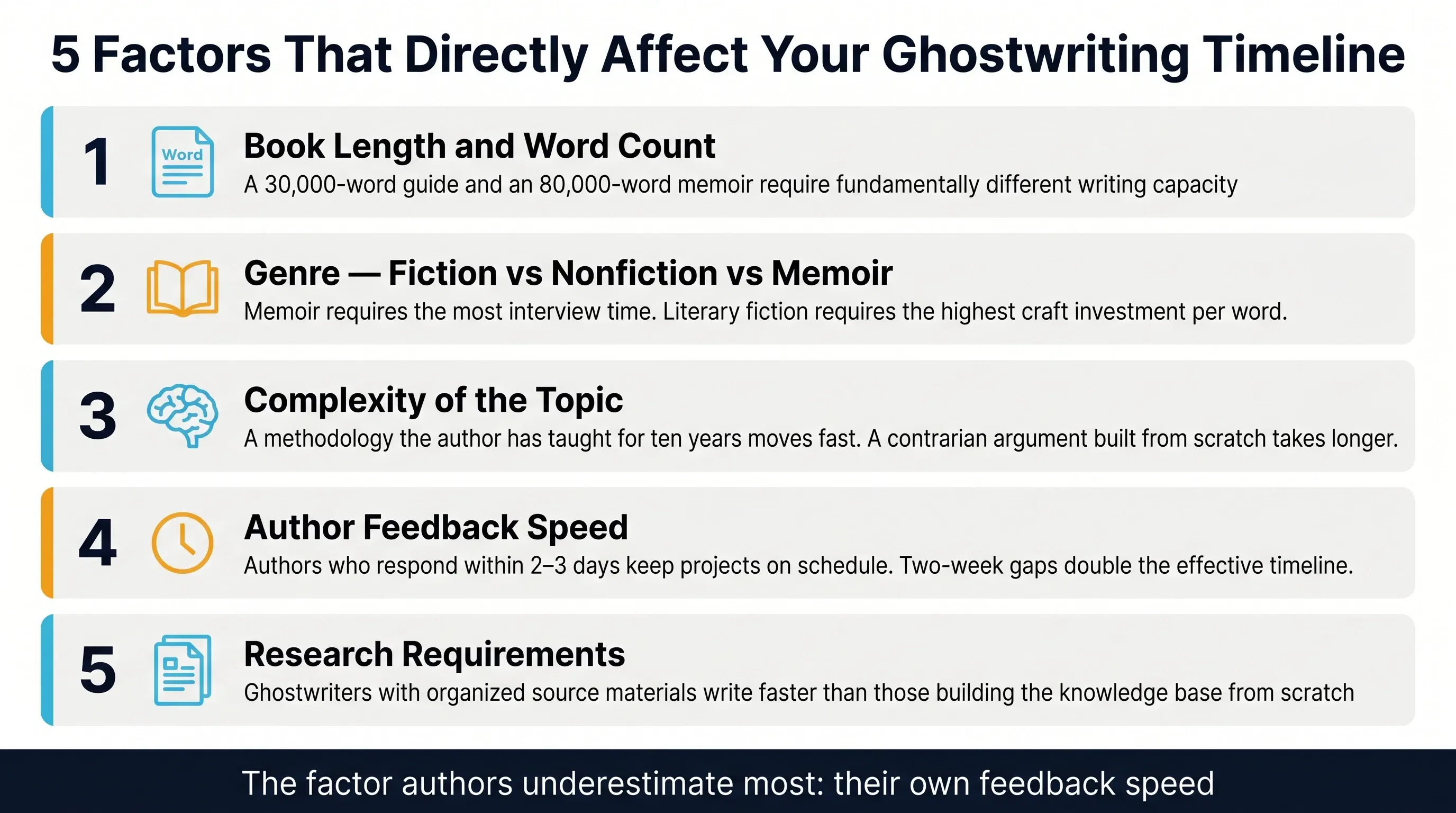
Two projects with the same word count can have very different timelines depending on a handful of factors that experienced authors and writing teams account for before the contract is signed. Understanding these variables makes it easier to set realistic expectations and plan accordingly.
Book Length and Word Count
This is the most obvious variable and the most straightforward to plan around. A 30,000-word business book and an 80,000-word memoir require fundamentally different writing capacity. Most professional ghostwriting services price and timeline projects in part based on word count, and the relationship between length and time is roughly linear once research and structural complexity are accounted for.
Genre - Fiction vs Nonfiction vs Memoir
Genre affects timeline in ways that go beyond word count. Nonfiction typically moves faster than fiction at the drafting stage because the content exists as real information to be organized and communicated rather than invented. Memoir requires significant author interview time and emotional processing before the writing can begin in earnest. Literary fiction and character-driven narrative require the most craft investment per word and generally carry the longest timelines for comparable word counts. The ghostwriting timeline breakdown for each genre reflects these underlying realities.
Complexity of the Topic
A book about a straightforward professional methodology the author has been teaching for a decade moves quickly because the content is already fully formed. A book that requires synthesizing research across multiple disciplines, covering an emerging field where sources are limited, or presenting a contrarian argument that must be built carefully from the ground up takes longer because the intellectual architecture itself needs time to develop.
Author Availability and Feedback Speed
This is the variable that authors underestimate most consistently. The author collaboration model that makes ghostwriting work depends on the author being available for interviews, reviewing draft chapters in a reasonable window, and providing consolidated feedback rather than fragmented notes across multiple communications. Authors who respond within two to three business days keep the project on schedule. Authors who take two to three weeks to review each chapter double the effective timeline without the word count changing at all.
Research Requirements
Books that require the ghostwriter to conduct independent research beyond what the author provides add time in proportion to the depth and breadth of that research. If the author can supply organized materials, case studies, existing content, and reference sources, the writing team moves faster. If the ghostwriter is essentially building the knowledge base from scratch, that work takes time and that time shows up in the timeline.
Ghostwriter vs Writing Yourself - Timeline Comparison
The comparison most authors want to see before making a decision is a direct, honest look at what each path actually costs in time. The table below reflects real-world outcomes, not optimistic projections.
| Factor | Writing It Yourself | Hiring a Ghostwriter |
|---|---|---|
| Average Timeline | 12–18+ months | 3–6 months |
| Writing Consistency | Depends on schedule | Dedicated, structured output |
| Professional Editing | Separate cost and step | Often included in package |
| Time Investment | High - hundreds of hours | Low - interviews and reviews |
| Risk of Abandonment | Very high - most manuscripts stall | Low - professional accountability |
| Quality Ceiling | Limited by writing experience | High - professional craft applied |
| Time to Market | Unpredictable | Defined from day one |
The most significant difference in the table is not the timeline itself. It is the abandonment risk. Studies and publishing industry data consistently show that the vast majority of authors who start writing a book alone never finish it. Life intervenes, motivation fades, the gap between the vision and the words on the page becomes demoralizing. A professional ghostwriting engagement creates accountability structures that keep the project moving even when the author's own motivation is not at its peak.
Faster publishing with ghostwriter support is not just about convenience. It is about the difference between a book that exists and a book that never gets finished. For most authors, that distinction is worth more than any other factor in the decision.
How the Ghostwriting Process Works - Behind the Scenes
Most authors who have never worked with a ghostwriter before have questions about what the collaboration actually looks and feels like in practice. The mechanics of how a professional ghostwriter captures someone else's voice and produces a book that reads authentically are worth explaining clearly.
Interviews with the Author
The foundation of every ghostwriting project is a series of structured interviews between the ghostwriter and the author. These conversations are not casual chats. They are designed to extract specific information: stories, examples, frameworks, opinions, experiences, and the underlying thinking behind the author's expertise. The best ghostwriters are excellent interviewers who know how to draw out material the author did not know they had.
These interviews also serve a second purpose. They give the ghostwriter an extended sample of how the author speaks, which words they favor, how they structure an argument, what they emphasize when making a point, and what their natural rhythm sounds like. This is the raw material of voice matching.
Voice Matching and Style Adaptation
Voice matching is the craft skill that separates a high-quality ghostwriting engagement from a generic writing service. It means reading samples of anything the author has written, studying how they communicate in interviews, identifying the sentence structures they naturally reach for, and then writing in a way that captures that specific person's communication style at its most coherent and compelling.
When voice matching is done well, the author reads the manuscript and recognizes themselves in it. They might think the ghostwriter made their ideas clearer or more structured than they would have managed alone, but the voice feels unmistakably theirs. That recognition is what makes custom ghostwriting services worth the investment.
Iterative Drafting Process
Professional ghostwriters do not disappear for three months and reappear with a finished manuscript. The drafting process is iterative, with chapters submitted in batches, author notes incorporated progressively, and the writing refined chapter by chapter across the project. This approach catches problems early, keeps the author engaged with the material, and ensures the final manuscript reflects genuine collaboration rather than one person's interpretation of another person's ideas.
Collaboration Workflow
A well-managed writing process stages workflow uses a combination of structured interviews, shared documents for draft review, a defined feedback protocol, and regular check-in calls to keep the project on track. The author is never out of the loop and is never overwhelmed. Their involvement is designed to be exactly as much as is needed to produce a book that is genuinely theirs, and no more than is necessary to keep the timeline moving.
How to Speed Up the Book Writing Process
The writing efficiency of a ghostwriting project is not solely in the ghostwriter's hands. Authors who want to hit the faster end of the timeline range have more control over that outcome than they often realize. These are the four highest-impact things an author can do to keep the project moving.
Provide Clear Ideas and Direction from the Start
The discovery phase exists precisely to build this clarity, but authors who arrive at that phase with organized thinking, existing content like presentations, articles, or course materials, and a strong sense of what they want the book to accomplish give the ghostwriter a head start that shortens every subsequent phase. Vague briefs produce slow writing. Clear direction produces fast, accurate output.
Respond Quickly to Drafts
There is no single factor that affects content creation timeline more directly than author feedback speed. A ghostwriter who receives a chapter review within two to three business days can maintain writing momentum and carry the tone, voice, and thematic threads from one chapter directly into the next. Gaps of two weeks between feedback rounds break that continuity and force reconstruction work that costs time without producing new content.
Choose an Experienced Ghostwriter
An experienced ghostwriter who has produced books in your genre writes faster, makes fewer structural errors, requires less revision, and delivers chapters that are closer to final quality on first submission. The time saved across a 60,000-word project by working with someone who has done it fifty times before, rather than someone doing it for the fifth time, is measured in weeks. The ghostwriting return on investment case for experience is strong even when the per-word rate is higher.
Avoid Major Scope Changes Mid-Project
Reconsidering the core premise of the book three months into writing is the single most expensive thing an author can do to their timeline. A new angle, a revised target audience, or a significantly restructured chapter sequence after 30,000 words have already been written does not just add time. It often invalidates work that cannot be salvaged. If scope changes are needed, addressing them during the outline approval phase costs days. Addressing them after the draft is half-written costs weeks.
Common Delays in Ghostwriting Projects
Even well-managed projects encounter delays. Understanding the most common causes makes them easier to avoid or address quickly when they do arise.
- Lack of clarity in the book concept. If the core premise is not fully defined before writing begins, the ghostwriter is essentially building and demolishing at the same time. Structural uncertainty in the early chapters tends to cascade through the entire manuscript.
- Slow feedback from the author. As discussed above, delayed reviews are the single most common cause of timeline overruns in ghostwriting projects. A project that loses two weeks per chapter across ten chapters arrives at delivery three months behind the original schedule with no change in quality.
- Extensive revisions driven by unclear briefs. When the initial brief does not capture what the author actually wants, the revision process becomes a discovery process. This is expensive in both time and goodwill. Strong upfront clarity prevents most of this.
- Complex research topics that expand in scope. Research-heavy projects sometimes reveal, partway through, that the topic is more complex than originally scoped. Managing this well means flagging the expansion early, adjusting the timeline with the author's agreement, and not attempting to compress genuinely complex content into an inadequate window.
Is Hiring a Ghostwriter Worth the Time Investment?
The question of hiring a ghostwriter comes down to what the book is meant to do and what the author's time is actually worth. For a professional using the book to attract premium clients, a single new client who found them through the book pays for the ghostwriting cost many times over. For a business owner whose hourly value is several hundred dollars, the 500 to 800 hours that writing a book alone would consume is worth more than the investment in a professional ghostwriter. For anyone who has been talking about writing a book for years without producing it, the value of a structure that actually makes it happen is incalculable.
Faster Time to Market
Every month that passes before a book is published is a month that competitors who have already published are collecting the authority, the media coverage, and the business opportunities that a published book generates. Benefits of hiring a ghostwriter include getting to market in three to six months instead of two or more years. For professionals in fast-moving industries, that time difference is not just convenient. It is strategically decisive.
Higher Quality Output
A professional ghostwriter's entire career is built on the craft of producing excellent long-form writing. The average author, regardless of how expert they are in their subject matter, produces their first book through a learning curve that costs quality as well as time. A ghostwriter brings that craft fully formed to the project, which means the book that results is typically better written than what the author would have produced alone, even though it sounds exactly like them.
Better Publishing Opportunities
A professionally ghostwritten manuscript opens doors that self-written drafts often cannot. Literary agents respond better to professionally polished submissions. Publishers make faster decisions on clean, well-structured manuscripts. Book publishing services downstream of the writing, including marketing, distribution, and launch support, integrate more smoothly with a manuscript that was built to professional standards from the beginning. The ghostwriting time vs quality trade-off resolves clearly in favor of professional ghostwriting when the downstream value is considered.
How Best Selling Publisher Structures a Ghostwriting Project
Best Selling Publisher can structure a ghostwriting scope around discovery, research, outline approval, drafting, editing, and final author review. The signed order defines the assigned roles, milestones, and acceptance criteria.
Structured Writing Process
A ghostwriting project can follow the phased structure described in this blog. Discovery, research, outline approval, iterative drafting, editing, and final delivery are treated as distinct stages with documented deliverables. The approved order records the project schedule and each party's review responsibilities.
Dedicated Writing Teams
Rather than assigning a single freelance writer to a project and hoping for the best, Best Selling Publisher uses dedicated teams matched to each project's genre and content requirements. This means the right expertise is applied at every stage, the team is accountable to each other as well as to the author, and projects do not stall because a single individual is overextended.
Efficient Collaboration Systems
Structured interviews, document sharing, feedback records, and milestone check-ins keep project decisions organized and reviewable. The exact workflow and meeting cadence are defined for the project.
Proven Timelines and Workflows
A professional production plan should define the scope, review stages, dependencies, and delivery checkpoints before work begins. Ownership and royalty terms should also appear in the signed order so the author can review them directly.
FAQs
Most professionally ghostwritten books are completed in three to six months from initial concept to final manuscript delivery. Short projects in the 20,000 to 35,000-word range can be completed in one to three months. Complex, research-heavy, or longer manuscripts may run six to twelve months. How long does it take to write a book question is best answered with a project-specific assessment that accounts for word count, genre, topic complexity, and author availability.
Yes, in specific circumstances. A short book of 15,000 to 25,000 words with a fully developed concept, an author who can commit to daily collaboration, and a dedicated writing team focused exclusively on the project can be completed in 30 days. This is not the typical timeline and not appropriate for every project, but it is achievable for the right combination of scope, commitment, and resources. If speed is a genuine priority, fast ghostwriting services with a defined sprint structure make it possible.
The fastest path from concept to finished manuscript combines three things: hiring an experienced ghostwriter with a proven track record in your genre, arriving at the project with a clear concept and organized materials, and committing to fast feedback turnaround throughout the drafting process. Authors who do all three consistently hit the faster end of the timeline range. Writing efficiency is a shared responsibility between the author and the writing team.
Your involvement is front-loaded and then relatively light. The discovery and outline phases require meaningful engagement because the decisions made there shape the entire project. During the drafting phase, the main requirement is reviewing chapter batches in a timely manner and providing clear, consolidated feedback. For most authors, the active time commitment across a full project is 20 to 40 hours spread over the project duration. The ghostwriter handles the thousands of hours of actual writing. Your job is to be the expert, not the writer.
Yes, significantly. Nonfiction business books and thought leadership titles tend to move fastest because the content exists as real expertise to be organized and communicated. Memoir requires more interview time and emotional processing before drafting can begin. Literary fiction and character-driven narrative require the highest craft investment per word and generally carry the longest timelines. A ghostwriting timeline breakdown by genre reflects these underlying differences in content type and writing process.
For the vast majority of professionals, yes. The ghostwriting return on investment is positive when a single outcome the book generates, whether that is a new client, a speaking engagement, a media feature, or the authority that justifies a fee increase, exceeds the investment. Beyond the financial case, the benefits of hiring a ghostwriter include professional quality, a defined timeline, and the simple fact that the book actually gets finished. Most authors who attempt to write alone never complete the manuscript. Working with a professional ghostwriter is the difference between a book that exists and one that stays an idea.