
How Professional Ghostwriters Write Books Across Every Genre

There is a book inside almost every person who has lived an interesting life, built something significant, or spent years accumulating expertise in a field that others are trying to understand. The obstacle is rarely a shortage of stories or ideas. It is the gap between having something worth saying and knowing how to say it in a way that holds a reader's attention across two hundred pages.
Professional ghostwriters close that gap. They are skilled writers who work in service of someone else's vision, translating ideas, experiences, and expertise into manuscripts that read as if the named author wrote every word. The result is a book that carries the subject matter expert's voice, reflects their authentic perspective, and meets the quality standard that publishing and commercial success demand.
The practice is far more widespread than most people realize. Business books, memoirs, political autobiographies, self-help titles, and genre fiction all routinely involve professional ghostwriters working behind the scenes. The named author provides the ideas, the authority, the life experience, or the creative concept. The ghostwriter provides the craft, the structure, and the tens of thousands of words that make a book worth reading.
What follows is a complete picture of how professional ghostwriting services work, what the process looks like from first conversation to finished manuscript, how skilled ghostwriters adapt their approach across radically different genres, and what authors at every stage of their publishing journey need to know before deciding whether ghostwriting is the right path for their book.
What Is Ghostwriting in Book Publishing?
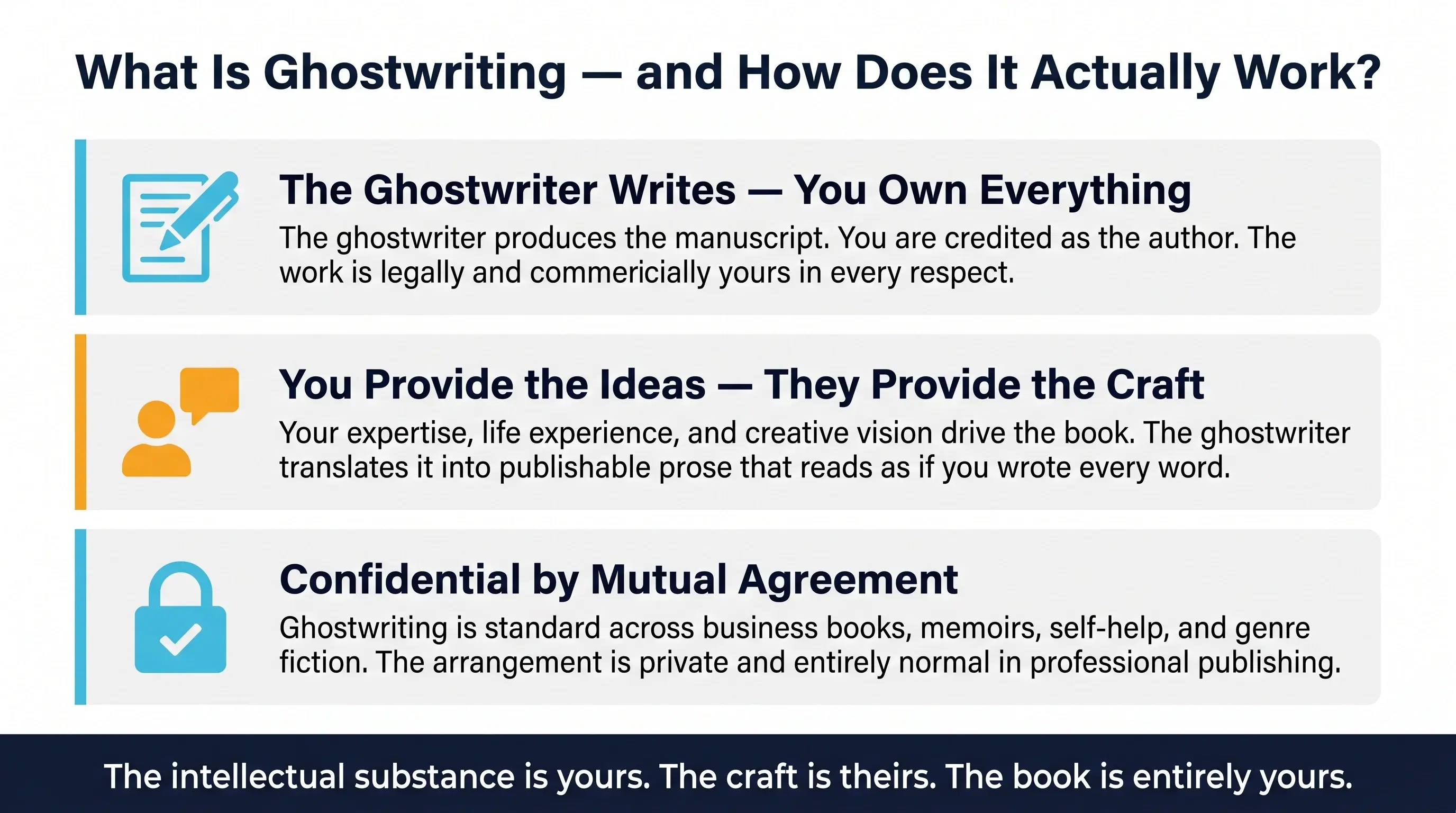
Definition of Professional Ghostwriting
Professional ghostwriting is the practice of writing a book on behalf of another person who is credited as the author. The ghostwriter produces the manuscript, the named author owns it entirely, and the arrangement is typically kept confidential by mutual agreement. The finished book is legally, commercially, and creatively the named author's work in every respect.
In publishing, book ghostwriting covers the full spectrum from concept to completed manuscript. Some ghostwriters are brought in at the idea stage and help shape the book's structure and scope before a single chapter is written. Others inherit a partial draft or a collection of notes and recordings and develop them into a publishable manuscript. The scope of involvement varies, but the outcome is always the same: a manuscript that is ready for editing, formatting, and publication under the named author's name.
Difference Between Ghostwriters and Authors
The distinction between a ghostwriter and an author is one of function rather than talent or creative contribution. Both are writers. Both produce manuscripts that require skill, craft, and sustained effort. The difference is in whose name appears on the cover and who holds the commercial and legal rights to the work.
A ghostwriter is a professional service provider whose creative output belongs to the client. An author whose book was written with ghostwriting assistance is not misrepresenting their work. They provided the ideas, the expertise, the life experience, or the creative vision. The ghostwriter provided the writing skill to realize that vision in publishable form. The intellectual substance of the book originates with the named author. The prose is the ghostwriter's contribution, transferred to the author upon completion.
Why Authors Hire Ghostwriters
The reasons are as varied as the authors themselves, but they cluster around a few consistent patterns. Many authors have deep expertise or compelling life stories but lack the writing experience to translate that material into a book that meets commercial publishing standards. Others have the writing ability but not the time to dedicate hundreds of hours to a manuscript while managing the demands of a career, a business, or a public life. Some authors have started a book and stalled, stuck at a structural problem or a motivational barrier that professional support can resolve.
There is also a strategic dimension to the decision. Ghostwriting for authors who are building a publishing-based business or author brand means the book gets written to a professional standard and released on a timeline that serves the author's commercial goals, rather than being indefinitely deferred because the writing process keeps yielding to other priorities.
How the Professional Ghostwriting Process Works
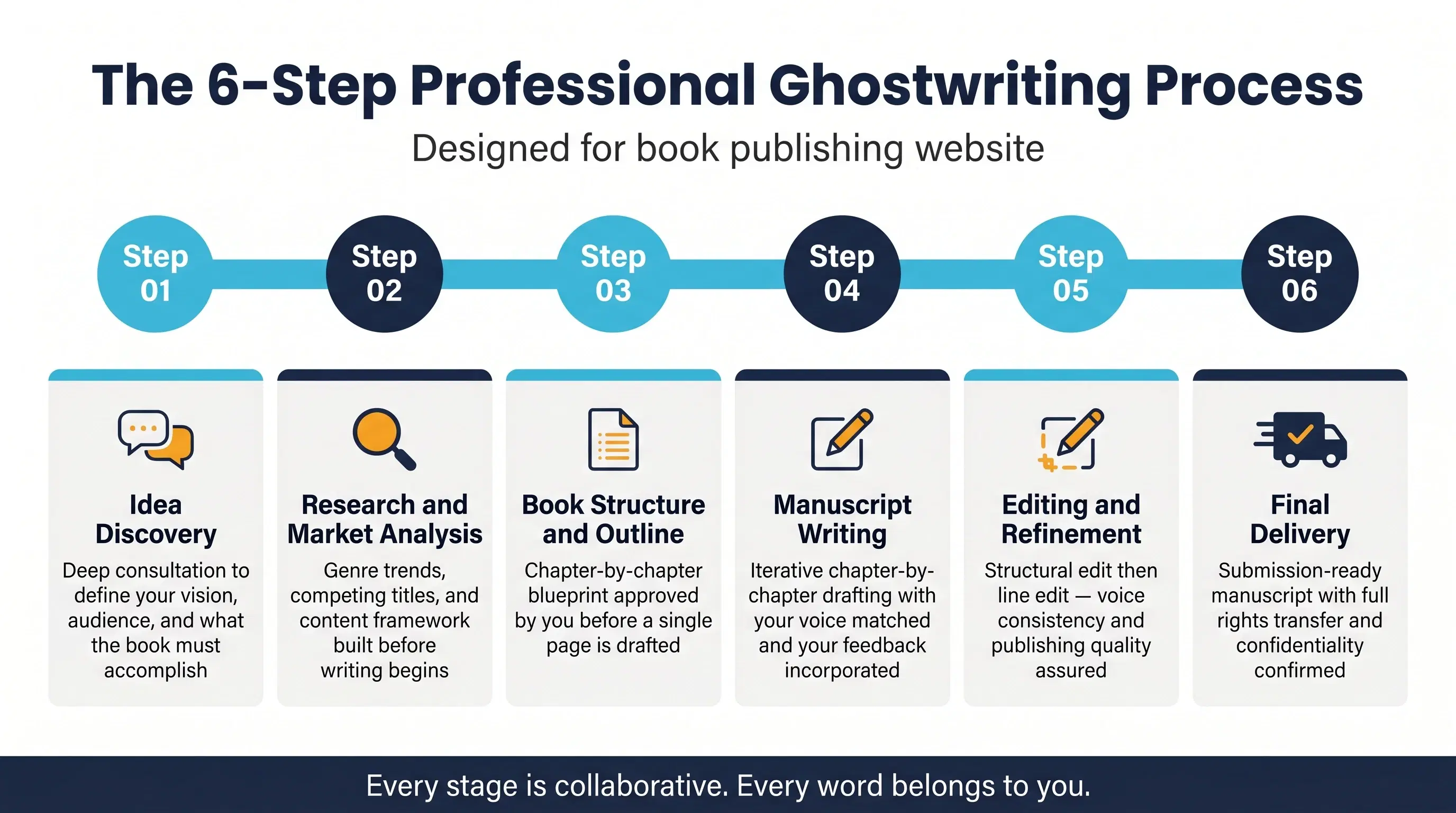
A professional book ghostwriting process is structured and collaborative. It does not begin with a blank page and end with a finished manuscript handed over without interaction. It is an iterative process in which the ghostwriter and the author work together at every stage, with the author providing the substance and creative direction and the ghostwriter providing the craft and execution.
Step 1: Idea Discovery and Consultation
Understanding author vision: The first stage of any ghostwriting engagement is a structured discovery process in which the ghostwriter works to understand the author's vision for the book as completely as possible. This means understanding not just what the book is about but why the author wants to write it, who it is for, what they want readers to take away, and what the book should accomplish commercially or personally. The deeper the ghostwriter's understanding of the author's intention, the more authentically they can represent that intention in the writing.
Defining book goals: Concrete goal-setting at the outset prevents the scope creep and misalignment that derail ghostwriting projects. Is the book intended for traditional publishing submission or self-publishing? Is the primary goal to generate direct book sales, establish thought leadership, attract speaking engagements, or create a legacy document? The answers to these questions shape every subsequent decision about structure, tone, length, and content priorities.
Step 2: Research and Market Analysis
Genre trends and reader expectations: A skilled ghostwriter does not write in a vacuum. Before drafting begins, they research the current market in the book's genre or category: what the bestselling titles look like structurally, how they are positioned, what reader reviews reveal about what the audience values and what they find lacking, and where the opportunity exists for a new title to offer something distinctive. This market intelligence informs the book's structure, tone, and positioning before a single chapter is written.
Competitor analysis: For non-fiction especially, understanding the existing titles in the space is essential to positioning the new book effectively. A ghostwriter who identifies what comparable titles are doing well and where they fall short can help the author develop a book that offers genuine differentiation, which is the foundation of strong sales performance in any category.
Step 3: Outlining the Book Structure
Chapter planning: A detailed chapter outline is the architectural blueprint of the book. It specifies what each chapter covers, how it connects to the chapters before and after it, what the reader should understand or feel at the end of each section, and how the overall arc of the book builds toward its conclusion. A well-constructed outline prevents the structural problems that are expensive to fix after a manuscript is written and ensures that the writing process itself is efficient rather than exploratory.
Story or content framework: The framework differs by genre. A memoir requires an emotional arc that gives shape to chronological events. A business book requires a logical framework that builds understanding progressively. A thriller requires a plot structure that manages information and tension with precision. The ghostwriter's genre expertise is most visible in this stage, where the framework is chosen and constructed to serve the specific requirements of the book's category.
Step 4: Writing the Manuscript
Drafting process: The drafting process for a professionally managed ghostwriting engagement is typically phased by chapter or section. The ghostwriter produces a draft of a defined portion of the manuscript, the author reviews it, and feedback is incorporated before the next section is drafted. This iterative approach catches misalignments early when they are inexpensive to correct, rather than at the end of a completed manuscript when revision requires significant rework.
Tone and voice matching: Voice matching is among the most demanding skills a ghostwriter deploys. The manuscript needs to be read as if the named author wrote it, which means the ghostwriter must study the author's natural speech patterns, vocabulary preferences, sentence rhythm, and characteristic ways of framing ideas. Extended interviews, recordings, existing writing samples, and social media content all provide material for voice calibration. A reader who knows the named author personally should not be able to identify the manuscript as the product of a different writer.
Step 5: Editing and Refinement
Structural editing: After a complete first draft is produced, the manuscript goes through a structural review that evaluates the overall architecture of the book. Are the chapter sequence and pacing optimal? Is the argument or narrative arc coherent from beginning to end? Are there sections that could be consolidated, expanded, or repositioned to improve the reader's experience? Structural editing at this stage addresses the book as a whole rather than at the sentence level.
Line editing and polishing: Line editing works at the paragraph and sentence level, refining clarity, sharpening transitions, ensuring consistency of voice throughout the manuscript, and elevating the quality of the prose to the standard the genre and the author's platform require. The polishing pass is the final stage before the manuscript is considered complete, catching anything that structural editing and line editing did not address and bringing the writing to a level of quality the author can publish with confidence.
Step 6: Final Approval and Delivery
Author review process: Before the manuscript is finalized, the author conducts a complete review of the finished work. This review is not a formality. The author needs to feel that the manuscript represents their voice, their ideas, and their vision accurately and compellingly. Any elements that feel inconsistent with the author's perspective or authentic communication style should be addressed in this stage. The goal is a manuscript the author can genuinely claim as their own, not simply one that is technically complete.
Final manuscript delivery: The delivered manuscript includes all agreed files in the formats required for the next stage of the publishing process, whether that is submission to a literary agent, upload to a self-publishing platform, or handoff to a professional editing and formatting service. Confidentiality agreements and rights transfer documentation are confirmed at this stage, and the author assumes full ownership of the manuscript for all subsequent publishing and commercial purposes.
How Ghostwriters Adapt Writing Across Different Genres
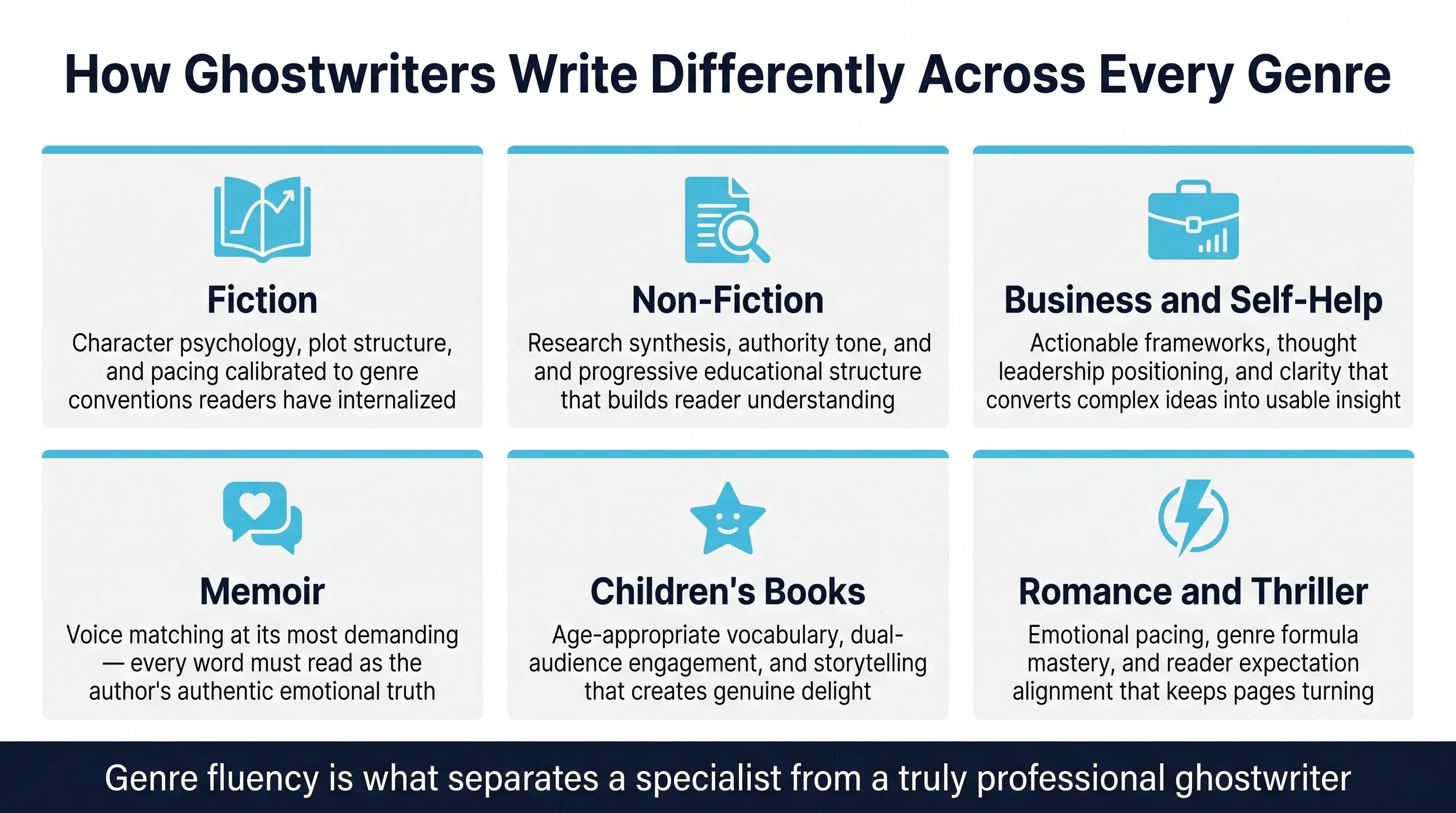
The most technically demanding aspect of professional book ghostwriting services is the ability to write with genuine competence across categories that have fundamentally different structural requirements, reader expectations, and craft conventions. A ghostwriter who can write a compelling thriller but produces stilted business prose is a specialist rather than a versatile professional. The best ghostwriters develop deep fluency in multiple genres.
Fiction Ghostwriting
Story development techniques: Fiction ghostwriting services require mastery of narrative structure, from three-act architecture and the hero's journey to more complex non-linear structures that contemporary literary fiction employs. Story development begins with understanding what the named author wants the reader to feel and experience, then constructing a narrative architecture that delivers those outcomes through character, conflict, and resolution.
Character building: Compelling characters are the foundation of commercially successful fiction in virtually every genre. A ghostwriter working in fiction must construct characters with psychological coherence, distinctive voices, believable motivations, and enough complexity to sustain reader engagement across a full-length novel. Characters who feel like authorial constructs rather than people generate the kind of reader feedback that tanks reviews.
Plot structure and pacing: Plot structure determines the sequence in which story information is revealed to the reader. Pacing determines how quickly the story moves through that sequence. Both are genre-specific skills. A romance novel requires a different pacing rhythm than a thriller. A literary novel has different structural conventions than an epic fantasy. A skilled fiction ghostwriter understands these conventions not as constraints but as tools, and uses them to meet reader expectations while finding the specific elements that make the named author's book distinctive within its genre.
Non-Fiction Ghostwriting
Research-heavy writing: Nonfiction ghostwriting services require the ability to absorb, evaluate, and synthesize large amounts of source material, whether that material comes from academic research, subject matter expert interviews, the named author's own documented experience, or a combination of all three. The ghostwriter must represent that material accurately while making it accessible and engaging to a reader who may not share the author's depth of expertise in the subject.
Authority-based tone: Non-fiction readers are evaluating the author's credibility on every page. The tone of the writing, the quality of the reasoning, the precision of the language, and the care taken with evidence all contribute to the sense that the author is someone whose conclusions can be trusted. A ghostwriter who cannot sustain that authoritative tone throughout a non-fiction manuscript undermines the author's credibility regardless of how substantive the content itself is.
Educational structure: Non-fiction books are most effective when they are structured to build the reader's understanding progressively. Each chapter should advance the reader's knowledge or capability in a way that prepares them for what comes next. The ghostwriter's role is to impose that pedagogical structure on the author's material, which often arrives in a form that reflects how the author thinks about the subject rather than the sequence that is most useful for a reader encountering it for the first time.
Business and Self-Help Books
Clear frameworks and actionable insights: Business book ghostwriting services and self-help book ghostwriting share a structural imperative: every chapter must deliver something the reader can apply. Abstract insight without practical application is the most common failing of business and self-help manuscripts, and it is among the most reliably cited complaints in negative reader reviews. A skilled ghostwriter structures business and self-help content around frameworks that are intuitive, memorable, and demonstrably actionable.
Thought leadership positioning: Business and self-help books succeed commercially when they establish the named author as a credible authority in their field, not simply as someone with an interesting perspective. The ghostwriter's responsibility includes positioning the author's ideas within the existing conversation in the field, distinguishing their contribution from comparable titles, and writing with the kind of confident clarity that thought leadership requires.
Memoirs and Autobiographies
Voice capturing techniques: Memoir ghostwriting services and autobiography ghostwriting services demand the highest level of voice-matching skill because the reader's expectation in memoir is that every word on the page is an authentic expression of the named author's inner life and perspective. The ghostwriter typically conducts extensive recorded interviews with the author, studies any existing writing they have produced, and spends significant time in the author's company before drafting begins, building the deep familiarity with the author's natural expression that genuine voice matching requires.
Emotional storytelling: Memoir is not a chronological record of events. It is an emotional journey that uses the raw material of real experience to create a narrative that readers experience with genuine feeling. The ghostwriter's task is to identify the emotional core of the author's story, the experiences and transformations that carry universal resonance, and to structure the memoir around those emotional truths rather than simply around what happened in what order.
Real-life structuring: Real lives do not come pre-structured as narratives. Events occur without the thematic coherence or dramatic pacing that makes a story compelling. The ghostwriter imposes narrative structure on real-life material by selecting which events to include and in what order, identifying the through-line that gives the memoir coherence, and shaping the arc of the author's experience so that the reader's journey through the book has the emotional progression of a well-constructed story.
Children's Books
Simple language adaptation: Children's book ghostwriting requires a counterintuitive skill set. Writing for children is not easier than writing for adults. It is harder. The vocabulary must be age-appropriate, the sentence structures must be accessible to the target reading level, and the content must engage young readers whose attention is not yet conditioned to sustain focus through complex narrative. Every word in a children's book earns its place at a higher standard than in adult fiction because there is nowhere to hide.
Engagement-driven storytelling: Children's books succeed when they generate genuine delight, curiosity, or emotional connection in young readers. The ghostwriter must understand the specific emotional and developmental needs of the target age group and craft a story that meets those needs in a way that also satisfies the adults who will be reading the book aloud or purchasing it as a gift. The dual audience, child reader and adult buyer, creates a unique creative challenge that experienced children's book ghostwriters navigate deliberately.
Age-appropriate tone: Tone in children's books is not simply a matter of vocabulary. It encompasses the humor style, the emotional register, the degree of complexity in themes addressed, and the relationship the narrative voice establishes with the young reader. A picture book written for three-year-olds requires a completely different tonal approach than a middle-grade novel written for ten-year-olds, and both require a different approach than young adult fiction. A ghostwriter working in children's categories must be fluent in these distinctions.
Romance, Thriller, and Genre Fiction
Emotional pacing techniques: Romance ghostwriting services require particular mastery of emotional pacing, the management of anticipation, tension, connection, and resolution that romance readers consume with practiced expectation. The emotional beats of a romance novel, the meet, the pull, the conflict, the dark moment, and the resolution, are well-defined genre conventions, and readers who love romance feel immediately when those beats are off-tempo or absent.
Genre-specific writing formulas: Thriller ghostwriting services operate within structural conventions that readers of the genre have internalized across hundreds of titles. Chapter endings that create forward momentum, reveals that are earned rather than arbitrary, pacing that maintains urgency without sacrificing character depth, and the careful management of information across a plot that typically involves significant misdirection are all skills the thriller ghostwriter must deploy with precision. Readers who love thrillers know when these elements are working and notice immediately when they are not.
Reader expectation alignment: Every genre has a reader contract: an implicit promise about what the reading experience will deliver. Genre fiction ghostwriters succeed when they understand that contract in their specific category well enough to fulfill it completely while finding the particular story, characters, or setting details that make the named author's book distinctive within a familiar framework. Meeting expectations is the floor. Exceeding them is what generates the word-of-mouth and review activity that builds a series into a commercially sustainable career.
Common Misconceptions About Ghostwriting
Ghostwriting is cheating: This is the most persistent misconception about book ghostwriting, and it does not withstand examination. The ideas, expertise, life experience, and creative vision in a ghostwritten book belong to the named author. The ghostwriter is a skilled craftsperson who translates that material into publishable prose, performing the same function that a skilled editor, cover designer, or publicist performs in other aspects of the publishing process. Using professional expertise to improve the quality of a finished product is not cheating. It is publishing.
Ghostwriters control the story: A professional ghostwriter's creative contribution is entirely in service of the named author's vision. The ghostwriter does not bring their own agenda to the manuscript or redirect the author's ideas toward their own preferences. Their skill is in disappearing into the author's perspective so completely that the manuscript reflects the author's authentic voice and vision rather than the ghostwriter's. Any ghostwriter who attempts to impose their own creative direction on a client's work has misunderstood their role fundamentally.
Only celebrities use ghostwriters: Ghostwriting is used by business executives, entrepreneurs, academics, coaches, consultants, first-time authors, subject matter experts, and anyone else who has material worth publishing and wants professional help bringing it to the standard that commercial publication requires. The practice is common across every category of publishing, and the authors who use it are far more diverse than the high-profile celebrity memoir cases that generate public attention.
Ghostwriting lacks originality: A ghostwritten book is entirely original. The ideas, the stories, the arguments, and the creative concepts originate with the named author. The ghostwriter contributes skilled prose, professional structure, and genre expertise. None of those contributions substitute for the author's original material. They enhance and realize it. A ghostwritten book that is commercially successful is successful because the named author had something original and valuable to say, and the ghostwriter ensured that value was communicated effectively.
Benefits of Hiring a Professional Ghostwriter
The decision to hire professional ghostwriter support is ultimately a decision about how to deploy limited time and resources toward a publishing goal that has genuine commercial or personal significance.
- Saves time and effort: Writing a full-length book is a commitment of hundreds of hours spread across months or years. For an author managing a business, a career, or a public life, those hours are not available without sacrificing other priorities. A professional ghostwriter allows the book to be written while the author continues operating at full capacity in the areas where their contribution is most valuable.
- Ensures publishing-quality writing: The quality standard for commercially published books is higher than most first-time authors anticipate. Custom ghostwriting services deliver manuscripts that meet that standard from the beginning, avoiding the cycles of revision that manuscripts written without professional support typically require before reaching a publishable state.
- Improves marketability: A book written by a professional ghostwriter with genre expertise and market knowledge is positioned more effectively for commercial success than a book written without that professional perspective. The ghostwriter's understanding of reader expectations, category conventions, and what the market is currently rewarding produces a more commercially competitive manuscript.
- Helps non-writers become authors: Ghostwriting democratizes authorship. Subject matter experts, entrepreneurs, and people with compelling life stories who are not writers can publish books that represent their ideas and experiences at a professional level. The barrier to authorship is not writing skill when professional ghostwriting is available. It is having something worth saying.
Challenges Ghostwriters Solve for Authors
Professional ghostwriters are problem solvers as much as they are writers. The specific challenges they address are the ones that most commonly prevent authors from completing or publishing their books.
- Writer's block: An author who has been stuck on a manuscript for months or years is not simply experiencing a creative obstacle. They may be facing a structural problem in the manuscript that the block is signaling, a motivational issue that professional accountability can address, or a skills gap that is creating genuine uncertainty about how to proceed. A ghostwriter can diagnose the actual problem and either solve it collaboratively or take the manuscript forward independently.
- Lack of writing experience: Having valuable ideas and being able to write them effectively across 60,000 words are entirely different competencies. Authors who excel in their professional field, who are compelling speakers and clear thinkers, frequently find that sustaining the quality and coherence of their ideas across the length of a book exceeds their writing experience. This is not a failure. It is a skills gap that professional ghostwriting is specifically designed to close.
- Time constraints: The most common reason books do not get written is not lack of ideas or lack of motivation. It is the competition between writing time and every other demand on the author's schedule. A ghostwriter removes the time constraint by doing the writing work, while the author contributes their expertise and vision through a process structured to minimize the demand on their time.
- Structuring complex ideas: Subject matter experts who are deeply immersed in their field often struggle with the organizational challenge of presenting their knowledge in a sequence that a reader without their background can follow. A ghostwriter with experience in the relevant non-fiction category brings an outside perspective that is invaluable for structuring complex material in a way that serves the reader rather than reflecting how the expert organizes their own thinking about the subject.
How Much Does Professional Ghostwriting Cost?
The book ghostwriting market has a wide range of pricing that reflects the enormous variation in project scope, ghostwriter experience, genre complexity, and the level of collaboration required. Understanding the pricing landscape before approaching a ghostwriter prevents unrealistic expectations and helps authors evaluate proposals accurately.
Pricing Models
Ghostwriting engagements are typically priced in one of three ways. Per-word pricing establishes a rate for each word in the finished manuscript, making the total cost predictable once the target word count is agreed. Per-project pricing establishes a flat fee for the complete engagement from initial consultation through final delivery. Hourly pricing is less common for full manuscripts but is used for shorter engagements, revision work, or consulting-only arrangements where the ghostwriter advises rather than writes.
Factors That Affect Cost
| Factor | Impact on Cost |
|---|---|
| Ghostwriter experience level | More experienced writers command higher rates |
| Book length and complexity | Longer, more research-heavy books cost more |
| Genre | Memoir and business books typically cost more than genre fiction |
| Timeline | Rushed timelines typically increase cost |
| Level of collaboration | More author interviews and revision rounds increase cost |
| Research requirements | Books requiring primary research cost more than those based on existing material |
| Rights and confidentiality | Full rights transfer with strict NDA is standard but affects structuring |
ROI of Hiring a Ghostwriter
Evaluating the ROI of professional ghostwriting requires thinking beyond the book's direct sales revenue. A business book that establishes the named author as the leading voice in their field generates speaking engagements, consulting inquiries, course sales, and media appearances that dwarf the book's royalty income. A memoir that becomes a cultural conversation piece creates opportunities that are commercially significant in ways that are impossible to attribute to book sales alone.
For self-published authors, the calculation also includes the cost of the alternative: an unpublished manuscript that never reaches its potential audience, or a self-written book that requires multiple rounds of expensive revision to reach a publishable standard. The upfront investment in professional book ghostwriting services often represents a more efficient path to a commercially viable book than the extended revision cycle that most unassisted manuscripts require.
Ethical Aspects of Ghostwriting
Ownership rights: In a standard professional ghostwriting arrangement, the named author receives complete and exclusive ownership of the manuscript upon delivery and final payment. The ghostwriter retains no rights to the work, cannot publish it independently, and has no claim on the royalties or other commercial outcomes it generates. This rights transfer is formalized in the contract that governs the engagement, which should be reviewed carefully before work begins to ensure the transfer terms are unambiguous.
Credit and confidentiality: Most professional ghostwriting engagements include a confidentiality agreement under which the ghostwriter agrees not to disclose their involvement with the project. This is a standard professional arrangement, not an ethically questionable one. The named author is under no obligation to disclose that they worked with a ghostwriter, just as they are under no obligation to acknowledge their editor, cover designer, or any other professional who contributed to the book's production. Ghostwriting has been an accepted and widely practiced part of the publishing industry for as long as publishing has existed. The ethical question is not whether to use it but whether the named author genuinely stands behind the ideas and content of the book. If they do, the method of production is irrelevant to the book's integrity.
Publishing transparency: There is no requirement in any major publishing market to disclose ghostwriting assistance. Publishers, literary agents, and retail platforms do not require or expect disclosure. The named author's legal ownership of the manuscript is complete and unambiguous. Where authors choose to acknowledge their ghostwriter, they do so as a matter of personal preference rather than professional obligation, and that acknowledgment does not in any way diminish the commercial or creative standing of the book.
How Best Selling Publisher Provides Professional Ghostwriting Services
Best Selling Publisher's book ghostwriting services are built around a team of experienced ghostwriters with specialized expertise across every major publishing category. Our approach to every project begins with the understanding that the book must represent the named author authentically, serve their publishing goals commercially, and meet the quality standard their genre and market require.
Genre-specific ghostwriting expertise: Our team includes writers with deep experience in fiction, non-fiction, business, self-help, memoir, autobiography, and children's publishing. When a project is assigned, the match between ghostwriter and genre is deliberate, ensuring that the writer working on your manuscript brings the specific craft knowledge and market awareness your category demands. Fiction ghostwriting services, nonfiction ghostwriting services, memoir ghostwriting services, and autobiography writing services are all delivered by writers whose primary expertise is in those respective areas.
Full publishing support: Our ghostwriting agency provides more than a finished manuscript. Authors who work with Best Selling Publisher have access to the complete publishing infrastructure that turns a ghostwritten manuscript into a commercially released book: professional editing, formatting for print and digital, cover design, metadata optimization, platform distribution setup, and launch marketing. The ghostwriting engagement is the beginning of the publishing process, not the end.
Editing, formatting, and launch assistance: Every manuscript produced by our ghostwriting team goes through our editorial process before delivery, ensuring that the author receives a manuscript that is not only well-written but professionally polished and ready for the next stage of publication. Our book editing services and formatting capabilities mean the transition from completed manuscript to published book is seamless rather than requiring the author to source and coordinate multiple additional service providers.
Author branding integration: A book is the most powerful author branding asset in publishing, but only when it is positioned and presented as part of a coherent author identity. Our author branding services ensure that the ghostwritten book is integrated into the author's broader platform, with consistent visual identity, messaging alignment, and the marketing infrastructure that connects the book to the audience the author is building. Book marketing services and book publishing services complete the picture, ensuring that a professionally written book reaches the readers it was written for.
Ready to Turn Your Idea Into a Professionally Written Book?
The idea you have been carrying around deserves more than a perpetual intention to write it someday. The expertise you have accumulated, the story you have lived, or the business insights you have developed through years of practice represent the raw material of a book that could change how readers in your field think, help people who are struggling with problems you have solved, or leave a record of a life lived with purpose and intention.
Professional ghostwriting services are not a shortcut. They are a professional solution to the genuine challenge of producing a book that meets commercial publishing standards while accurately representing your voice, your ideas, and your vision. Every element of the process, from the initial consultation through the final manuscript delivery, is designed to produce a book you can publish with complete confidence and genuine pride.
Best Selling Publisher's team of professional ghostwriters is ready to begin the conversation. Whether your book is fully formed in your mind or still taking shape, whether you have a partial draft or only a concept, we have the expertise and the process to take it from where it is to where it needs to be. Reach out today and take the first step toward the book you have been meaning to write.
FAQs
Professional ghostwriters develop genre-specific expertise through extensive reading, studying successful titles in the category, and writing across multiple projects in the same genre. The structural conventions, reader expectations, and craft requirements of each genre are distinct, and a skilled professional ghostwriter invests in understanding those distinctions deeply enough to produce work that readers cannot distinguish from the work of a writer who has spent their entire career in the category. The best ghostwriting agencies match each project to a writer whose primary expertise is in the relevant genre.
In most professional ghostwriting arrangements, ghostwriters do not receive public credit. The confidentiality agreement that governs most engagements prevents the ghostwriter from disclosing their involvement, and the named author is not required to acknowledge the collaboration publicly. Some authors choose to acknowledge their ghostwriter in the book's acknowledgments section as a personal choice, but this is entirely at the author's discretion. The ghostwriter's professional compensation is their fee, not public recognition.
Ghostwriting is entirely legal. There is no law, regulation, or publishing industry standard that prohibits it or requires disclosure. The named author owns the copyright to the manuscript through the rights transfer agreed in the ghostwriting contract. Book ghostwriting has been practiced legally and ethically throughout the history of commercial publishing. Literary agents, publishers, and retail platforms do not distinguish between books written by the named author alone and books produced with ghostwriting assistance, because the named author's legal ownership of the work is complete in either case.
The timeline for a professional ghostwriting engagement depends on the book's length, the complexity of the research required, the level of collaboration involved, and the ghostwriter's availability. A standard trade-length non-fiction book of 50,000 to 70,000 words typically takes four to eight months from initial consultation through final manuscript delivery. A full-length novel may take six to twelve months. Shorter projects, including business books, self-help titles, and children's books, can be completed more quickly. Hire a ghost book writer with a clear timeline in mind and discuss realistic delivery milestones during the initial consultation.
Professional ghostwriting costs vary significantly based on the ghostwriter's experience level, the length and complexity of the book, the genre, and the level of collaboration required. Entry-level ghostwriters with limited track records charge at the lower end of the market. Experienced professionals with demonstrated commercial success in their category command substantially higher rates. Authors evaluating ghostwriting proposals should consider the total value delivered, including genre expertise, market knowledge, and the quality of the finished manuscript, rather than comparing quotes based on price alone. A ghostwriting agency that matches projects to appropriately experienced writers provides more reliable quality assurance than an individual writer hired without a vetting process.