
ISBNs, Copyrights and Legal Essentials Every Author Must Understand Before Publishing
Picture this. An author spends eight months writing a nonfiction book, uploads it to Amazon, and hits publish. Within weeks, a reader emails to say the book cannot be found through any search outside of Amazon. A bookstore refuses to stock it. A library acquisition team rejects the request because there is no valid cataloguing number attached to the title. The author had no idea any of this was connected to a single decision made before uploading the file. There was no ISBN for self published books in place, no copyright registration, no legally sound copyright page. The book existed, but professionally speaking, it barely counted.
This is not an edge case. It is one of the most common and most avoidable situations in self-publishing, and it happens because the legal and administrative side of publishing rarely gets the same attention as the writing itself. Most first-time authors focus entirely on the manuscript and treat everything else as an afterthought. But without the right legal foundations in place, a book can be unprotected, undiscoverable, and quietly unprofessional in ways the author never sees coming.
Understanding the legal essentials for self-publishing is not a matter of becoming an attorney. It is a matter of knowing what authors need to know before publishing so that when the book goes live, it is built on a foundation that protects the work, supports full distribution, and signals to every reader, retailer, and library that this is a book produced by someone who takes their craft seriously.
This guide covers everything from ISBNs and how to get one, to copyright registration and what it actually protects, to the legal structures authors should consider, publishing contracts worth reading carefully, disclaimers and front matter that protect both the author and the reader, and brand-new territory most publishing guides leave out entirely, including DRM decisions, pen name legality, trademark protection for series titles, and how to handle editions and revisions correctly.
What Is an ISBN and Why Every Published Book Needs One
An ISBN, which stands for International Standard Book Number, is a 13-digit numeric identifier assigned to a specific edition of a book. It functions as a universal fingerprint for that particular title in a particular format. Every time a retailer lists a book for sale, a library adds it to a catalogue, or a distributor routes it through a supply chain, the ISBN is what makes identification possible. Without it, the book simply does not exist in the systems that the publishing world runs on.
The 13-digit structure is divided into five segments. The prefix element (currently 978 or 979) identifies the product as a book. The registration group identifies the country or language group. The registrant element identifies the specific publisher. The publication element identifies the particular title and edition. The final digit is a check digit used to validate the number. Understanding this structure matters because it explains why each format of a book, its ebook, paperback, hardcover, and audiobook, requires a separate ISBN. They are separate products in a catalogue, not variations of the same entry.
Retailers, libraries, and distributors do not work around the absence of an ISBN. They require one. Bookstores cannot place orders for a book without it. Libraries cannot list a book in their acquisition systems. Major distributors like Ingram will not accept a title into their network without a valid registered number. An author publishing without one has opted out of most of the distribution infrastructure that connects books to readers.
One point of confusion that trips up many first-time authors is the difference between an ISBN and a barcode. A barcode is the visual scanning symbol that appears on the back of a printed book. It encodes the ISBN for point-of-sale and inventory systems. An ISBN is the number itself. You need the number before you can generate the barcode, and the barcode is only relevant for print editions.
Free ISBN vs Paid ISBN - What Self-Publishers Need to Know
When you publish through Amazon KDP or IngramSpark, both platforms offer a free ISBN during setup. On KDP this covers paperback and hardcover only: eBooks are issued an ASIN rather than an ISBN, and low-content books are excluded. Many new authors take this option without fully understanding what it means. When you accept a free ISBN from KDP, the imprint registered against it is "Independently published" - not your own imprint name, and not Amazon either (KDP free ISBN, checked 14 August 2026). The real cost is portability rather than attribution: a free KDP ISBN is tied to KDP and cannot be moved to another distributor, so changing platforms later means starting a new ISBN and losing the title’s accumulated review and ranking history.
For authors who are publishing purely as a personal project, this may be an acceptable trade-off. But for professionals using their book to build authority, attract clients, or position themselves within an industry, having a distribution platform listed as the publisher of your work undercuts the professional signal you are trying to create. It also limits flexibility. An ISBN assigned by KDP cannot be transferred to another distributor if you decide to move platforms or expand your distribution in the future.
Purchasing your own ISBN from Bowker in the United States or Nielsen in the United Kingdom puts you in control. You are the publisher of record. Your imprint name appears in every catalogue and database. You can assign the ISBN to any distribution platform you choose. The cost is a one-time investment that pays professional dividends for the life of the book.
How to Get an ISBN for a Self Published Book - Step by Step
ISBN for self published book registration in the United States is handled exclusively through Bowker at myidentifiers.com. A single ISBN costs $125. A block of ten costs $295, which is the better option if you plan to publish multiple formats or additional titles. UK authors register through the Nielsen ISBN Agency. Canadian authors can obtain ISBNs free of charge through Library and Archives Canada, which is one of the more author-friendly systems globally.
The application process is straightforward. You create an account, provide the book's title and publication details, select the format the ISBN will be assigned to, and the number is generated. The timeline is typically immediate for digital ISBNs, though full database propagation to retail and library systems can take a few weeks.
The most important timing guidance is this: apply for your ISBNs before you finalize your cover and copyright page, because the number needs to appear on both. Applying during the editing phase gives you enough lead time to have the number ready before any print files are prepared.
ASIN, LCCN and Other Book Identifiers Authors Should Know
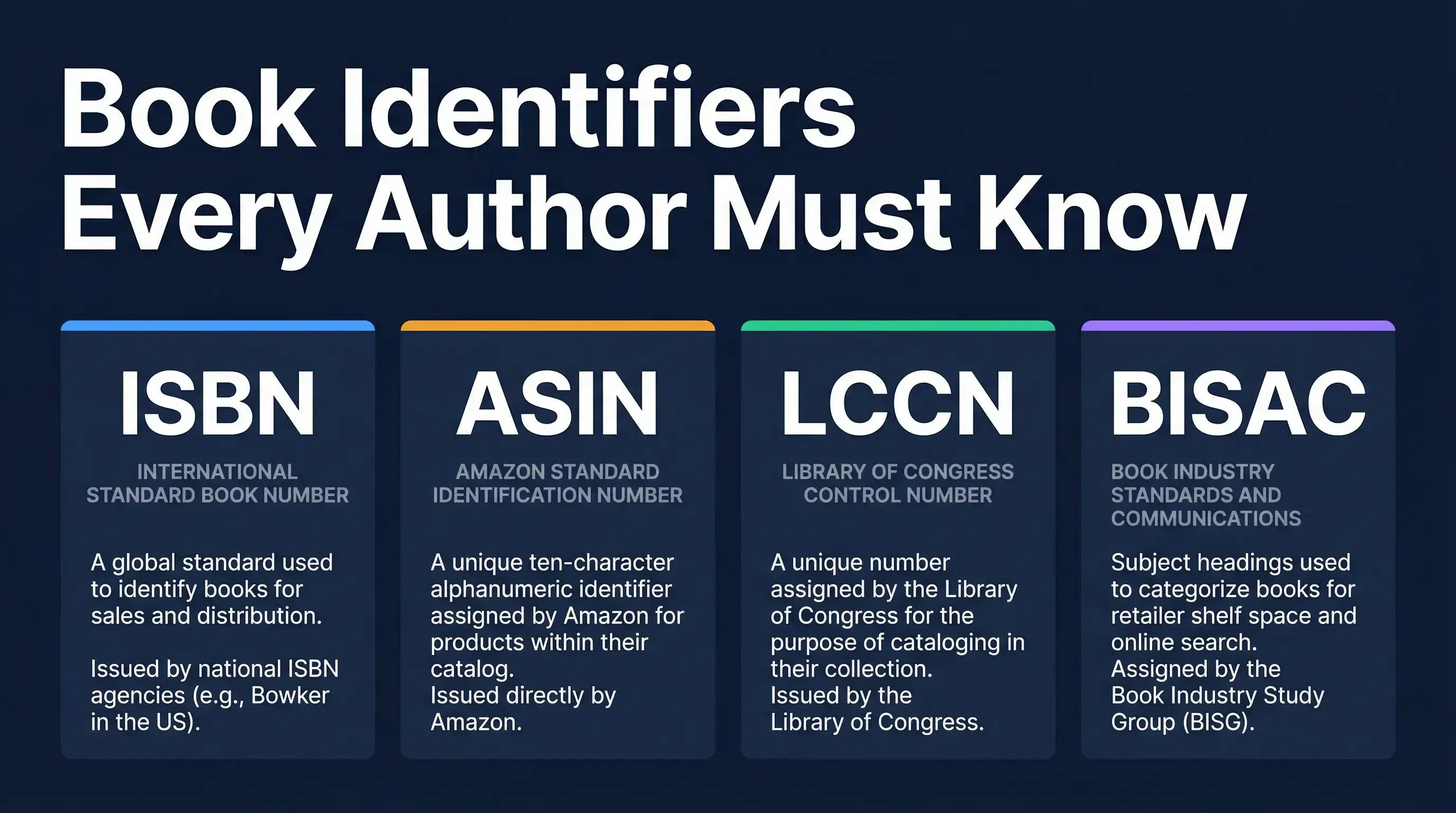
Beyond the ISBN, authors publishing professionally will encounter several other identifiers. Understanding what each one does prevents confusion and ensures your book is correctly set up across every system it enters.
An ASIN is Amazon's internal product identifier. It is automatically assigned when you upload your book to KDP and cannot be applied for or transferred. It exists solely within Amazon's system and is not recognized by retailers, libraries, or distributors outside of Amazon. Treating an ASIN as a substitute for an ISBN is a mistake that limits your book's reach before it has even launched.
An LCCN, or Library of Congress Control Number, is a cataloguing identifier assigned by the Library of Congress in the United States. Applying for one before publication gives libraries a pre-assigned number to use when ordering and cataloguing your book. The process is free through the Preassigned Control Number program at loc.gov. For nonfiction authors targeting library sales, an LCCN signals institutional-level seriousness that reinforces credibility.
BISAC codes are not identifiers in the same sense. They are categorization codes developed by the Book Industry Study Group that tell retailers and distributors which genre shelf or digital category a book belongs to. Choosing the right BISAC codes during setup directly affects where your book appears in retail systems, library catalogues, and recommendation algorithms.
Identifier Comparison
| Identifier | Full Name | Assigned By | Primary Use |
|---|---|---|---|
| ISBN | International Standard Book Number | Bowker / Nielsen / LAC | Retail, library & distributor catalogues |
| ASIN | Amazon Standard Identification Number | Amazon (auto-assigned) | Internal Amazon product ID |
| LCCN | Library of Congress Control Number | Library of Congress | US library cataloguing and acquisition |
| BISAC | Book Industry Standards and Communications Code | BISG | Genre categorization for retailers and distributors |
Copyright Explained - What It Protects, What It Does Not and What Authors Often Get Wrong
Copyright is automatic. The moment you create an original piece of writing and fix it in a tangible form, whether that is a Word document, a printed manuscript, or a PDF, the work is legally protected under copyright law in the United States and in every country that has signed the Berne Convention, which covers over 180 nations. You do not need to register it, file anything, or pay anyone for that protection to exist.
What copyright actually protects is the specific expression of ideas, not the ideas themselves. Your book is protected. The storyline of a novel, the specific arguments made in a nonfiction chapter, the prose you wrote to communicate a concept, all of that is covered. What copyright does not protect is the underlying idea, a factual claim, a title, a concept, a style of writing, or a genre convention. Two authors can both write books about productivity habits. Copyright prevents one from copying the other's sentences. It does not prevent both from writing about the same topic.
In the United States and across most of Europe, copyright lasts for the life of the author plus 70 years. For works made for hire or published anonymously, different terms apply. The practical implication for most authors is that their work will be protected for their entire lifetime and well beyond, without any action required on their part to maintain that protection.
One myth worth addressing directly is the concept of the poor man's copyright, which involves mailing yourself a sealed copy of your manuscript so the postmark establishes a creation date. This confers no rights at all. The Copyright Office is explicit that there is no provision in the law for it and that it is no substitute for registration. A court might still admit the envelope as ordinary evidence of when a draft existed, but it does not satisfy the registration prerequisite for filing suit and does not unlock statutory damages, so relying on it instead of registering leaves you without the remedies that matter.
Should You Register Your Copyright and How to Do It
The question of how to copyright a book before publishing comes down to a practical distinction. Automatic copyright gives you ownership. Registered copyright gives you the tools to enforce it. In the United States, you cannot file a lawsuit for copyright infringement unless the work is registered with the US Copyright Office. More importantly, if you register within three months of publication or before the infringement occurs, you are eligible to claim statutory damages and attorney fees without having to prove actual financial loss. Those damages run from $750 to $30,000 per work infringed, rising to as much as $150,000 per work where the infringement is found to be willful. Note the unit: it is one award per work, however many separate acts of infringement there were, not a sum per act (17 U.S.C. 504(c), checked 14 August 2026).
The book copyright registration process through the US Copyright Office at copyright.gov is entirely online. The cost ranges from $45 to $65 depending on the registration type. The typical processing timeline is three to six months, though expedited processing is available for an additional fee when legal proceedings are time-sensitive.
Registering before publication is ideal. If you publish first, registering within three months of the publication date still preserves your eligibility for statutory damages and attorney's fees for infringement beginning after publication. Your copyright itself exists from the moment of creation either way; what the deadline protects is that specific set of remedies. International copyright is handled through the Berne Convention, but not in the way it is usually described. There is no single international copyright, and a US registration grants you nothing abroad. Berne obliges member countries to protect foreign works automatically, with no formalities, based on your nationality or where the work was first published - so your work is protected in member countries whether or not you ever register in the US (US Copyright Office, Circular 38A, checked 14 August 2026). US registration matters for enforcement in US courts, not for recognition elsewhere.
The Copyright Page - What It Must Include and How to Write It
The copyright page for self-published book is one of the most functional pieces of front matter in any professionally published title. It is not a formality. It is a legal notice that establishes ownership, edition history, and any applicable restrictions or disclaimers in a form that courts and industry professionals recognize.
At minimum, a copyright page must contain:
- The copyright symbol (©), the year of first publication, and the author's full legal name
- An all rights reserved statement
Recommended additions for a professional publication include:
- The ISBN for each format of the book
- The publisher or imprint name and address
- An edition notice (First Edition, Second Edition, etc.) and the year
- The country of printing for physical editions
- Any applicable disclaimers relevant to the content
A clean adaptable template for most nonfiction books reads as follows:
Copyright © [Year] [Author Full Name]All rights reserved. No part of this publication may be reproduced, distributed, or transmitted in any form or by any means without the prior written permission of the publisher, except in the case of brief quotations embodied in critical reviews.Published by [Imprint Name]ISBN: [ISBN-13 for this format]First Edition, [Year]Printed in the United States of America
Using Third Party Content - Permissions, Fair Use and What You Cannot Copy
Fair use is one of the most misunderstood concepts in publishing, and misunderstanding it has ended careers and launched lawsuits. Fair use is a legal doctrine that allows limited use of copyrighted material without permission under specific conditions, but those conditions are narrower than most authors assume.
US law evaluates fair use claims across four factors. The first is the purpose and character of the use, with commentary, criticism, education, and transformative use weighing in favor of fair use. The second is the nature of the original work, with factual works affording more fair use leeway than creative ones. The third is the amount used relative to the whole, where even a short excerpt can be problematic if it represents the heart of the original work. The fourth is the market effect, which asks whether the use substitutes for purchasing the original.
The areas where authors most commonly make costly mistakes are song lyrics, which are almost never fair use regardless of how few lines are quoted; images sourced through a Google search, which carry full copyright protection regardless of how they appear online; and news articles reprinted in full or near-full, which require permission from the publication even when attributed correctly.
Public domain works, meaning works whose copyright has expired or been forfeited, can be used freely. In the United States, works published in 1930 or earlier are in the public domain as of 1 January 2026, and the rules become more complex for works published between 1931 and 1977 (US Copyright Office, Circular 15A, checked 14 August 2026). Note that this cutoff advances by one year every 1 January, so check the current year rather than relying on a date you read in an older guide. Verifying public domain status before use and citing the source correctly is always the right approach.
Creative Commons licenses offer a middle ground. A work published under CC BY allows use with attribution. CC BY-NC restricts commercial use. CC BY-SA requires derivative works to carry the same license. Each license type has specific conditions, and ignoring those conditions is still copyright infringement even when the original was freely available.
DRM and What It Means for Your Ebook Copyright Protection
DRM stands for Digital Rights Management. It is a technical system that adds encryption or access controls to a digital file, making it harder to copy, share, or open on unauthorized devices. When you upload an ebook to KDP you choose whether to enable DRM. Older guides describe this as a permanent, one-time election; it is not. You can change the setting at any time from your Bookshelf, and it takes roughly 24 to 72 hours to take effect (KDP digital rights management, checked 14 August 2026). The change applies only to future downloads, so readers who already have the file keep the version they downloaded.
Understanding DRM for ebooks requires being honest about what it actually does and does not do. DRM does not prevent piracy in any absolute sense. Anyone with the right technical knowledge can strip DRM from a file in minutes, and pirated ebook copies circulate regardless of whether DRM was enabled. What DRM does is raise the barrier for casual unauthorized sharing, which has some deterrent value for the majority of readers who are not motivated enough to circumvent it.
There is a real downside to DRM that authors rarely consider before enabling it. Readers who purchase a DRM-protected ebook are tied to the platform they bought it through. If they switch devices, change ebook readers, or if the platform changes its policies, access to the purchased content can be disrupted. This creates friction for legitimate paying customers and can generate negative reviews from readers who blame the author for a technical limitation they did not understand.
Many indie authors choose to publish DRM-free and rely on ebook copyright protection through registration and enforcement rather than technical locks. Their reasoning is that readers who want to pirate will find a way regardless, while readers who are paying customers deserve friction-free access. The decision depends on the author's priorities, audience, and business model, but it should be made deliberately rather than by default.
One critical point that applies in either case: DRM is a technical measure, not a legal one. It does not replace copyright registration and does not grant any additional legal rights. An unregistered work with DRM enabled has weaker legal protection than a properly registered work published DRM-free.
Legal Structures and Business Considerations for Self-Publishing Authors
Most first-time authors publish under their own name, through their own Amazon account, with no legal structure separating their publishing activity from their personal finances. For a casual project, this is fine. For anyone treating their book as a professional asset or a business tool, the absence of any legal structure is a gap worth addressing before the first royalty payment arrives.
The core question is whether to publish as a private individual or establish a separate publishing imprint or limited liability company. Publishing as an individual is the simplest path, but it means your legal name appears as the publisher of record in every catalogue, your personal financial accounts receive royalty payments directly, and any legal disputes involving the book are your personal legal exposure. Setting up even a basic imprint costs nothing beyond the ISBN registration and adds an immediate layer of professionalism that changes how your book is perceived by retailers, libraries, and industry professionals.
An LLC, or limited liability company, creates a formal legal separation between you and your publishing activity. Royalties are paid to the business entity. Business expenses, including editing, design, and marketing, become potentially deductible. Personal assets are shielded from business-related liability. For authors who are also using their books as part of a broader business strategy, the LLC structure is one that a business attorney or accountant can help set up for a few hundred dollars and maintain with minimal ongoing effort.
On the tax side, self-publishing as a business means royalties are treated as self-employment income. They are taxable and, depending on your jurisdiction, subject to self-employment tax in addition to income tax. Authors can deduct legitimate business expenses including writing software, editing fees, cover design costs, marketing spend, and even a portion of a home office if it is used exclusively for writing work. Keeping records from the beginning is far easier than reconstructing them at year end.
How to Create a Publishing Imprint for Your Book
A publishing imprint for self-published authors is simply a trade name under which you publish your books. It appears on your copyright page as the publisher, shows up in retail catalogues and library databases, and signals to anyone who sees it that the book was produced with the same intentionality as traditionally published titles. It costs nothing to create and requires no special registration to use, though registering it with Bowker as the publisher of record in the Books In Print database is the professional step that makes it visible in the systems that matter.
Choosing an imprint name involves practical considerations. It should not be the same as, or easily confused with, an existing registered publisher. It should not create trademark conflicts with established brands. A quick search through Bowker's database and the USPTO's trademark search tool takes fifteen minutes and prevents a problem that could require rebranding years into a publishing career. Many authors use a variation of their name, a thematic phrase connected to their genre, or a name that reflects the tone of their work.
Once established, your imprint name appears consistently on every title you publish, which builds a recognizable publishing identity over time. Authors who plan to publish multiple books, across different topics or genres, find that a strong imprint name provides a unified brand under which all titles can live.
W-9, W-8BEN and Tax Forms Authors Need When Publishing on Amazon
When you set up a KDP account, Amazon requires tax information before paying royalties. For US authors, this means submitting a W-9 form, which provides your legal name, address, and either your Social Security Number or Employer Identification Number. Amazon uses this information to report royalty payments to the IRS and to generate the Form 1099-MISC you will receive by 31 January each year. KDP does not issue a 1099-NEC for royalties. Non-US publishers receive Form 1042-S by 15 March instead.
For non-US authors, the equivalent form is the W-8BEN. This form allows authors in countries with US tax treaties to claim a reduced withholding rate on royalties earned from US sales. Without submitting a W-8BEN, KDP withholds 30% of all US royalties by default. Many tax treaties reduce this rate significantly, sometimes to zero, but the reduction is only applied when the form is submitted and correctly completed.
Regarding tax forms for Amazon KDP authors, one practical step worth taking early is obtaining an EIN from the IRS. An EIN, or Employer Identification Number, is a federal tax ID that can be used in place of a Social Security Number on tax forms submitted to publishers and platforms. Using an EIN rather than your SSN on documents like W-9 forms reduces the risk of identity exposure in the event that paperwork is ever mishandled.
Pen Names and Legal Identity - What Authors Must Know Before Publishing
Pen names are common for good reasons. Authors who write across genres use them to keep audiences separate. Authors who value personal privacy use them to maintain the distinction between their public writing identity and their private life. Authors building a specific brand voice use them as part of a deliberate positioning strategy. Whatever the motivation, pen name publishing legal considerations are straightforward once you know the rules.
Copyright can be registered under a pen name, and the US Copyright Office does not require you to give your legal name when you do. Its guidance on pseudonyms states you are not obliged to provide the author's full name when registering a pseudonymous work. Note the trade-off it describes: registration records are public, not confidential, so a legal name you do supply becomes publicly searchable, while leaving it out keeps you anonymous but affects how the copyright term is calculated (US Copyright Office, Circular 32, checked 14 August 2026). This is a decision worth taking legal advice on rather than following a rule of thumb.
Publishing contracts, ghostwriting agreements, and any legal documents related to the book must always be signed with your legal name. A pen name has no legal standing to enter contracts, and agreements signed only under a pseudonym may not be enforceable. The pen name appears on the cover, the copyright page as the author, and in your marketing. Your legal name is the entity that actually owns and controls the rights.
Tax forms are always completed with your legal name and your SSN or EIN, regardless of what name appears on the book. Amazon and other platforms pay royalties to your legal identity, not to a pen name. For ISBN registration, your publishing imprint can list the pen name as the author while you remain the legal registrant and publisher of record.
Trademark Considerations for Book Titles and Series Names
One of the most significant gaps in most authors' legal knowledge is the distinction between copyright and trademark as they apply to book titles. Copyright does not protect a title. In the United States and most other jurisdictions, book titles are explicitly excluded from copyright protection because they are considered too short and functional to qualify as original creative expression.
What a trademark protects is different. A title used consistently as a brand identifier, especially for a series that develops commercial recognition, may qualify for trademark for book title protection. If readers associate a specific series name with a specific author in the same way they would associate a product name with a brand, that series name may be registerable as a trademark.
Before publishing any series or brand-tied title, a search through the USPTO's Trademark Search at tmsearch.uspto.gov takes minutes and reveals whether a conflicting registration already exists. Finding out that your series name is already trademarked after three books are published is a problem that a fifteen-minute search before the first book prevents entirely.
For authors who are building a series with genuine commercial momentum, the trademark registration process through the USPTO involves a base filing fee of $350 per class, with surcharges possible on top of it, and a typical review and approval timeline of eight to twelve months. The protection, once granted, is renewable and enforceable in a way that copyright protection for titles simply is not. Consulting a trademark attorney before filing makes the process more efficient and significantly reduces the risk of an application being rejected.
Book Contracts and Publishing Agreements - What Authors Must Read Before Signing
The instinct to avoid paperwork in creative work is understandable, but it is one of the most expensive instincts in publishing. Verbal agreements with co-authors, handshake deals with illustrators, and informal arrangements with ghostwriters create ambiguity that becomes costly the moment the relationship or the project encounters any friction. A written contract is not a sign of distrust. It is a clear record of what both parties agreed to, which protects everyone involved.
Every publishing contract for authors should address a core set of issues. Rights granted define exactly what the other party can do with the work and for how long. Territory specifies the geographic scope of those rights. Royalty rates set out exactly how and when the author is paid. Advance terms detail any upfront payment and the conditions under which it is earned out. The reversion clause defines under what conditions the rights return to the author if the book goes out of print or fails to meet sales thresholds. A non-compete clause, if present, restricts the author from publishing directly competing works within a certain period.
In traditional publishing contracts, the clauses that cause the most long-term damage are often the ones that seem minor at signing. Vague reversion language tied to digital availability means a book that earns one sale per year can never technically go out of print, preventing rights from ever returning to the author. Overly broad rights grabs that include formats not yet invented at the time of signing can claim ownership of audio, film, or interactive rights without the author realizing it. Non-compete clauses broad enough to prevent an author from writing in their own genre for years deserve particularly careful scrutiny.
Ghostwriting agreements require clarity on three points above all else: who owns the final manuscript, what confidentiality obligations the ghostwriter carries, and how and when payments are structured across the project. A ghostwriting contract that is vague on ownership creates a situation where the ghostwriter could claim authorship rights even when the intent was clearly work for hire. Illustrator and cover designer agreements need to specify whether the engagement is work for hire, in which case all rights transfer to the author upon payment, or a license, in which case the designer retains copyright and grants the author permission to use the work in defined ways.
Rights Reversion - How to Get Your Book Rights Back
For authors who have previously published through a traditional house and want to reclaim control of their work, book rights reversion is the legal mechanism that makes it possible. Most traditional publishing contracts include a reversion clause that specifies when the publisher's rights expire and return to the author. The triggering condition is typically the book going out of print, but in the digital era, what constitutes out of print has become one of the most contested questions in publishing contracts.
To determine whether a reversion clause can be triggered, the author must first review the exact language of the contract. Many contracts define out of print based on sales thresholds rather than physical availability. If the contract specifies that rights revert when annual sales fall below a defined number and the book meets that threshold, a formal written request to the publisher is the next step. The request should be delivered in a way that creates a documented record, and the publisher typically has a defined response window, typically six months rather than the 60 to 90 days often quoted, to either commit to reactivating the title or release the rights.
Once rights are recovered, the book enters a new publishing chapter. A new ISBN is required for any new edition or re-release. The copyright page needs to be updated. If the original publisher held subsidiary rights that were not exercised, clarifying the status of those rights in the reversion agreement is important before republishing. Authors who recover rights to backlist titles and relaunch them through self-publishing consistently report a significant increase in both earnings and control over how the work reaches readers.
Disclaimers, Dedications and Front Matter Every Book Should Include
Front matter is the collection of pages that appear before the main text of a book. It includes everything from the title page and copyright page to the table of contents, foreword, and author's note. For many self-published authors, front matter is treated as a minor administrative task completed after the real writing is done. In practice, it is one of the most visible signals of professional publishing quality, and getting it right is part of what to include in a book copyright page and every page that surrounds it.
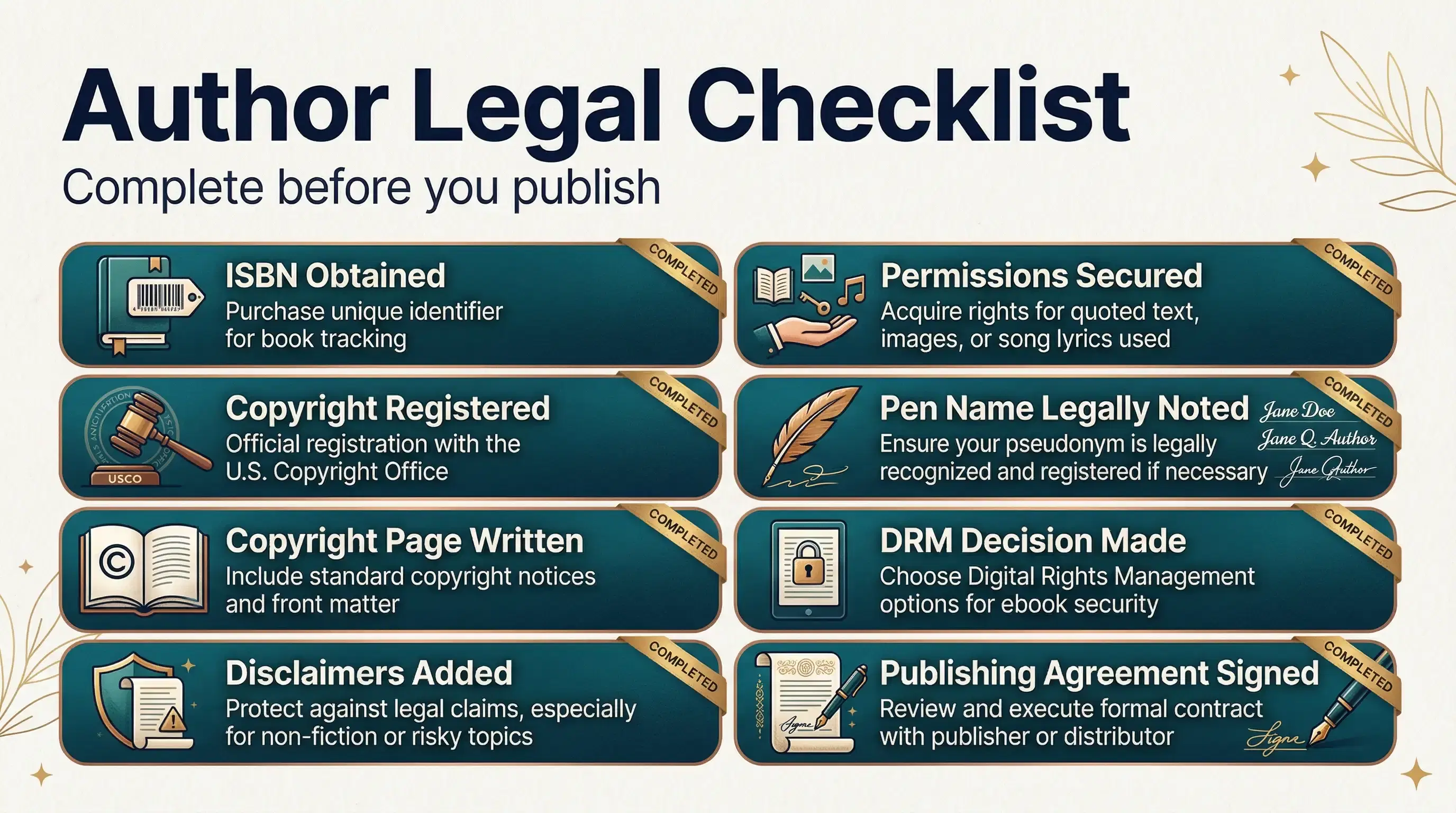
Disclaimers exist to provide liability protection and to set honest expectations for the reader. For nonfiction authors writing on health, legal, financial, or advisory topics, a disclaimer is not optional. It is a standard professional practice that every reputable publishing house includes as a matter of course. A health and wellness author who publishes without a medical disclaimer invites liability exposure that a single sentence at the front of the book would have prevented. A book disclaimer for nonfiction authors does not eliminate liability entirely, but it demonstrates that the author made no claim to be providing licensed professional advice, which is a meaningful distinction in any legal proceeding.
Genre-specific disclaimers cover the following common situations:
- Health and medical books: the content is for informational purposes only and does not constitute medical advice. Readers should consult a licensed healthcare professional before making any health-related decisions.
- Legal books: the content does not constitute legal advice and does not create an attorney-client relationship.
- Financial books: the content is educational and not a substitute for personalized financial advice from a licensed professional.
- Memoir: some names and identifying details have been changed to protect the privacy of individuals.
- Fiction: this is a work of fiction. Names, characters, places, and incidents are either the product of the author's imagination or are used fictitiously.
Complete Front Matter Checklist for a Professionally Published Book
- Title page: the full title, subtitle if applicable, author name, and publisher or imprint name. No additional text.
- Copyright page: the complete legal notice described in the copyright section above, on the reverse side of the title page.
- Dedication page: optional, brief, and placed after the copyright page. One or two sentences addressed to the person or people the author wishes to honour.
- Table of contents: required for nonfiction, optional for fiction. Lists chapters with page numbers and reflects the book's actual structure.
- Foreword: written by someone other than the author, typically a recognized voice in the field, to lend external credibility before the author's own words begin.
- Preface: written by the author to explain the origin and purpose of the book. Different from an introduction in that it is about the book, not about the subject.
- Introduction: written by the author to orient the reader to the subject matter, set up the structure of the book, and establish why this content matters to this reader.
- Acknowledgements: can appear in the front matter after the table of contents, or in the back matter after the final chapter. Both placements are acceptable.
- About the Author page: essential for nonfiction. Appears in the back matter and serves as a professional bio that reinforces the author's credentials and credibility.
Edition and Revision Notices - When You Update a Published Book
The question of revised edition new ISBN requirements is one that confuses many authors who want to update their published work. The rules are clear once you understand the distinctions between different types of updates.
A new edition involves substantial changes to the content, structure, or purpose of the book. It is treated as a new product and always requires a new ISBN. A revised edition that updates a significant portion of the content, adds new chapters, or meaningfully restructures the book also warrants a new ISBN, both for retail accuracy and for library systems that track edition histories. A corrected reprint that fixes typos, corrects minor factual errors, or updates contact information without changing the substance of the work can retain the same ISBN, but the copyright page should note the correction date.
The copyright page for a revised edition should be updated to include the new edition statement, such as Second Edition, 2025, and the new publication year. The original copyright date remains, because the underlying work has not changed ownership. Only the edition-specific details are updated.
One practical warning about edition and revision book publishing on Amazon: authors who update their manuscript file on KDP without issuing a new ISBN create confusion for readers who purchased the original and for libraries that have the first version catalogued. When a meaningful update has been made, treating it as a new edition with its own ISBN is the professionally correct approach, even if it involves slightly more setup work.
Defamation, Privacy and What Authors Must Know Before Writing About Real People
Defamation in published works is called libel, and it is one of the more serious legal risks authors face when writing about real people. Libel occurs when a false statement of fact is published about an identifiable person in a way that damages their reputation. The key elements are all of them: the statement must be false, it must be presented as fact rather than opinion, and it must cause or be likely to cause harm to the subject's reputation.
The legal standard differs depending on who is being written about. Public figures, including politicians, executives, celebrities, and others who have voluntarily entered public life, must prove that false statements were made with actual malice, meaning the author knew the statement was false or acted with reckless disregard for its truth. Private individuals face a lower bar to prove defamation, which means writing critically about non-public figures without solid factual grounding carries meaningfully higher legal exposure.
Memoir and true crime are the two genres where these issues arise most frequently. Authors writing about real events involving real people should distinguish clearly between what they personally witnessed, what they believe to be true based on evidence, and what they are characterizing as their subjective experience or interpretation. Changing identifying details of private individuals reduces risk without compromising the integrity of the narrative. Obtaining signed releases from individuals who appear in difficult or potentially damaging contexts adds a layer of protection. For content that involves serious allegations against specific named people, consulting a publishing attorney before final submission is not overcaution. It is standard professional practice.
How Best Selling Publisher Ensures Your Book Is Legally and Professionally Ready
Best Selling Publisher is a full-service book publishing company built around one commitment: when a book carries the Best Selling Publisher name in its publishing process, every detail that matters for a professional launch has been handled correctly. That includes the legal and administrative foundations that most authors do not know to think about until something goes wrong.
ISBN procurement is part of every publishing package. The copyright page is drafted, reviewed, and formatted to industry standards before a single file is uploaded to any platform. Front matter is structured according to the conventions of the genre, giving each book the interior architecture that signals professional quality to the readers and industry professionals who know what to look for. Disclaimers appropriate to the content are included wherever needed, without the author having to research legal language on their own.
Rights, licenses, royalty allocation, and service fees for a Best Selling Publisher project are defined in the signed order and the applicable platform agreements. Authors should review those terms before release. The Amazon publishing services include KDP setup, keyword and category optimization, and launch strategy built around generating the early momentum that Amazon's algorithm rewards. IngramSpark distribution is available for authors who want their book accessible through library and bookstore channels beyond Amazon.
The team has worked across every genre and format, from first-time memoir writers to established business professionals publishing their first authority-building nonfiction title. The range of professional book publishing services available covers the full spectrum from ghostwriting and developmental editing through to cover design, formatting, publishing, and ongoing marketing support.
Authors who have gone through the process consistently describe the relief of knowing that the legal and technical foundation of their book was built correctly, so they could focus entirely on what only they can do: write something worth reading and share it with the readers who need it.
FAQs
Yes. Without an ISBN your book cannot be listed in retail catalogues, ordered by bookstores, or held by libraries. While Amazon allows publishing without one using its own ASIN, serious self-publishers should always have their own ISBN for self published book registered in their name. It signals professionalism and ensures full distribution flexibility across every channel that matters.
Yes. Copyright protection is automatic under the Berne Convention the moment you create and fix original work in tangible form. However, registering with the US Copyright Office gives you the legal ability to sue for infringement and claim statutory damages, which automatic protection alone does not provide. Book copyright registration is the step that turns ownership into enforceable protection.
In the US, a single ISBN costs $125 from Bowker. A block of ten costs $295, which is better value if you plan to publish multiple formats or titles. Free ISBN vs paid ISBN comes down to control: free ISBNs from KDP or IngramSpark assign the platform as publisher of record rather than you, which limits your professional positioning and distribution flexibility.
No. Each format is considered a separate product and requires its own unique ISBN. Your ebook, paperback, hardcover, and audiobook each need a different ISBN assigned at the time of publication. Sharing a single ISBN across formats creates cataloguing errors and distribution problems that are difficult to correct after the fact.
At minimum: the copyright symbol, year of publication, author full name, and an all rights reserved statement. Recommended additions include the ISBN, publisher or imprint name, edition notice, country of printing, and any applicable disclaimers relevant to your genre or topic. This is a central part of what to include in a book copyright page for any professionally published title.
It depends on your topic. Health, legal, financial, and self-help books should always include a professional book disclaimer for nonfiction authors. Memoirs should note when names or identifying details have been changed. A disclaimer does not eliminate liability entirely but demonstrates good faith and is standard professional publishing practice in any advisory genre.
You can, with careful attention to context. Public figures written about truthfully in a factual context carry lower legal risk. Private individuals written about negatively without factual basis carry significant defamation risk. For memoir and true crime, changing identifying details and consulting a publishing attorney before publication is strongly recommended.
A publishing imprint for self-published authors is a trade name under which you publish your books. It appears as the publisher on your copyright page and in retail catalogues. It is not legally required but is highly recommended for authors who want to appear professional and avoid having a platform like KDP listed as the publisher of their work.
It depends on your goals. DRM adds a technical lock to your ebook to deter unauthorized copying but does not replace copyright registration and can create friction for legitimate readers on certain devices. Many indie authors choose to publish DRM-free and rely on copyright law for protection. This is a permanent decision on KDP, so it deserves deliberate consideration before publishing. DRM for ebooks is a technical measure, not a legal substitute for proper copyright registration.
No. Book titles are not protected by copyright law in the US or most other countries. However, a title used consistently as a brand identifier, especially for a series, may qualify for trademark for book title protection. If you are building a series or brand around a title, search the USPTO database before publishing and consult a trademark attorney if the brand has significant commercial value.
Yes, in most cases. A revised edition new ISBN is required whenever substantial content changes are made. Minor corrections to an existing edition may not require a new ISBN, but a clearly updated or revised edition always should have one to avoid version confusion for readers, libraries, and retailers.