
How Middle Grade Books Tackle Real Emotions in Ways That Stay With Readers Forever
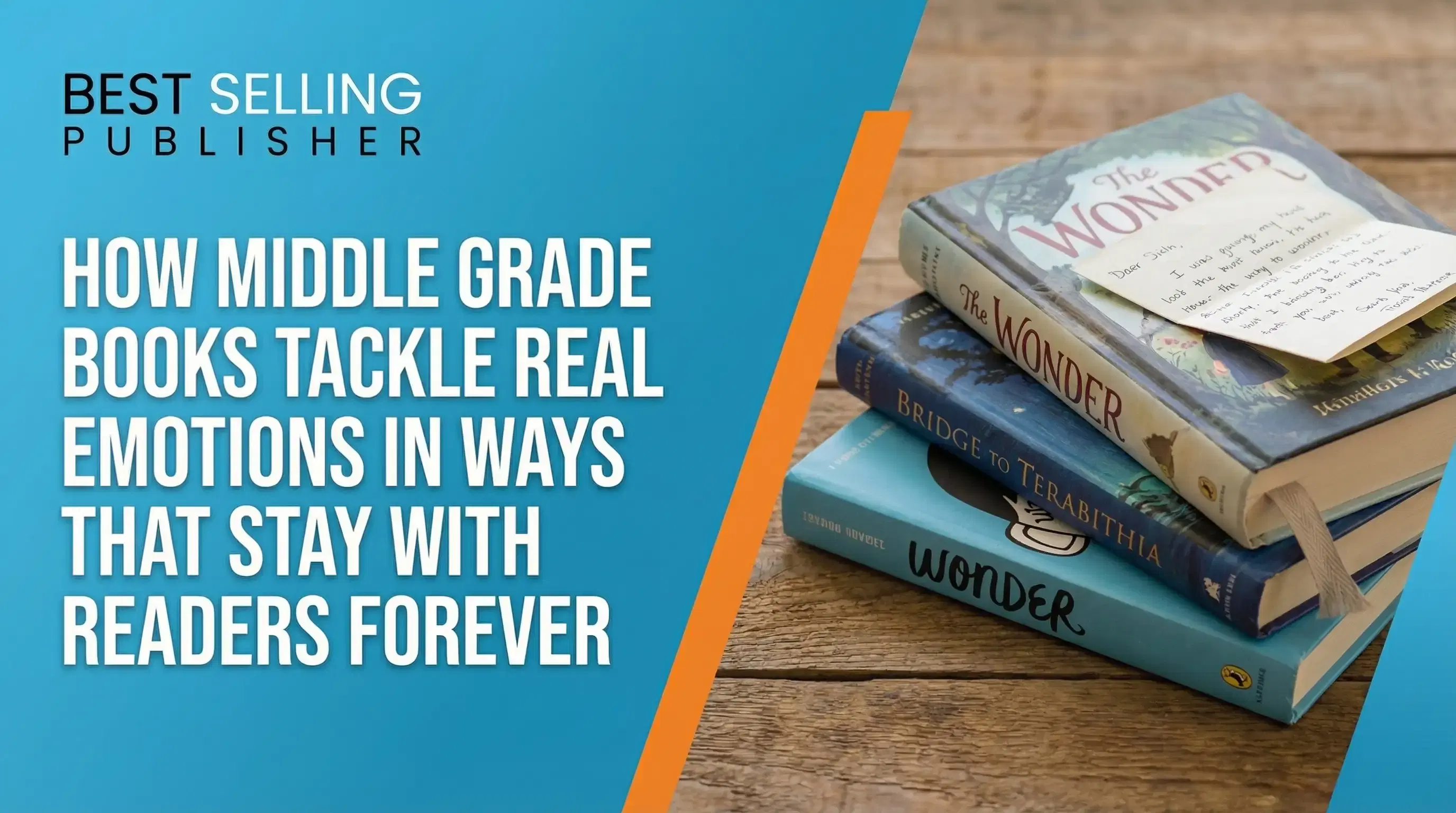
Middle grade books do not talk down to children, they talk straight to them, and that is why they last a lifetime.
Ask any adult to name the book that changed them as a reader, the book that made them understand what stories could actually do, that made them stay up past their bedtime reading, that made them feel genuinely seen for the first time, and the answer is almost always a middle grade novel. Not the literary fiction they studied in university. Not the acclaimed adult novels they read in their twenties. The book they read at ten, or eleven, or twelve, when the world felt enormous and confusing and full of stakes they did not have the language to describe.
Middle grade fiction, books written for readers between approximately 8 and 12 years old, is the genre that produces more passionate lifelong readers than any other. Not because it is the best-written category in publishing, though some of the most accomplished writing for any audience lives here. But because it reaches readers at the exact developmental moment when the emotional resonance of the story is most powerful, most lasting, and most likely to create the kind of reading identity that a person carries into every subsequent decade of their life.
In this guide, we are going to explore what makes middle grade fiction so uniquely powerful, which books have earned their permanent place in readers' memories, why adults are as drawn to this category as the children it was written for, and what you need to know to publish a middle grade book of your own.
Why Middle Grade Books Hit Differently Than Anything Else a Child Reads
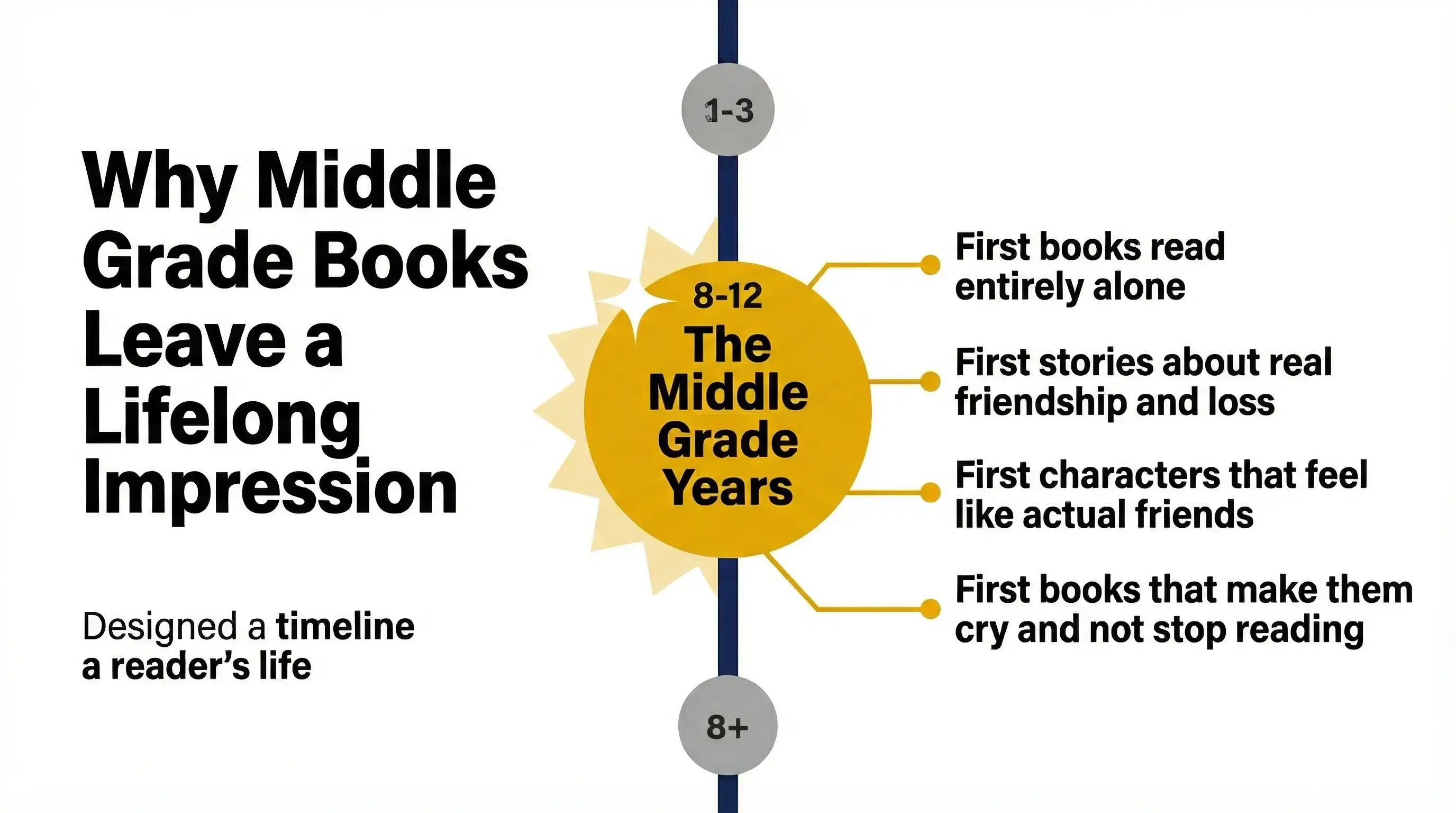
The years between 8 and 12 are, by any measure, one of the most emotionally intense periods of a human life. The children moving through this window are navigating a level of social and emotional complexity that is genuinely new to them, friendships that feel as serious as any relationship they will form as adults, encounters with injustice that are often the first time the world has felt genuinely unfair, a growing awareness of their own identity and the ways it differs from or aligns with the identities around them. They are experiencing things for the first time that adults have learned to manage through repetition and distance. And because they are experiencing them for the first time, they experience them with an intensity that adults rarely recover.
Middle grade books treat children as intelligent, capable readers for the first time, as readers who can handle complexity, who do not need to be protected from difficulty, who are capable of following a narrative that has more than one layer of meaning. The best middle grade writing does not simplify its emotional content for its audience. It presents that content honestly, with the respect that genuine honesty requires, the respect of believing that a ten-year-old can handle the truth about friendship, about loss, about the way the world sometimes fails to be fair, without needing to have those truths softened beyond recognition.
This is why the stories people read at this age stay with them more deeply than almost anything they read as adults. The emotional receptivity of childhood, combined with books that meet that receptivity with genuine honesty, creates reading experiences that become permanently embedded in a person's emotional architecture. When an adult says that Harry Potter or Bridge to Terabithia or The Giver changed their life, they are not being hyperbolic. They are describing something real, a book that reached them at the moment when they were most open to being reached, and that left marks that are still present decades later.
The Real Topics Middle Grade Books Are Not Afraid to Explore
One of the defining characteristics of great middle grade fiction is its willingness to deal with subjects that are genuinely difficult, not in the way that adult literary fiction deals with them, through complexity and ambiguity and unresolved darkness, but with a specific kind of directness and emotional honesty that children recognize immediately as the truth rather than a comfortable version of it.
Friendship, and specifically, the kind of friendship that breaks your heart and puts it back together, is the central emotional territory of middle grade fiction. The friendships in these books are not the uncomplicated relationships of younger children's literature. They are friendships with jealousy and betrayal and misunderstanding and the specific fear of losing someone who has become essential to your sense of yourself. They are friendships that end, and friendships that survive ending, and friendships that turn out to have been something other than what they appeared. Bridge to Terabithia deals with friendship and loss with an honesty that has made it one of the most emotionally powerful books in all of children's literature. R.J. Palacio's Wonder deals with the friendship formed across differences with a specificity and a warmth that has resonated with millions of readers across every age.
The experience of being different, of being the child who does not fit the available categories, whose identity does not match any of the identities that the social world around them has prepared a place for, is another central theme of the best middle grade fiction. And the resolution these books offer is not the resolution of conformity. The children in middle grade books who are different discover, usually through significant difficulty, that the difference is not a problem to be solved but a source of strength to be claimed. This message, delivered at the exact developmental moment when children are most vulnerable to the pressure to conform, has had an effect on readers that extends far beyond the books themselves.
Loss and grief are also present in middle grade fiction with a seriousness that sometimes surprises adults who expect children's literature to protect young readers from difficult emotions. The best middle grade authors understand that children experience grief, the death of grandparents, the loss of friendships, the end of childhood itself as they begin to sense it approaching, and that books that acknowledge these losses honestly are more comforting and more useful than books that pretend the losses do not happen.
What Separates Middle Grade From Children's Books and Young Adult
Middle grade fiction is not simply a bridge between early reader books and young adult fiction. Authors and middle grade book publishing services both recognize it as its own distinct literary world with its own specific voice, its own specific emotional register, and its own specific relationship with its reader, and understanding what makes it distinct is essential to understanding why it produces the effects it does.
The specific voice that middle grade demands is one of the most technically demanding in all of fiction to execute well. It needs to be honest without being cynical, funny without being superficial, emotionally serious without being heavy or oppressive. It needs to treat its readers as intelligent without being self-conscious about its own intelligence. It needs to acknowledge darkness without drowning in it, to give difficulty its proper weight without suggesting that difficulty is inescapable or permanent. The writers who can maintain this balance across the length of a novel are doing something genuinely difficult, and the readers who respond to it recognize the achievement intuitively even if they cannot articulate it.
The difference between middle grade and young adult is most visible in how each genre handles darkness. Young adult fiction can go dark, can follow its characters into places from which recovery is uncertain, can end without full resolution, can sit in the complexity of ongoing trauma without offering easy exits. Middle grade acknowledges darkness but does not abandon its readers to it. A middle grade book can kill a character who matters, can put its protagonist through genuine suffering, can deal honestly with injustice and loss, but it maintains throughout a fundamental orientation toward hope and toward the protagonist's continued agency. The world of middle grade is a world where difficulty is real and consequences are genuine, but where the protagonist's resilience is ultimately confirmed.
Adults who discover middle grade often report that it hits harder than adult literary fiction, not in spite of its accessibility but because of it. The emotional honesty of great middle grade writing, delivered without the defensive complexity that literary fiction sometimes uses to hold its reader at a safe distance, reaches adult readers in places that more sophisticated prose cannot always access.
The Middle Grade Books That a Generation of Readers Will Never Forget
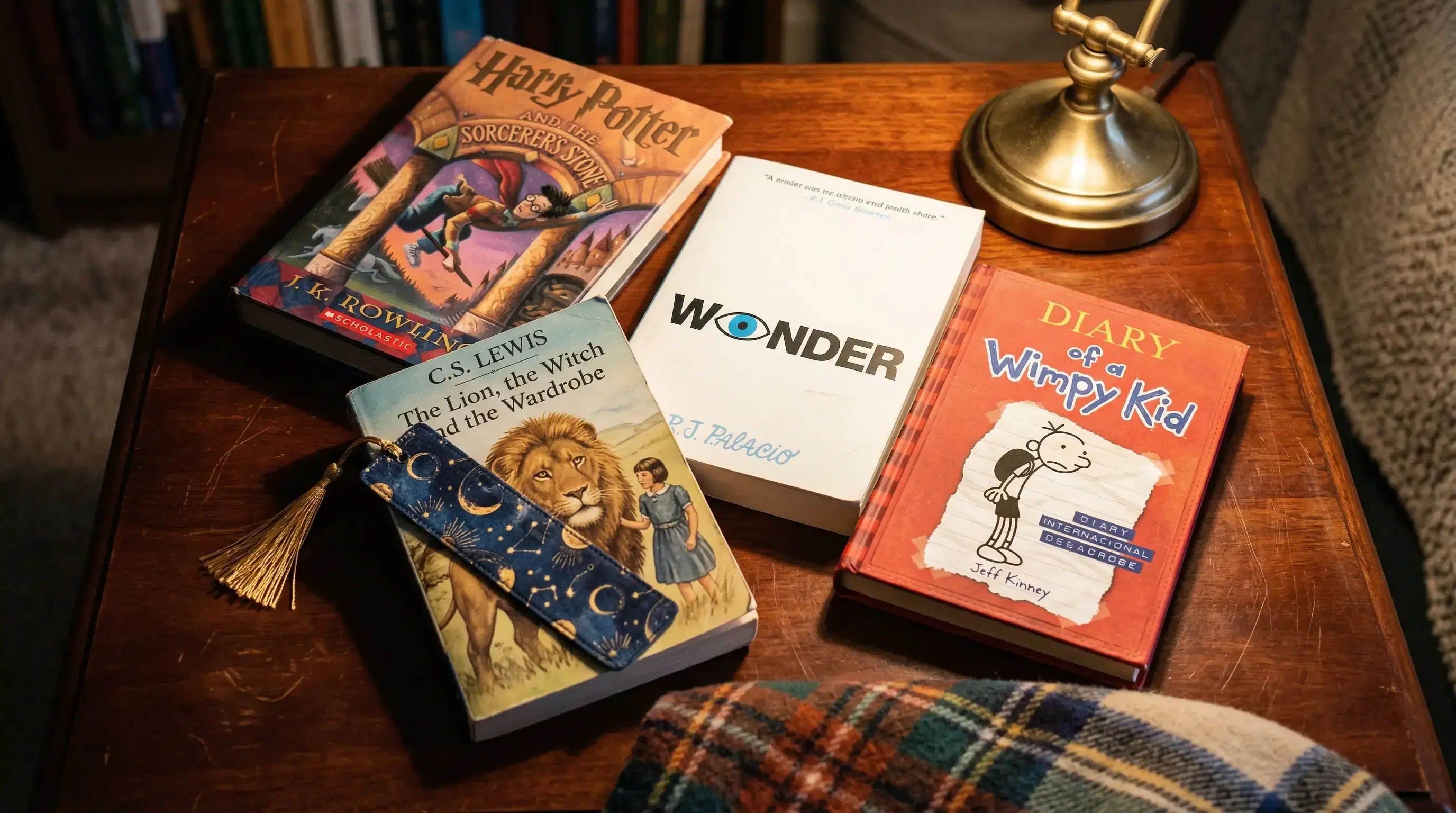
The books below have done what only the very best middle grade fiction achieves: they have become permanent parts of the emotional landscape of the readers who encountered them at the right moment, books that are not just remembered but carried, consulted, and returned to across decades.
Harry Potter and the Sorcerer's Stone by J.K. Rowling
The most commercially successful middle grade series in history, and a genuine phenomenon in the sense that the word is almost never used accurately. The first Harry Potter novel is a masterclass in middle grade craft: a protagonist who is ordinary-extraordinary in exactly the way that 8 to 12 year old readers most powerfully respond to, a world built with extraordinary internal consistency and sensory detail, humor and darkness balanced with perfect precision, and a moral universe that treats the difference between right and wrong as genuinely important rather than as a convenient plot device. The series created a generation of readers who might otherwise never have discovered the pleasure of a genuinely long book, and that is perhaps its most enduring achievement.
Wonder by R.J. Palacio
R.J. Palacio's 2012 debut novel tells the story of Auggie Pullman, a boy with a severe facial difference who attends school for the first time in fifth grade, and it does something remarkable: it makes the reader inhabit not just Auggie's perspective but the perspectives of every significant person in his world, including some whose responses to him are not admirable. The result is a book about kindness, difference, and the difficulty of being genuinely good that has been used as a classroom text around the world and that has changed how countless readers, children and adults both, think about what it means to see someone rather than look past them.
The Giver by Lois Lowry
Published in 1993 and still one of the most discussed books in middle grade fiction, The Giver presents a future society from which pain, conflict, and genuine choice have been eliminated, and asks the question of whether a life without suffering is actually a life worth living. Lois Lowry's novel handles one of the most profound philosophical questions available with a clarity and a restraint that make it accessible to young readers while giving it enough depth to sustain adult engagement. The ending, deliberately ambiguous, deeply moving, has been debated by readers for three decades.
Bridge to Terabithia by Katherine Paterson
Katherine Paterson's 1977 novel about the friendship between Jess and Leslie, and the devastating loss that defines the story's second half, is one of the most emotionally powerful books in all of children's literature. It is often the first book in which a young reader encounters the kind of loss, sudden, arbitrary, incomprehensible, that the world actually contains, and the honesty with which Paterson handles Jess's grief has made this book one of the most frequently cited formative reading experiences of adults who read it as children. It does not soften the loss. It does not resolve the grief. It witnesses them, and in witnessing them, helps.
Diary of a Wimpy Kid by Jeff Kinney
Jeff Kinney's illustrated series about Greg Heffley, whose self-absorption is both hilariously accurate and quietly illuminating, created an entirely new format for middle grade fiction and reached millions of children who had been resistant to traditional novels. The diary format, the cartoon illustrations on every page, the combination of genuine humor with genuine social anxiety, and Greg's complete lack of the qualities typically celebrated in middle grade protagonists make these books feel radically honest about the actual experience of being 12. They have brought more reluctant readers into the habit of reading than almost any other series of the past two decades.
The Lion, the Witch and the Wardrobe by C.S. Lewis
The first published volume of C.S. Lewis's Chronicles of Narnia has been in continuous print since 1950, which is, in the book world, as close to an absolute verdict as exists. Lewis's extraordinary gift for creating a world that feels physically real and emotionally true, and for embedding within the adventures of four children a set of moral and spiritual questions that neither condescend to young readers nor exclude them, has made Narnia one of the most enduring imaginary geographies in all of fiction. Every reader who went through the wardrobe as a child carries some part of Narnia with them permanently.
A Wrinkle in Time by Madeleine L'Engle
Madeleine L'Engle's 1962 novel about Meg Murry's journey through the universe to rescue her father combines science fiction cosmology, genuine philosophical depth, and a protagonist whose awkwardness, emotional intensity, and passionate love for her family feel radiantly real. The book was rejected by 26 publishers before it was published and went on to win the Newbery Medal. It remains one of the most original and most beloved middle grade novels ever written, and one of the earliest middle grade novels to place a girl's intelligence and emotional life at the unambiguous center of a space adventure.
Hatchet by Gary Paulsen
Brian Robeson's survival story, thirteen years old, alone in the Canadian wilderness after a plane crash, with only a hatchet, is one of the most purely compelling middle grade novels ever written. Paulsen writes the physical reality of survival with extraordinary precision and sensory immediacy, and the result is a reading experience that is almost physically involving. But the book is not only about survival in the wilderness. It is about the survival of a specific kind of inner clarity that the wilderness forces and that the comfortable world outside it sometimes prevents. Boys in particular have been reached by this book who were unreachable by almost any other.
Why Adults Love Middle Grade Books Just as Much as the Children They Were Written For
The adults who read middle grade fiction, and there are many more of them than the publishing industry's age categorizations suggest, are not reading it as a nostalgic retreat into simplicity. They are reading it because the best middle grade fiction offers something that adult literary fiction sometimes fails to provide: emotional directness without defensive irony, narrative stakes that feel genuinely important, and characters whose interiority is rendered with clarity rather than obscured behind the complexity that adult fiction sometimes mistakes for depth.
Adults who return to middle grade books they loved as children consistently report finding things they missed at first reading, layers of meaning that were present in the text but that they lacked the life experience to fully receive. The adult who re-reads Bridge to Terabithia is experiencing a different book from the child who first read it, not because the text has changed but because grief is something the adult now knows from the inside rather than the outside. The adult who re-reads The Giver is reading a political novel as well as a philosophical one. The adult who re-reads Harry Potter is seeing the scaffolding of the moral universe that they absorbed intuitively as a child.
Middle grade is also the category that consistently produces the most re-read books of any in publishing. The books in this category are re-read not because they are simple enough to be consumed quickly but because they are rich enough to reward returning to, and because the experience of returning to them connects adult readers to a version of themselves that felt things with an intensity that adult life sometimes muffles. There is something in the emotional honesty of the best middle grade writing that gives adult readers permission to feel that intensely again. That is not a small thing.
What Middle Grade Readers and Their Parents Are Looking for in 2026
The middle grade publishing landscape in 2026 reflects a readership that is more diverse, more visually sophisticated, and more knowledgeable about its own preferences than any previous generation. The demand for middle grade book publishing serviceshas grown alongside this expanding and increasingly discerning audience, and the books that are reaching the most readers are the ones that have adapted to these changes without compromising on what makes the genre essential.
The demand for diverse middle grade stories is both commercially significant and genuinely meaningful. Readers between 8 and 12 are at the developmental stage when they are most actively forming their understanding of who they are and where they fit in the world, and books that reflect more of the actual diversity of that world back to them are doing developmental work that homogeneous bookshelves cannot. The success of books like Front Desk by Kelly Yang, Merci Suarez Changes Gears by Meg Medina, and the Rick Riordan Presents imprint's amplification of diverse mythological traditions has demonstrated that young readers are hungry for middle grade stories that reflect more of the world they actually live in.
Graphic novel hybrids and illustrated chapter books continue to explode in popularity, with Dog Man by Dav Pilkey leading a category that is now one of the fastest growing in children's publishing. These formats have proven extraordinarily effective at reaching the middle grade readers who have been most resistant to traditional text-heavy novels, and publishers are increasingly recognizing that the visual literacy of this generation of readers is an asset to be worked with rather than a problem to be overcome.
Series continue to dominate the middle grade market with an intensity that is unmatched in any other publishing category, and authors who publish middle grade books as part of a planned series consistently outperform standalone titles in terms of reader loyalty and long-term sales. Middle grade readers do not simply want books. They want worlds, and when they find a world they love, they want to live in it for as long as possible. The series that offer the richest, most fully realized worlds consistently produce the most passionate reader communities, the most sustained sales, and the most word-of-mouth advocacy from readers who press the books on everyone they know.
How to Find the Perfect Middle Grade Book for the Child in Your Life
Finding the right middle grade book for a specific child requires understanding what that child is actually drawn to, not what adults think they should be drawn to, but what genuinely captures their attention and imagination. The child who is passionate about fantasy and magic will be reached by a book that takes magic seriously, as a set of real rules with real consequences, rather than a vague background element. The child who is primarily interested in friendship and social dynamics will be reached by a book that puts those dynamics at the center rather than the periphery. The child who needs to see their own experience reflected will be reached by a book whose protagonist shares something essential about their own situation.
For readers who love adventure and fantasy, start with Harry Potter, Percy Jackson, or The Chronicles of Narnia, each of which offers a fully realized secondary world with its own logic and mythology. For readers who respond most powerfully to emotional realism, Wonder, Bridge to Terabithia, and any Newbery Medal winner are excellent starting points. For reluctant readers or children who are more visually oriented, Diary of a Wimpy Kid and the Dog Man series have the best track record of building reading enthusiasm in children who have resisted other formats.
How Best Selling Publisher Publishes Middle Grade Books
Middle grade publishing requires a specific understanding of the genre's voice, its conventions, and the developmental stage of its reader, and this understanding shapes every aspect of how Best Selling Publisher works with middle grade manuscripts.
We work with every author who comes to us to publish middle grade book on the specific craft challenges of the form: maintaining the balance between emotional honesty and narrative momentum, sustaining the specific voice that middle grade demands across the length of a full novel, and ensuring that the protagonist's journey delivers the kind of genuine development and resolution that middle grade readers expect and need. Our editorial process for middle grade manuscripts is grounded in a deep understanding of what makes this genre work at its best.
Cover design for middle grade titles is one of the most important investments a middle grade author can make, because the visual design of a middle grade book is what communicates its genre, its tone, and its intended reader before a single word is read. Our design team understands the visual language of middle grade fiction and creates covers that attract the specific readers the book is written for. Our Amazon book publishing and marketing strategy for middle grade titles is calibrated to reach both child readers and the parents and educators who buy books for them. Authors work with Best Selling Publisher with their work.
Conclusion
Middle grade is the genre that reminds every reader, at any age, what it felt like to discover that books could change your world. Not just entertain you. Not just distract you. Actually change you, give you language for things you were feeling but could not articulate, show you that other people had been where you were, make you believe that the difficulty you were navigating was not permanent and not uniquely yours.
The middle grade story that reaches a child at the right moment, that meets them in the specific emotional place they are in when they open it, and takes that place seriously, and gives them something true and useful in return, is doing something that no other intervention in a child's development can quite replicate. It is giving them evidence, through the particular intimacy of the story, that they are not alone. That evidence is worth everything. And the best middle grade novels carry it on every page.
FAQs
Middle grade fiction is primarily written for readers between the ages of 8 and 12, though the readership extends beyond this range in both directions. Many 7-year-olds who are strong readers engage comfortably with middle grade novels, and many adults, as this guide has explored, read middle grade fiction with genuine enthusiasm and considerable benefit. The age range is a guide to the developmental stage the books are designed for rather than a strict restriction on who can enjoy them.
Middle grade fiction is written for readers between approximately 8 and 12, while young adult fiction targets readers from about 13 to 18. The practical differences are significant: middle grade books typically have younger protagonists (usually between 8 and 13), deal with challenges appropriate to that developmental stage, handle darkness with an orientation toward hope and resilience, and rarely include the romantic or sexual content that is common in young adult fiction. Young adult fiction can go darker, can be more morally ambiguous, and can leave readers in more unresolved territory, reflecting the developmental stage of an older readership that is more capable of sustaining that ambiguity.
Most middle grade novels fall between 25,000 and 50,000 words. Fantasy and adventure middle grade novels often run longer, 50,000 to 80,000 words, because the world-building they require demands more space. Contemporary middle grade novels, which do not require extensive world-building, typically fall in the lower half of the range. The appropriate length is always determined by the story: middle grade readers are capable of sustaining engagement with long books when the books earn that engagement, and the Harry Potter series, the longest of which runs to over 250,000 words, is the clearest proof of this.
Absolutely, and many do. Survey data consistently shows that a significant portion of middle grade readership is adult, and the reasons are understandable: the best middle grade fiction combines emotional honesty, narrative momentum, and genuine moral seriousness in a form that is often more direct and more affecting than adult literary fiction. Adults who read middle grade are not reading it as a guilty pleasure or an escape from complexity. They are reading it because it offers something specific and valuable that adult publishing sometimes fails to provide.
The middle grade books that stand out from the many thousands published each year share a specific set of qualities: a protagonist who is genuinely compelling rather than generically likeable, with a specific personality, specific strengths, and specific flaws; a narrative voice that is distinctive, consistent, and genuinely specific to this story and no other; emotional honesty about the real difficulties of the age group the book is designed for; and a resolution that feels genuinely earned rather than imposed. The books that endure are the ones where readers feel that the author has taken their emotional experience seriously.
Working with a professional publishing partner who understands the specific requirements of middle grade publishing, including the genre's voice conventions, cover design language, and marketing channels, is the most effective route for most middle grade authors. Best Selling Publisher offers complete middle grade publishing services, from manuscript development and editing through cover design, Amazon KDP publishing, and targeted marketing to both young readers and the adults who buy books for them. Contact our team to learn how we can help your middle grade story reach its audience.