
How Mystery and Thriller Books Keep You Hooked From the First Page to the Very Last
Picture this. It is midnight. You have work tomorrow. You told yourself you would stop after one more chapter, but that was three chapters ago. Your heart is beating a little faster than it should be. You are barely breathing. And there is absolutely no way you are putting this book down until you find out what happens.
If you have ever been there, you already know exactly what mystery and thriller books do to a reader. No other genre in the world creates that specific kind of obsession, that complete inability to stop, that racing pulse, that desperate need to know. And in this guide, we are going to explore exactly why that happens, what makes this genre so uniquely powerful, and which books you should read if you want to experience it for yourself.
Whether you are a lifelong fan of suspense fiction or someone who has never picked up a thriller in your life, by the time you finish reading this, you will understand why mystery and thriller books have been captivating readers for over a century, and if you are a writer who wants to publish mystery book, why this is one of the most exciting genres to write in, and why they show absolutely no signs of stopping.
What Makes Mystery and Thriller So Different From Every Other Genre
Every genre offers something. Romance gives you emotional connection. Fantasy gives you escape. Science fiction gives you ideas. But mystery and thriller gives you something that none of the others can, the unanswered question.
From the very first page of a great mystery or thriller, there is something you do not know. A body has been found. A person has gone missing. Someone is being followed. A secret is about to unravel. And that single unanswered question creates a kind of tension in the reader's mind that is genuinely impossible to shake until the answer arrives.
What makes this so powerful is that it is not just a storytelling trick, it is psychology. Human beings are hardwired to need resolution. When we encounter an open question, our brains cannot rest until it is answered. Great mystery and thriller authors understand this at a deep level, and they use it with extraordinary skill. They give you just enough to keep you engaged, just enough to make you think you know the answer, and then they pull the rug out from under you at exactly the right moment.
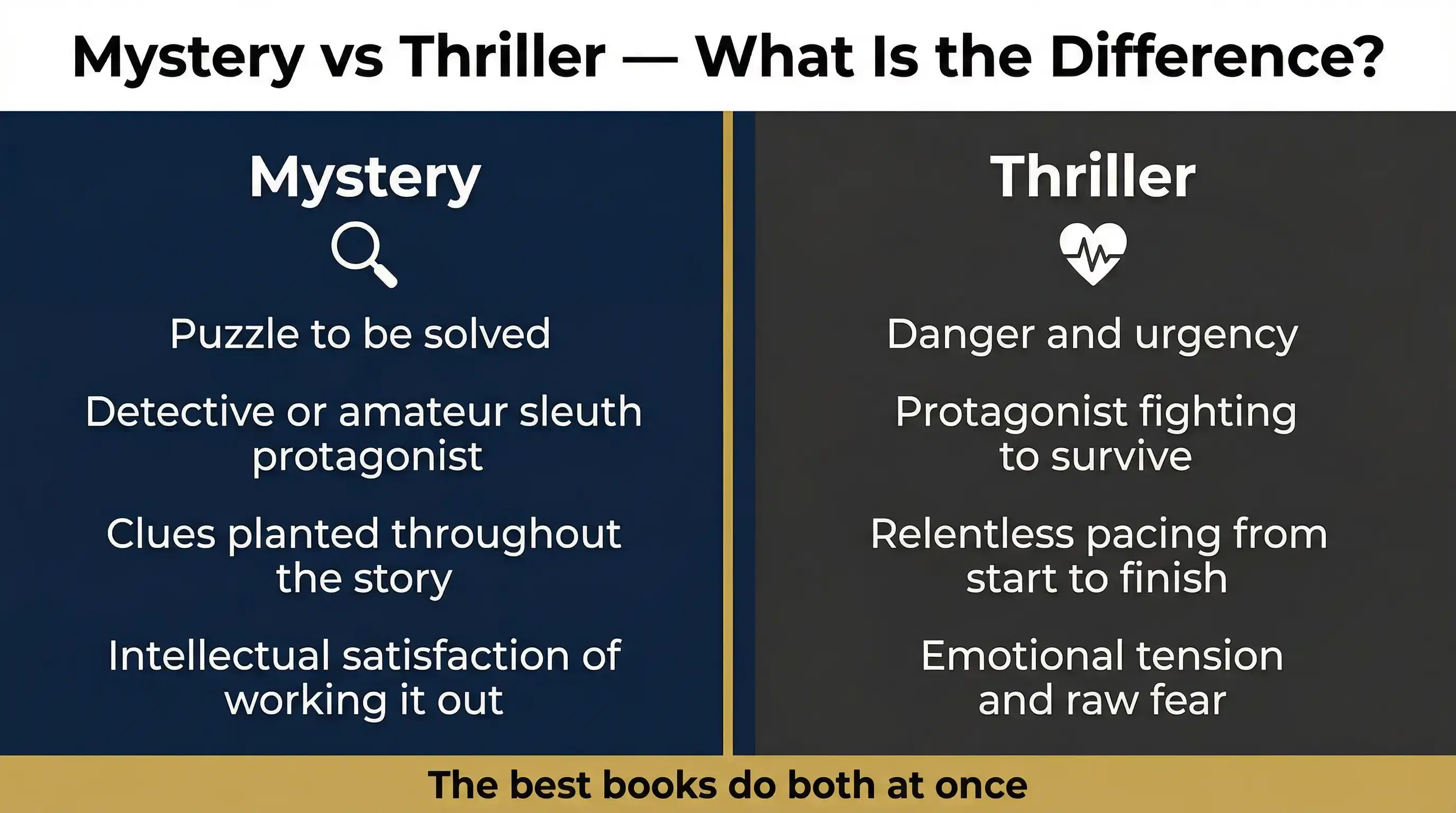
The difference between a mystery and a thriller is worth understanding clearly because while they share a family resemblance, they deliver slightly different experiences.
A mystery is a puzzle. At its heart, something has happened, usually a crime, and the story is about figuring out what, how, and most importantly, who. The reader becomes a kind of detective alongside the protagonist, gathering clues, weighing suspects, and trying to solve the puzzle before the answer is revealed. The pleasure of a mystery is intellectual as much as emotional, there is a real satisfaction in the process of working things out.
A thriller, on the other hand, is about danger and urgency. In a thriller, the protagonist is not just trying to solve something, they are usually trying to survive something. The stakes are immediate, the pace is relentless, and the threat is personal. Where a mystery makes you think, a thriller makes you feel, specifically, it makes you feel fear, tension, and the desperate hope that the person you are rooting for is going to make it out alive.
The best books in this genre do both at once, and that combination is close to irresistible.
The Two Sides of This Genre - Mystery and Thriller Explained
The world of mystery and thriller fiction is broader and richer than most readers realize when they first discover it. Within this one genre, there are reading experiences that feel completely different from each other, which means that wherever you are as a reader, there is a corner of this genre that was made exactly for you.
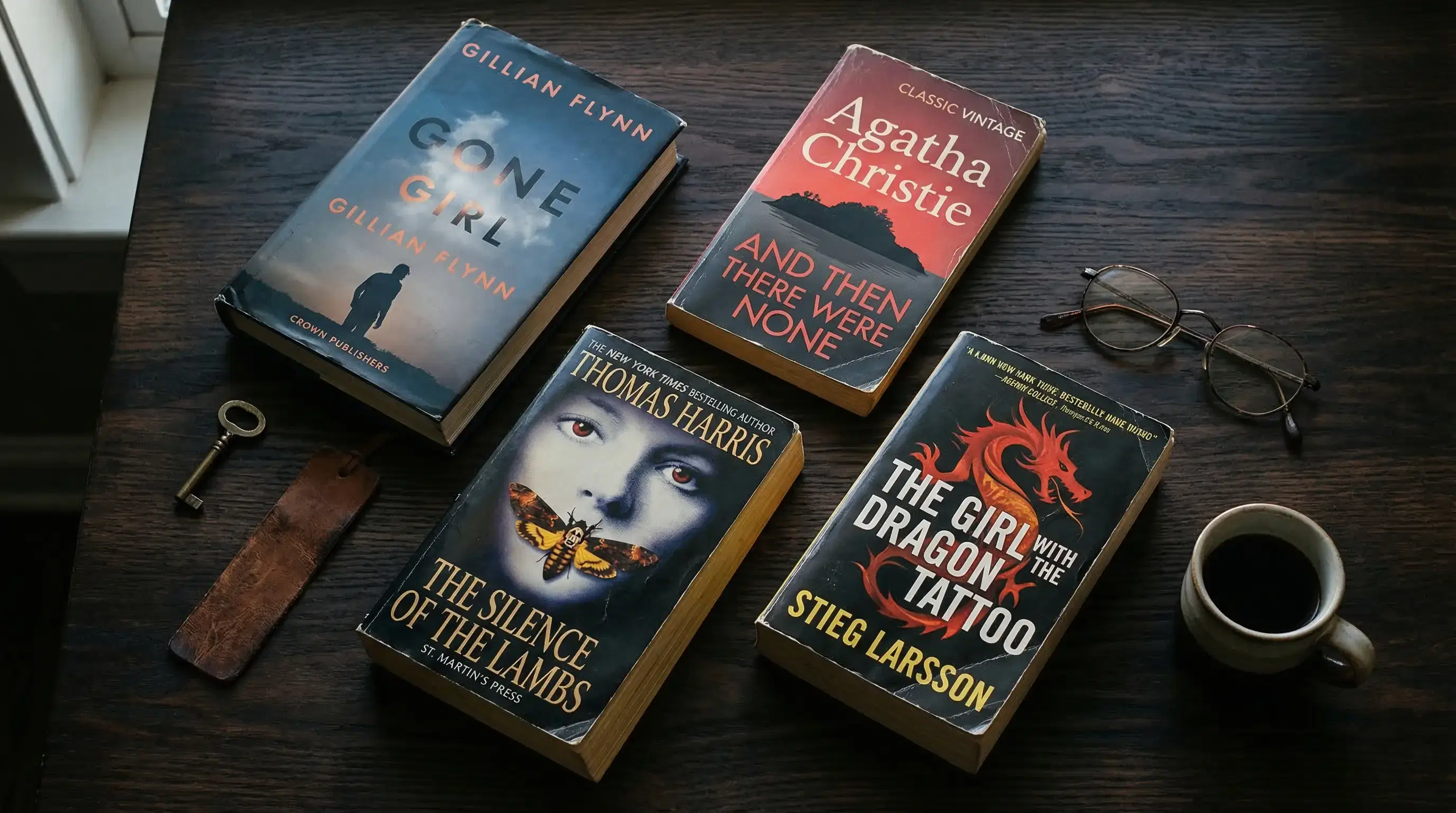
Mystery fiction has one of the longest and most celebrated histories in all of literature. It stretches back to Edgar Allan Poe, who essentially invented the detective story in the 1840s with his character C. Auguste Dupin. But it was Agatha Christie who turned mystery fiction into a global obsession. Her books, including And Then There Were None, which remains one of the bestselling novels ever written, and Murder on the Orient Express, which has been adapted more times than almost any other mystery, established a template for the genre that still shapes how mystery books are written today.
Classic mystery fiction tends to follow certain beloved conventions. There is a crime, usually a murder. There is a detective, either professional like Christie's Hercule Poirot or amateur like her Miss Marple. There are suspects, each with their own motive, means, and opportunity. There are clues scattered through the story, some genuine and some designed to mislead. And there is a revelation, a moment where everything comes together and the truth is finally laid bare. The reader who has been paying close attention experiences a particular kind of pleasure at this moment: the satisfaction of seeing a complex puzzle solved with elegance.
Thriller fiction operates on a different frequency. Think of Thomas Harris's The Silence of the Lambs, a book so intense, so psychologically unsettling, that it changed what readers believed a thriller could be. Or Gillian Flynn's Gone Girl, which took the psychological thriller to a completely new place by making both of its central characters deeply unreliable narrators, forcing the reader to question everything they think they know at every single turn. Or more recently, Tana French's In the Woods, which combines the puzzle elements of classic mystery with the psychological darkness of the best thrillers to create something that feels genuinely unique.
What these books share, despite their differences, is the fundamental promise of the genre. From the first page to the last, something is at stake. Someone needs to find out the truth. And the reader is along for every twist, every revelation, and every moment of dread along the way.
The Tricks Great Authors Use to Keep You Guessing
One of the most fascinating things about mystery and thriller fiction is that the best authors in the genre are essentially performing a magic trick on their readers, and doing it so skillfully that even readers who know it is happening cannot help but fall for it every single time.
The first and most famous tool in the mystery writer's arsenal is the misleading clue, a piece of information that seems significant and points the reader toward a particular conclusion, only to be revealed later as either irrelevant or deliberately deceptive. Agatha Christie was the undisputed master of this technique. She would plant a misleading clue so cleverly that readers would stake everything on it, only to discover at the end that they had been looking in exactly the wrong direction all along. The genius of it is that when you go back and reread a Christie novel knowing the answer, you can see every misleading clue for what it was, and the craft behind it becomes even more impressive.
The second great tool is the unreliable narrator, a storytelling technique where the person telling you the story cannot be fully trusted. Gillian Flynn's Gone Girl is perhaps the most celebrated modern example of this. The entire novel is told through two alternating perspectives, both of which turn out to be deeply unreliable, and the reader spends the whole book trying to figure out which version of events is closer to the truth. It is a deeply unsettling reading experience, and completely addictive.
The third tool is pacing, the control of how fast or slow information is released to the reader. Great thriller writers understand that tension is built not just through what happens but through when the reader finds out about it. A revelation that comes too early deflates tension. One that is held back just long enough makes the reader feel like they are going to explode. The best thriller writers have an almost musical sense of timing, they know exactly when to accelerate and exactly when to hold back, and the result is a reading experience that feels almost physically overwhelming.
And finally, there is the twist, the moment that reframes everything the reader thought they understood. A great twist in a mystery or thriller is not just surprising. It is surprising and inevitable at the same time. When you reach it, you think "I never saw that coming", and then five seconds later you think "but of course, it could never have been anything else." That combination is extraordinarily rare and extraordinarily satisfying when an author pulls it off.
The Greatest Mystery and Thriller Books Ever Written
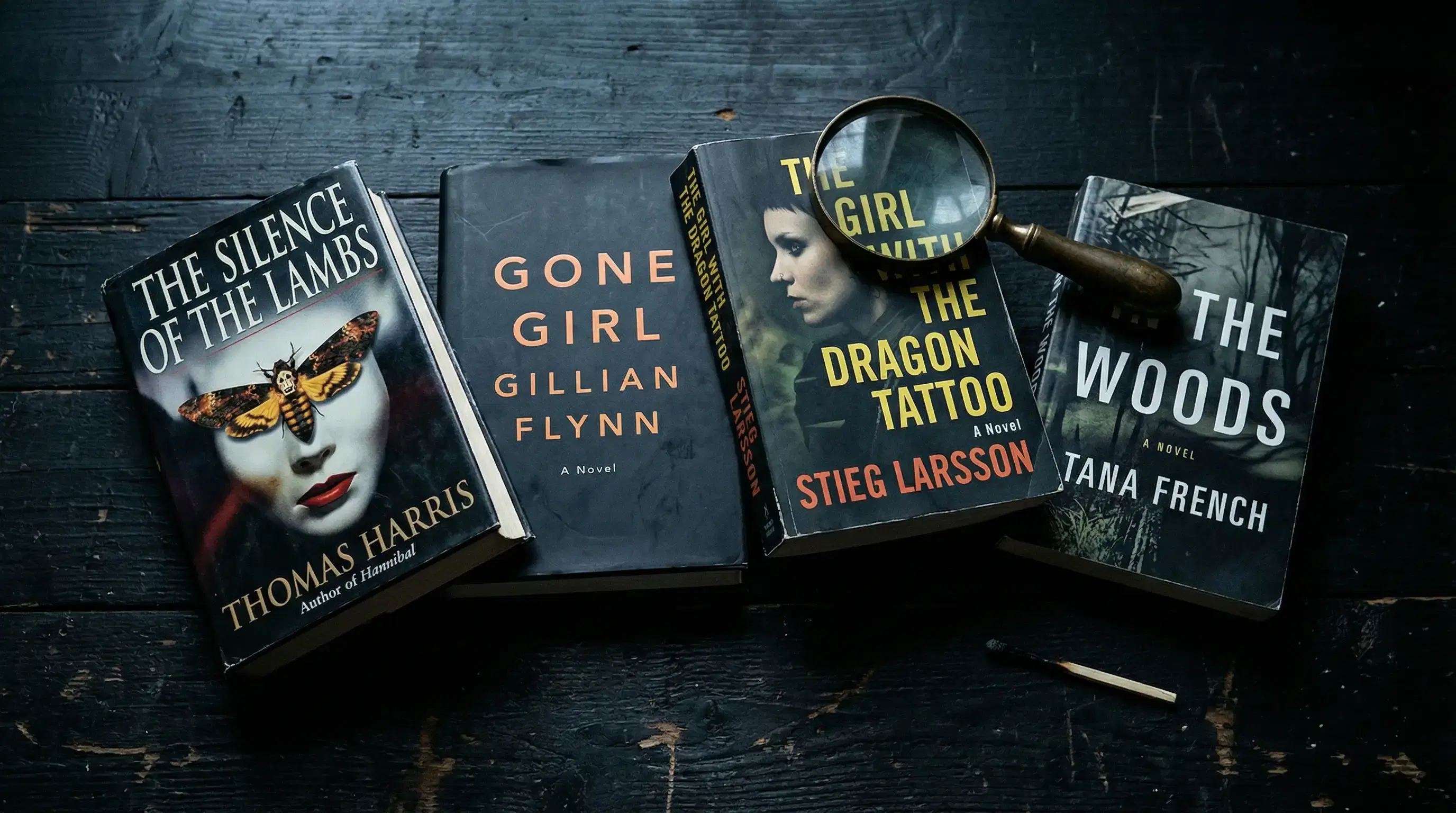
If you are ready to experience everything this genre has to offer, the books below represent the very best of what mystery and thriller fiction can be. From the timeless classics that built the genre to the modern masterpieces that have taken it to new places, each of these books delivers exactly what great suspense fiction promises, and then some.
And Then There Were None by Agatha Christie Ten strangers are invited to a remote island. One by one, they begin to die. With no way off the island and a killer hiding among them, the tension builds to a breathtaking conclusion that readers have been talking about since 1939. The bestselling mystery novel ever written, and for very good reason.
The Silence of the Lambs by Thomas Harris FBI trainee Clarice Starling must interview the brilliant and deeply terrifying Dr. Hannibal Lecter to catch another serial killer. The psychological cat-and-mouse between Starling and Lecter is one of the most compelling relationships in all of thriller fiction, and the book's atmosphere of dread is unmatched.
Gone Girl by Gillian Flynn On the morning of Nick and Amy Dunne's fifth wedding anniversary, Amy disappears. As the investigation unfolds, both Nick and Amy's alternating narrations reveal that neither of them is telling the whole truth. A psychological thriller that made readers question everything they thought they knew about the people closest to them.
The Girl with the Dragon Tattoo by Stieg Larsson Journalist Mikael Blomkvist and the brilliant, unconventional hacker Lisbeth Salander investigate a decades-old disappearance within a wealthy Swedish family. Dark, complex, and completely gripping, this book launched one of the most beloved crime fiction series of the 21st century.
In the Woods by Tana French When a child's body is found in the same Dublin woods where two children vanished twenty years earlier, and where the sole survivor of that earlier case is now the detective on the new investigation, the result is a mystery of extraordinary psychological depth and emotional complexity.
The Da Vinci Code by Dan Brown A murder in the Louvre sends Harvard professor Robert Langdon on a trail of cryptic clues through the works of Leonardo da Vinci. Whatever its literary critics might say, this is one of the most purely unputdownable thrillers ever written, the book that reminded millions of people why they loved reading.
Big Little Lies by Liane Moriarty Three women, a school community full of secrets, and a murder that has not yet happened. Told through flashbacks and police interviews, this is a thriller that uses warmth and dark humor alongside genuine menace to create something genuinely unlike anything else in the genre.
The Thursday Murder Club by Richard Osman Four retirees at a luxurious retirement village meet weekly to solve cold cases, until a real murder lands on their doorstep. Witty, warm, and absolutely full of genuine mystery plotting, this is one of the most purely enjoyable mystery novels of recent years.
Why Mystery and Thriller Readers Are Unlike Any Other
Ask any dedicated mystery or thriller reader about their genre and you will notice something immediately, they do not just like these books. They are devoted to them in a way that readers of almost any other genre rarely are.
Part of this is the rereading phenomenon that is unique to mystery fiction. Unlike almost any other genre, mystery books reward rereading in a completely specific way. When you know who did it, the entire book looks different. Every conversation, every scene, every seemingly throwaway detail reveals a new layer of meaning. Readers who love Agatha Christie do not just read her books once, they return to them again and again, each time catching something they missed before, each time marveling at how cleverly everything was constructed.
Part of it is also the community that has built up around this genre. Mystery and thriller readers are some of the most active book club members, some of the most passionate online reviewers, and some of the most loyal genre advocates in all of publishing. Cozy mystery readers, who love the puzzle and the atmosphere but prefer their fiction without excessive darkness, have built enormous online communities where they discuss not just books but the entire lifestyle associated with reading them. True crime podcast listeners carry their genre obsession beyond fiction into the real world. Psychological thriller fans on BookTok create reading lists, reviews, and recommendations that regularly launch new books onto bestseller lists overnight.
And part of it is simply the emotional experience that these books create, an experience that is, in the truest sense, addictive. The tension, the release, the twist, the satisfaction. Once you have felt it in a great mystery or thriller, you want to feel it again. And again. And again.
What to Read First If You Are New to This Genre
If you have never read a mystery or thriller before, or if you have only dipped a toe in and want to find the book that turns you into a true devotee, the good news is that this genre has perfect entry points for every kind of reader.
If you love puzzles and enjoy the intellectual satisfaction of working things out, start with And Then There Were None by Agatha Christie. It is short, perfectly constructed, and delivers one of the most satisfying mystery conclusions ever written. It has been introducing new readers to the genre for over eighty years and it has never once failed to impress.
If you prefer your reading fast, modern, and psychologically intense, start with Gone Girl by Gillian Flynn. It is the book that most reliably converts readers who think they do not like thrillers into readers who cannot get enough of them. The pacing is relentless, the characters are deeply compelling, and the twist is one for the ages.
And if you want something that blends warmth and humor with genuine mystery plotting, the kind of book you can read in a sunny afternoon and still feel the satisfying pull of suspense, start with The Thursday Murder Club by Richard Osman. It is funny, clever, and completely addictive in the best possible way.
Whichever door you walk through, the world of mystery and thriller fiction is waiting for you on the other side.
How Best Selling Publisher Brings Mystery and Thriller Stories to Life
Mystery and thriller is a genre that demands a very specific kind of publishing expertise, and authors who come to us looking for mystery book publishing services quickly realize how much genre knowledge matters. The cover has to signal the right tone immediately, too light and it loses the genre's atmosphere, too dark and it becomes generic. The editing has to preserve pacing while tightening every sentence. The Amazon positioning has to reach the right readers, the ones who are actively searching for their next obsession.
At Best Selling Publisher, we have worked with mystery and thriller authors at every stage of the writing and publishing journey. We understand what makes this genre work, the craft, the tension, the reader's expectations, and we bring that understanding to every manuscript we work with.
Whether you come to us with a polished manuscript ready for the world, a rough first draft that needs shaping, or nothing more than a powerful idea and a burning desire to tell it, our team of writers, editors, cover designers, and book publishing experts will work with you to create a book that delivers everything a mystery and thriller reader is looking for.
We handle everything, professional ghostwriting and manuscript editing, genre-specific cover design that stops readers mid-scroll, Amazon KDP setup and keyword optimization to put your book in front of the right audience, and a targeted marketing strategy that gives your thriller the launch it deserves.
Authors work with Best Selling Publisher with their stories. We would love to help you tell yours.
Conclusion
Mystery and thriller fiction does something that no other genre quite manages. It takes hold of you. It refuses to let go. It makes ordinary evenings into something urgent and consuming. It turns one more chapter into the whole night. And when it is finally over, when the last page is turned and the truth is finally known, it leaves you with that very specific feeling of satisfaction that only the best storytelling can deliver.
Whether you are drawn to the elegant puzzle of a classic Agatha Christie, the psychological darkness of a Gillian Flynn, or the warm wit of Richard Osman, there is a mystery or thriller out there that was made for exactly the reader you are. The only question is which one you are going to read first.
And if you are a writer with a mystery or thriller story inside you, a plot that will not leave you alone, a character who demands to be brought to life, remember that the world needs your story. The readers are out there, waiting for their next obsession. Best Selling Publisher is here to help you give it to them.
FAQs
A mystery centers on solving a crime or puzzle, the reader follows the detective's investigation toward a revelation. A thriller focuses on danger and urgency, the protagonist is usually in direct peril and the story is driven by tension and survival. Many great books blend both elements together.
For puzzle lovers, start with And Then There Were None by Agatha Christie. For psychological intensity, Gone Girl by Gillian Flynn is the perfect entry point. For something warm and humorous with genuine mystery plotting, The Thursday Murder Club by Richard Osman is an outstanding choice.
Mystery and thriller fiction exploits a genuine psychological response, the human brain's need for resolution when faced with an unanswered question. Great authors in this genre build tension, plant misleading clues, and control the release of information so precisely that readers find it genuinely difficult to stop reading.
Most thriller novels fall between 70,000 and 100,000 words, roughly 280 to 400 pages. Pacing is critical in this genre, so very long thrillers are relatively rare. The goal is to keep the tension high from beginning to end without giving the reader a reason to put the book down.
The best mystery endings are surprising and inevitable at the same time. When the truth is revealed, the reader should feel both completely shocked and, a moment later, completely convinced, as if the answer could never have been anything else. An ending that feels random or unearned destroys the entire experience of the book.
The most effective route for most authors today is working with a professional publishing partner who understands the genre. If you are ready to publish a mystery book, Best Selling Publisher offers comprehensivemystery book publishing servicesfor authors at every stage, from manuscript development and editing to cover design, Amazon publishing, and marketing. Contact our team to find out how we can help you get your book into readers' hands.