
How Picture Books Use Art and Words Together to Teach Children Things That Last Forever
A picture book is the first time a child understands that a story can live inside an object they can hold in their hands. That moment, the moment a child realizes that the marks on the page mean something, that the images and the words together are telling them a story, that the object in their hands contains an entire world they can enter whenever they choose, is one of the most significant moments of their intellectual and emotional development. It is where every reader begins. It is where every lifelong love of books is born.
Picture books are not a simple category. They are not just stories with pictures added. They are one of the most technically demanding forms of writing and illustration that exists, and the authors who decide to publish picture books quickly discover that the craft required is unlike anything else in publishing - books in which every word has been weighed carefully, every image has been considered in relation to every other image, and every page turn has been designed as a storytelling moment. The best picture books are works of extraordinary craft that happen to be accessible to the youngest readers. The worst picture books are books that underestimate children, and children always notice when they are being underestimated.
In this guide, we are going to show you why picture books are so powerful, what separates a truly great picture book from a merely adequate one, which books have earned their place as genuine classics, and everything you need to know about how to publish a picture book of your own.
Why Picture Books Are the Most Powerful Teaching Tool a Child Can Have
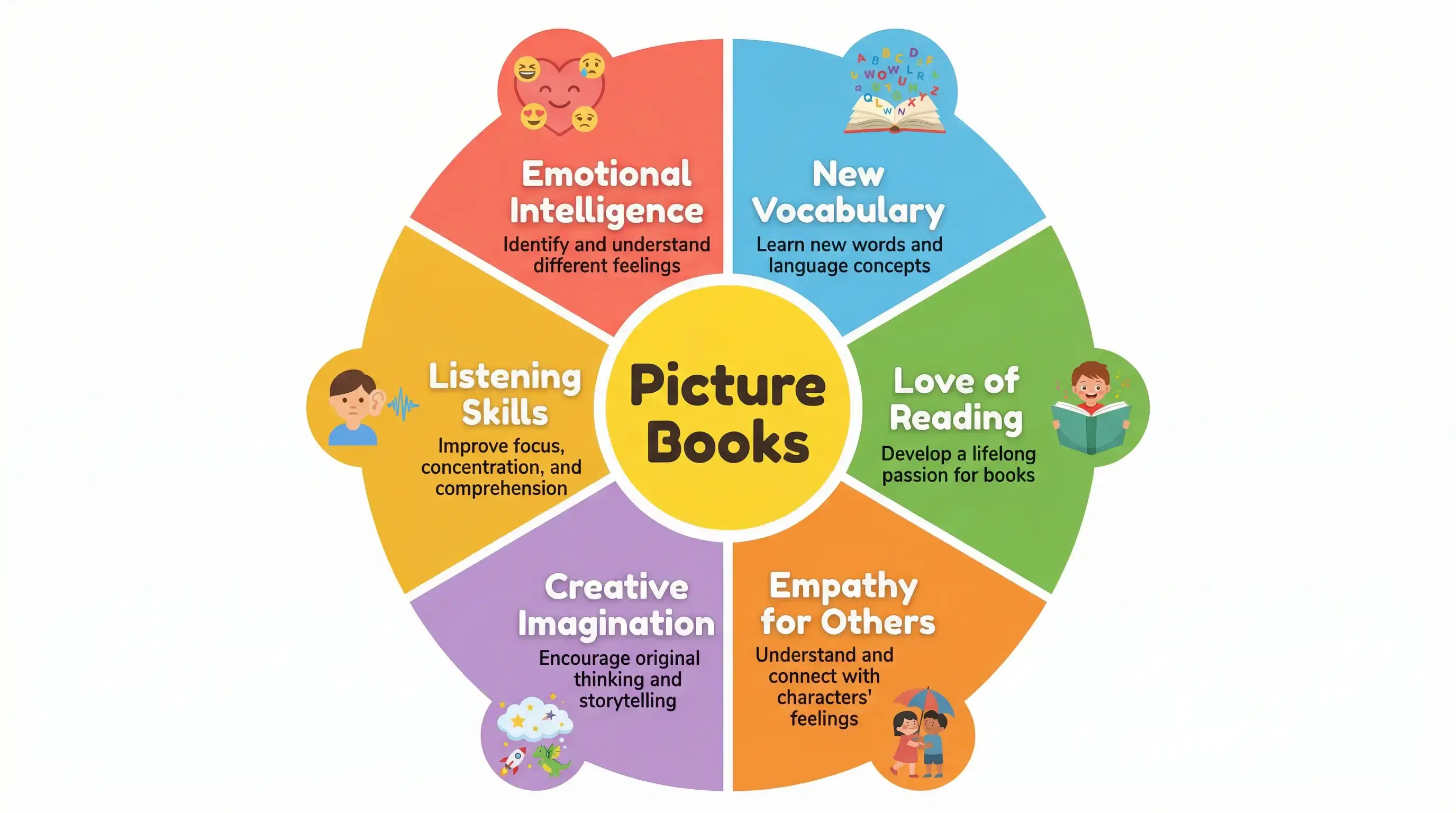
Long before a child can read a single word independently, they are learning from picture books at a pace and at a depth that no other medium can match. The combination of images and spoken words, when a parent or caregiver reads aloud, creates a learning experience that engages multiple cognitive systems simultaneously, and the research on its effects is remarkably consistent.
Picture books teach language at a rate that everyday conversation cannot achieve. When an adult reads a picture book aloud to a child, they expose that child to vocabulary that would almost never appear in normal speech - words that are more precise, more varied, and more emotionally nuanced than the language of daily interaction. A child who is read to regularly from picture books enters school with a vocabulary that is demonstrably larger than a child who has not, and that vocabulary advantage compounds over their entire educational career.
Picture books also teach emotional intelligence in a way that is uniquely effective for young children. When a child sees a character in a picture book experiencing fear, joy, anger, or sadness, and hears an adult narrating that experience out loud, they are learning to name their own emotions, to recognize those emotions in others, and to understand that feelings are a shared human experience rather than something private and inexplicable. This is foundational emotional education, and it happens naturally, without effort, through the simple act of reading together.
There is real research behind this, though it supports the direction of the claim more firmly than its strength. Work by Hutton and colleagues at Cincinnati Children's found that brain connectivity supporting language, imagery and attention was strongest when children experienced an illustrated storybook rather than an animated version, and a 2020 JAMA Pediatrics study linked heavier screen use to lower white-matter integrity and weaker early literacy. These are small, mostly cross-sectional studies, so they show association rather than proof that picture books cause deeper empathy. The interactivity of reading together - the questions asked, the details pointed to, the story discussed - engages a child's brain in active learning rather than passive consumption. No screen technology, however sophisticated, has replicated this effect.
What Makes a Picture Book Truly Great
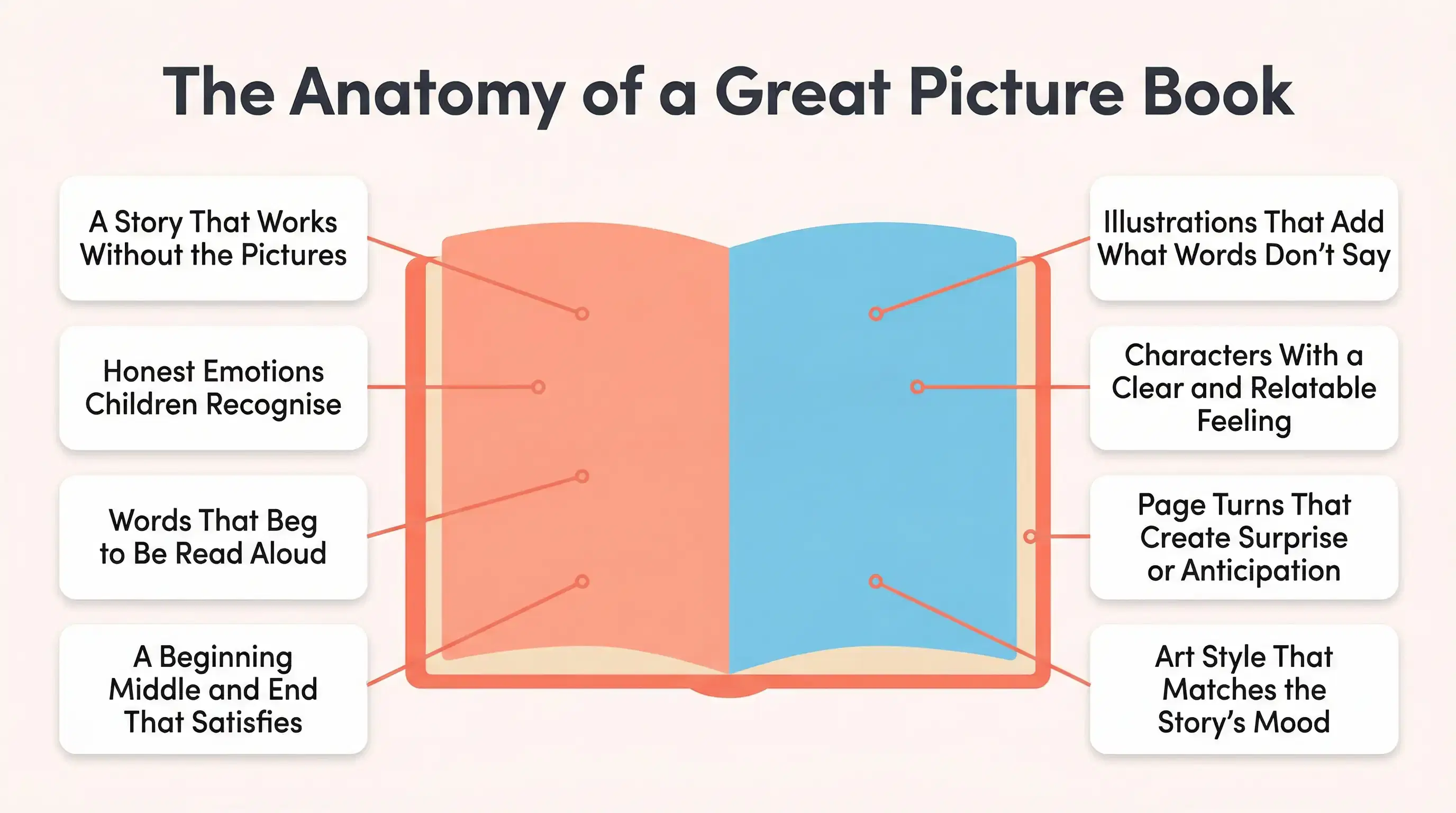
The technical requirements of a great picture book are more demanding than they appear from the outside. The constraints of the form, typically 32 pages, rarely more than a thousand words, and often far fewer, mean that every element has to work extremely hard. There is no room for anything that is not essential. There is no room for a scene that is only interesting, or a word that is only accurate. Everything has to earn its place.
The story has to work even if you cover the pictures, and the pictures have to work even if you cover the words. This is the fundamental test of a great picture book, and it is a demanding one. The text has to be complete as a story, with a beginning, a middle, and an end, with a character who wants something and either gets it or learns something from not getting it, and the illustrations have to tell a visual story that is equally complete and equally satisfying. If either element depends entirely on the other for its coherence, the book is not working at its full potential.
Simplicity is the hardest thing to achieve in picture book writing, and it is the quality that most distinguishes great picture books from merely adequate ones. The temptation, for a writer who is not yet fully in command of the form, is to over-explain, to add words that describe what the pictures already show, to spell out what the story has already demonstrated, to underestimate the reader's ability to fill in the gaps. The best picture book writers resist this temptation completely. They trust the child. They trust the illustrator. They say what needs to be said and leave everything else to the image.
The picture books that children return to again and again, the ones that become worn from use, that are requested at every bedtime for months at a time, are almost always the ones that deal with real emotions honestly. The Very Hungry Caterpillar is a book about satisfaction and transformation. Goodnight Moon is a book about the anxiety of going to sleep and the comfort of a familiar routine. Where the Wild Things Are is a book about anger and the need for love. These books do not talk down to children about these emotions. They acknowledge them. And children recognize that acknowledgment and return to it, over and over, as long as they need to.
The Picture Books That Every Child and Parent Should Experience Together
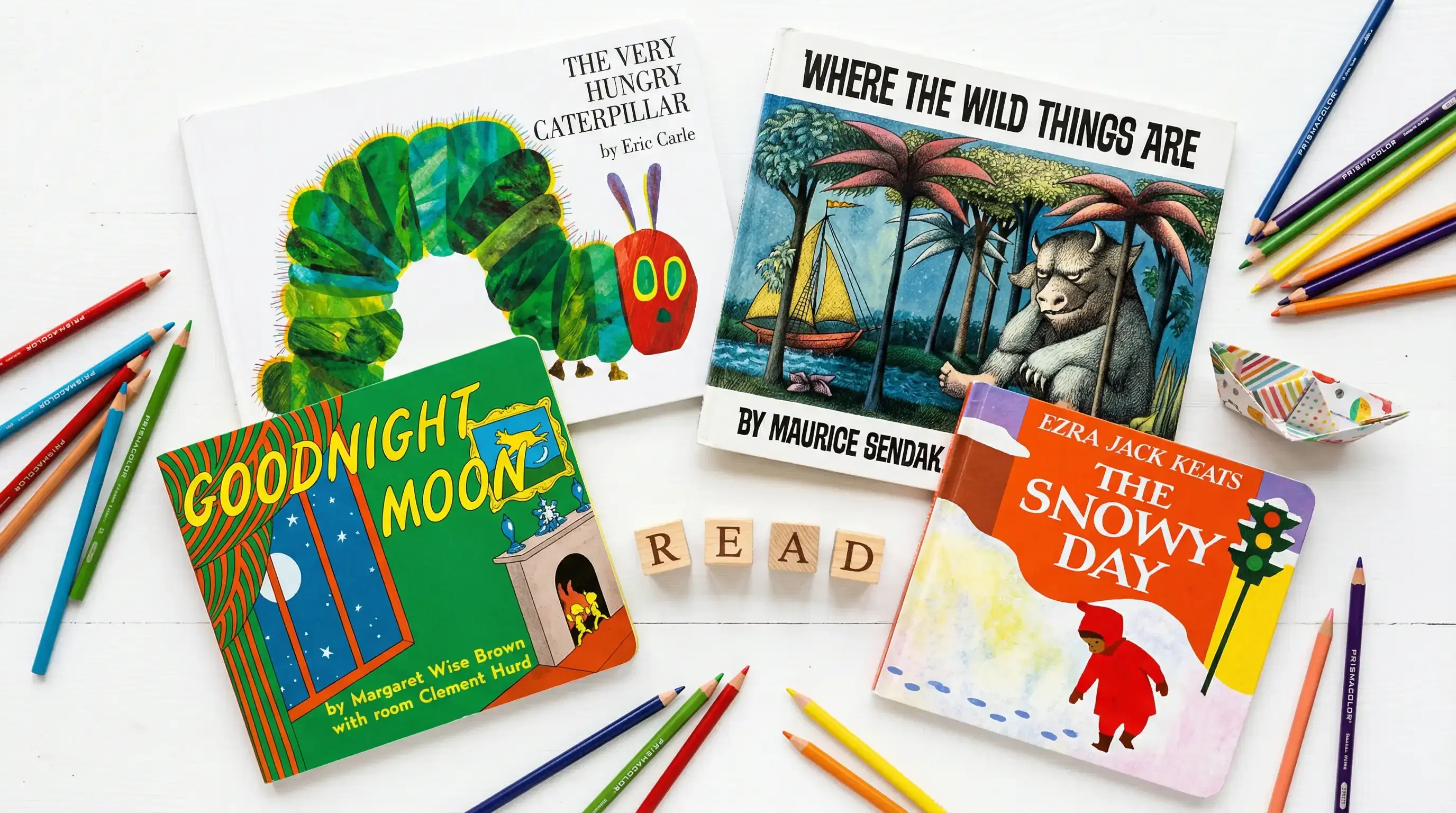
The Very Hungry Caterpillar by Eric Carle
First published in 1969 and still selling over a million copies a year, Eric Carle's masterpiece is one of the most beloved picture books in history. The story of a caterpillar who eats his way through a remarkable variety of food before emerging as a butterfly teaches counting, the days of the week, and the names of foods, while also telling a deeply satisfying story about transformation and appetite. The die-cut pages that show the caterpillar's progress through the food are one of the most brilliant pieces of picture book design ever created, making the book a physical object that delights children as much as a story.
Where the Wild Things Are by Maurice Sendak
Maurice Sendak's 1963 masterpiece remains one of the most psychologically sophisticated picture books ever published. Max, sent to his room after behaving badly, imagines a voyage to a land of Wild Things where he becomes king, before choosing to return home to the people who love him. The book's genius is its complete respect for the emotional reality of childhood anger and its equally complete confidence that children can hold the tension between wildness and the need for love. The minimal text, barely 338 words, and the extraordinary progression of the illustrations, in which the pictures gradually overwhelm the text entirely, make this a picture book that teaches young readers about the relationship between words and images simultaneously.
Goodnight Moon by Margaret Wise Brown
The bedtime ritual book against which all others are measured. Margaret Wise Brown's 1947 classic follows a young bunny saying goodnight to every object in the great green room, and its genius is the way it embodies the ritual comfort of a familiar routine in a form that a very young child can participate in completely. The warm colors, the deliberately slowing pace of the text, and the gradually darkening room across the page spreads create a reading experience designed to do what it says, to ease a child toward sleep through the comfort of a story that is entirely predictable and entirely reassuring.
The Snowy Day by Ezra Jack Keats
When Ezra Jack Keats published The Snowy Day in 1962, he created the first picture book with a Black child as its protagonist to win the Caldecott Medal, and he did it without making race the subject of the book at all. The story of Peter's perfect day playing in the snow is a story of joy, wonder, and the particular pleasures of childhood in winter. The mixed-media illustrations, collage, paint, and fabric, created a visual style that was entirely new to picture books and that remains as fresh and beautiful today as when it was first published.
Guess How Much I Love You by Sam McBratney
A book about love told through the most universally recognizable parent-child dynamic: the attempt to find words big enough for something that exceeds all words. The competition between Little Nutbrown Hare and Big Nutbrown Hare to measure their love with increasingly large comparisons, all the way to the moon and back, is a story that reads differently at every age. Children hear a reassuring declaration of infinite love. Adults hear the bittersweet truth of parental love that always exceeds what the child can yet comprehend. Both hearings are moving.
The Giving Tree by Shel Silverstein
Few picture books have generated more thoughtful discussion and debate among readers of all ages than Shel Silverstein's 1964 story of a tree that gives everything it has to a boy who grows into a man. The book has been read as a meditation on unconditional love, as a cautionary tale about taking without giving, as a portrait of the parent-child relationship, and as an ecological parable. Whatever interpretation a reader brings, the book's emotional power is undeniable, and the fact that it continues to prompt genuine discussion among adults is evidence that great picture books are not simple at all.
Owl Babies by Martin Waddell
One of the most emotionally honest picture books ever written about the fear of separation and the comfort of return. Three baby owls wake up to find their mother gone and cope with her absence in completely different ways, the two older owls constructing reasons and reassurances while the youngest simply repeats 'I want my mummy' on every page. Children find this book both terrifying and deeply comforting simultaneously, because it tells them the truth about separation anxiety and then resolves it completely. Martin Waddell understood that children need stories that acknowledge their fears rather than pretending those fears do not exist.
Don't Let the Pigeon Drive the Bus by Mo Willems
Mo Willems revolutionized picture books when he gave a pigeon a personality so specific, so funny, and so immediately recognizable that children across generations have responded to it with delighted recognition. The simple premise, a pigeon trying every manipulation tactic available to get permission to drive the bus, works because every child knows exactly what it feels like to want something desperately and to argue for it with increasing desperation. The book teaches children that their feelings are funny as well as real, and that being told no is something everyone survives.
Why the Best Picture Books Are Just as Meaningful for Adults
There is a moment that almost every parent experiences, usually unexpectedly, often at the end of a long day, when a picture book they are reading to a child makes them cry. Not the child. The parent. And this experience, which is extremely common and almost entirely unacknowledged in the public conversation about children's books, reveals something important about what the best picture books actually are.
The best picture books operate on two levels simultaneously. At the surface level, they are stories accessible to and engaging for very young children. At a deeper level, they contain truths about love, time, loss, protection, and the bittersweet nature of growth that adults recognize with a sharpness that children cannot yet access, because adults have lived enough to understand what they mean. When The Giving Tree gives everything it has and says it is happy, a child hears a story about love. A parent hears a story about the particular kind of love that requires giving yourself away, and the question of whether that is beautiful or devastating, and cannot always immediately decide.
Picture books also become family heirlooms in a way that almost no other object does. The copy of The Very Hungry Caterpillar that a parent reads to their child is the same book they may have been read as a child themselves, the same pages, the same words, the same images, and when a grandparent reads it to a grandchild, three generations of the same experience occupy the same moment. This continuity of experience is rare and precious, and it is something that only a book that has genuinely earned its place in a culture across decades can provide.
What Makes Picture Book Publishing Different From Every Other Book
Picture book publishing is the most technically complex category in children's publishing, and it requires expertise that is specific to this format and not transferable from any other kind of book publishing.
The most important thing anyone seeking to publish a picture book must understand is that the illustration and the text must be developed together, not separately. A text that is written without any understanding of how it will be illustrated, how it will be divided across 32 pages, which moments will be shown, and which will be implied by the art, will almost certainly not work as a picture book, regardless of how good the writing is in isolation. The layout of a picture book is a narrative tool: the placement of text on the page, the size of the images, the decision about whether a given moment gets a full spread or a small panel, all of these choices affect the story's pacing and emotional impact.
The physical properties of a picture book, its trim size, its paper stock, its binding, the finish on its cover are also part of the reading experience in a way that is not true of most other books. Children handle picture books differently from adults. They touch the pages. They look at the details of the illustrations at close range. They return to their favorite pages repeatedly. A picture book that is beautifully produced feels different in a child's hands, and that physical quality communicates something about how seriously the book takes its reader.
How to Know If Your Picture Book Idea Is Ready to Become a Real Book
A picture book idea that works is not simply a story with a child as its main character. It is something more specific than that, and understanding what makes a picture book idea ready for development is the first step toward creating something genuinely publishable.
The first question every picture book idea needs to answer is: What is the emotional core? Not the plot, not the character, not the setting, the single emotion that the book is about. The Very Hungry Caterpillar is about the satisfaction of appetite and the wonder of transformation. Goodnight Moon is about the comfort of routine and the gentling of anxiety. If you cannot identify the emotion at the center of your idea, the book does not yet have its heart.
The second question is: does this story need pictures? A story that can be told completely in words alone is not a picture book, it is a short story. A true picture book idea has elements that can only be shown, moments that need to be seen rather than described, and visual details that would be impossible or wrong to put into words. And the third question is: is this genuinely for children, or is it for adults who want to tell children something? The best picture books are written from inside childhood, with complete respect for what a child actually feels and understands. Books written from outside childhood, as gentle lessons or as expressions of adult anxiety, almost never work.
How Best Selling Publisher Creates and Publishes Picture Books
At Best Selling Publisher, we understand that a picture book is unlike any other publishing project, because it requires both a writer and a visual artist working in close collaboration, and because the physical production of the book is as important as its content. We have built our picture book publishing process around these specific requirements.
For authors who have a manuscript but not an illustrator, we provide illustration matching and direction, working to find an illustrator whose style is right for the emotional register of the specific story, and then managing the illustration development process to ensure that the art and the text are genuinely in conversation. For authors who have both a story and a vision for its visual style, we provide the production expertise to realize that vision at the highest possible quality.
Everything authors need to publish picture books professionally is covered in our production process, from manuscript editing and illustration development through page layout, cover design, and print specification. We handle Amazon KDP setup and distribution across all major children's book platforms, with positioning and keywords specifically optimized for the children's picture book category. Authors work with Best Selling Publisher with their most personal work. We would love to help your picture book find the children it was written for.
Conclusion
Picture books are not just for children, and the decision to publish picture books is a decision to create something that belongs to every human being who has ever needed a story told simply and honestly, with economy and precision and complete respect for the reader's intelligence, whatever age that reader may be. The best picture books achieve something that the most complex novels sometimes fail to achieve: they tell a truth that is genuinely true, in a form so clear that even a three-year-old can feel its weight.
The lasting impact of a picture book that a child loves is difficult to overstate. The books a child loves in their earliest years become part of the architecture of their imagination, part of the emotional vocabulary they carry into every subsequent reading experience. They become references for what a story can feel like, what an image can do, what words and pictures together can achieve. They become, often, the books that a parent reads to their own child decades later, the proof that a truly great picture book does not belong to a moment. It belongs to every moment.
FAQs
Picture books are traditionally published for children between the ages of 2 and 8, with the core audience typically between 3 and 6 years old. However, the readership of picture books extends well beyond this range in both directions. Board books, the sturdiest physical format designed for very young children, target babies and toddlers from birth to age 3. And the best picture books have a demonstrated adult readership that makes the age designation somewhat misleading: they are books that work for any reader, at any age, who is willing to engage with them on their own terms.
Most picture books published for the traditional 3 to 6 age range fall between 500 and 1,000 words. Many of the most celebrated picture books are considerably shorter: The Very Hungry Caterpillar is under 250 words, and Where the Wild Things Are is only 338. The constraint is not arbitrary: picture books are typically 32 pages long, and the text needs to be short enough that the illustrations can do their essential storytelling work alongside it. Books of over 1,000 words often become too text-heavy for effective illustration and are better suited to the early reader format.
No. Most picture book authors submit text-only manuscripts to publishers and publishing services, without any illustrations attached. Illustrators are typically chosen and contracted separately, after the text has been accepted. If you are working with a publishing partner like Best Selling Publisher, we will help you find and commission an illustrator whose style matches your story. You do not need to be an artist, or to have an illustrator in mind, to publish a picture book, but you do need to write a text that leaves room for the illustrations to do their part of the storytelling.
A picture book is defined by the equal importance of its illustrations and its text, and by the specific physical format, typically 32 pages, a larger trim size than most books, and a production quality that makes the book itself a pleasurable physical object. The illustrations in a picture book are not decorative additions to a text. They are co-equal storytelling elements that carry meaning the text does not. This distinguishes picture books from illustrated chapter books, early readers, and other children's formats in which illustrations are primarily supplementary rather than structurally essential.
The picture books that attract the most interest from publishers and publishing partners share several characteristics: a clear and specific emotional core that speaks to a genuine experience of childhood, text that is minimal and precise enough to give illustrations room to work, a story with a satisfying arc that resolves in a way that is emotionally true, and language that begs to be read aloud, with rhythm, sound, and a musicality that makes repeated readings a pleasure rather than a chore. The most common mistake new picture book writers make is writing too many words and explaining things that the illustrations should be trusted to show.
Working with a professional publishing partner who specializes in picture book production is the most effective route for most authors who want to publish picture books. Best Selling Publisher offers complete children's picture book publishing services, from illustration development and manuscript editing to page layout, cover design, Amazon KDP publishing, and targeted marketing in the children's book space. Contact our team to learn how we can help your picture book find the children it was written for.