
Prepare Your Book for Launch with a Proven Pre-Publishing Checklist
Most books do not fail because they were poorly written. They fail because they were poorly prepared. The manuscript gets finished, the author hits publish before every critical step is in place, and the book enters the market at a disadvantage it never recovers from.
A weak cover signals amateur work before a reader reads the title. Metadata that was guessed rather than researched means the book never surfaces in the searches its ideal readers are running. An absent marketing plan means launch week passes without momentum, and the algorithm never builds the early traction that creates long-term discoverability.
Each of these failures is preventable. None of them require exceptional skill or unlimited budget. They require preparation.
The pre publishing checklist that follows covers every stage of book preparation from final manuscript to launch day and beyond. It is not a theoretical framework. It is a practical, sequenced list of actions that, when completed properly, give a book the infrastructure it needs to reach readers, earn reviews, and build sales over time.
Work through it in order. Do not skip sections because they feel less urgent. The steps that feel least urgent before publication are often the ones whose absence causes the most damage after it.
What Is a Pre-Publishing Checklist?
Definition and Purpose
A pre publishing checklist is a structured sequence of tasks that an author completes before a book goes live on any publishing platform. It covers every element of book preparation that affects how the book is received by readers and how it performs in retail and discovery environments.
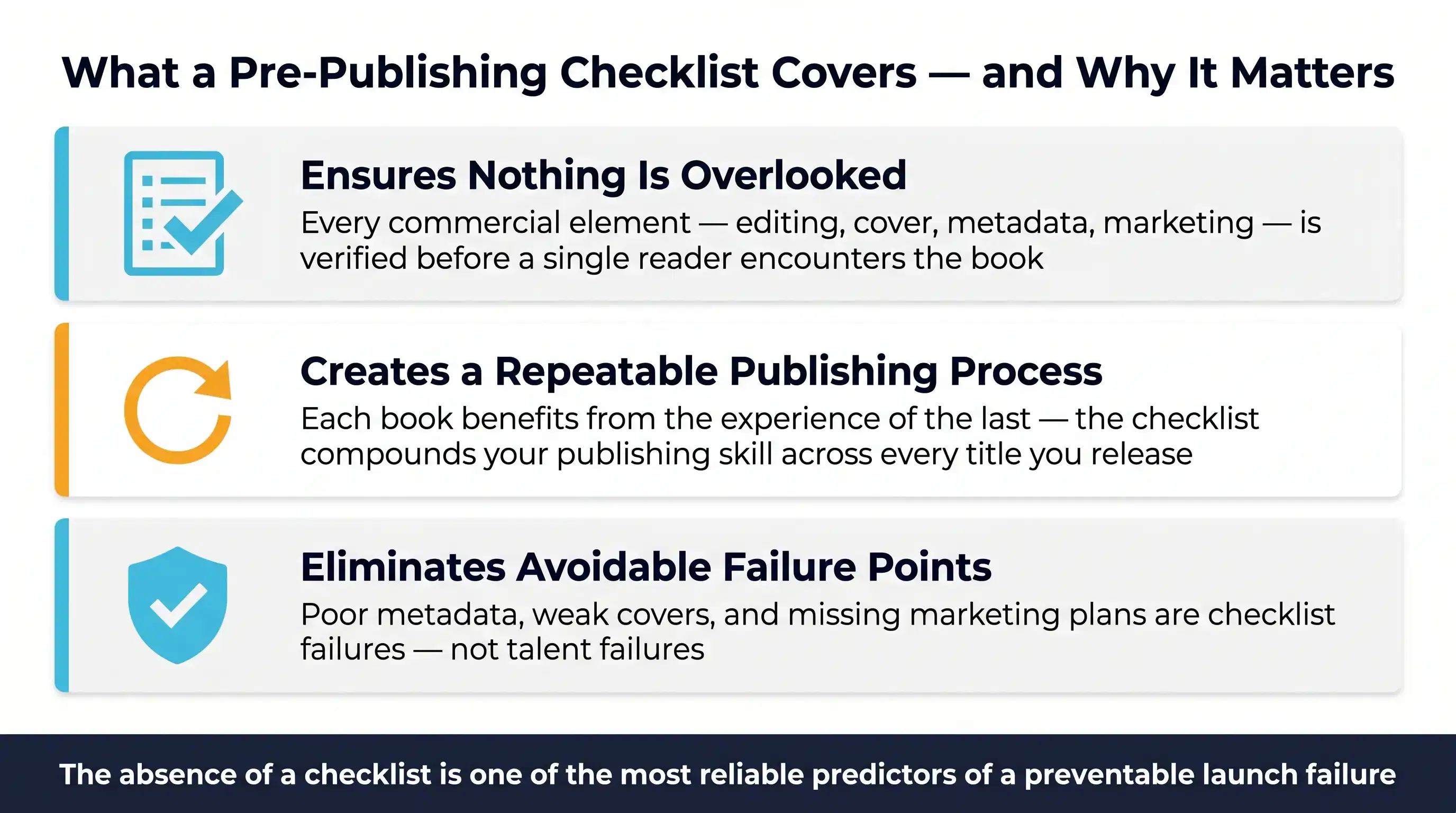
The purpose is twofold. First, it ensures that nothing important is overlooked in the weeks and months before publication, when there is still time to address problems without affecting a live listing. Second, it creates a repeatable process that improves with each book an author publishes, reducing the learning curve and the margin for error on every subsequent title.
A book publishing checklist is not a guarantee of commercial success. But the absence of one is among the most reliable predictors of avoidable failure. Every major element it covers, from editing to cover design to metadata to marketing preparation, has a direct, documented impact on how a book performs once it is live.
Why Every Author Needs One Before Launch
Publishing a book without a structured preparation process is the equivalent of opening a business without a plan. The enthusiasm that drives the writing phase is valuable, but it does not substitute for the methodical verification that every commercial element is in place before the book reaches readers who will make permanent judgments about it within minutes of discovery.
Authors who rush to publish typically encounter the same set of problems: cover design that does not hold up against genre competition, metadata that fails to attract the right readers, formatting errors that generate negative reviews, and a complete absence of marketing activity that makes launch week commercially irrelevant. None of these problems are difficult to prevent. All of them are expensive to fix after the fact.
Common Mistakes Without a Checklist
The most expensive pre-publishing mistakes are not dramatic errors. They are quiet omissions. An author who publishes without completing keyword and category research does not see an error message. The book simply never appears in the searches that would have brought it to its ideal readers.
An author who launches without an ARC strategy does not receive a warning. The book simply goes live with zero reviews at the moment when early social proof matters most.
Other common omissions include publishing without a professional edit, using a cover that was not tested at thumbnail size, setting a price without researching category norms, and launching without any coordinated marketing activity. A thorough self publishing checklist prevents all of these by making each step explicit and placing it in the correct sequence relative to everything else.
Why Pre-Publishing Preparation Determines Your Book's Success
First Impressions and Market Readiness
A book that enters the market underprepared makes a first impression it cannot take back. Readers who encounter a poorly designed cover, a book description that fails to communicate value clearly, or formatting errors in the first few pages make a judgment about that title and that author that persists indefinitely. Reviews mentioning these problems accumulate and suppress future sales regardless of how good the content actually is.
Market readiness means arriving at your launch date with every commercial element performing at the level readers in your category expect. That standard is set by the best-performing titles in your genre, not by what felt good enough to an author excited to be done with the manuscript. Preparing a book for publication to meet that standard is the core purpose of every step in the checklist below.
Impact on Sales, Reviews, and Rankings
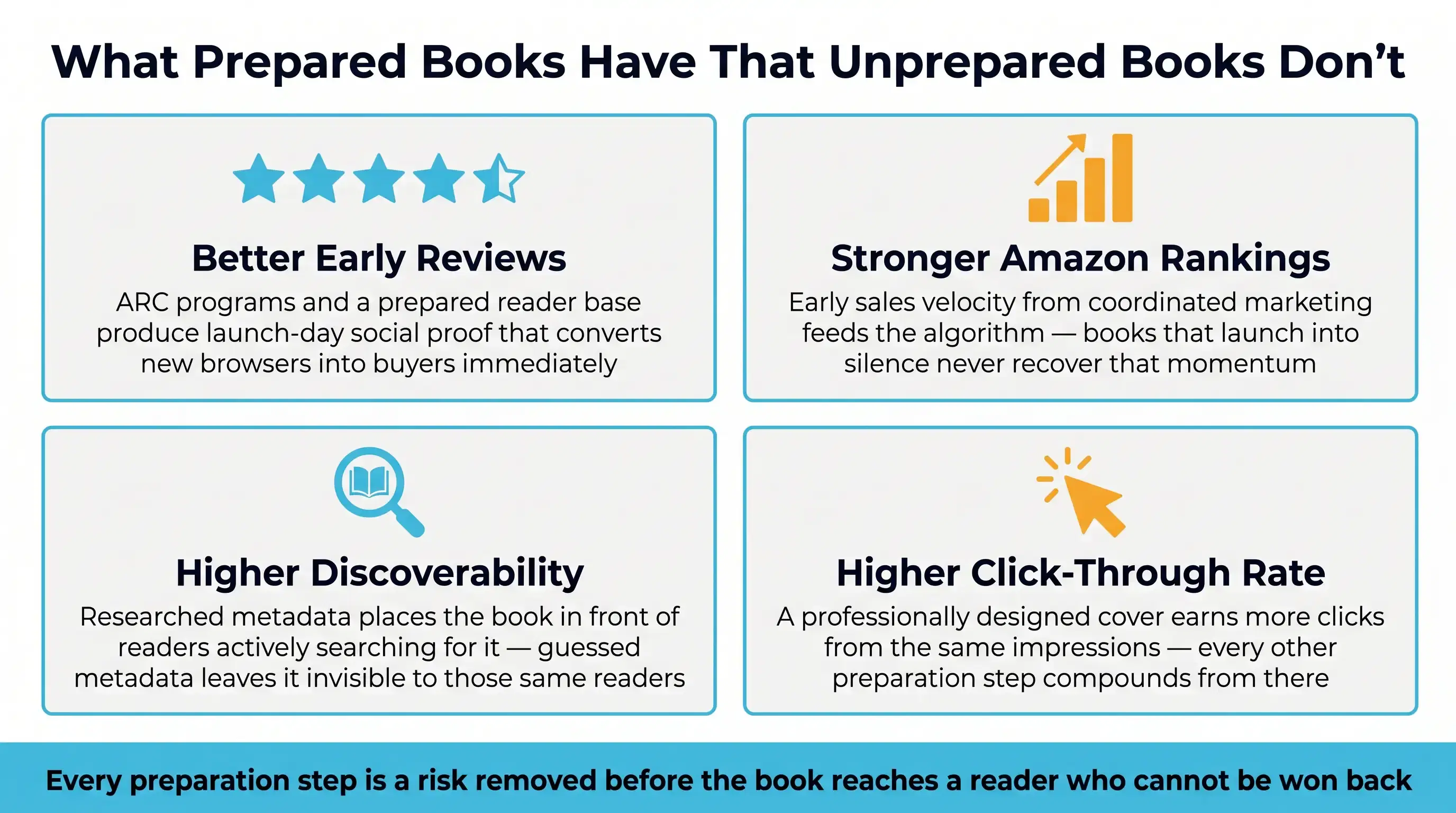
The relationship between pre-publishing preparation and commercial performance is direct and measurable. Books with professionally designed covers earn higher click-through rates from search results and advertising. Books with optimized metadata appear in more relevant searches and convert more browsers into buyers. Books that launch with early reviews from an ARC program generate social proof that makes subsequent buyers more confident and more likely to purchase.
Amazon's ranking algorithms reward books that demonstrate early sales velocity and engagement. A book that launches with coordinated marketing activity, pre-gathered reviews, and an audience prepared to buy generates the early traction that the algorithm uses to determine how prominently to feature a title in search results and recommendations. A book that launches into silence generates none of those signals, regardless of its quality.
How Preparation Reduces Publishing Risks
Publishing risk comes in two categories: risks that can be addressed before launch and risks that emerge after. Pre-publishing preparation is specifically about eliminating the first category entirely. Cover quality, editing standard, metadata accuracy, formatting integrity, and marketing readiness are all variables the author controls completely before a single reader encounters the book.
Working with professional book editing services before publication eliminates the risk of reader-facing errors. Completing keyword and category research before upload eliminates the risk of metadata-driven invisibility. Building a launch marketing plan before the publication date eliminates the risk of a launch week with no momentum. Each item on the checklist is a specific risk that preparation removes from the equation.
The Ultimate Pre-Publishing Checklist for Authors
The ten steps below represent the complete pre-publishing process for a book entering any retail channel. They are sequenced deliberately. Each step builds on the previous one, and completing them out of order creates rework and delays that a proper sequence prevents.
1. Finalize Your Manuscript
Complete final draft:A manuscript is finished when the story is complete, the argument is fully made, or the information is entirely delivered. Not when the author is tired of revising. Before any other step begins, read the entire manuscript one final time as a reader rather than a writer, looking specifically for gaps in logic, unresolved narrative threads, pacing problems, and sections that exist because the author wanted to include them rather than because the reader needs them.
Review structure and flow:Chapter order, section transitions, and the overall arc of the reading experience need to be evaluated independently of the quality of individual sentences. A manuscript that is beautifully written at the sentence level but poorly structured at the book level will generate reader feedback about confusion, slow pacing, or unsatisfying resolution. Address structural issues before editing begins because structural edits after copy editing create significant rework.
Incorporate beta reader feedback:Beta readers represent your first audience, and their responses to the manuscript are the closest approximation of how the broader reading public will respond. Collect feedback from multiple readers whose reading habits match your target audience, identify the patterns in that feedback, and address the issues that appear consistently. Individual preference comments can be set aside. Recurring observations about the same characters, scenes, or arguments almost always reflect real issues that need to be resolved before the book reaches a professional editor.
2. Professional Editing and Proofreading
Editing is not optional for any book that is intended to reach a paying readership. The question is not whether to edit but which type of editing is needed at which stage, and whether to invest in professional support or attempt the work independently.
Developmental editing:Developmental editing addresses the manuscript at the structural level, evaluating plot, character arc, pacing, argument construction, and overall coherence. It is the most valuable type of editing for manuscripts with significant structural issues and the most appropriate first stage of professional editing for any book that has not been through a structured developmental review. Professional book editing services at the developmental level can transform a manuscript that is not yet working into one that is ready for the subsequent editing stages.
Copy editing:Copy editing works at the paragraph and sentence level, addressing clarity, consistency, word choice, and the logical flow of ideas from one sentence to the next. A copy editor catches the inconsistencies that authors are too close to their own work to see: character names that change spelling, timelines that do not hold up, arguments that contradict earlier statements, and transitional language that loses the reader's thread. Book editing services at the copy editing stage are the most common form of professional editing investment for manuscripts that are structurally sound.
Grammar and consistency checks:Proofreading is the final editorial stage, conducted on a formatted manuscript after all other edits have been incorporated. It catches typographical errors, punctuation inconsistencies, spacing irregularities, and formatting errors that survived earlier editing passes. A book submitted to a proofreader before developmental and copy editing is not yet ready for proofreading. The sequence matters because earlier edits introduce changes that create new errors requiring a final review.
3. Book Formatting and Layout
Formatting transforms an edited manuscript into a file that displays correctly across every device and platform your readers will use. Poor formatting creates a reading experience that feels unprofessional regardless of the quality of the writing, and formatting errors are among the most commonly cited issues in negative reviews.
eBook formatting:Ebook files need to be formatted for reflowable reading across devices with different screen sizes, font settings, and display preferences. Ebook formatting services produce files that maintain consistent chapter navigation, functional table of contents links, correct image sizing, and clean paragraph formatting across Kindle, EPUB, and other ebook formats. A file that looks correct in the KDP previewer but breaks on older Kindle devices or in the iOS Books app has not been adequately tested.
Print formatting:Print layout requires precise attention to trim size, margin specifications, gutter allowances for binding, header and footer placement, and page number positioning. Book formatting services for print produce camera-ready PDF files that meet the technical specifications of print-on-demand platforms without revision rejections. Interior images, tables, and charts require additional formatting consideration for print that ebook formatting does not address.
Table of contents and navigation:Both ebook and print editions need a properly structured table of contents. For ebooks, the table of contents must be both visible in the text and embedded in the file's navigation metadata so that reading devices can use it for chapter jumping. For print editions, the table of contents page must accurately reflect the final page numbers of the formatted manuscript. Any changes to the text after the table of contents is created require a corresponding update to page numbers.
4. Book Cover Design
Your cover is the primary sales tool for your book in every online retail environment. It communicates genre, quality, and the emotional experience of the book in the fraction of a second before a reader decides whether to click or scroll past. A cover that fails this test costs more in lost sales than any other single element of the publishing process.
Genre-specific design:Every genre has visual conventions that readers use to identify books likely to deliver the experience they want. A cover that does not meet the visual expectations of its genre sends readers who would be its ideal audience to other books. Book cover design services from designers with genre-specific experience produce covers that work within those conventions while finding the differentiating detail that makes one book stand out among many.
Thumbnail optimization for online stores:Every cover design decision must be evaluated at thumbnail size, which is approximately how your cover appears in Amazon search results on a mobile device. Fine details, subtle textures, and small typography all disappear at thumbnail scale. The cover needs to communicate genre and create visual interest at 150 pixels wide before it is finalized at full size.
Final file formats:Different publishing platforms and formats require different cover file specifications. KDP requires a specific pixel dimension and file size for ebook covers. Print covers require a different file that incorporates spine width and back cover, calculated based on page count and paper type. IngramSpark has its own technical specifications that differ from KDP. Every required format should be prepared and verified before the upload stage begins.
5. Metadata and SEO Optimization
Metadata is the information that publishing platforms use to place your book in search results, category rankings, and recommendation algorithms. Getting metadata right is the difference between a book that readers in your target audience can find and one that is invisible despite being exactly what those readers are looking for.
Title and subtitle optimization:Your title and subtitle carry significant weight in Amazon's search algorithm. A subtitle that includes the primary search terms your ideal readers use improves search visibility without compromising the title's appeal on the cover. Non-fiction titles in particular benefit from subtitles that function as keyword-rich descriptions of the book's core value proposition.
Book description:The book description is the conversion point between a browser who clicked your cover and a buyer who purchases your book. It needs to be written with the same attention to craft that went into the manuscript, opening with a hook that creates immediate engagement, building desire through premise and tension or value promise, and closing with a clear call to action. A description written as a plot summary or a table of contents for a non-fiction book consistently underperforms one written as a piece of persuasive copy aimed at a specific reader.
Keyword and category research:Amazon's category system and keyword fields are the primary mechanism through which your book surfaces in relevant searches. Selecting the right categories, including less competitive subcategories where your book can rank in the top twenty rather than being invisible in an overcrowded main category, is one of the most high-leverage metadata decisions an author makes. Keyword research for the seven KDP keyword fields should be based on actual search data, not assumptions about what readers search for.
6. ISBN, Copyright, and Legal Setup
ISBN assignment:An ISBN (International Standard Book Number) is the universal identifier that allows retailers, libraries, and distributors to catalog and order your book. Each format edition requires its own ISBN. A paperback, a hardcover, and an ebook are three distinct editions requiring three separate ISBNs. Authors publishing through KDP can use the free KDP ISBN, but this ISBN is not transferable to other platforms. Authors pursuing distribution through IngramSpark or other channels should purchase their own ISBNs from their national ISBN agency.
Copyright registration:In the United States, copyright protection exists automatically upon creation of original work, but registration with the US Copyright Office provides legal advantages in the event of infringement, including the ability to pursue statutory damages and attorney's fees. Registration is a relatively low-cost protection that authors intending to publish commercially should complete before their book goes live. Authors in other countries should verify the copyright registration options and benefits available through their national copyright authority.
Publishing rights verification:Authors who have previously submitted their manuscript to agents, publishers, or writing competitions should verify that no rights have been transferred or optioned that would restrict self-publishing. Authors who have previously published portions of the manuscript as articles, essays, or excerpts should verify that the rights to those portions have reverted or were never transferred. Publishing a book that includes content to which another party holds rights creates legal exposure that is both avoidable and serious.
7. Pricing and Royalty Strategy
Pricing research:Pricing decisions should be based on what comparable titles in your specific subcategory are currently priced, not on what feels fair relative to the effort of writing the book. Research the top twenty bestselling titles in your primary category and identify the price range in which most of them cluster. Pricing significantly above that cluster reduces conversion even when the quality justifies it. Pricing significantly below it signals lower quality to browsers who have not yet assessed the content.
Royalty selection:KDP's 70% royalty tier requires a price between $2.99 and $12.99, an upper limit KDP raised from $9.99 on 7 July 2026 (KDP eBook list price requirements, checked 14 August 2026). Pricing outside that range reduces the royalty to 35%. For most fiction and non-fiction ebooks, pricing within the 70% tier is commercially appropriate. For short reads, lead magnets, and certain non-fiction categories where lower pricing is standard, the 35% tier may be the correct choice. Understanding the royalty structure before setting pricing ensures there are no surprises in the earnings calculations after publication.
Discount and launch pricing strategy:Many authors launch at a reduced price to generate initial sales velocity, gather early reviews, and improve their ranking in category lists. A structured book launch marketing strategy that includes a defined launch price, a timeline for the price increase, and coordinated marketing activity during the launch window produces better early results than an unplanned price reduction. The launch pricing decision should be made before publication, not improvised after the book goes live with poor initial sales.
8. Platform Selection and Distribution Setup
Choose publishing platforms:The publishing platform decision determines where your book is available and how it reaches readers. Amazon KDP provides direct access to the world's largest book marketplace and the Kindle ecosystem. IngramSpark provides access to the wholesale distribution network that supplies bookstores, libraries, and international retailers. Other platforms including Kobo Writing Life, Apple Books Direct, and Draft2Digital serve authors pursuing wide distribution independently of aggregators.
Exclusive vs wide distribution:KDP Select enrollment requires 90-day exclusivity for the ebook edition in exchange for access to Kindle Unlimited and promotional tools. Wide distribution means making the ebook available on all platforms simultaneously, which maximizes reach but forgoes KDP Select benefits. This decision should be made based on genre, target audience platform preferences, and marketing strategy.
Upload readiness:Every platform has specific technical requirements for manuscript files, cover files, and metadata entry. Verifying that all files meet platform specifications before the upload session begins prevents the rejection and revision cycles that delay publication. Prepare a checklist of required files and their specifications for each platform you intend to use.
9. Build Your Author Platform
Author website:A professional author website serves as the central hub of your online presence. It should include a biography, a complete books page with links to purchase, a contact form for media and reader inquiries, and a clear mechanism for visitors to join your email list.
Social media profiles:Identify the platforms where your target readers are most active, establish a consistent presence there, and focus on providing content that is genuinely interesting rather than constant purchase requests.
Email list setup:Email is the highest-converting marketing channel available to authors. A lead magnet such as a free story or sample chapter gives readers a reason to join your list, creating a prepared audience before launch day.
10. Pre-Launch Marketing Strategy
ARC distribution:Advance Review Copies are pre-publication versions of your book distributed to reviewers in exchange for honest reviews posted on or after launch day. A strong ARC strategy builds early social proof that improves conversion rates from day one.
Email marketing campaign:Your email list should receive a structured sequence before launch, including announcements, cover reveal, pre-order links, and launch reminders. Each message should provide value, not just repeat sales messaging.
Social media content plan:A content calendar in the weeks before launch builds anticipation through behind-the-scenes content, reveals, and reader engagement posts. The goal is to create momentum before publication, not after it.
Book Launch Preparation Checklist (Final 7 Days Before Release)
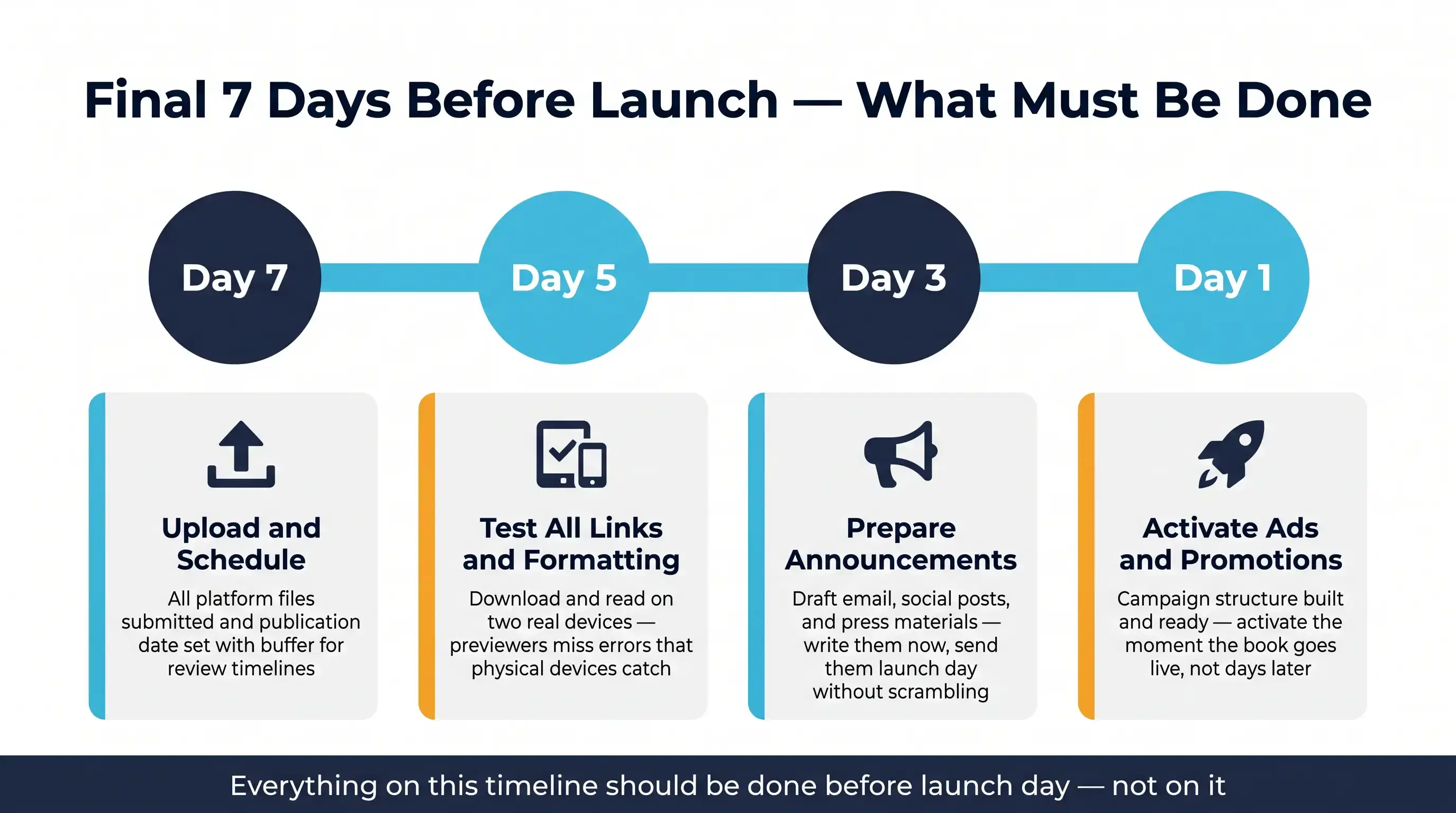
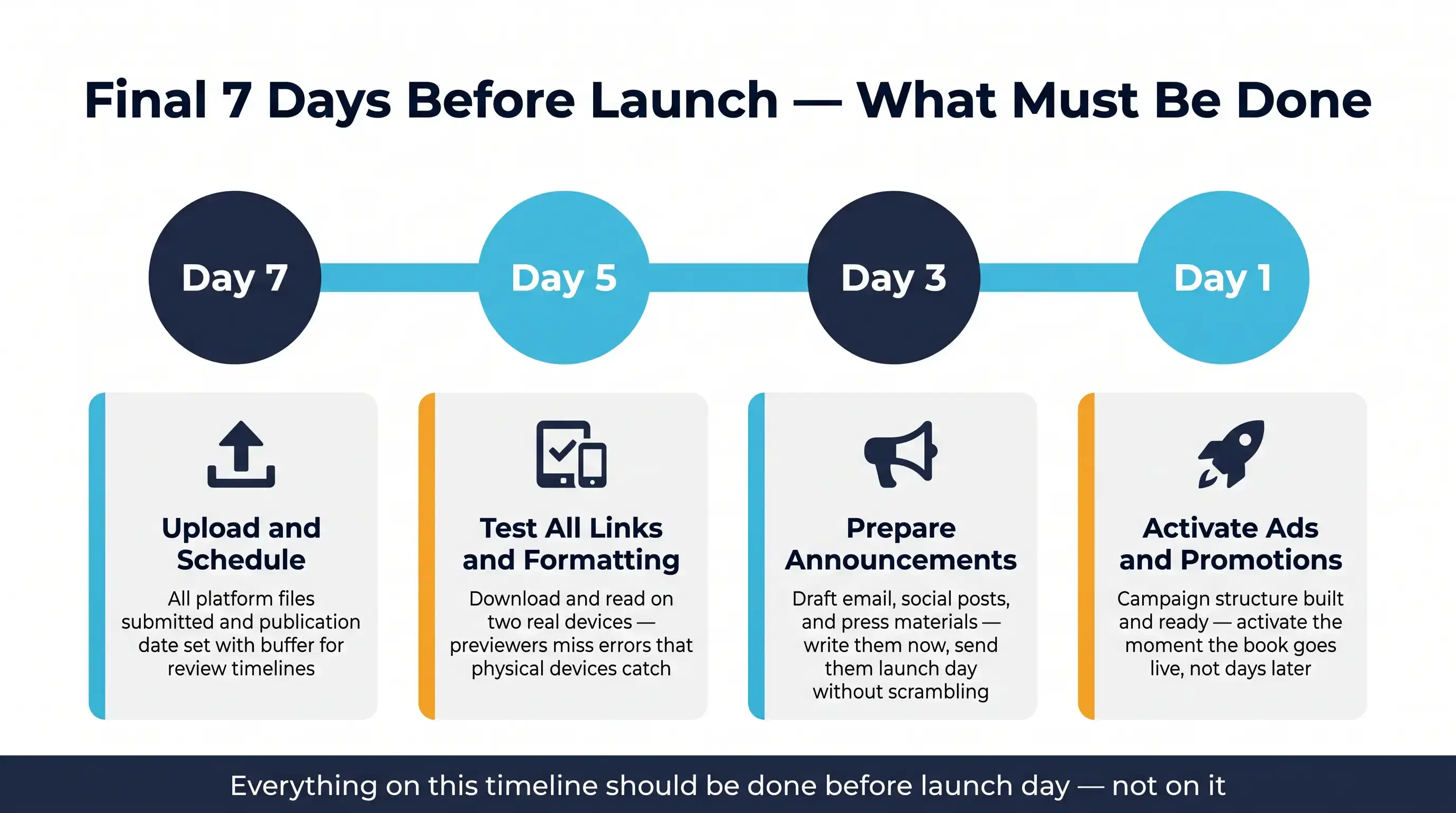
The final week before launch is where preparation converts into execution. Every item on this list should be completed before the book goes live, not on launch day when there is no time to address problems that emerge.
Upload and Schedule Your Book
Upload all final files to every publishing platform you are using and verify that the previewer on each platform displays the book correctly. Set your publication date with enough lead time that platform review processes complete before your intended launch date. Amazon KDP allows up to 3 business days for review, and up to 10 for low-content titles, with the book taking roughly another 72 hours to appear reliably in search. IngramSpark can take longer. Apple Books and Kobo have their own review timelines.
If you are using pre-orders, verify that the pre-order listing is live and that the final file has been submitted before the platform's pre-order deadline.
Test All Links and Formatting
Test every link in your book: internal navigation links in the table of contents, external links in non-fiction references, and any hyperlinks in your author bio or back matter. Download and read a sample of the published ebook on at least two different devices or apps to verify that formatting is rendering correctly outside the platform previewer.
Formatting that looks correct in a browser-based previewer sometimes breaks on physical devices or in specific reading apps.
Prepare Launch Announcements
Draft your launch day email, social media posts, and any press release or media outreach materials in advance so they are ready to send the moment the book goes live. Do not rely on writing launch day communications on launch day.
Prepare them during the week before, have someone review them for clarity and typos, and schedule or queue them so they go out promptly when the book becomes available for purchase.
Set Up Ads and Promotions
If your book launch ads strategy includes Amazon Advertising, Facebook ads, or other paid promotion, set up the campaigns before launch day rather than after. Amazon ads require a live listing to run, but the campaign structure, targeting, bids, and creative can be prepared in advance and activated the moment the book is live.
Book launch marketing services typically handle this campaign setup as part of a complete launch package, ensuring that advertising is contributing to sales velocity from the first day rather than being set up days later when early launch momentum has already been lost.
Post-Launch Preparation (What to Do After Publishing)
Publication is not the end of the process. The weeks immediately following launch set the trajectory for the book's long-term performance, and authors who stay actively engaged with their book's performance data and marketing during this period consistently outperform those who publish and move immediately to the next project.
Monitor Performance Metrics
Track your sales rank, category rankings, and review count daily during the first two weeks after launch. Understanding how these metrics move in response to specific marketing actions helps you identify which activities are driving results and which are not. KDP's dashboard provides real-time sales data and rank tracking. Author Central provides additional data on sales trends and review accumulation. Use this data to make informed decisions about when to adjust pricing, intensify marketing, or run promotions.
Collect and Respond to Reviews
Reviews are the primary social proof mechanism in online book retail. A book with fifty reviews converts browsers into buyers at a higher rate than a comparable book with five reviews, regardless of which has the higher average rating. Follow up with ARC readers who have not yet posted their reviews. Remind your email list that reviews are genuinely helpful to independent authors.
Respond professionally to negative reviews without being defensive, and thank reviewers who leave detailed positive feedback when platform policies allow it.
Optimize Keywords and Pricing
If your book is not ranking in the categories and search results you targeted, the metadata may need adjustment. Review your keyword selections against current search data, check whether your category placements are still the most advantageous available, and consider whether your pricing is aligned with category norms and your current review count.
Small metadata adjustments in the weeks after launch can significantly change a book's search visibility without requiring any changes to the content.
Scale Marketing Campaigns
Once you have initial sales data and review accumulation, you have the evidence base needed to scale marketing investment with reasonable confidence in the return. Book promotion before launch builds the foundation. Post-launch scaling, based on actual performance data from the first two to four weeks, is how authors build sustained momentum rather than a single spike followed by a return to obscurity.
Increase ad budgets on campaigns that are demonstrably profitable. Cut or restructure campaigns that are generating impressions without producing sales.
Common Pre-Publishing Mistakes to Avoid
Skipping professional editingNo author is objective enough about their own work to serve as their own editor at a professional level. Professional book editing services are not a luxury. They are the minimum investment required to publish a book that can compete with the edited content that readers have been conditioned to expect by the traditionally published titles they have read throughout their lives.
A book with editing errors loses readers permanently, and those readers leave reviews that affect future buyers.
Poor cover designA cover that does not meet the visual standards of its genre costs sales every single day the book is live. Unlike editing errors that readers encounter inside the book, a weak cover prevents readers from ever reaching the content.
There is no recovery mechanism for a cover that fails to earn clicks. The only solution is a redesign, which means the investment that was avoided upfront must be made later alongside the relaunch cost.
Ignoring keyword researchPublishing without researching keywords and categories is the equivalent of opening a store on a street with no foot traffic and no signage. The book exists, but the readers who would buy it have no mechanism to find it.
Keyword research is not technical or complicated. It requires spending time in Amazon's search environment understanding what your target readers actually type when they are looking for books like yours.
No marketing planA book with no marketing plan is entirely dependent on organic platform discovery, which is driven by sales velocity and review accumulation that do not exist at launch. Book marketing services and a structured book launch marketing strategy create the early momentum that feeds the algorithm, generates reviews, and builds the reader base that sustains sales after the launch window closes.
Rushing the launchThe urgency to publish is understandable after months or years of work on a manuscript. It is also one of the most reliable predictors of an underprepared book entering the market.
A launch delayed by two weeks to complete a missing checklist item costs two weeks of sales. A launch executed before the book is ready costs indefinitely through negative reviews, poor conversion rates, and missed opportunities during the period when early momentum is most achievable.
How Best Selling Publisher Prepares Your Book for a Successful Launch
Every item on the checklist above represents a decision point where expertise and experience produce better outcomes than guesswork. Working with a full service book publishing company means those decision points are handled by professionals who have navigated them across hundreds of titles, not approached as novel problems by an author encountering them for the first time.
End-to-End Publishing Support
Best Selling Publisher provides complete pre-publishing support from manuscript assessment through launch execution. Authors who work with us do not need to research platform specifications, test thumbnail performance, or figure out keyword strategy independently. Every element of the book publishing checklist is managed by the appropriate specialist in our team, with the author involved in every creative decision and informed at every stage of the process.
Our self publishing services are structured around the specific needs of each title and each author's publishing goals, not a generic package that applies the same process to every book regardless of genre, format, or distribution strategy.
Professional Editing and Formatting
Our editorial team includes developmental editors, copy editors, and proofreaders with genre-specific experience across fiction, non-fiction, self-help, business, and memoir. Book editing services at every level are available as standalone services or as part of a complete publishing package. Every manuscript that goes through our editorial process enters the formatting stage ready for professional layout.
Our formatting team produces ebook and print files that meet platform specifications for KDP, IngramSpark, Apple Books, Kobo, and other distribution channels. Book formatting services and ebook formatting services are delivered with platform verification before handoff, ensuring that files are ready for upload without revision requests.
Amazon SEO Optimization
Our metadata team conducts category and keyword research specific to each book's genre and target audience before any platform setup begins. Amazon KDP publishing services through Best Selling Publisher include metadata optimization as a core component, not an afterthought. Book descriptions are written by our copywriting team with both conversion and search visibility as explicit goals.
Launch and Marketing Strategy
Our marketing team builds and executes complete launch strategies that include ARC program management, email marketing for authors, social media content planning, advertising campaign setup and management, and post-launch performance optimization. Book launch marketing services are coordinated with the publication date to ensure that every marketing channel is active and contributing to sales velocity from the first day the book is available.
For authors who want to handle their own marketing with professional guidance, we provide strategic consulting that covers book promotion before launch, launch week execution, and post-launch optimization based on actual performance data. Our book marketing services are designed to be as hands-on or as advisory as each author's situation requires.
Ready to Launch Your Book the Right Way?
The checklist above is not a theoretical ideal. It is the actual preparation process that separates books that launch with momentum from books that launch into silence. Every step it covers is a variable the author controls before publication, and every step that is skipped is a risk that materializes after the book is live, when the cost of addressing it is substantially higher.
The authors who build successful publishing careers are not necessarily the most talented writers. They are the ones who take the publishing process as seriously as the writing process, who understand that getting a book to readers is as demanding as creating it, and who either develop the expertise to execute every step well or partner with professionals who have.
Best Selling Publisher is a full service book publishing company built around the complete pre-publishing and launch process. From manuscript assessment through post-launch optimization, our team provides the expertise, the tools, and the execution support that gives every book we work on the preparation it needs to compete at the highest level in its market. When you are ready to hire book publishing expert support for your next book, we are ready to build the launch it deserves.
FAQs
Before publishing, complete a full book publishing checklist that covers manuscript finalization, professional editing, formatting for all intended formats, cover design, metadata and SEO optimization, ISBN and copyright setup, platform selection, and a pre-launch marketing strategy.
The sequence matters: structural editing should precede copy editing, formatting should follow all editorial changes, and marketing preparation should begin well before the publication date. Completing these steps in order is what separates books that launch effectively from those that do not.
The pre-publishing timeline depends on manuscript length, editing requirements, and distribution complexity. A standard novel typically requires eight to sixteen weeks from final manuscript to launch-ready book.
Non-fiction books with complex formatting or research needs may take longer. Pre-launch marketing, including ARC distribution and email planning, should begin at least six to eight weeks before publication.
Yes. Professional book editing services are essential for any book intended for paying readers. Authors cannot objectively edit their own work, and automated tools cannot replace human editorial judgment.
Most books require a combination of developmental editing, copy editing, and proofreading depending on the manuscript’s condition and stage of development.
While every step matters, pre-launch marketing preparation has the greatest impact on early performance. A book with an audience, ARC reviews, and coordinated marketing activity generates stronger launch momentum.
Without this preparation, even a high-quality book may struggle to gain visibility in the early stages of publication.
Technically yes, but it significantly increases the risk of missing critical steps. Without a structured pre publishing checklist, decisions are made in isolation rather than as part of a complete system.
Most authors who skip a checklist end up creating one after their first publication to correct avoidable mistakes. Using one from the beginning reduces that learning curve.