
How Personal Autobiography Books Turn Real Life Experiences Into Stories the World Needs to Hear
- Home
- /
- Blogs
- /
- How Personal Autobiography Books Turn Real Life Experiences Into Stories the World Needs to Hear
Every person alive has lived a story that no one else has, and that is exactly what makes autobiography so powerful.
Not the famous person's story. Not an extraordinary story. Every person's story. The child who grew up navigating two cultures simultaneously. The parents who rebuilt their life after losing everything. The professional who walked away from the career they were supposed to want in order to pursue the life they actually needed. The survivor who found something on the other side of the worst thing that ever happened to them. These are the stories that change the people who read them, because they are real, because they are true, and because in them, readers see reflections of their own lives that no novel, however well-crafted, can quite provide.
Writing a personal autobiography is one of the most courageous things a person can do, and the decision to publish an autobiography book is ultimately a decision to trust that your experience has value beyond your own life. It requires looking at your own life with honesty and clarity, not just the achievements, but the failures; not just the moments of pride, but the moments of shame; not just the things that happened to you, but the choices you made and what those choices revealed about who you were and who you became. It requires trusting that your story matters enough to be shared. And it requires the particular bravery of putting your real self on the page for anyone to read.
In this blog, we are going to show you why your life story is worth telling, how the greatest autobiographies are built, which books have changed readers’ lives through the raw power of personal truth, and how autobiography book publishing services can help you take your story from lived experience to published book-the first steps toward writing and publishing your own.
Why Your Life Story Is Worth Telling, Even If You Think It Is Not
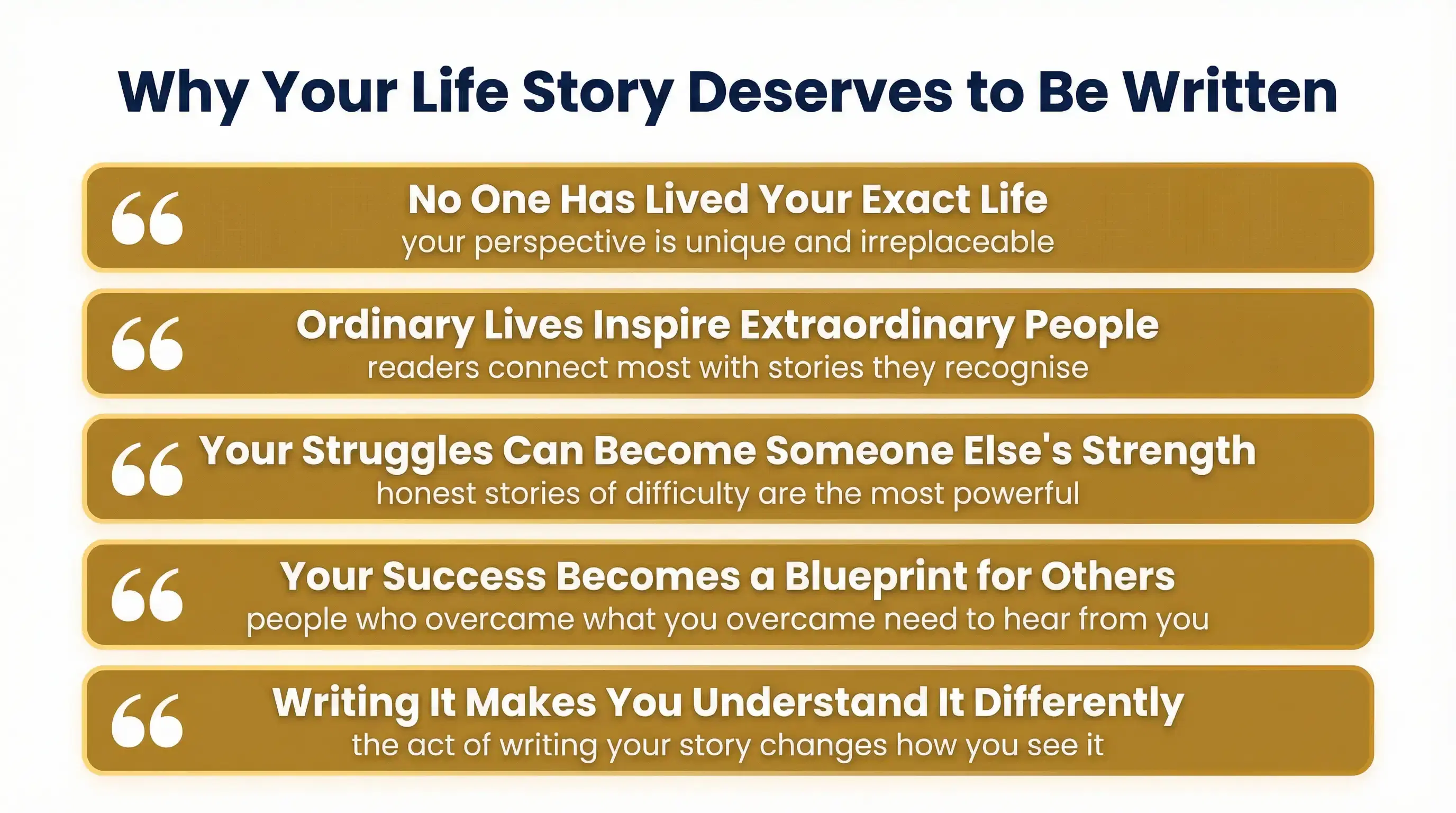
The single biggest reason most people never write their autobiography is a belief that their life is not interesting enough. That autobiography is for presidents, pop stars, and people who have done something historically significant. That ordinary lives, lives lived in ordinary places, through ordinary struggles, without extraordinary fame or achievement, do not deserve the formality of a published book.
This belief is wrong, and it is worth understanding exactly why. Readers do not pick up autobiographies because they want to read about someone more extraordinary than themselves. They pick up autobiographies because they want to feel less alone in their own experience, because they want to find, in someone else's real life, a reflection of something true about their own. And the lives most likely to create that recognition are not the ones furthest from ordinary experience. They are the ones closest to it.
The parent who writes about raising a child with a serious illness is writing for every other parent who has sat in a hospital waiting room feeling the particular terror of that specific situation. The person who writes about growing up poor in a community that is never represented in mainstream publishing is writing for every person who grew up in that community and has never seen their life reflected anywhere. The specificity of your experience is not a limitation on its reach. It is the source of its power.
Your struggles can become someone else's strength. Your survival can become someone else's evidence that survival is possible. Your path through something difficult can become a map for someone who is currently lost in the same territory. This is the unique gift of personal autobiography, and it is available to every person who has lived a life, which is to say, every person alive.
What Makes a Personal Autobiography Different From Every Other Book
Every other genre of writing involves a degree of separation between the author and the material. A novelist invents characters who are not them. A historian interprets events they did not experience. A science writer explains discoveries made by others. Even memoir, which is autobiographical in nature, focuses on a particular chapter or theme rather than the full arc of a life.
A personal autobiography is unique because the author and the subject are the same person, and this is why autobiography book publishing services must approach every manuscript with a level of personal sensitivity that other categories do not require. The writer is not observing life from the outside. They are inhabiting it from the inside, looking back at every significant moment with the particular perspective of someone who has lived through the consequences of every decision they are describing. This creates a level of access and a quality of emotional honesty that simply cannot be achieved any other way.
The best autobiographies balance personal truth with universal meaning. This is the central craft challenge of the form: to be specific enough about your own experience that it feels real and true, while finding within that specificity the larger human truths that make a reader who has lived a completely different life feel that you are somehow speaking directly to them. Nelson Mandela's Long Walk to Freedom is a deeply personal account of one man's experience of apartheid and imprisonment. It is also a universal story about human dignity, the capacity for endurance, and what it means to remain committed to justice over an entire lifetime. The personal and the universal are not in tension. When the autobiography is working at its best, they are the same thing.
What readers are really looking for when they pick up an autobiography is permission, permission to believe that their own complicated, imperfect, unfinished life story is also worth taking seriously. When a reader sees a real person navigate something as difficult as what they have navigated, and then tell that story with honesty and without shame, it gives them something extraordinarily valuable: the sense that their own story matters too.
The Journey of Writing Your Own Life Story
Every autobiography begins in the same place, not at birth, but at a moment of meaning. The moment that divided your life into before and after. The experience that changed how you understood yourself and the world. The decision that set everything else in motion. Identifying that moment is the first act of autobiography, and it is more important than any other structural decision that follows.
From that starting moment, the autobiography expands outward, backward into the childhood and circumstances that shaped the person who faced that moment, and forward through the consequences and transformations that followed. The best autobiographies are not simply lists of things that happened in chronological order. They are shaped narratives, stories with a beginning, a middle, and an end, in which every scene and every memory serves the larger meaning of the life being described.
One of the most difficult decisions in writing an autobiography is what to leave out. A life contains infinitely more material than any book can hold, and the temptation to include everything, every memory, every relationship, every event, produces books that are comprehensive but shapeless. The most powerful autobiographies are ruthlessly selective. They include what serves the story they are telling and leave out everything else, however personally significant it may be. This is not dishonesty. It is craft.
The process typically moves through several distinct stages. It begins with gathering, pulling together the memories, journals, letters, photographs, and conversations that will form the raw material of the book. It moves into drafting, getting the story down on paper in whatever rough and imperfect form it emerges, without trying to make it perfect before it exists. It continues into shaping, finding the narrative arc within the raw material, identifying what the book is really about, and structuring the material around that understanding. And it concludes with polishing, making the prose as clear and as compelling as possible, so that the book is finally ready to share with the world.
The Personal Autobiographies That Changed How Readers See the World
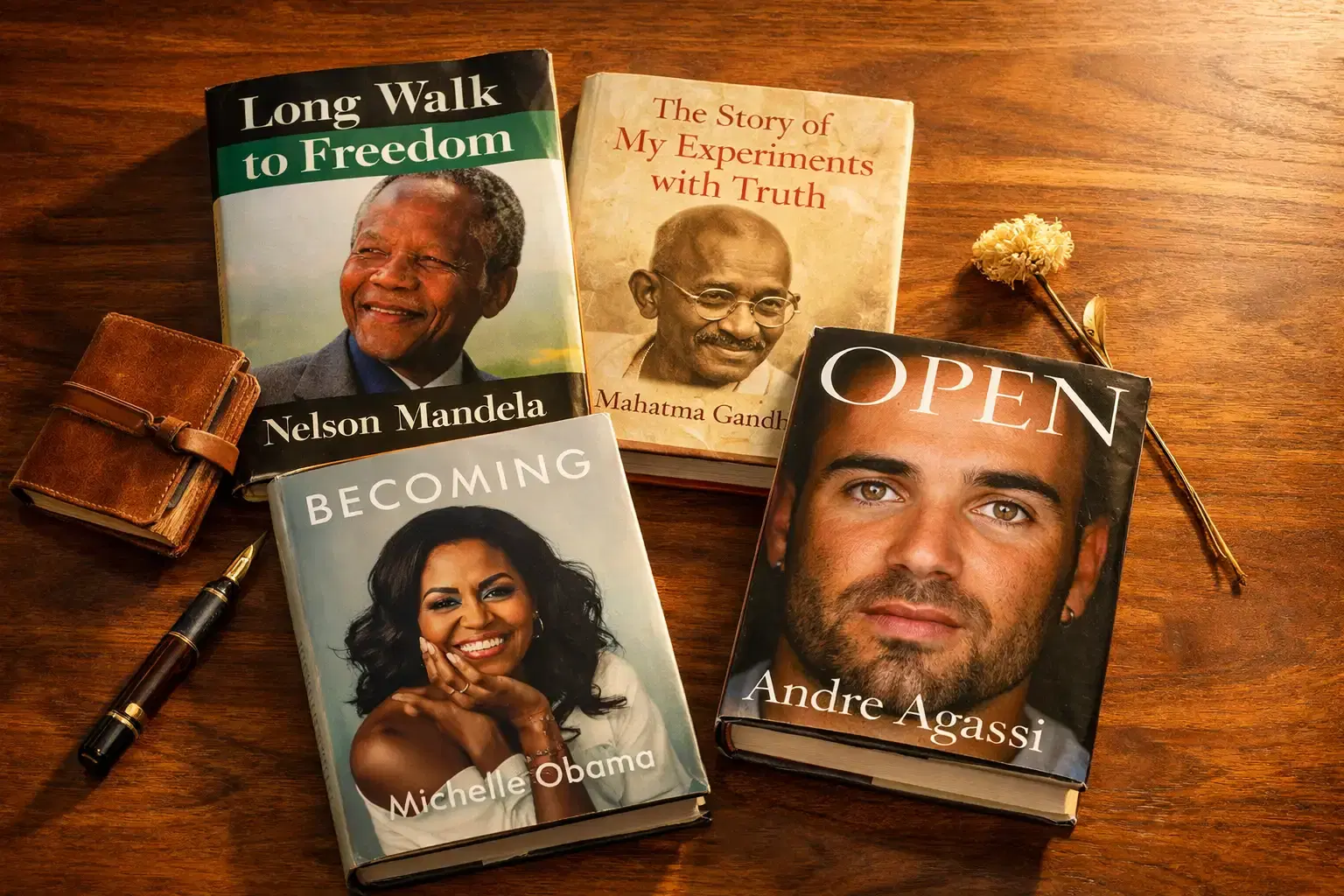
Long Walk to Freedom by Nelson Mandela
The autobiography of Nelson Mandela, from his rural childhood in the Transkei through his years as an anti-apartheid activist, his 27 years of imprisonment, 18 of them on Robben Island before transfers to Pollsmoor and Victor Verster, and his emergence to lead South Africa's transition to democracy, is one of the most extraordinary personal documents of the 20th century. Mandela's voice throughout is measured, reflective, and entirely free of bitterness. The dignity and moral clarity with which he describes the worst of what he endured has made this one of the most widely read and most deeply admired autobiographies ever written. What strikes every reader is not the scale of what he achieved but the quality of the man it reveals: someone who chose, consciously and repeatedly, not to be broken by what was done to him.
Becoming by Michelle Obama
One of the bestselling autobiographies in publishing history. Michelle Obama's account of her journey from the South Side of Chicago to the White House, and more importantly, her honest exploration of who she was becoming throughout that journey, resonated with readers worldwide for its combination of extraordinary warmth, unguarded honesty, and the sense that the author was telling the truth about her life in ways that public figures rarely allow themselves. The book had sold more than 11.5 million copies worldwide by its first anniversary in November 2019 and became a cultural phenomenon that transcended the boundaries of publishing entirely.
The Story of My Experiments with Truth by Mahatma Gandhi
Gandhi's autobiography is remarkable for its almost unprecedented moral honesty, a document in which one of the 20th century's most admired figures describes his failures, his contradictions, and his constant experiments with the principles he was developing as frankly as he describes his achievements. It is not a book about a saint. It is a book about a human being trying hard to live according to his values, failing regularly, learning from those failures, and never losing sight of the purpose that gave his life meaning. For readers who want to understand what a life lived in genuine pursuit of principle actually looks like from the inside, there is no better starting point.
Open by Andre Agassi
Perhaps the most surprising autobiography ever written by a professional athlete. Agassi opens his memoir with the confession that he hates tennis, has always hated it, and then spends the rest of the book explaining how a person who hates something can spend their entire life becoming the best in the world at it. The result is a book about identity, parental pressure, freedom, and the complicated relationship between talent and desire. It has been praised as one of the greatest sports autobiographies ever written and one of the most honest autobiographies in any category, precisely because Agassi was willing to say things that athletes almost never say.
Born a Crime by Trevor Noah
The comedian and television host's account of growing up as a mixed-race child under apartheid in South Africa, where his very existence was literally illegal, is one of the most extraordinary autobiographies of recent years. Noah writes with humor, anger, love, and insight about a childhood that was by any measure remarkable, and about a mother whose relationship with her son is one of the great portraits in modern memoir. The book reaches readers who know nothing about apartheid and readers who lived through it, and it gives both audiences something they could not have found anywhere else.
I Know Why the Caged Bird Sings by Maya Angelou
The first volume of Maya Angelou's autobiography, covering her childhood and adolescence in the American South in the 1930s and 1940s, is one of the most celebrated American autobiographies of the 20th century. Angelou's prose is extraordinary: precise, lyrical, and deeply felt. Her willingness to write with complete honesty about the hardest things she experienced created a book that helped open American literature to voices and experiences that had previously been systematically excluded.
Dreams from My Father by Barack Obama
Written before Obama entered politics, this is one of the most thoughtful and most literarily accomplished autobiographies written by any political figure. Obama's exploration of his mixed-race identity, his search for his Kenyan father, and his experience as a community organizer in Chicago is written with the care and craft of a serious writer rather than the strategic self-presentation of a politician. It reveals something about the interior life of a remarkable person that his subsequent public career made impossible to see.
The Diary of a Young Girl by Anne Frank
Perhaps the most powerful demonstration in all of literature that an ordinary person's honest account of their experience can become one of the most important books ever written. Anne Frank was a thirteen-year-old girl writing in a hidden annex in Amsterdam. Her diary was not written for publication. And yet it has sold tens of millions of copies and been translated into more than seventy-five languages, because the combination of historical circumstances and its author's extraordinary voice produced something that no professional writer could have created deliberately. It is a reminder that autobiography requires no credentials beyond the willingness to observe your own life honestly.
What Separates a Good Autobiography From an Unforgettable One
There are many autobiographies that are interesting, that are informative, that cover a life worth knowing about. And then there are autobiographies that people read and never forget, books that stay with readers for decades, that they press into the hands of people they love, that they return to when they need to be reminded of something important. What is the difference?
The difference is almost always honesty. Not comprehensive honesty, every autobiography makes choices about what to include and exclude. But the specific honesty of being willing to describe your own failures, your own cowardice, your own moments of smallness and weakness alongside the moments of achievement and courage. The autobiographies that endure are the ones where the author does not protect themselves from the reader's judgment. They let the reader see them fully, the complicated, contradictory, fully human being behind the public story.
Vulnerability is the engine of connection in autobiography, and connection is what makes a book unforgettable. When a reader encounters a moment of genuine vulnerability in an autobiography, a moment where the author describes something painful or shameful or difficult with complete truthfulness, they feel something that transcends the ordinary reading experience. They feel recognized. They feel that the author is trusting them with something real. And that trust creates a bond between writer and reader that is the most powerful thing any book can achieve.
The other crucial difference is the distinction between listing what happened and revealing what it meant. A weak autobiography describes events. A great autobiography interprets them, shows the reader not just what occurred but what the author made of it, how it changed them, what they understand now that they did not understand then. This layer of retrospective meaning is what transforms a sequence of events into a story. And it is what keeps the reader engaged from first page to last.
Why Personal Autobiographies Are More Powerful Than Ever in 2026
Something significant is happening in publishing right now: personal autobiography is experiencing a renaissance. The appetite for autobiography book publishing has grown alongside a cultural hunger for authentic, unfiltered human stories.
Social media has created a generation of readers who are more hungry for authentic, unfiltered human stories than any previous generation, and simultaneously more exhausted by the performative, curated version of life that social media typically delivers. The person who spends their day scrolling through carefully constructed highlights reels comes to a personal autobiography with a specific and urgent need: the need to encounter something real. Authentic autobiography, honest, specific, unpolished in the ways that matter, fills that need in a way that social media cannot.
The rise of diverse voices in publishing has also transformed the personal autobiography landscape. More people than ever before are choosing to publish stories that mainstream gatekeepers previously overlooked, and finding audiences ready and waiting for them. Stories that were once absent from mainstream publishing, because the gatekeepers did not recognize their value, or because the people with those stories did not have access to the tools to publish them, are now reaching audiences through self-publishing and digital distribution. The range of human experience available in autobiographical form has never been broader, and readers are responding with enormous enthusiasm.
How to Know If You Are Ready to Write Your Autobiography
The most common question people ask when considering writing their autobiography is whether they are ready. The honest answer is that there is no perfect moment of readiness, and that waiting for it guarantees the book never gets written. But there are genuine signs that your story is ready to be told.
You are ready if you can talk about the hardest parts of your life without feeling that you are still inside them. You are ready if you find yourself telling stories from your life regularly and noticing that those stories connect with the people who hear them. You are ready if you have been asked by people who know you, more than once, by more than one person, to write down what you have been through. You are ready if you feel that there is a through-line in your life that you now understand in a way you did not while you were living it, and that you believe others could benefit from understanding. You are ready if the idea of sharing your story feels more important to you than the fear of sharing it.
And even if none of those signs fully apply yet, that is valuable information too. The best autobiographies are written from a place of understanding rather than from the middle of the experience being described. Give it the time it needs. The story will be there when you are.
How Best Selling Publisher Helps You Write and Publish Your Autobiography
Writing and publishing a personal autobiography is different from any other publishing project, because the material is not invented or researched. It is alive. And working with that material requires a level of sensitivity, care, and personal respect that not every publishing partner is equipped to provide.
At Best Selling Publisher, our autobiography book publishing services support authors at every stage of the journey. For those who have the story but not the confidence or skills to write it themselves, we offer professional ghostwriting services, working with you closely to capture your voice, your perspective, and the specific texture of your experience in prose that reflects the approved brief. For authors who have a first draft, developmental editing can cover structure, clarity, voice, and revision checkpoints.
Our cover design team understands the visual language of autobiography and how to translate the book's tone, subject, and selected category into a reviewable cover brief. Optional Amazon setup and marketing support can include metadata, launch assets, channel selection, and reporting defined in the signed order.
Conclusion
The world is richer every time someone chooses to share their real story. Not because every life is objectively extraordinary, but because every life, told honestly, contains something that another person recognizes and needs. The reader who picks up your autobiography is not looking for a perfect life. They are looking for a true one. They are looking for the sense that someone else has navigated something like what they have navigated, and found something worth holding on to on the other side.
A personal autobiography also creates something that outlasts its author, a record of a life lived with intention, a gift to the people who loved you and the people who never met you, a contribution to the vast collective record of human experience that is, in the end, what culture is made of. Your children's children can read it. Strangers in countries you have never visited can read it. People facing the things you have already survived can read it and know that survival is possible. That is not a small thing. That is a legacy.
FAQs
Working with a professional publishing partner who offers dedicated autobiography book publishing services is the most effective route for most authors. Best Selling Publisher's complete autobiography book publishing support covers everything from ghostwriting to Amazon distribution services, from manuscript editing to cover design, Amazon KDP publishing, and marketing that puts your story in front of the readers who need it. Contact our team to learn how we can help your life story reach its audience.
A personal autobiography is a book in which the author tells the story of their own life, written in the first person, from their own perspective, typically covering the full arc of their life from childhood to the present. Unlike a memoir, which focuses on a particular chapter or theme, an autobiography covers the breadth of a person's experience. Unlike a biography, which is written by someone else about its subject, an autobiography is written by the subject themselves. The form is defined by the unique intimacy of a person telling their own story in their own voice, with the authority and the emotional access that only comes from having actually lived it.
An autobiography covers the full arc of a person's life, typically in roughly chronological order from childhood to the present. A memoir focuses on a specific chapter, period, theme, or experience within a life, going deep rather than broad. Memoirs tend to be more thematically focused and more literary in approach, while autobiographies tend to be more comprehensive. In practice, the distinction is often fluid, and many books described as one contain strong elements of the other. The form that matters most is the one that best serves the story you are trying to tell.
Absolutely not. Fame is not a qualification for autobiography, a life worth examining is. Some of the most powerful autobiographies ever written were by people who were entirely unknown before they wrote their book. What makes an autobiography worth reading is not the fame of its subject but the honesty of its telling, the universality of the truths it contains, and the quality of the writing that conveys them. The most important qualification for writing your autobiography is having lived something real and being willing to describe it truthfully.
Most published autobiographies fall between 70,000 and 100,000 words. Longer autobiographies covering particularly eventful or complex lives can run to 150,000 words or more. The appropriate length depends on the scope of the life being described and the depth at which the author wants to explore it. The guiding principle is that every word should earn its place, that every scene, reflection, and digression should serve the story the autobiography is telling. An autobiography that achieves its purpose in 70,000 words is better than one that stretches to 120,000 out of reluctance to leave anything out.
Yes, and this is more common than most people realize. Professional ghostwriters work with autobiography subjects to capture their voice, their story, and their perspective in prose that the subject then publishes under their own name. The ghostwriter's job is to disappear entirely, to serve the subject's story so faithfully that the finished book sounds entirely like the person whose life it describes. Best Selling Publisher offers professional ghostwriting services for autobiography authors who have the story but want expert help putting it on the page with the craft and impact it deserves.