
Why Early Reader Books Are the Most Important Step in Your Child's Reading Journey
The moment a child reads their first book on their own is one of the most important moments of their entire life, and early reader books make it happen.
Think about what that moment actually represents. A child who was, only recently, entirely dependent on an adult to deliver the world of stories to them, who could only access books through someone else's voice, someone else's availability, someone else's patience, suddenly discovers that they can access that world entirely on their own. They can open a book, decode the words on the page, and travel inside a story any time they choose, without asking anyone for help. That is not simply a reading skill. That is a form of independence that changes how a child understands their own capabilities.
Early reader books are the specific category of children's publishing designed to make that transition possible, and authors who want to publish early reader books are contributing to one of the most developmentally significant categories in all of children's literature. They are not picture books, which primarily depend on illustrations to carry the story. They are not chapter books, which assume a reading confidence that developing readers have not yet built. They occupy a precise developmental window, carefully constructed with larger type, controlled vocabulary, shorter sentences, frequent illustrations, and just enough narrative to be genuinely satisfying, designed to match exactly where a young reader's brain and reading skills are right now.
In this guide, we are going to explore what happens in a child's development when they begin reading independently, why choosing the right early reader books matters enormously, which books have the best track record of creating genuine reading enthusiasm, and what you need to know if you want to publish an early reader book of your own.
What Happens in a Child's Brain When They Start Reading on Their Own
The cognitive leap from being read to reading independently is one of the most significant developmental transitions of early childhood, and it is worth understanding what is actually happening in a child's brain when it occurs.
When a child begins to read independently, they are not simply decoding symbols on a page. They are building and strengthening neural pathways that connect visual recognition, phonological processing, semantic comprehension, and working memory simultaneously. These pathways, once established through the practice of reading, become the infrastructure on which all future literacy development is built. A child who reads independently and regularly in their early years is not just learning to read better. They are physically changing the structure of their brain in ways that support learning across every subject they will encounter throughout their education.
The confidence that reading independence builds is equally significant, and it compounds in ways that are difficult to overstate. A child who reads successfully at an early age develops a self-image as a reader, and that self-image influences their engagement with books for years afterward. Reading confidence built early is extraordinarily durable. Reading confidence that was never built, or that was damaged by early frustration with books that were too difficult, is much harder to repair later. This is why choosing the right books for this stage, books that are genuinely achievable and genuinely satisfying, is so important.
Early reader books are specifically designed to create this kind of success. The controlled vocabulary ensures that a beginning reader encounters familiar words frequently enough to build fluency without being overwhelmed by unfamiliar ones. The larger type size reduces the visual complexity of the page. The short chapters create natural stopping points that give a child the experience of finishing something, and with it, the specific pride of having read a whole chapter, a whole section, a whole book. This pride is not trivial. It is the fuel that keeps a young reader going.
What Makes Early Reader Books Different From Picture Books and Chapter Books
Early reader books occupy a very specific position in the children's publishing ecosystem, one that is often misunderstood by parents who are navigating the category for the first time. They are not simply picture books with longer text, and they are not simply chapter books with easier words. They are a distinct format with their own design principles, their own developmental purpose, and their own specific relationship with the reader they are designed for.
The most visible design features of early reader books are the ones that serve the beginning reader most directly. Larger type size reduces the visual complexity of the page and makes individual words easier to isolate and identify. Shorter sentences reduce the working memory load of tracking a sentence from beginning to end. Line breaks that correspond to natural speech patterns help a beginning reader maintain the rhythm of spoken language while decoding written text. Illustrations that appear on most pages provide context clues that help a reader decode unfamiliar words and maintain comprehension when the text alone becomes challenging.
The vocabulary level in a well-constructed early reader book is a precise science, not a casual judgment. The most carefully developed early reader series use controlled vocabulary lists, sets of high-frequency words that a child at a given reading level can be expected to know, and they introduce new words gradually and with sufficient repetition to allow a beginning reader to master them across the course of a book. This precision is invisible to a casual reader but essential to a child who is building their reading vocabulary word by word.
The thing that early reader books give children that no other format can is the feeling of reading a real book. Not a picture book, which a child perceives as something read to them by an adult. Not a chapter book, which belongs to a reading level they have not yet reached. An early reader book is a book that belongs to them, that they can carry and open and read on their own, and the pride that comes with this ownership is a genuine motivating force that carries children through the challenging work of building reading fluency.
The Biggest Mistakes Parents Make When Choosing Reading Books for Their Child
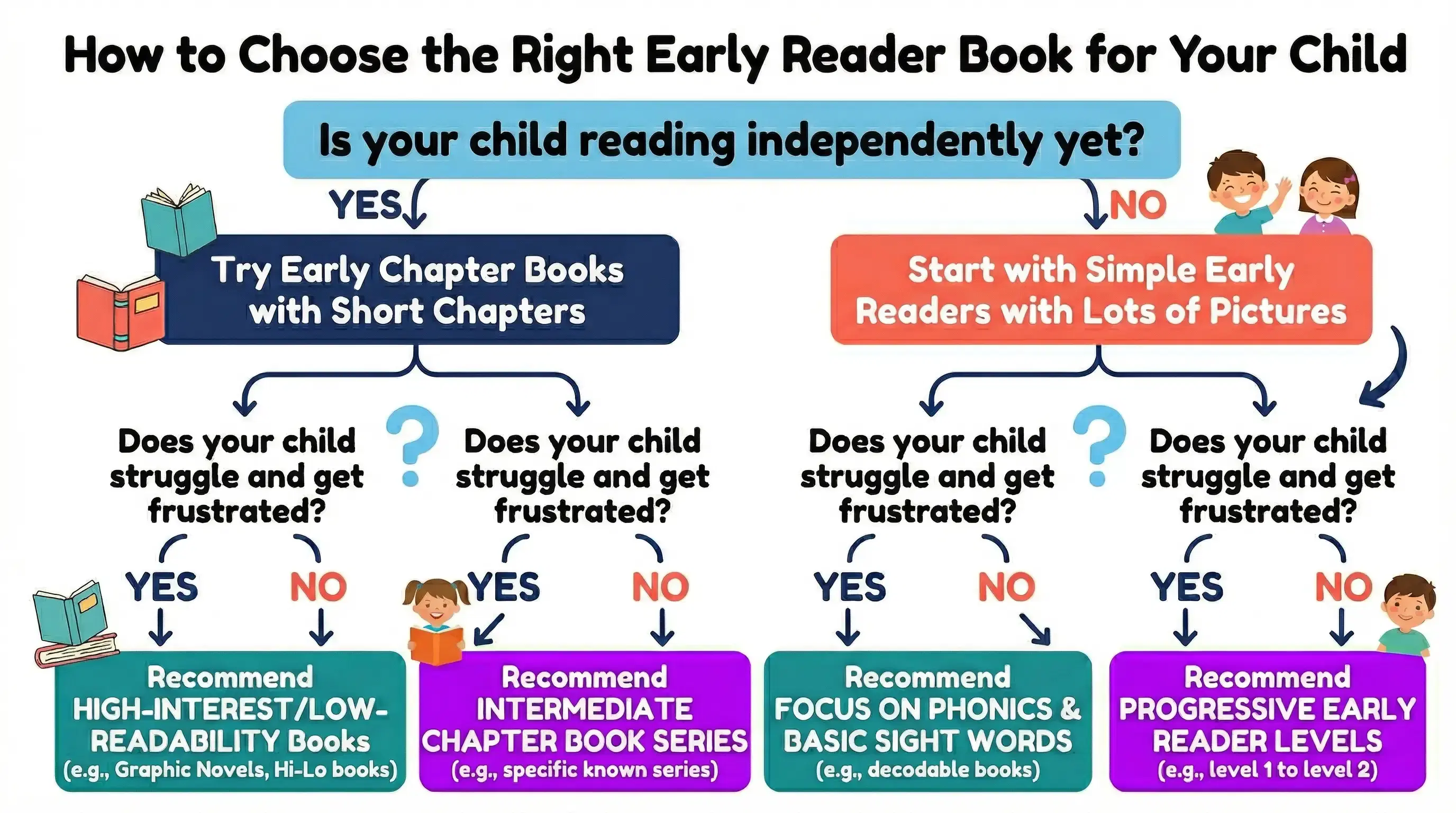
The most common and most damaging mistake parents make when choosing books for early readers is selecting books that are too difficult. The logic is understandable: parents want to challenge their child, want to see them stretching toward harder material, and want to avoid the possibility of boredom. But the effect of a book that is too difficult for a beginning reader is almost always the opposite of what parents intend. A child who struggles and fails repeatedly through the first pages of a book that is beyond their current skill level does not become more motivated to read. They become less confident and less willing, because they have learned from repeated experience that reading means struggling and failing.
The sweet spot for early readers is a book where approximately 95 percent of the words are already familiar, where the child is succeeding on almost every line and encountering only occasional unfamiliar words that they can decode with effort and context. This level of challenge feels comfortable rather than frustrating, and it allows a child to build both fluency and confidence simultaneously. Books where more than one word in ten is unfamiliar are working against a beginning reader rather than for them.
The second significant mistake is choosing books based on what seems educational rather than what the child is genuinely interested in. A child who is passionate about dinosaurs will read a book about dinosaurs more willingly, more repeatedly, and with more sustained attention than a book about a topic they find unengaging, regardless of the relative quality of the writing. Interest is the single most powerful motivator for beginning readers, and a book that captures a child's genuine interest will do more for their reading development than a technically superior book about something they do not care about.
The third mistake is failing to read alongside a child at this stage, under the assumption that independent reading means the adult's work is done. Children who read independently but without any adult engagement, without anyone asking them what they are reading, celebrating their progress, or sharing in their discoveries, develop reading as a solitary and sometimes lonely skill rather than as a source of connection and shared experience. The adult who remains engaged in a child's independent reading, even from a step back, even through brief conversations rather than read-alouds, maintains the social context that makes reading feel worthwhile.
The Early Reader Books That Turned Reluctant Readers Into Passionate Ones
The books and series below have an extraordinary track record, not of winning awards or receiving critical praise, though many have done both, but of the specific thing that matters most at this stage: turning children who were uncertain or reluctant about reading into children who read willingly, enthusiastically, and repeatedly.
Frog and Toad Are Friends by Arnold Lobel
Arnold Lobel's series of four Frog and Toad books, published between 1970 and 1979, represents the gold standard of early reader writing. The friendship between Frog, who is optimistic and energetic, and Toad, who is anxious and self-doubting, is one of the most psychologically true relationships in all of children's literature. The stories are gentle, funny, and quietly profound, dealing with friendship, courage, self-acceptance, and the pleasures of small things in ways that are completely accessible to beginning readers while carrying more emotional weight than their simple text suggests. Generations of children have learned to love reading through Frog and Toad, and they never entirely outgrow them.
Elephant and Piggie by Mo Willems
Mo Willems created the Elephant and Piggie series with a specific and brilliant insight: that the graphic novel format, dialogue in speech bubbles, minimal narration, expressive cartoon illustrations, is ideally suited to early readers who are building fluency. The books can be read as scripts, with two children reading the roles of Gerald and Piggie respectively, which transforms reading practice into performance and removes the solitary struggle that beginning readers sometimes experience. The books are also genuinely, laugh-out-loud funny in ways that surprise adults who expected simple fare, because Willems understands that humor is one of the most powerful motivators for any reader at any age.
The Magic Tree House series by Mary Pope Osborne
The Magic Tree House series, 28 original books plus additional Merlin Mission volumes, has introduced more children to chapter book reading than almost any other series in the history of children's publishing. Jack and Annie's time-traveling adventures take them through dinosaur eras, medieval castles, ancient Egypt, and dozens of other historical and fantastical settings, combining genuine educational content with genuinely exciting adventure stories. The books are specifically designed to bridge the gap between early readers and full chapter books, with short chapters, clear language, and enough illustration to support readers who are not yet fully fluent.
Junie B. Jones series by Barbara Park
Barbara Park's Junie B. Jones books have been both celebrated and occasionally criticized for their protagonist's imperfect grammar and unconventional approach to school and authority, and the controversy itself is evidence of how specifically and accurately Park captured the voice of a real six-year-old. Junie B. is funny, loud, frequently wrong, deeply loyal, and completely believable, and children who read her books feel seen in a way that more polished early reader protagonists sometimes fail to achieve. The series has been credited by countless readers with creating their love of reading at this precise stage.
Flat Stanley by Jeff Brown
The premise of Flat Stanley, a boy who is flattened by a bulletin board and discovers the advantages of being two-dimensional, including being mailed inside envelopes to visit friends and family, is exactly the kind of brilliantly absurd concept that early readers respond to with immediate delight. The books are short, funny, and completely undemanding in terms of reading complexity, while consistently delivering the kind of inventive imagination that makes a beginning reader feel that books are full of surprises worth discovering. The Flat Stanley Project, in which schools use the books as the basis for a global letter-writing program, has made these books a classroom standard worldwide.
Henry and Mudge series by Cynthia Rylant
Cynthia Rylant's series about a boy and his enormous dog is one of the gentlest and most emotionally warm early reader series ever published. The books deal with the ordinary textures of a child's life, weekend mornings, family routines, the particular comfort of a pet's companionship, with a precision and a tenderness that make them as satisfying to read aloud as they are for children to read independently. For children who find the adventure-focused early reader series too energetic, Henry and Mudge offers a different kind of reading pleasure: the pleasure of recognition, of seeing your own daily life reflected honestly and warmly.
Nate the Great by Marjorie Weinman Sharmat
Nate the Great is a boy detective who solves neighborhood mysteries with the methodical dedication of a professional investigator and a steady diet of pancakes. The series introduced countless children to the mystery genre while maintaining the controlled vocabulary and accessible structure of a well-constructed early reader. The pleasure of following a logical chain of clues to a satisfying conclusion is one that early readers can experience fully in these books, and the experience of that particular kind of reading pleasure, at this early stage, has sent many readers directly toward a lifelong engagement with mystery fiction.
Cam Jansen series by David A. Adler
Cam Jansen, who has a photographic memory she activates by saying 'Click,' uses her remarkable gift to solve mysteries that unfold in and around her school and neighbourhood. The series works particularly well for children who are drawn to the idea of a protagonist with a special ability, a child who is capable and resourceful in a specific and understandable way, and the mysteries are genuinely satisfying puzzles that give early readers the experience of following a narrative that requires attention and memory as well as just decoding.
How to Make Reading Early Books a Joy Not a Chore for Your Child
The single most important principle for parents at this stage is that reading should never feel like homework. The moment a child perceives reading as an obligation, as something they must do rather than something they choose to do, the intrinsic motivation that drives genuine reading development is replaced by external pressure, and the results are almost always worse. Reading practice that feels like play develops fluency. Reading practice that feels like duty builds resistance.
Creating a reading routine that children actually look forward to requires understanding what makes the routine appealing rather than burdensome. A consistent time, perhaps at bedtime, or after school, or during a quiet period in the afternoon, that the child comes to associate with pleasure and choice is more effective than reading sessions that are imposed without regularity or predictability. The environment matters too: a comfortable physical space, good light, and freedom from competing demands creates conditions that support sustained attention.
The role of choice in this stage cannot be overstated. Children who are allowed to choose their own books from a range of appropriate options, rather than having books selected for them entirely, develop a relationship with reading as an autonomous activity that reflects their own interests and preferences. This ownership is foundational. A child who has chosen their own book is invested in it in a way that a child who was handed a book by an adult is not. And the act of choosing, browsing a library shelf, selecting from a basket of options, picking one book over another, is itself a form of reading engagement that builds the habit of thinking about books as objects of genuine personal interest.
Celebrating small wins matters more than most parents realize. A child who finishes their first early reader book deserves a response that acknowledges the significance of what they have achieved, not a small compliment, but a genuine recognition of the specific thing they have accomplished. They read a whole book. On their own. That is a milestone, and treating it as one sends a message about reading's value that the child carries forward.
How Early Reader Books Are Evolving in 2026
The early reader category in 2026 looks significantly different from even a decade ago, shaped by changing reader demographics, new understandings of how children learn to read, and the influence of digital culture on what young readers expect from the books they choose.
Diverse characters and stories are now a genuine priority in early reader publishing. Authors looking to publish early reader books in 2026 are entering a market that actively seeks stories reflecting a broader range of children's lives and experiences rather than treating diversity as an occasional addition. The research showing that children who see characters like themselves in the books they read develop stronger reading identities and more sustained engagement has driven major changes in what publishers commission and what readers seek. Children from every background, every family structure, every cultural tradition, and every physical ability now have early reader books in which they can see their own lives reflected, and this expansion of representation has brought new readers into the category who might previously have found nothing there for them.
Graphic novel style early readers have become one of the fastest growing sub-formats in the category, because they have demonstrated an extraordinary ability to bring in children who resisted traditional text-heavy books. The visual storytelling skills that children develop through engagement with digital media translate directly to graphic novel comprehension, and publishers have increasingly recognized that meeting children where they are visually is more effective than requiring them to adapt to formats that feel foreign. Series like Dog Man by Dav Pilkey have reached millions of children who were previously considered reluctant readers.
Audio companions to early reader books are also transforming the category in meaningful ways. Children who can listen to a professional reading of a book while following along with the printed text are getting simultaneous auditory and visual reinforcement that accelerates vocabulary acquisition and fluency development. This combination, which research supports as particularly effective for children who are making the transition to independent reading, is increasingly built into early reader publishing as a standard complement rather than an add-on.
How to Know When Your Child Is Ready for the Next Reading Level
The transition from early reader books to full chapter books is one of the most exciting milestones in a young reader's development, and knowing when a child is ready for it requires attention to specific signals rather than adherence to age guidelines alone.
A child is ready to move to chapter books when early readers no longer present any meaningful challenge, when they can read them smoothly, fluently, and without effort, when they finish them quickly and immediately ask for another, and when their interest in the story clearly outpaces what the controlled vocabulary of early readers can deliver. Boredom with the format, paradoxically, is one of the clearest signs of readiness: a child who is bored by books that are too easy is a child whose reading skills have outgrown the support those books provide.
The key to making the transition exciting rather than daunting is to choose first chapter books that genuinely appeal to the child's specific interests, and to allow some scaffolding during the transition. Reading the first chapter book aloud together, or listening to an audiobook version of it while following along with the text, can help a child get started with a longer and more complex narrative before they have fully built the stamina to sustain independent reading across many chapters.
How Best Selling Publisher Publishes Early Reader Books
At Best Selling Publisher, our children's book publishing services for early readers are built around a core understanding: early reader books require a level of developmental precision that distinguishes them from almost every other category in publishing. The vocabulary control, the page layout, the illustration frequency, the chapter length, every element of an early reader book needs to be calibrated against the specific developmental stage it is designed for, and getting these elements right requires both editorial expertise and genuine understanding of how children learn to read.
We work with every author who comes to us to publish an early reader book to review and refine vocabulary level, sentence structure, and chapter construction, ensuring that the book genuinely serves the beginning reader it is designed for rather than simply being a short book with simple-seeming language. Our illustration services ensure that the visual elements of your early reader book are doing their developmental work, supporting comprehension, providing context clues, and making the reading experience as accessible and as satisfying as possible.
Our page layout and formatting expertise for early reader titles covers type size, line spacing, page design, and the specific balance of text and illustration that makes an early reader book feel like a book a child can conquer. We handle Amazon KDP setup, BISAC categorization, and keyword optimization specifically for the early reader and beginning chapter book categories. Authors work with Best Selling Publisher with their work, and we would love to help your early reader book find the children who need it.
Conclusion
The early reader stage is one of the most precious and most consequential in a child's entire development, a window that opens when a child is ready to begin reading independently and that, if navigated with the right books and the right support, produces something genuinely transformative: a child who has discovered that they are a reader.
That identity, the self-image of someone who reads, who chooses books, who enters stories on their own initiative, is one of the most valuable things a childhood can produce. It compounds across decades. The child who builds reading confidence and reading enthusiasm in these early years grows into an adult who reads for pleasure, who learns through reading, who navigates the world with the particular advantage of someone who has always known how to find what they need in a book. The early reader books that make this identity possible are not simple things, however simple they appear. They are precisely engineered tools for one of the most important developmental transitions a child makes.
FAQs
Early reader books are primarily designed for children between the ages of 5 and 8, the years when most children are making the transition from emergent reader to independent reader. However, the appropriate age varies significantly depending on a child's individual reading development, and the most useful guide is a child's current reading level rather than their age. Some children are ready for early readers at 4 and a half; others make the transition at 7 or 8. What matters is matching the book to where the child is developmentally, not where a chronological chart says they should be.
Picture books are primarily designed to be read aloud by an adult to a child, with illustrations that carry at least equal storytelling weight to the text. Early reader books are specifically designed for children to read independently, with controlled vocabulary, larger type, short chapters, and frequent illustrations that support comprehension without carrying the primary narrative weight. A picture book can be enjoyed by a child who cannot read a single word; an early reader book is designed for a child who is actively building their reading skills and needs text they can decode on their own.
Early reader books vary in length depending on their level within the category. The simplest early readers, designed for children who have just begun to read independently, typically run between 200 and 800 words. Mid-level early readers, designed for children who have built some fluency, typically run between 1,500 and 3,000 words. Early chapter books, which bridge the gap between early readers and full chapter books, typically run between 5,000 and 10,000 words. The key is not word count but vocabulary control and sentence complexity, both of which need to match the specific developmental level the book is designed for.
Most early reader series use numbered levels or letter designations that correspond to specific reading skill benchmarks. A good starting point is to have a child try reading a page or two of a book aloud: if they struggle with more than one word in every ten, the book is likely too difficult. If they read every word with complete ease, the book may be too simple. The ideal level is one where the child can read fluently with occasional challenges, where the reading feels achievable but not effortless. Teachers and school reading assessments can also provide specific guidance on a child's current level.
For the earliest independent readers, the best-regarded series include Elephant and Piggie by Mo Willems for its graphic novel format and humor, Frog and Toad by Arnold Lobel for its emotional depth and beautiful simplicity, and Henry and Mudge by Cynthia Rylant for its warmth and accessibility. For children who are ready for slightly more complex text, the Magic Tree House series by Mary Pope Osborne and Junie B. Jones by Barbara Park consistently rank among the most effective series for building both reading skill and genuine reading enthusiasm.
Working with a publishing partner who offers dedicated children's book publishing services and understands the specific developmental and technical requirements of early reader publishing is the most effective route for most authors who want to publish an early reader book. Best Selling Publisher offers complete early reader publishing services, from manuscript review and vocabulary assessment through illustration, layout, Amazon KDP publishing, and marketing specifically targeted to parents and educators seeking early reader titles. Contact our team to learn how we can help your early reader book reach the young readers who need it.