
How the Best Memoirs Turn One Chapter of a Life Into a Story That Stays With You Forever

A memoir does not try to tell you everything, it tells you the one thing that matters most. That constraint, the deliberate narrowing of focus to a single period, a single experience, a single truth, is not a limitation of the memoir form. It is its greatest strength. Where autobiography spreads itself across the full span of a life, memoir digs deep into one corner of it. And that depth, that concentration of attention and honesty on one particular slice of human experience, is what creates the emotional intimacy that makes the best memoirs feel unlike any other reading experience.
When you read a great memoir, you do not simply learn about someone else's life. You inhabit it. You see through their eyes, feel what they felt, and understand, often with a clarity that surprises you, why they made the choices they made. And somewhere in that intimacy, you find something that applies to your own life in ways you could not have anticipated when you opened the book. That is the particular magic of memoir: the more specific and personal the story, the more universal its resonance.
In this blog, we are going to explore everything that makes memoir one of the most powerful forms of writing available, what separates the great memoirs from the merely good ones, which books have left readers permanently changed, and how to take the first steps toward writing and publishing your own.
What Makes a Memoir Completely Different From Any Other Book
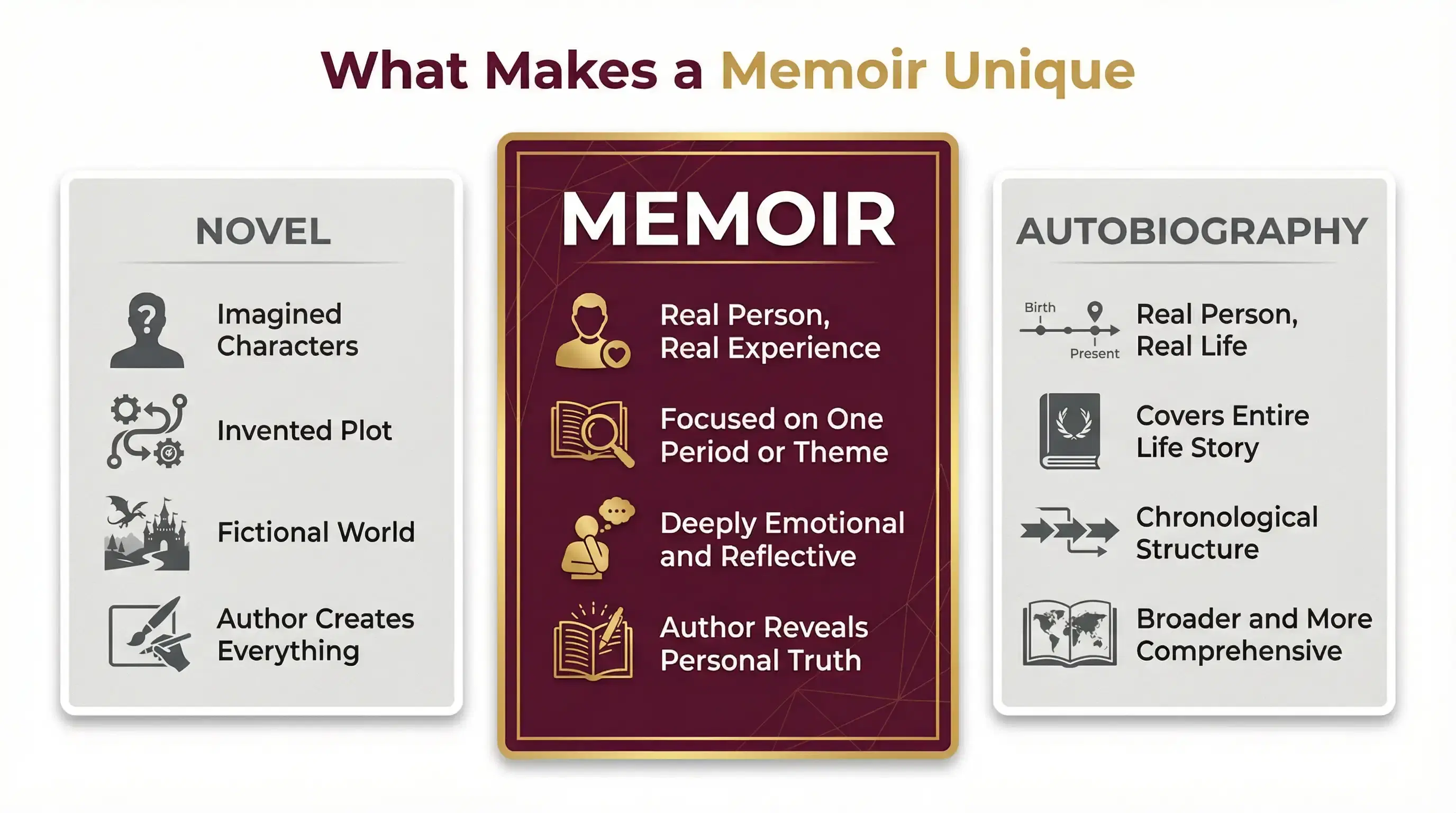
Memoir occupies a unique position in the landscape of writing, neither the intimate breadth of autobiography nor the invented emotional world of fiction, but something with its own specific and irreplaceable qualities.
The memoir's secret weapon is extreme focus. A memoirist chooses one truth, one period, one experience, and pursues it with a depth and an intensity that autobiography rarely achieves, which is why memoir book publishing services must be equally focused on preserving that singular emotional core throughout production. Tara Westover's Educated is not the full story of her life. It is the story of one specific journey, a young woman who grew up without formal education in a survivalist household in rural Idaho and found her way to a Cambridge PhD, and the entire book is built around the question of what education means and what it costs. That focus is what makes it so powerful. By choosing one thread and following it to its conclusion, Westover creates a reading experience far more concentrated and far more emotionally affecting than a more comprehensive account of her life could have been.
The narrowing of focus in memoir creates intimacy of a very specific kind, the intimacy of being invited into a single window of a real human life and seeing everything through it with extraordinary clarity. The reader of a memoir is not being given an overview. They are being given access. Access to the specific thoughts and feelings of a specific person at a specific moment, rendered with all the uncertainty and contradiction and emotional complexity that real human experience contains.
This intimacy is something that readers cannot find anywhere else. Fiction can create intimacy with invented characters, but the knowledge that everything is invented creates a slight remove that memoir does not have. The reader of a memoir knows that this is real, that this person existed, that these events happened, that these feelings were genuinely felt by a real human being. That knowledge changes the experience of reading in ways that are subtle but profound.
The Moment That Becomes a Memoir
Not every experience demands to be written about. But certain experiences do, and the people who have lived them often feel the demand clearly, even if they cannot immediately articulate it. There is a quality of unfinished business about experiences that are ready to become memoirs, a sense that something happened that has not yet been fully understood, or that a truth was learned that has not yet been fully shared.
The experiences that make the most powerful memoirs tend to share certain characteristics. They involve transformation, a before and an after, a person who entered the experience one way and came out of it changed. They involve something that was genuinely at stake, a relationship, an identity, a belief system, a life. And they involve a truth that the writer has arrived at through living, not a truth they were told, not a truth they read in a book, but a truth they earned through their own experience.
What is remarkable about memoir is that the subject does not need to be dramatic to be powerful. Paul Kalanithi’s When Breath Becomes Air is about dying, which is, in one sense, the most universal of all human experiences. Mary Karr's The Liars' Club is about a difficult childhood in a small Texas town. Cheryl Strayed's Wild is about a woman hiking alone along the Pacific Crest Trail. None of these experiences are historically significant. None of them involve famous people or world-changing events. But all three found large and lasting readerships. When Breath Becomes Air has sold over two million copies, and Wild was a number one bestseller and the first Oprah's Book Club 2.0 pick; The Liars' Club is the smallest of the three at roughly half a million, which is still a remarkable figure for a literary memoir by a then-unknown writer. Each stayed with its readers in ways they cannot entirely explain.
The thread a memoir should follow is not necessarily the most dramatic experience in the writer's life. It is the experience that the writer most needs to understand, the one that is still unresolved, still alive, still asking questions that have not yet been fully answered. Memoir is, among other things, a tool for understanding your own life. And the best memoirists write about what they most need to understand.
What the Greatest Memoirs Have in Common
The memoirs that endure, the ones still being read decades after publication, still being pressed into the hands of friends, still cited by other writers as formative influences, share a set of qualities that distinguish them from the many thousands of memoirs that are read once and forgotten.
The first and most essential quality is honesty that makes the reader uncomfortable in the best way, the kind of honesty that requires the writer to describe themselves at their worst, their most confused, their most morally compromised, without the protection of retrospective wisdom or self-justification. The best memoir writers do not present themselves as heroes of their own stories. They present themselves as human beings who were doing their best with what they had, which was often not very much. This honesty is what creates the sense that you are reading something real rather than a performance of reality.
The second quality is the ability to find, inside deeply personal experience, the universal truths that every reader can recognize. The best memoirists are not simply people who had interesting experiences. They are writers who can look at their own experience from sufficient distance to see what it shares with the experience of the rest of humanity, and who can articulate those shared truths in language that makes them feel freshly discovered rather than already known.
The third quality is transformation that is visible to the reader, a change in the writer between the first page and the last that the reader can feel happening as they read. Memoir is a story of transformation, and the transformation needs to be real. Not necessarily dramatic or complete or unambiguously positive, real life transformations rarely are all of these things, but genuinely present. The person who finishes the memoir should be meaningfully different from the person who began it.
The fourth quality is the thing the reader carries away, a feeling, an insight, a truth that changes how they see something in their own life. The best memoirs are generous in a very specific way: they give the reader something that belongs to them, not just to the writer. They earn their place in the reader's life by making that life feel more understood.
The Memoirs That Readers Cannot Stop Recommending

Memoirs That Have Left a Lasting Impact
The memoirs below have done something that only the best books in any genre achieve: they have created a readership that actively recruits new readers, people who finish the book and immediately need to talk about it, to press it on everyone they know, to understand why it affected them so deeply.
Educated by Tara Westover
The memoir that defined the genre for a generation of readers. Westover grew up in a survivalist family in rural Idaho, was never formally educated, worked in her father's junkyard, and survived serious accidents and family violence before finding her way to Brigham Young University, then Cambridge, then a PhD. It is about the terrifying, necessary process of choosing your own understanding of reality over the version you were given, and what it costs when that version is given to you by the people who love you most.
The Glass Castle by Jeannette Walls
Walls grew up in a family that moved constantly, lived in extreme poverty, and was presided over by a brilliant, charismatic, deeply unreliable father who promised his children a glass castle he would never build. The Glass Castle is remarkable for its emotional ambivalence, showing love and failure coexisting and refusing to resolve into simple judgment.
When Breath Becomes Air by Paul Kalanithi
A neurosurgeon in his mid-thirties, diagnosed with terminal lung cancer, writes about facing death and what it means to live a meaningful life. Kalanithi writes with extraordinary clarity, grace, and absence of self-pity, creating one of the most beautifully written and profound memoirs ever published.
The Liars' Club by Mary Karr
Karr's account of her chaotic Texas childhood, with an unstable mother and a stoic father, is celebrated for precise, funny, fierce prose and honesty about difficulty without sentimentality. It launched the modern memoir renaissance.
Wild by Cheryl Strayed
After personal tragedy and addiction, Strayed hikes the Pacific Crest Trail alone, carrying an enormous pack she calls Monster. Wild is a physical and emotional memoir, capturing grief, struggle, and the journey back to oneself.
I Am Malala by Malala Yousafzai
The memoir of the young Pakistani activist shot by the Taliban for advocating girls' education. Malala’s story is both personal and political, written with directness, clarity, and moral courage.
The Year of Magical Thinking by Joan Didion
Didion recounts the year after her husband’s sudden death, giving an exact, unsentimental account of grief. Her memoir provides readers with a guide to the real experience of loss.
A Long Way Gone by Ishmael Beah
Beah was thirteen when civil war turned him into a child soldier in Sierra Leone. His memoir recounts survival, rehabilitation, and recovery without self-pity, raising difficult questions about violence, forgiveness, and healing.
Why Writing a Memoir Is as Powerful for the Writer as It Is for the Reader
Most of the discussion around memoir focuses on what it gives the reader. But the writers of the most powerful memoirs consistently report that the act of writing the book was as transformative for them as the experience of reading it has been for their audience.
Writing a memoir requires you to examine your own experience with a specificity and an honesty that ordinary memory does not demand. When you are simply remembering something, you can be approximate, impressionistic, selective in ways you may not fully be aware of. When you are writing it down, you have to make choices about what exactly happened, what exactly was said, what exactly you felt, and what exactly it meant. Those choices force a clarity that many memoir writers describe as one of the most significant experiences of their lives.
There is also a quality of completion that writing memoir provides that simply living through an experience cannot. Experiences happen to us in fragments, without narrative shape, without clear meaning, without the retrospective understanding that only comes with time and distance. Writing a memoir imposes shape on what was shapeless, meaning on what was confusing, narrative on what was chaotic. This is not falsification. It is the act of understanding. Memoir writers consistently report that the process of writing their story helps them understand it, and themselves, in ways that living through it never did.
This is why memoir is unlike any other form of writing, and why the authors who choose to publish memoir are doing something that benefits both their readers and themselves. It is simultaneously a gift to the reader and a gift to the writer, a process that heals and clarifies as it creates, that produces understanding as a byproduct of production. The writer who finishes a memoir is not the same person who began it. The act of telling the story changes the person who tells it.
What Memoir Readers Are Looking for in 2026
Memoir publishing in 2026 is being shaped by a cultural moment unlike any before it. The demand for memoir book publishing services has surged alongside a cultural conversation around mental health, identity, and the complexity of lived experience that has never been more open or more urgent, and readers are seeking books that meet them in that conversation with honesty and depth.
Mental health and recovery memoirs are the fastest growing category in the genre right now. The destigmatization of mental health conversations that has accelerated through the 2020s has created an enormous appetite for first-person accounts of living with anxiety, depression, trauma, addiction, and other mental health challenges, written not from the safe distance of recovery but from inside the experience, with the kind of honesty that readers who are currently in the middle of their own struggles can actually use.
Identity and belonging narratives are also central to where memoir is going right now. Memoirs that explore the experience of navigating multiple cultural identities, of belonging fully to none of the worlds available to you, of constructing a self from materials that were not designed to fit together, these stories are reaching readers who have lived versions of the same experience and have been hungry to see it reflected in print.
The cultural conversation around trauma and healing is also driving memoir in a direction that would not have been commercially viable a decade ago: memoirs that do not resolve. Books that describe ongoing struggles without tidy conclusions, that present healing as non-linear and incomplete, that resist the pressure to deliver a redemptive arc, are finding readers who are grateful for the permission to see their own non-linear struggles reflected honestly.
How to Know If Your Experience Is Ready to Become a Memoir
One of the most important distinctions in memoir writing is the difference between an experience that is still too raw and one that is ready to be written. Writing from the middle of an experience, before you have arrived at any understanding of what it means or any distance from the emotions it contains, produces writing that is urgent and real but not yet shaped into the narrative that memoir requires.
Time and perspective are the essential transformers of lived experience into memoir material. You do not need to be fully healed, fully resolved, or fully at peace with what happened to you; some of the most powerful memoirs are written by people who are still in the process of understanding their experience. But you need enough distance to describe what happened with some degree of clarity rather than being overwhelmed by it, and to have arrived at some understanding, however partial, however uncomfortable, of what it meant.
Your experience is ready to become a memoir when you can describe the hardest parts of it without losing yourself in them. When you can see the person you were during the experience with a degree of compassion and understanding that was not available to you while you were living it. When you have arrived at a truth about your experience that feels genuinely hard-won, that cost you something to reach, and that you believe others could benefit from hearing.
How Best Selling Publisher Helps You Write and Publish Your Memoir
Memoir is the most personal of all book categories, and working with memoir manuscripts requires a combination of editorial skill and human sensitivity that not every publishing partner is equipped to offer. At Best Selling Publisher, we bring both.
We work with every writer who wants to publish a memoir at every stage of the process. For those who have a story they need to tell but are not sure how to begin, we offer initial consultations that help identify the specific focus of your memoir, the thread you most need to follow, and the structure that will serve your story best. For writers who have a first draft but are not sure it is working, we offer developmental editing that looks at the large-scale questions of what the memoir is really about, whether the narrative arc is present and visible, and whether the emotional honesty is consistent throughout.
We understand that memoir manuscripts often contain material that is difficult, raw, and deeply personal, and we bring the same care to working with that material as we would want brought to our own. Our editors are not just technically skilled. They are genuinely respectful of the courage it takes to tell your real story, and they work to preserve what is most authentic about your voice while helping you achieve the fullest possible impact. Our cover design team understands memoir's visual language, and our Amazon publishing specialists ensure your memoir reaches the audience that needs it. Authors work with Best Selling Publisher with their most personal work.
Conclusion
The world needs more people willing to tell the truth about their lives. Not the curated truth, the highlights-reel truth, the version that shows only the parts we are not ashamed of. The real truth, the complicated, contradictory, painful, beautiful, unresolved truth of a life actually lived. Memoir is the form designed to carry that truth, and the writers who are willing to write it are doing something genuinely important.
A memoir leaves a legacy that goes far beyond its author's personal circle. It creates a record of a way of seeing the world, of navigating a specific kind of difficulty, of arriving at a specific kind of understanding, that is available to anyone who needs it, long after the writer has moved on. The person who reads your memoir in ten years, in a completely different country, going through something that resembles what you described, will find in it something they could not have found anywhere else. That is the unique gift of memoir, and it is available to every person willing to do the difficult work of telling the truth.
FAQs
Working with a professional publishing partner who offers dedicated memoir book publishing services is the most effective route for most authors who want to publish a memoir. Best Selling Publisher provides complete memoir publishing services, from developmental editing and manuscript refinement to cover design, Amazon KDP publishing, and targeted marketing that reaches readers who are actively looking for the kind of memoir you have written. Contact our team to learn how we can help your experience reach its audience.
Most published memoirs fall between 60,000 and 90,000 words. This range reflects the focused nature of the form, memoir covers a specific period or theme rather than an entire life, and this concentration typically produces a tighter book than autobiography. Shorter memoirs focused on a single experience can work beautifully at 50,000 words or even less. Longer memoirs covering complex multi-year experiences can extend to 100,000 words or beyond. The appropriate length is always determined by the story rather than a target word count.
An autobiography covers the full arc of a person's life, typically in chronological order from childhood to the present. A memoir focuses on a specific chapter, period, theme, or experience within a life, going deep rather than broad. Memoirs tend to be more literary and more thematically focused, while autobiographies tend to be more comprehensive. In practice, many books described as one or the other contain elements of both, and the distinction matters less than finding the form that best serves the story you are trying to tell.
No. Some of the most powerful memoirs ever written are about experiences that are, in objective terms, entirely ordinary. What makes a memoir powerful is not the drama of the events it describes but the honesty, the depth of understanding, and the quality of the writing with which it describes them. A memoir about learning to make peace with a difficult relationship can be as profound as a memoir about surviving a war, if it is written with the same degree of truth and the same willingness to examine uncomfortable things clearly.
By definition, a memoir is written from a first-person perspective about the writer's own experience. You can write a biography about someone else, or a personal narrative that centers your relationship with another person, in which the other person is seen through the lens of your own experience of them. But if the book is primarily about someone else's life rather than your own, it is more accurately described as a biography or biographical account. The defining characteristic of memoir is the writer's own subjective experience as the central subject.
The most common structural approach for memoir is a modified chronological structure, moving roughly forward through the period being covered while using flashbacks and reflective passages to provide context and meaning. More experimental memoirs sometimes use thematic structures, organizing material around ideas or emotional states rather than a timeline. The key structural principle is that every scene and every reflection should serve the central question or truth the memoir is exploring. A good test: if you removed any given section, would the memoir lose something essential? If not, it may not need to be there.