
How Science and Technology Books Make the Most Complex Ideas in the World Feel Simple
The greatest science writers don’t simplify ideas, they make you feel smart enough to understand them.
That distinction matters enormously. Simplification is condescension, it takes a complex idea and strips away everything that makes it interesting until what remains is a cartoon version of the truth. What the best science writers do is something completely different. They take a complex idea and they find the angle of approach that makes it accessible without making it smaller. They find the story inside the science, the human being behind the discovery, the moment of confusion before the breakthrough, and through those human elements, they give the reader a way in.
We live in the most scientifically and technologically advanced moment in human history, and the demand for science book publishing services has grown alongside the public hunger to understand the forces reshaping every aspect of our lives. Every year, discoveries are made that would have seemed miraculous to our great-grandparents. Every decade, the technology that defines daily life becomes unrecognizable from what came before. And yet most people walk through this extraordinary world with only the vaguest understanding of how any of it works, not because they are not curious, but because no one has ever explained it to them in a way that respects their intelligence while meeting them where they are.
Science and technology books, at their best, fix that, and authors who invest in professional science book publishing services are bringing these ideas to the readers who need them most. They are the most mind-expanding reads available to any curious person, books that leave you looking at the world around you differently, understanding things that once felt completely out of reach, and feeling the particular pleasure of a mind that has just been genuinely stretched. In this guide, we are going to show you exactly why.
How Science Books Turn the Complicated Into the Fascinating
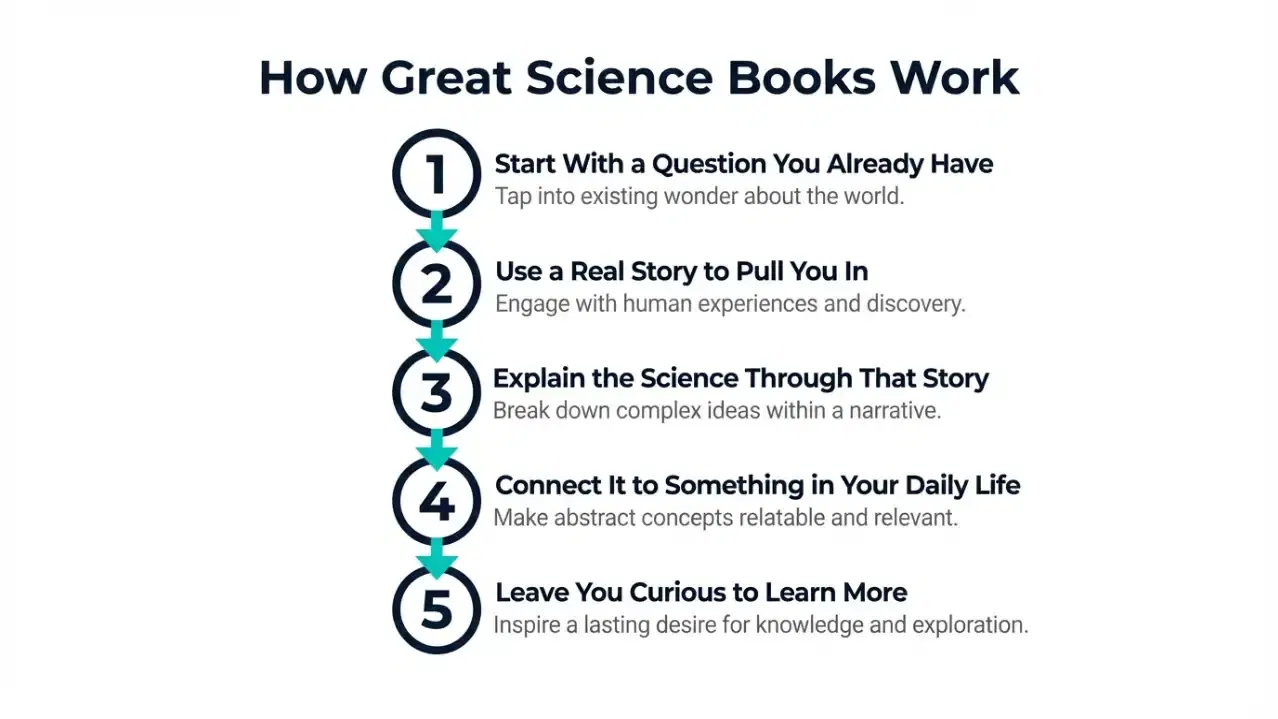
The best science writers share a quality with the best teachers, an ability to meet a reader exactly where they are and walk with them toward understanding without ever making them feel inferior for not already knowing. But the best science writers do something teachers rarely have time to do: they are also great storytellers.
Richard Feynman, the Nobel Prize-winning physicist whose memoir Surely You’re Joking, Mr. Feynman! became one of the most beloved science books ever written, understood this instinctively. Feynman believed that if you could not explain something simply, you did not truly understand it yourself. His writing had a quality of genuine delight in ideas, an infectious enthusiasm for the strangeness and beauty of the physical world, that made readers feel not that they were being taught but that they were being invited to share in something wonderful.
Carlo Rovelli’s Seven Brief Lessons on Physics is perhaps the most elegant demonstration of this quality in contemporary science writing. A book that covers quantum mechanics, general relativity, and the architecture of the cosmos in 79 pages, it manages this impossible feat not by cutting corners but by finding the poetic core of each idea, the image or metaphor that makes the abstract suddenly concrete and luminous. Readers who approach it expecting to be confused come away feeling that they have genuinely glimpsed the structure of reality, and that it is more beautiful than they had imagined.
The satisfaction of finishing a great science book, the feeling of actually understanding something that once seemed beyond you, is one of the most distinctive reading experiences available. It is not the satisfaction of a story resolved or a mystery solved. It is the satisfaction of a mind genuinely enlarged.
The Two Big Worlds Inside Science and Technology Books
Science and technology books occupy two related but distinct territories, and understanding the difference helps you find the books that match what you are most curious about right now.
Science books engage with the natural world, with physics and chemistry, biology and evolution, neuroscience and the human body, astronomy and the vastness of the cosmos. They ask the questions that humanity has been asking since it was first capable of asking questions: How did the universe begin? Why does life exist? What is consciousness? How does a single fertilized cell become a complete human being? These are the questions that science has been making progress on, sometimes extraordinary progress, for four hundred years, and science books are the most accessible way to understand what that progress has actually revealed.
Technology books engage with the human-made world, with the machines and systems and networks that now shape virtually every aspect of how we live. They tell the stories of how the digital world was built, who the people were, what problems they were trying to solve, what decisions they made and why, and what consequences those decisions have had for the billions of people who now live inside the systems they created. Walter Isaacson’s The Innovators, which traces the history of the computer and the internet through the lives of the visionaries who created them, is the defining example of this form: a book that shows you the human beings behind the technology you use every day.
In 2026, the two worlds are increasingly overlapping. The demand for technology book publishing services reflects this shift, as books about artificial intelligence sit at the intersection of technology and neuroscience. Books about genetic engineering span biology, chemistry, and technology simultaneously. Books about climate change require understanding of physics, chemistry, ecology, and the technology of energy production all at once. The most important questions of our moment do not respect the boundaries between disciplines, and the best science and technology writers do not either.
The Two Big Worlds Inside Science and Technology Books
Science Books
Science books engage with the natural world, with physics and chemistry, biology and evolution, neuroscience and the human body, astronomy and the vastness of the cosmos. They ask the questions that humanity has been asking since it was first capable of asking questions: How did the universe begin? Why does life exist? What is consciousness? How does a single fertilized cell become a complete human being? These are the questions that science has been making progress on, sometimes extraordinary progress, for four hundred years, and science books are the most accessible way to understand what that progress has actually revealed.
Technology Books
Technology books engage with the human-made world, with the machines and systems and networks that now shape virtually every aspect of how we live. They tell the stories of how the digital world was built, who the people were, what problems they were trying to solve, what decisions they made and why, and what consequences those decisions have had for the billions of people who now live inside the systems they created. Walter Isaacson’s The Innovators, which traces the history of the computer and the internet through the lives of the visionaries who created them, is the defining example of this form: a book that shows you the human beings behind the technology you use every day.
Overlap in 2026
In 2026, the two worlds are increasingly overlapping. The demand for technology book publishing services reflects this shift, as books about artificial intelligence sit at the intersection of technology and neuroscience. Books about genetic engineering span biology, chemistry, and technology simultaneously. Books about climate change require understanding of physics, chemistry, ecology, and the technology of energy production all at once. The most important questions of our moment do not respect the boundaries between disciplines, and the best science and technology writers do not either.
The Science and Technology Books That Blew People’s Minds
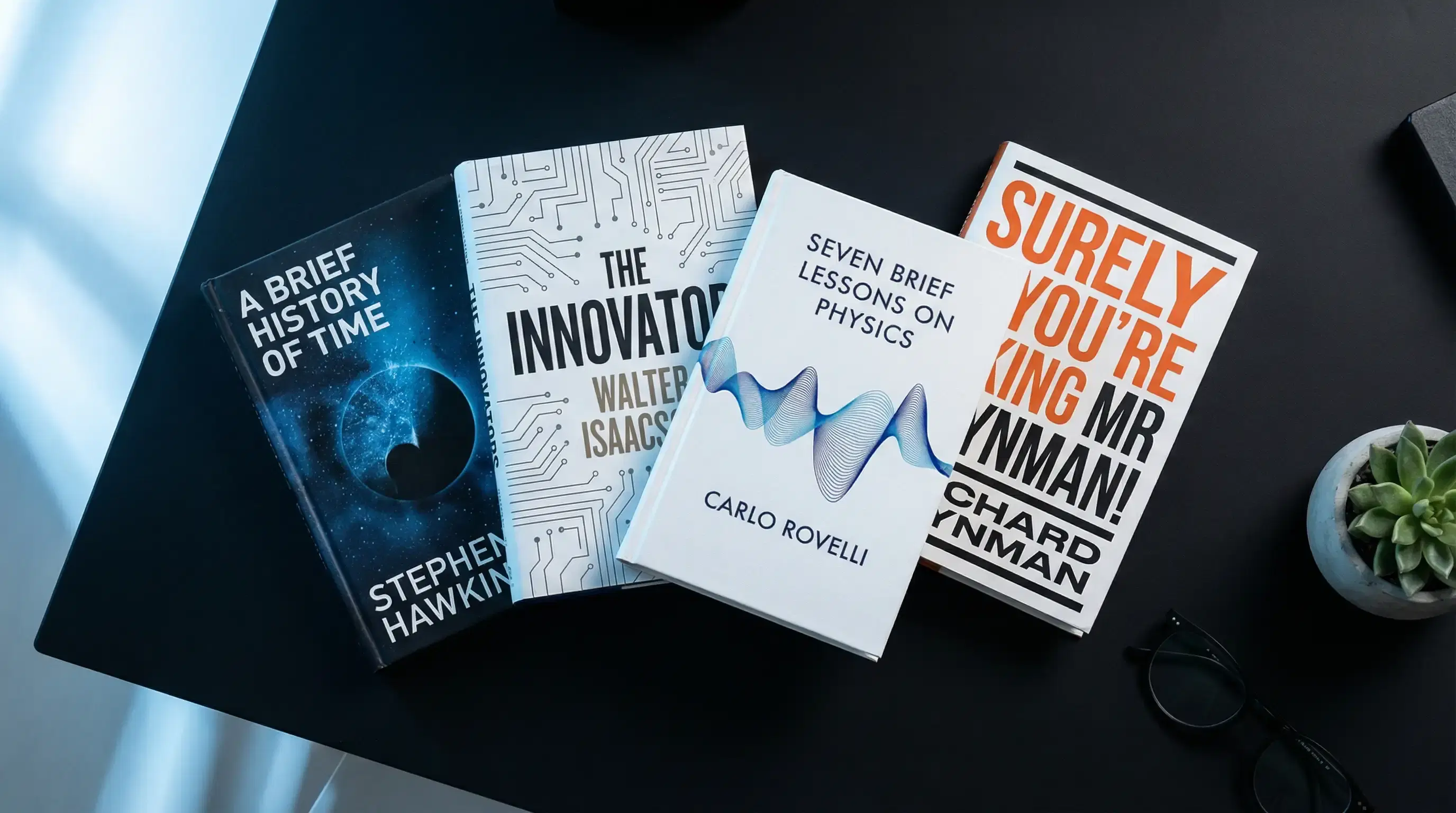
A Brief History of Time by Stephen Hawking
The book that proved popular science could reach a global mainstream audience. Hawking covers the Big Bang, black holes, the nature of time, and the search for a theory of everything with a clarity and an ambition that have made it one of the most widely read science books ever published. Hawking’s personal story, a man who confronted the deepest questions about the universe while fighting a disease that confined him to a wheelchair, gives the book a human dimension that makes its scientific content land with unusual emotional force.
The Innovators by Walter Isaacson
The definitive account of how the computer and the internet were invented. Isaacson traces the story from Ada Lovelace’s 19th-century insights through the wartime computing efforts of Alan Turing, the development of the microchip, the personal computer revolution, and the creation of the World Wide Web, always with his characteristic focus on the human beings whose decisions, collaborations, and rivalries shaped the digital world. Essential reading for anyone who wants to understand the technology that now defines modern life.
Seven Brief Lessons on Physics by Carlo Rovelli
An extraordinary achievement, a book that covers the whole of modern physics in 79 pages and leaves readers feeling not that they have been lectured to but that they have glimpsed something beautiful. Rovelli writes with the sensibility of a philosopher and the soul of a poet, and the result is science writing that has reached readers who had never before thought of themselves as people who read science. A perfect introduction to what popular science writing can be at its finest.
Surely You’re Joking, Mr. Feynman! by Richard Feynman
Part memoir, part science, and entirely delightful, Feynman’s account of his own extraordinary life, from his childhood in Queens through his work on the Manhattan Project and his Nobel Prize-winning contributions to quantum electrodynamics, is one of the most purely entertaining books in all of science writing. But it is also a profound illustration of what it means to think like a scientist: with curiosity, rigor, irreverence, and an absolute refusal to accept something as true simply because an authority says it is.
The Code Breaker by Walter Isaacson
The story of Jennifer Doudna, CRISPR, and the gene-editing revolution that is transforming medicine, agriculture, and the future of the human species. Isaacson brings the same narrative mastery he applied to Steve Jobs and Leonardo da Vinci to what may be the most consequential scientific development of the 21st century, making a technically complex story accessible without sacrificing any of its depth or its urgency.
The Gene: An Intimate History by Siddhartha Mukherjee
A sweeping history of genetics from Mendel’s pea plants to CRISPR, written with the literary skill and the personal intimacy that made Mukherjee’s The Emperor of All Maladies, his history of cancer, one of the most acclaimed science books of the modern era. Mukherjee is the rare scientist who is also a genuine writer, and the combination produces science books that are as emotionally affecting as the best memoir.
Thinking, Fast and Slow by Daniel Kahneman
Psychologist Daniel Kahneman, who won the 2002 Nobel Memorial Prize in Economic Sciences, and his account of the two systems that drive how humans think, the fast, intuitive, emotional system and the slow, deliberate, logical one, is one of the most widely read science books of the 21st century. It has changed how millions of readers understand their own decision-making, and it has become required reading in fields as diverse as behavioral economics, medicine, law, and military strategy.
The Selfish Gene by Richard Dawkins
First published in 1976 and never out of print, Dawkins’s reframing of evolution from the perspective of the gene rather than the individual organism is one of the most influential science books ever written. It introduced the concept of the meme, explained altruism through the logic of genetic self-interest, and challenged readers to think about life in a completely new way. Decades later, it remains essential reading for anyone who wants to understand the evolutionary framework that underlies all of biology.
Why You Don’t Need to Be a Scientist to Love Science Books
The most common reason people give for avoiding science books is a version of the same thing: “I’m not a science person.” And what this almost always means is: “I had a bad experience with science in school, and I concluded from that experience that science is not for me.”
But the qualification for reading a science book is not a science degree. It is curiosity, and specifically the kind of curiosity that makes you wonder, even for a moment, about the things that most people take for granted. Why is the sky blue? How does memory work? What actually happens inside a black hole? Why do some people get cancer and others do not? If you have ever found yourself genuinely wondering about questions like these, you are already a science reader. You have simply not found the right book yet.
The best science writers write for curious people, not for experts. Carlo Rovelli does not assume that his readers know quantum mechanics before they open Seven Brief Lessons on Physics. Richard Feynman delighted in explaining the most complex physics to anyone who would listen, because he believed that the pleasure of understanding was not reserved for specialists. Mary Roach, whose books on subjects ranging from digestion to space medicine are among the funniest and most accessible science books ever written, builds her entire approach around the assumption that her readers are intelligent people who know nothing about her subject and want to.
The unique joy of understanding something that once felt completely out of reach is one of the most rewarding experiences reading can provide. There is a particular satisfaction in finishing a book about quantum physics or evolutionary biology or the architecture of the internet and realizing, not that you have become an expert, but that you genuinely understand something you did not before, and that the world looks slightly different because of it. That experience is available to anyone. It requires nothing except a book and the willingness to be curious.
What Science and Technology Readers Are Reaching for in 2026
The science and technology book category in 2026 is being shaped by the same forces that are reshaping the world itself, and the authors who invest in science book publishing services are entering a market with exceptional reader appetite, and readers are hungry for books that help them understand those forces at a depth that headlines and social media posts cannot provide.
AI books are dominating the science and technology category in a way that has no real precedent. As artificial intelligence transforms work, creativity, education, healthcare, and virtually every other domain of human activity simultaneously, readers are desperate for books that explain what is actually happening, how large language models work, what they can and cannot do, what the risks are, and what human beings need to understand to navigate this transformation intelligently. Books that deliver this understanding with clarity and without either panic or uncritical optimism are currently some of the most sought-after titles in all of non-fiction.
Neuroscience books are experiencing their own surge in 2026, driven by a growing public awareness of mental health and a hunger to understand the biological foundations of psychological experience. Books that explain how trauma is stored in the nervous system, how addiction works at the neurochemical level, how sleep deprivation affects cognitive function, and how meditation and exercise change the brain are reaching enormous audiences, because these are questions that feel immediately personal and immediately practical.
Climate science books are more urgent than ever, and the best of them are combining rigorous science with genuine narrative power to reach readers who need to understand what is actually happening to the planet and what human beings can realistically do about it. The challenge for climate science writers is to convey the genuine urgency of the situation without producing paralysis, to inform without overwhelming, and the best books in this space are navigating that challenge with increasing skill.
Where to Start If Science Books Are New to You
The most important principle for finding your first science book is to start with a subject that already makes you curious, even slightly, even vaguely. Genuine curiosity is the engine of science reading, and a book about a subject you are already interested in will carry you through the moments of difficulty in a way that a book about a subject someone told you you should read will not.
If you are curious about the universe, about the large-scale structure of reality, the nature of time, or the origin of everything, start with Seven Brief Lessons on Physics by Carlo Rovelli. It is the most beautiful and most accessible entry point into the physics of the cosmos available, and it has converted readers who were certain they hated science into enthusiastic science readers in the space of an afternoon.
If you are curious about how your own mind works, why you think the way you do, make the decisions you make, and remember what you remember, start with Thinking, Fast and Slow by Daniel Kahneman. It is the science book most likely to make you feel that you understand something fundamental about yourself that you did not before.
And if you want to understand the technology that now defines every aspect of modern life, how it was built, by whom, and what it means, start with The Innovators by Walter Isaacson. It is the most engaging and most comprehensive account of the digital revolution available, and it reads as compellingly as any biography.
How Best Selling Publisher Publishes Science and Technology Books
Our technology book publishing services are built around a challenge that is unique in all of non-fiction: the content needs to be technically accurate and the writing needs to be genuinely accessible, and achieving both simultaneously requires editors who understand both the science and the craft of writing about it.
The most common failure mode of science and technology manuscripts is not inaccuracy, it is inaccessibility. Authors who have deep expertise in their subject often find it genuinely difficult to remember what it was like not to know what they know. They use technical language without realizing it has become invisible to them. They skip explanatory steps that feel obvious to them but are not obvious to the reader. Our editors work with science and technology authors to identify these moments and to find the explanations, analogies, and narrative approaches that make complex content genuinely accessible without losing any of its depth or accuracy.
Cover design for science and technology books requires a specific understanding of what signals credibility and intellectual seriousness to this genre’s readership, and what signals accessibility versus intimidation. We bring genuine genre knowledge to this challenge. Our Amazon KDP setup and keyword optimization for science titles ensures your book reaches the curious readers actively searching for exactly what you have written.
Authors work with Best Selling Publisher with their stories and their expertise. We would love to help your scientific knowledge find the readers who are waiting to be changed by it.
Conclusion
We live in the most scientifically advanced moment in the four-billion-year history of life on this planet. The knowledge available to any curious person with access to a library is more extraordinary, more detailed, and more genuinely useful than anything that existed even fifty years ago. The tools for understanding the universe, the human body, the mind, and the technologies that now shape every aspect of daily life have never been more powerful or more accessible.
Science and technology books are the most direct path to that understanding, more thorough than articles, more current than textbooks, and more human than academic papers. They take the greatest discoveries of the greatest minds in history and make them available to anyone willing to sit down and read. The only requirement is curiosity, and curiosity is something you already have.
FAQs
Working with a professional publishing partner who offers dedicated science book publishing services and technology book publishing services is the most effective route for most authors. Best Selling Publisher provides complete science book publishing services, from manuscript editing that makes complex content accessible without sacrificing accuracy, to genre-specific cover design, Amazon KDP publishing, and marketing that reaches the communities of curious readers your book was written for. Contact our team to learn how we can help your knowledge reach its audience.
Popular science books vary considerably in length. Short, focused books like Carlo Rovelli’s Seven Brief Lessons on Physics run under 100 pages. Most popular science books fall in the 70,000 to 100,000 word range. Comprehensive works like Walter Isaacson’s The Innovators or Siddhartha Mukherjee’s The Gene run to 150,000 words or more. The appropriate length is determined by the scope of the subject and the depth at which it needs to be treated to do justice to the material.
No. The best popular science books are written specifically for intelligent curious readers who do not have a scientific background. The qualification for reading a science book is simply curiosity, an interest in understanding how something works or why something is the way it is. The best science writers assume no prior knowledge and build understanding from the ground up, using stories, analogies, and clear explanations to make complex ideas genuinely accessible.
Popular science writing is science writing intended for a general audience rather than a specialist one. It communicates scientific ideas, discoveries, and debates using narrative, clear language, and accessible explanation rather than the technical terminology and peer-review conventions of academic science. The best popular science writers are scientists or science journalists who understand both the science deeply and the craft of writing for general readers well enough to do both justice simultaneously.
In 2026, the science and technology books generating the most discussion are primarily in the AI and neuroscience categories. Books that explain how large language models work, what artificial general intelligence might mean, and how to think clearly about the risks and opportunities of AI are currently the fastest-selling titles in the category. In neuroscience, books on longevity science, brain health, and the biological basis of mental health conditions are reaching broader audiences than ever before.