
How Publishing a Niche Nonfiction Book Can Position You as an Industry Authority
You have spent years building expertise in your field. You have the knowledge, the experience, and the results to prove it. But when potential clients, event organizers, or industry peers search for the go-to voice in your space, your name is not the one they find. Someone else is getting the media features, the speaking invitations, and the high-value clients. And the uncomfortable truth is, it is rarely because they know more than you.
The gap between experts who are recognized and those who remain invisible is not about credentials anymore. A long list of certifications or an impressive LinkedIn bio does not automatically generate trust in today's market. People are overwhelmed with content from every direction, and they have learned to tune out most of it. What they cannot tune out is a published book sitting on their desk, or appearing in their Amazon search results, written by someone who clearly understands their exact problem.
A niche nonfiction book is not just a writing project. It is the single most powerful credibility asset available to any professional today. It signals authority in a way that no podcast episode, LinkedIn article, or conference talk can match. And when that book is positioned correctly and published professionally, it becomes a 24/7 sales tool, a reputation builder, and a career accelerator all at once.
This blog will walk you through exactly why a book outperforms every other content format for authority building, why going narrow wins bigger than going broad, the five tangible ways a published book grows your professional reputation, what the book publishing process actually looks like from start to finish, and how Best Selling Publisher helps professionals at every stage turn their expertise into a published book that works for them long after launch day.
What Makes a Book the Ultimate Authority Signal?
There is a reason why book publishing for professionals has become one of the fastest-growing segments in the publishing industry. Professionals across every sector, from consulting and law to healthcare and technology, are waking up to something that marketing experts have known for years. Writing and publishing a book changes how people perceive you before you ever speak a word.
The word "author" carries weight that no job title can replicate. When someone reads your name alongside the phrase "author of," their brain immediately files you in a different category. You are no longer a service provider competing for attention. You are the source. The expert. The person who, quite literally, wrote the book on it.
Social media posts vanish within 48 hours of being published. Even high-performing podcast episodes fade from memory within a week. A well-crafted article on LinkedIn might generate a spike in profile views, but it does nothing to differentiate you in any lasting way. A book, on the other hand, compounds over time. It lives on shelves, shows up in search results for years, gets cited in other content, and sits on the desks of people who matter in your industry. The permanence alone makes it incomparable as a credibility tool.
And there is something deeper happening psychologically. People intuitively trust authors. They believe that anyone who sat down and wrote a full book on a subject has earned the right to speak on it. This perception is powerful, and once it forms, it is almost impossible to undo.
Books vs. Other Content Formats - What Buyers Actually Trust
Think about the last time you were about to hire someone for a high-stakes decision. You probably searched their name, looked at their website, maybe watched a video or two. Now think about what would have made you immediately more confident in your choice. If you discovered they had a published book on exactly the topic you needed help with, the decision would have felt much easier.
That is the difference between content that informs and content that converts. Social media informs. A book converts. When a buyer is weighing their options and one of the candidates has a published book and the others do not, the author wins that consideration more often than not.
Buyers today are also more skeptical than ever. They have seen too many polished social media profiles that do not translate into real results. A book, because of the effort, expertise, and investment it represents, cuts through that skepticism in a way nothing else does. It is proof of depth, and depth is exactly what high-value clients are paying for.
The professionals who understand this are using their books to build thought leadership with a book the way previous generations used television appearances or major magazine features. It is the modern authority signal, and it is available to anyone willing to do it right.
Why Niche Is More Powerful Than Mass Appeal
Most first-time authors make the same mistake. They try to write a book that appeals to everyone, assuming that a wider audience means more sales and more recognition. The opposite is almost always true. A broad book gets lost in a sea of other broad books. A niche book becomes the definitive resource for a specific group of people who are actively searching for exactly what you wrote.
This is especially important when it comes to Amazon nonfiction book publishing . Amazon operates on categories and keywords. A book titled "A Guide to Better Business" has no chance against the thousands of similar titles competing for the same vague search terms. But a book titled "The Procurement Playbook for SaaS Companies" or "Financial Planning Strategies for Independent Dentists" faces a fraction of the competition and speaks directly to a reader who will immediately feel understood.
Niche books consistently achieve bestseller status in their specific Amazon categories because the competition is lower and the reader intent is higher. A bestseller badge, even in a niche category, is a real marketing asset. It is something you can display on your website, mention in your bio, and reference in every sales conversation. And it signals to prospective clients that your book is not just published, it is recognized.
The deeper power of niche positioning is what it does to the quality of attention you attract. When the right reader finds your book, they do not just buy it. They reach out. They hire you. They invite you to speak. The narrower your focus, the more powerful the signal you send to exactly the people you want to work with.
How Niche Positioning Turns Readers Into Clients
A well-positioned niche book functions as a pre-qualification filter. Every person who reads it has already demonstrated interest in your specific area of expertise. They are not browsing. They are actively seeking the knowledge you have. By the time they finish reading, they know how you think, how you approach problems, and what working with you might look like. That relationship, built through pages, converts at a far higher rate than any cold outreach or generic marketing campaign.
Many professionals report that their best clients came to them already sold, because they had read the book first. The conversation skips the trust-building phase entirely and moves straight into scope and pricing. That shift in dynamic is not just convenient. It changes your positioning in every negotiation that follows.
Choosing Your Niche - Industry vs. Problem vs. Audience Type
Before writing a single page, the most important decision is how to define your niche. There are three frameworks that work well for self-publishing for business professionals.
The first is industry-based positioning, where you write for a specific vertical. A cybersecurity consultant might write specifically for healthcare IT teams. A leadership coach might write for middle management in financial services.
The second is problem-based positioning, where you organize your book around a single pain point. This works well when the problem is universal across industries but your solution is specific. A sustainability consultant who helps companies reduce waste might write specifically about how manufacturing firms can meet ESG reporting requirements.
The third is audience-type positioning, where you write for a specific role or life stage. An attorney who helps startup founders navigate intellectual property would use this approach. The audience is defined not by what industry they are in, but by where they are in their professional journey.
The strongest niche books often combine two of these frameworks. The narrower and more specific the target, the more powerfully the right reader will respond to it.
The 5 Ways a Published Book Grows Your Professional Reputation
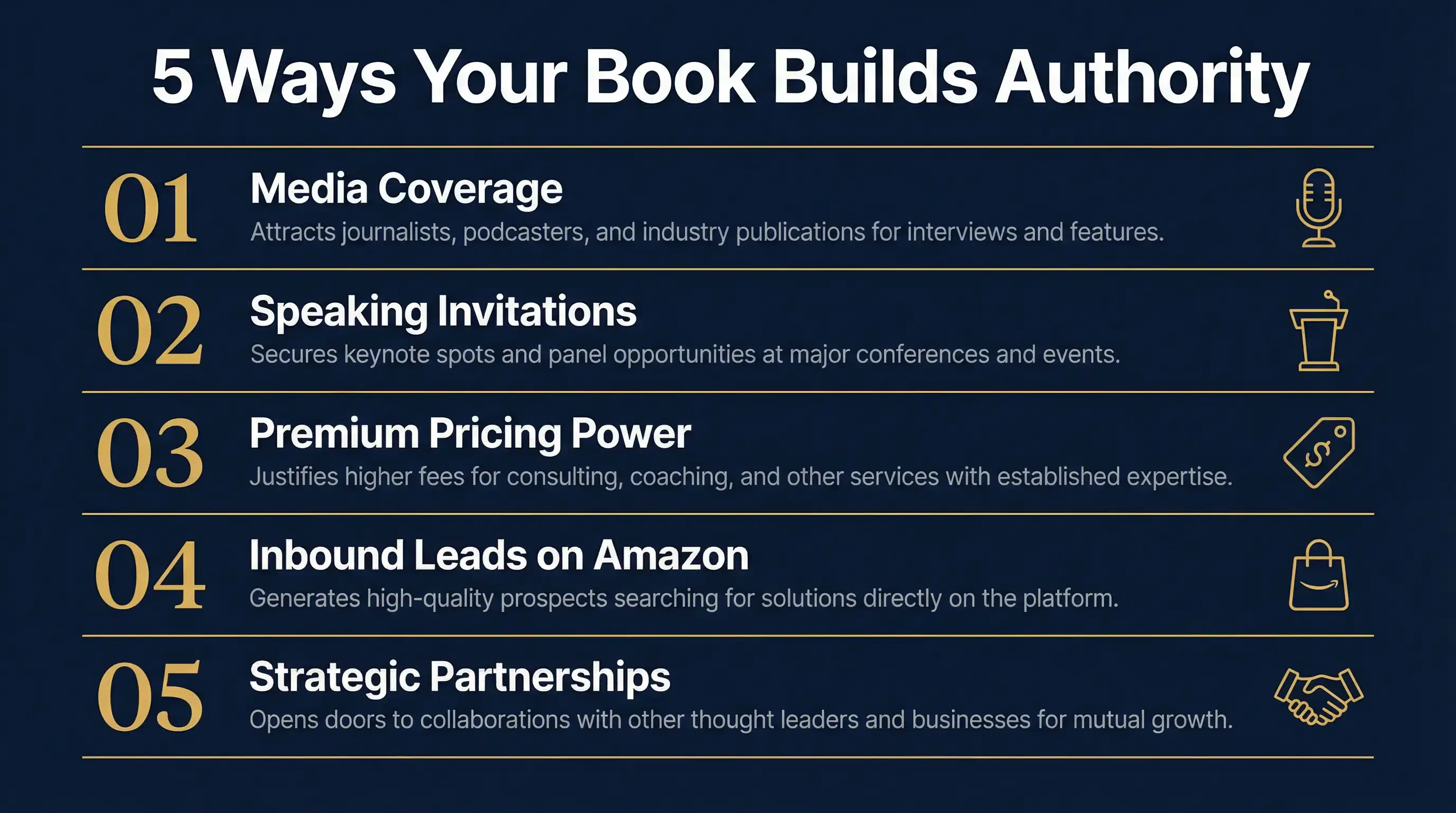
Understanding why a book matters is one thing. Seeing the specific, tangible outcomes it produces is what tends to move professionals from considering to committing. Here are the five most direct ways that publishing a nonfiction book grows your professional reputation, often faster than people expect.
1. Media Coverage - Journalists Quote Authors, Not Consultants
Journalists and media producers are under constant pressure to find credible sources. When they are writing about a topic, they do not type a consultant's name into Google. They search for the author of a book on the subject. Having a published book on your topic puts you inside that search result. It makes you findable in a way that a website or a podcast never quite achieves.
Once you appear in one major publication, the credibility compounds. Other journalists see the feature and add you to their source lists. Podcast hosts invite you as a guest. Your name starts appearing in roundup articles, expert panels, and industry reports. The first media appearance is hard. Each one after that is easier, because you are now the person who has been covered before.
2. Speaking Invitations - Event Planners Look for Published Authors
Conference organizers and event bureaus operate on one core principle. They need speakers their audience will trust and pay to see. A published book is one of the strongest signals of that trust. It tells the event planner that you have organized your thinking, that you can articulate ideas clearly, and that the audience will recognize your name.
Many professionals who had been trying to break into speaking for years report that their first speaking invitation arrived within weeks of their book going live on Amazon. The book does not just open doors. It builds the door frame that did not exist before.
3. Premium Pricing Power - Your Book Justifies Higher Rates
When you are able to hand a prospective client your published book, or when they discover it before they reach out, the price conversation changes. You are no longer competing on hourly rate or project fee against three other consultants. You are the recognized expert who wrote the defining resource on the problem they are trying to solve. That positioning supports premium pricing in a way that no amount of experience or testimonials alone can.
Many authors of professional book publishing report that they increased their rates after publishing, and clients accepted the increase without pushback. The book gave them permission to charge what their expertise was worth.
4. Inbound Leads - Your Book Works as a 24/7 Sales Tool on Amazon
Amazon receives hundreds of millions of visitors every month. People searching for solutions to the problem your book addresses will find it. They will read the description, review the table of contents, and often read the preview. By the time they finish that process, they are warm leads. Some will buy the book. Some will go directly to your website. Some will email you.
The best part is that this happens without any active effort on your part. While you are sleeping, traveling, or working with other clients, your book is on Amazon doing outreach for you. That is the kind of scalable visibility that best book publishing services are designed to help you achieve, and it starts generating returns the day your book goes live.
5. Strategic Partnerships - Collaborators Appear When You Have a Book
Publishing a book signals seriousness. It tells potential partners, co-authors, foreword writers, and collaborators that you are playing a long game, not just looking for a quick win. When other professionals in adjacent fields see your book, they begin to think about how their audience might benefit from your expertise. Joint webinars, cross-promotions, referral arrangements, and co-authored projects all become more likely once you are a published author.
A book creates professional gravity. It pulls the right people into your orbit because it communicates your positioning clearly and permanently.
From Manuscript to Authority - What the Publishing Process Looks Like
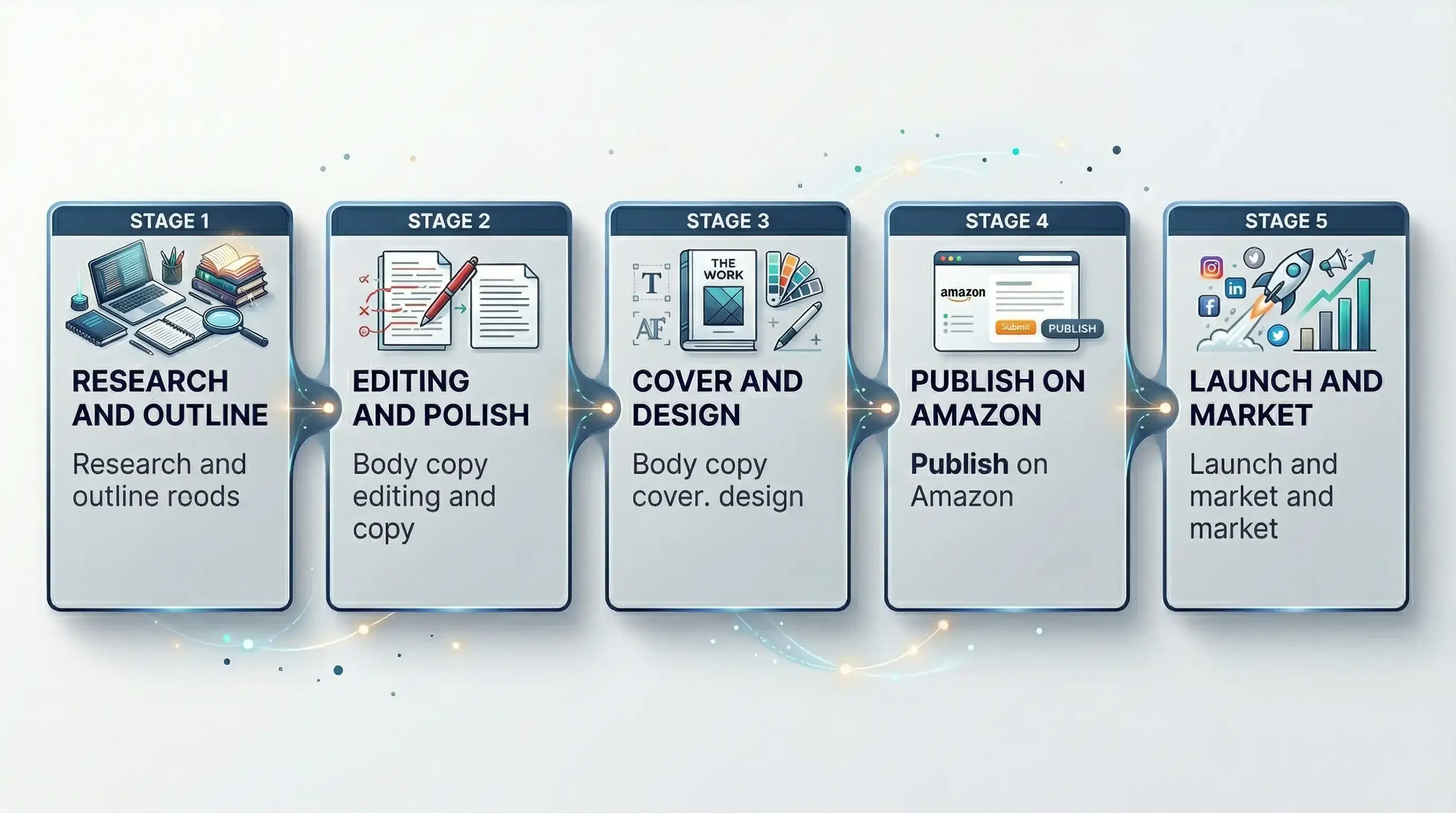
One of the most common reasons professionals delay publishing is that they do not know what the process actually involves. The uncertainty feels overwhelming, so they keep saying they will get to it eventually. Understanding each step removes that barrier and makes it clear that with the right partner, the path from idea to published book is far more manageable than most people assume.
Step 1 - Idea Research and Manuscript Planning
Before writing begins, the most valuable work is strategic. A professional publishing partner helps you identify the most compelling angle for your topic, research what already exists on Amazon in your category, and define the reader clearly enough to shape every chapter. This phase also includes competitive analysis to find the gaps that your book can fill, and a structural outline that keeps the writing process focused and efficient.
Many professionals start with a broad idea and leave this phase with a sharper, more marketable concept than they started with. The clarity that comes from proper pre-publication research is often the difference between a book that sells and one that sits.
Step 2 - Professional Editing and Proofreading
Your credibility lives or dies in the quality of your writing. One typo on page three is not just a typo. It is a signal to the reader that the rest of the content may not have been produced with care. Professional editing at both the developmental and line level ensures that your ideas are structured logically, your arguments land clearly, and your writing reflects the standard of expertise you are claiming to have.
This is the step that separates a published book from a professional asset. Anyone can upload a document to Amazon. Not everyone can produce a book that earns five-star reviews and gets recommended by readers to their networks.
Step 3 - Book Cover Design That Signals Credibility
On Amazon, your cover is your first impression. Before a reader reads your title, they see your design. Covers that look self-made, outdated, or mismatched to the genre of nonfiction you are writing will lose readers before they even click. A professionally designed cover that follows the visual conventions of your category tells readers immediately that the content inside is worth their time and money.
The best Amazon book publishing services include cover design as a core part of the process, not an afterthought. A good designer does not just make the cover look attractive. They make it look authoritative, genre-appropriate, and memorable at thumbnail size.
Step 4 - Publishing and Distribution
Amazon KDP is the starting point for most professional book publishing company clients, and for good reason. It offers global reach, print-on-demand availability, and the most powerful retail search engine for books in the world. Combined with IngramSpark for library and bookstore distribution, a professionally published book can reach virtually every reader channel available.
Proper setup at this stage includes keyword research for Amazon search, category selection for maximum discoverability, book description optimization, and pricing strategy. Done correctly, this work pays dividends in organic visibility for the life of the book.
Step 5 - Book Marketing and Launch Strategy
A strong launch creates momentum that Amazon's algorithm rewards with increased organic visibility. The first weeks after publication are the most important, and a coordinated launch strategy that includes pre-orders, advance review copies, social media outreach, email list activation, and promotional pricing can push a book into bestseller categories and establish the social proof that sustains long-term sales.
Ongoing marketing, through Amazon ads, newsletter features, and content repurposing, ensures that the book continues to generate leads and build authority long after the initial launch excitement fades.
Common Mistakes Professionals Make When Publishing Their First Book
Understanding how to publish a nonfiction book the right way requires knowing what the wrong way looks like. Most of the professionals who come to a publishing partner frustrated with poor results made one or more of these mistakes along the way.
Skipping Professional Editing
This is the most damaging mistake, and the most common. Professionals assume that because they write well in their day-to-day communications, their manuscript does not need a professional editor. Writing a long-form book requires a different skill set than writing emails or reports. Unedited manuscripts frequently have structural issues, unclear arguments, and inconsistent voice that readers notice immediately. Negative reviews that mention poor writing or confusing content follow an author forever and actively undermine the authority the book was meant to build.
Poor Cover Design
Readers judge books by covers on Amazon, and they do it in under a second. A cover that looks like it was assembled in a free design tool signals to potential buyers that the author either did not care enough to invest in quality or did not understand the standards of their category. Either interpretation damages credibility before the first page is read. This is one of the most visible self-publishing mistakes and also one of the easiest to avoid with the right publishing partner.
No Keyword or Category Strategy
Amazon is a search engine, and it rewards books that are optimized for discovery. Authors who choose keywords based on guesswork and select categories without competitive analysis are essentially publishing invisibly. Without the right metadata, even a well-written, professionally designed book can sit at page 50 of search results where no reader will ever find it. The technical side of Amazon nonfiction book publishing is not optional. It is the foundation of discoverability.
No Launch Plan
Amazon's algorithm interprets early sales velocity as a signal of quality and relevance. Books that launch with a coordinated burst of sales and reviews move up in rankings quickly. Books that trickle onto the platform with no marketing plan start at the bottom and have to fight their way up from a cold start. A launch without a plan is not just a missed opportunity. It is a disadvantage that can take months to overcome.
Trying to Do It All Alone
Self-publishing does not mean solo publishing. The professionals who treat their book as a DIY project and try to handle editing, design, formatting, keyword research, and marketing themselves are trying to build expertise overnight in fields that specialists spend years developing. The result is almost always a book that looks self-published in the worst sense of the word. Hiring the right book publishing service is not an expense. It is an investment in the asset you are trying to build.
How Best Selling Publisher Helps Experts Become Published Authors
Best Selling Publisher is a full-service publishing partner built specifically for professionals who have expertise worth sharing and a reputation worth protecting. The entire model is designed around one outcome: turning your knowledge into a published book that works as a professional asset, generates inbound leads, and builds lasting authority in your field.
The process begins before a single word is written. The team works with each author to refine their concept, identify the most strategic niche angle, and build a roadmap for the entire publishing journey. From there, the work includes professional ghostwriting for those who have the ideas but not the time to write, developmental and line editing, custom cover design, interior formatting, Amazon KDP setup, keyword and category optimization, and a coordinated launch strategy designed to generate early momentum.
Ownership and royalty terms are documented in each signed order so authors can review the service model before work begins. This is what a book publishing company for professionals should look like. Transparent, strategic, and completely focused on the author's success.
The team has helped cybersecurity consultants, healthcare professionals, financial advisors, executive coaches, attorneys, and entrepreneurs across dozens of industries publish books that opened doors they had been knocking on for years. Whether the goal is speaking invitations, premium clients, media coverage, or simply leaving a lasting professional legacy, the path begins with a published book and a publishing partner who knows how to position it correctly.
If you are ready to stop being the best-kept secret in your industry and start building the kind of authority that brings the right opportunities to you, hiring a book publishing service is the most direct step you can take. Best Selling Publisher is ready to help you take it.
FAQs
Not at all. Many of today's most respected professional authors never wrote their books themselves. Ghostwriting services exist precisely for experts who have deep knowledge and valuable insights but do not have the time or inclination to translate that expertise into a manuscript. Best Selling Publisher offers full ghostwriting support, meaning the team can take your ideas, interviews, and existing content and craft a complete, professional book that reads in your voice and reflects your expertise authentically.
The schedule depends on manuscript readiness, length, editing needs, design complexity, review rounds, and platform processing. A project-specific schedule and milestones should be documented in the approved order before work begins.
Platform fit depends on format, territory, distribution goals, budget, and each provider's eligibility and content rules. A publishing scope may include file preparation and setup guidance for the platforms selected by the author; each provider independently controls acceptance, placement, availability, and results.
Costs vary with manuscript readiness, editing, design, formatting, platform setup, marketing assets, and review requirements. Best Selling Publisher provides a project-specific quote that documents pricing, fees, deliverables, exclusions, and schedule before work begins.
Absolutely. Some of the most recognized voices in business, technology, health, and personal development today are self-published authors. What determines whether a book builds authority is not the publisher's name on the spine but the quality of the content, the professionalism of the production, and the strategic positioning behind the launch. A self-published book produced to a professional standard and marketed intelligently builds just as much authority as anything produced by a traditional house, and it does so while keeping the author in full control of their work and their royalties.
The books that build the strongest professional authority are those that solve a specific problem for a specific audience. A broad general title competes with thousands of similar books and rarely becomes the resource anyone reaches for. A book that addresses the exact challenge faced by a defined group of professionals, whether that is a cybersecurity playbook for healthcare startups, a financial planning guide for independent dentists, or a leadership framework for remote team managers, becomes the go-to reference in its niche. Specificity is what creates the perception of deep expertise, and deep expertise is what buyers and clients pay premium rates for.