
How Romance Books Became the World's Most Beloved Genre and What to Read First
There is a reason romance fiction outsells every other genre on the planet year after year without exception. It is not luck. It is not marketing. It is something far more fundamental than either of those things. Romance books speak directly to one of the deepest and most universal human needs, the need to love, to be loved, and to believe that love, in the end, wins.
Every culture in human history has told love stories. From ancient poetry carved into stone tablets to Shakespeare's plays to the novels topping every bestseller list right now, the love story has always been at the center of how human beings make sense of themselves and each other. Romance fiction is simply the purest, most dedicated expression of that instinct, a genre built entirely around the belief that love deserves to be celebrated, explored, and felt as deeply as possible.
In this blog, we are going to explore everything that makes romance fiction the most beloved genre in publishing, its history, its incredible variety, the books that have defined it, exactly where to start if you want to discover it for yourself, and how to publish romance book if you have a love story of your own to tell. Whether you are a lifelong romance reader or someone who has never picked up a romance novel, by the end of this, you will understand why hundreds of millions of readers around the world keep coming back to this genre again and again.
Why the World Can Never Get Enough of Romance Books
To understand why romance fiction dominates global book sales the way it does, you have to understand what it actually gives its readers - because it is giving them something that almost nothing else in their lives provides in quite the same way.
Romance novels offer emotional safety. In a world that is frequently unpredictable, frequently unkind, and frequently exhausting, a romance novel makes a promise to its reader from page one - this story will end well. The couple will find each other. Love will win. That promise is not a weakness or a simplification of reality. It is a profoundly generous gift. It says: you can invest your emotions fully in these characters, you can feel every heartbreak and every moment of longing alongside them, and you will not be punished for caring. You will be rewarded with exactly the ending you were hoping for.
This is why romance readers are so fiercely devoted to their genre. They are not reading in spite of the happy ending - they are reading because of it. In a world where happy endings are not guaranteed, there is something genuinely powerful about a story that insists on delivering one.
Romance fiction also does something else that is easy to underestimate - it takes emotional experience seriously. The internal lives of romance protagonists, the nuances of attraction and connection and conflict between two people, the way love changes a person from the inside out - these are treated in romance novels with the same depth and care that literary fiction gives to war or grief or political upheaval. Romance says that love is not a lesser subject. It is one of the most important things that happens to a human being, and it deserves to be written about with full seriousness and full skill.
How Romance Fiction Has Changed Over the Decades
Romance fiction has one of the most fascinating histories in all of publishing, and anyone considering romance book publishing services today is entering a genre with one of the richest and most resilient traditions in literary history, a story that started in drawing rooms and ballrooms, went through decades of being dismissed and underestimated, and emerged in the 21st century as the most commercially powerful category in books.
The story begins, as so many things in English literature do, with Jane Austen. When Pride and Prejudice was published in 1813, it introduced the world to Elizabeth Bennet and Mr. Darcy, arguably the most iconic romantic pairing in the history of literature. Austen understood something that the best romance writers have understood ever since: that the obstacle between two people who belong together is not just a plot device, it is the entire emotional engine of the story. The reason readers have been falling in love with Darcy for over two hundred years is not that he is perfect, it is that he and Elizabeth are wrong for each other in exactly the right ways, and watching them find their way to each other is one of the great pleasures in all of fiction.
The 20th century saw romance fiction evolve dramatically. The founding of Harlequin Books in 1949 brought romance to mass market paperback readers in an entirely new way, making it accessible and affordable to millions of women who had previously had limited access to books. Through the 1970s and 1980s, romance paperbacks became a genuine cultural phenomenon, the bestselling category at drugstores, supermarkets, and airport bookshops across the English-speaking world.
But perhaps the most significant transformation in romance fiction's history is happening right now, in the 2020s. Colleen Hoover, whose emotional, intensely honest novels like It Ends with Us and Ugly Love were discovered and championed by a generation of younger readers on TikTok, held six of the top ten places on the New York Times paperback trade fiction list at once in 2022. She did not achieve this through traditional publishing machinery. She achieved it through a community of passionate readers who found her books, felt something real, and told everyone they knew.
That community, known as BookTok, has fundamentally changed what romance fiction looks like and who reads it. It has brought younger readers into the genre in enormous numbers. It has created overnight bestsellers from books published years earlier. And it has made romance fiction more diverse, more emotionally honest, and more adventurous than it has ever been before.
The Most Popular Types of Romance Stories Right Now
One of the things that surprises people who are new to romance fiction is just how much variety lives inside this one genre. Romance is not one kind of story, it is dozens of different kinds of stories, each with its own atmosphere, its own conventions, and its own devoted readership.
Contemporary Romance is set in the modern world and deals with love as it actually exists today, in cities and small towns, through dating apps and coffee shop encounters, between people navigating careers and families and the ordinary complications of modern life. Books like The Hating Game by Sally Thorne and Beach Read by Emily Henry are perfect examples, real, relatable, funny, and deeply emotionally satisfying.
Historical Romance transports readers to the past, most commonly to Regency England, the American frontier, the Scottish Highlands, or the courts of medieval Europe, and tells love stories against a backdrop of different social rules, different dangers, and a different kind of intimacy. Diana Gabaldon's Outlander is perhaps the most beloved historical romance series ever written, combining time travel with one of fiction's great love stories in a way that has captivated readers for decades.
Paranormal Romance brings supernatural elements into the love story, vampires, werewolves, witches, fae, and everything in between. Stephenie Meyer's Twilight introduced millions of younger readers to this sub-genre, while Nalini Singh and Kresley Cole have built enormous readerships with their richly imagined paranormal romance worlds.
Dark Romance is one of the fastest growing corners of the genre, stories that explore love in morally complex, emotionally intense, sometimes deliberately uncomfortable territory. Dark romance does not follow conventional rules and it is not trying to. It is exploring the full emotional spectrum of love, obsession, and connection without apology.
Romantasy, the combination of romance and fantasy, is arguably the most talked-about development in all of publishing right now. Sarah J. Maas's A Court of Thorns and Roses series essentially created the modern romantasy phenomenon, proving that epic fantasy world-building and deeply satisfying romance are not just compatible, they are extraordinary together.
The Romance Books That Every Reader Talks About
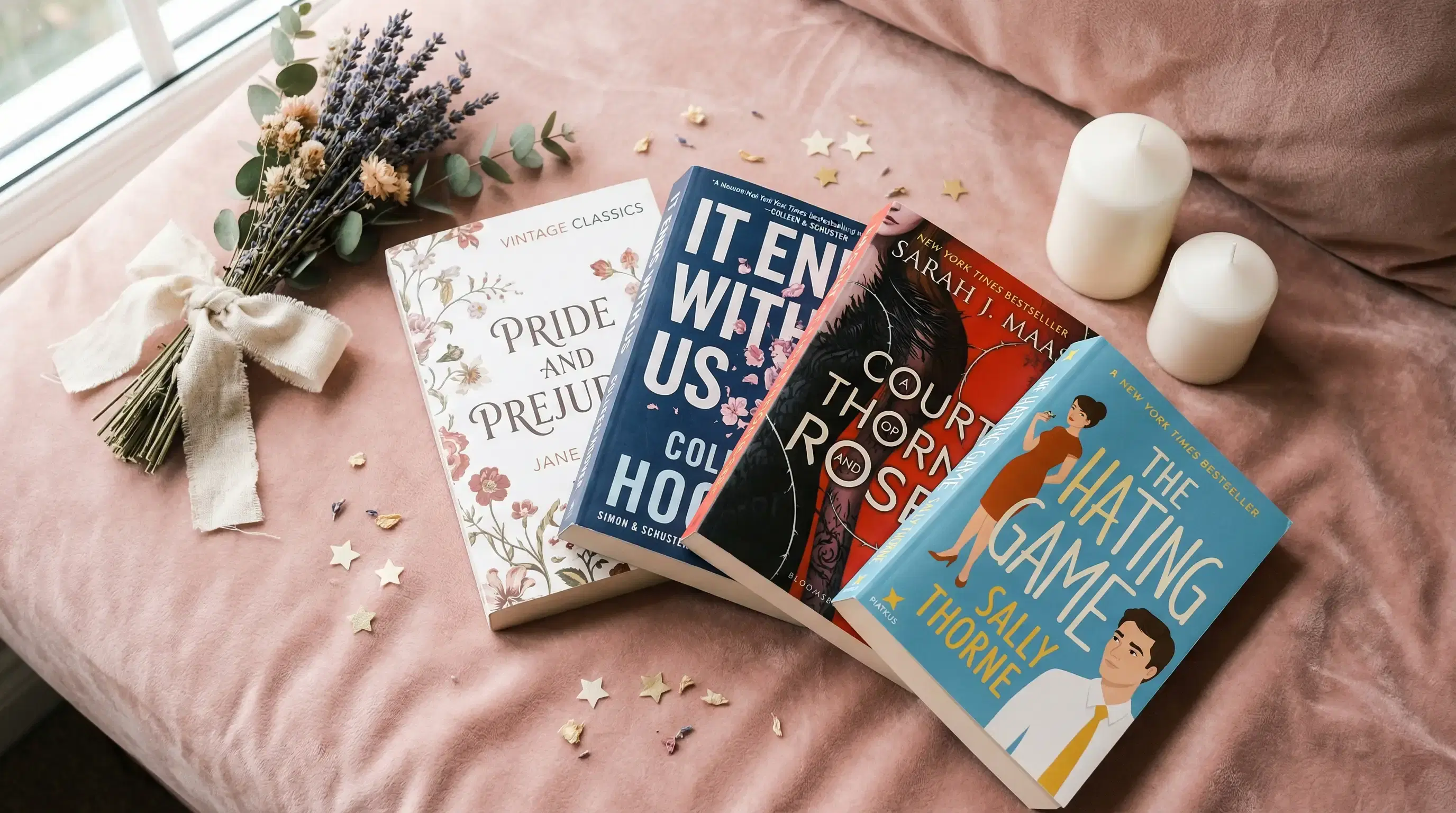
Romance fiction has produced some of the most beloved and widely read books in the history of publishing. The titles below represent the very best of what this genre can deliver, from the timeless classics that defined romance for generations to the modern novels that have introduced millions of new readers to the genre in the last few years.
Pride and Prejudice by Jane Austen The novel that started it all. Elizabeth Bennet and Mr. Darcy remain the gold standard of romantic tension, witty dialogue, and the deeply satisfying payoff of watching two people work through their pride and prejudice to find each other. Two hundred years old and still as compelling as the day it was written.
Outlander by Diana Gabaldon When Claire Randall, a married British nurse in 1945, accidentally travels back in time to 18th-century Scotland, she finds herself caught between two worlds, and between two men. Epic in scale, deeply romantic, and utterly addictive, Outlander is one of the great reading experiences of the last thirty years.
It Ends with Us by Colleen Hoover Lily has always had a rule about love, never settle. But when she falls for the charming and brilliant Ryle, she finds herself navigating something far more complicated than she ever imagined. Hoover's ability to write emotional truth without flinching is on full display here, making this one of the most genuinely affecting romance novels of the past decade.
The Hating Game by Sally Thorne Lucy and Joshua are executive assistants to co-CEOs who hate each other, and Lucy and Joshua seem to hate each other just as much. Enemies-to-lovers romance at its absolute best, with crackling wit, electric tension, and a will-they-won't-they dynamic that is almost physically painful to read in the best possible way.
Beach Read by Emily Henry Two novelists, one who writes literary fiction and one who writes romance, swap genres for the summer. What results is funny, smart, emotionally rich, and deeply romantic, with a love story that sneaks up on you before you realize what has happened. Emily Henry has become one of the defining voices of contemporary romance and this is the perfect place to start with her work.
The Notebook by Nicholas Sparks Noah writes to Allie for a year after they are separated and gets no reply. (The famous detail of 365 letters, one a day, belongs to the 2004 film rather than the 1996 novel.) Years later, their paths cross again, and what follows is one of the most emotionally devastating and ultimately beautiful love stories in modern romance fiction.
Bridgerton by Julia Quinn Set in Regency London's glittering social season, the Bridgerton series follows the eight Bridgerton siblings and their various romantic entanglements. Smart, funny, romantic, and endlessly rereadable, this is historical romance at its most irresistible.
A Court of Thorns and Roses by Sarah J. Maas When Feyre, a mortal huntress, kills a wolf in the woods, she is taken prisoner by a fae beast. What follows is a lush, dangerous, deeply romantic story set in a richly imagined fantasy world that has captivated millions of readers worldwide and essentially launched the romantasy era.
What Separates a Good Romance From an Unforgettable One
There are a lot of romance novels in the world. Hundreds of thousands of them. And while most romance readers will happily devour a good romance and enjoy it thoroughly, certain books become something more than enjoyable, they become unforgettable. They become the books that readers recommend to every person they know, the books that get reread every few years, the books that make people say "this changed how I think about love."
What separates those books from the merely good ones?
The first thing is chemistry, and not just physical attraction, although that matters. The best romance novels create a sense of two specific, fully realized human beings who are uniquely, almost cosmically right for each other. When you read their scenes together, you feel the electricity between them. You feel the pull. And because you understand them both as complete people with their own histories and fears and desires, you understand why this particular connection matters so much.
The second thing is conflict that earns its resolution. Romance readers are not naive, they know the couple will end up together. The entire emotional investment of reading a romance is in the question of how, not whether. The obstacles that keep the couple apart have to feel real and meaningful, not manufactured or trivial. When the conflict is genuine, when it comes from who the characters actually are and what they actually fear, the resolution earns its emotional payoff in a way that leaves readers genuinely moved.
The third thing is voice. The best romance writers have a distinctive voice that readers fall in love with almost as much as the characters themselves. Sally Thorne's wit. Colleen Hoover's emotional rawness. Emily Henry's warmth and intelligence. When a romance author has a voice that readers connect with deeply, they do not just read one book, they read everything that author has ever written and wait impatiently for whatever comes next.
And finally, there is emotional honesty, the willingness to go to the real, complicated, sometimes painful places that love actually takes people. The romance novels that last are not the ones that pretend love is simple. They are the ones that show how difficult and frightening and transformative it can be, and then deliver the happy ending anyway. That combination is what makes a romance unforgettable.
How Romance Became a Community Not Just a Genre
Something happened to romance fiction in the early 2020s that has no real precedent in publishing history. A generation of young readers discovered romance on TikTok, specifically on a corner of the platform that came to be known as BookTok, and what happened next changed the entire industry.
BookTok romance readers do not just read books. They make videos about them. They cry on camera over the emotional moments. They create lists of their favorite tropes. They post the exact page that broke them. They argue passionately about which fictional love interest is superior. They build communities around shared obsessions. And they have an extraordinary ability to take a book, sometimes a book that was published years ago, and turn it into an overnight bestseller simply by being passionate about it in public.
Colleen Hoover's rise is the most famous example, but it is far from the only one. Authors like Ana Huang, Emily Henry, and Ali Hazelwood have built enormous readerships almost entirely through BookTok and Bookstagram communities. The genre has become genuinely social in a way that no other genre has quite managed, and the result is a reading culture around romance fiction that is vibrant, enthusiastic, and growing faster than ever.
What this means for romance as a genre is significant. It means new voices are being discovered and celebrated faster than traditional publishing gatekeepers can keep up with. It means readers have more power than ever to determine what becomes a bestseller. And it means that if you write a romance novel that connects with readers emotionally, the community exists to carry it further than you might ever have imagined possible.
How to Find the Right Romance Book for You
Romance fiction is so varied that the challenge is not finding a good romance novel, it is finding the right romance novel for exactly who you are as a reader right now.
If you love wit, banter, and the slow burn of two people who are obviously perfect for each other refusing to admit it, start with enemies-to-lovers contemporary romance, The Hating Game by Sally Thorne or People We Meet on Vacation by Emily Henry will give you everything you need.
If you want to be transported to another time and lose yourself in a world of elaborate social rules and deeply felt passion, historical romance is your corner of the genre, start with Outlander for the epic sweep, or Bridgerton by Julia Quinn for something witty and delightful.
If you want to feel deeply, honestly, sometimes painfully, and come out the other side believing in love more than you did before, Colleen Hoover is the author most likely to give you that experience. Start with It Ends with Us and prepare to be changed.
And if you want romance combined with magic, adventure, and a fantasy world you can disappear into completely, A Court of Thorns and Roses by Sarah J. Maas is the place to start.
How Best Selling Publisher Helps Romance Authors Find Their Readers
Romance is a genre where presentation matters enormously. A romance cover needs to communicate the right tone, the right heat level, the right sub-genre, and the right emotional promise, all before a potential reader has read a single word. Get it wrong and even a brilliant romance novel can be invisible. Get it right and readers will click, read the first page, and be hooked.
At Best Selling Publisher, we understand romance fiction from the inside out. We know what contemporary romance readers expect from a cover versus what historical romance readers look for. We know how to position a romantasy on Amazon to reach both the fantasy audience and the romance audience simultaneously. We know how to write Amazon descriptions that capture the emotional promise of a romance novel and make readers feel they absolutely must read it right now.
Whether you write sweeping historical epics or sharp, witty contemporaries, dark romance or heartwarming small-town love stories, authors who come to us to publish romance book find a team with the genre expertise to help their book reach the readers who are going to love it most.
We offer complete romance book publishing services, professional editing that understands the genre's conventions and knows when to push against them, cover design that makes your book impossible to scroll past, Amazon KDP setup and keyword optimization specifically for romance, and marketing strategies that tap into the communities where romance readers actually live.
Authors work with Best Selling Publisher with their stories. We would love to help your romance find the readers who have been waiting for it.
Conclusion
Romance fiction has survived every prediction of its own decline and emerged stronger, more diverse, and more beloved than ever before. It has survived being dismissed as frivolous. It has survived the transition from pulp paperback to digital bestseller. It has survived every shift in the publishing industry and come out on top every single time. Because it is built on something that never goes out of fashion, the belief that love is worth writing about, worth reading about, and worth celebrating with everything a story has to offer.
Whether you are picking up your very first romance novel or your five hundredth, the genre has something waiting for you. A witty contemporary that makes you laugh out loud. A sweeping historical that transports you to another world. A raw, honest emotional journey that leaves you changed. A romantasy that makes you believe in magic.
And if you are a writer with a love story to tell, if there is a romance living in your imagination that deserves to exist in the world, our romance book publishing services are designed to help you take it from manuscript to the hands of the readers waiting for exactly your story. Your readers are out there. Let us help you find them.
FAQs
Romance fiction speaks to one of the most fundamental human needs, the need to love and be loved. It offers emotional safety through the promise of a satisfying ending, takes emotional experience seriously as a subject, and delivers a reading experience that is deeply engaging and genuinely moving. These qualities, combined with the enormous variety within the genre, have made it consistently the bestselling fiction category in the world.
Contemporary romance and romantasy are currently the two dominant forces in romance publishing. Contemporary romance, particularly in the emotionally raw style pioneered by authors like Colleen Hoover, has attracted enormous numbers of younger readers, while romantasy, led by authors like Sarah J. Maas, has become one of the fastest growing categories in all of publishing.
All romance novels contain a love story, but not all love stories are romance novels. Romance as a genre has two defining requirements: the central focus of the story must be the romantic relationship between two people, and the ending must be emotionally satisfying and optimistic. A love story that ends in tragedy or ambiguity may be beautiful literature, but it is not a romance novel in the genre sense.
Absolutely not. While the majority of romance readers have historically been women, the genre is read and enjoyed by people of all genders, and this is increasingly reflected in the kinds of romance novels being published. Romance featuring same-sex couples, non-binary characters, and diverse casts has grown enormously in recent years, and the readership has grown alongside it.
Romantasy is a blend of romance and fantasy, stories that combine the world-building, magic systems, and epic scope of fantasy fiction with a central romantic relationship that drives the emotional core of the narrative. Sarah J. Maas's A Court of Thorns and Roses series is the most widely cited example, and the sub-genre has become one of the most commercially powerful in all of publishing.
The most effective approach for romance authors who want to publish romance book is working with a professional publishing partner who understands the genre's specific requirements. Best Selling Publisher offers complete romance publishing services, from manuscript editing and cover design to Amazon KDP publishing, keyword optimization, and marketing. Contact our team to learn how we can help your romance reach its readers.