
How Science Fiction Books Went From Niche Genre to One of the Most Powerful in Publishing
- Home
- /
- Blogs
- /
- How Science Fiction Books Went From Niche Genre to One of the Most Powerful in Publishing
Here is something worth thinking about. Every time you make a video call, you are living inside a science fiction story someone wrote decades ago. Every time you ask an AI assistant a question, you are inhabiting a future that science fiction authors imagined long before the engineers built it. Every time you read about space exploration or self-driving cars or gene editing, you are watching science fiction become science fact in real time.
No other genre of books has this relationship with reality. No other genre has looked at the world, imagined what it could become, and then watched those imaginings come true again and again throughout history. Science fiction is not just entertainment, it is a way of thinking about the future that has genuinely shaped the world we live in today.
And yet for most of the 20th century, science fiction was considered a niche genre. Pulp magazines. Rocket ships on the cover. Stories for teenage boys who liked gadgets. The kind of books that serious literary people looked down upon with barely concealed condescension.
Today, science fiction books sit at the top of bestseller lists around the world. They are adapted into the biggest films and television series ever made. They are read by scientists, engineers, philosophers, and world leaders. And more writers than ever before are choosing to publish sci-fi books because the appetite for new voices in this genre has never been stronger. They have produced some of the most important and widely discussed books of the last hundred years.
This is the story of how that happened, and why science fiction has become one of the most powerful genres in all of publishing.
How Science Fiction Predicted the World We Live In Today
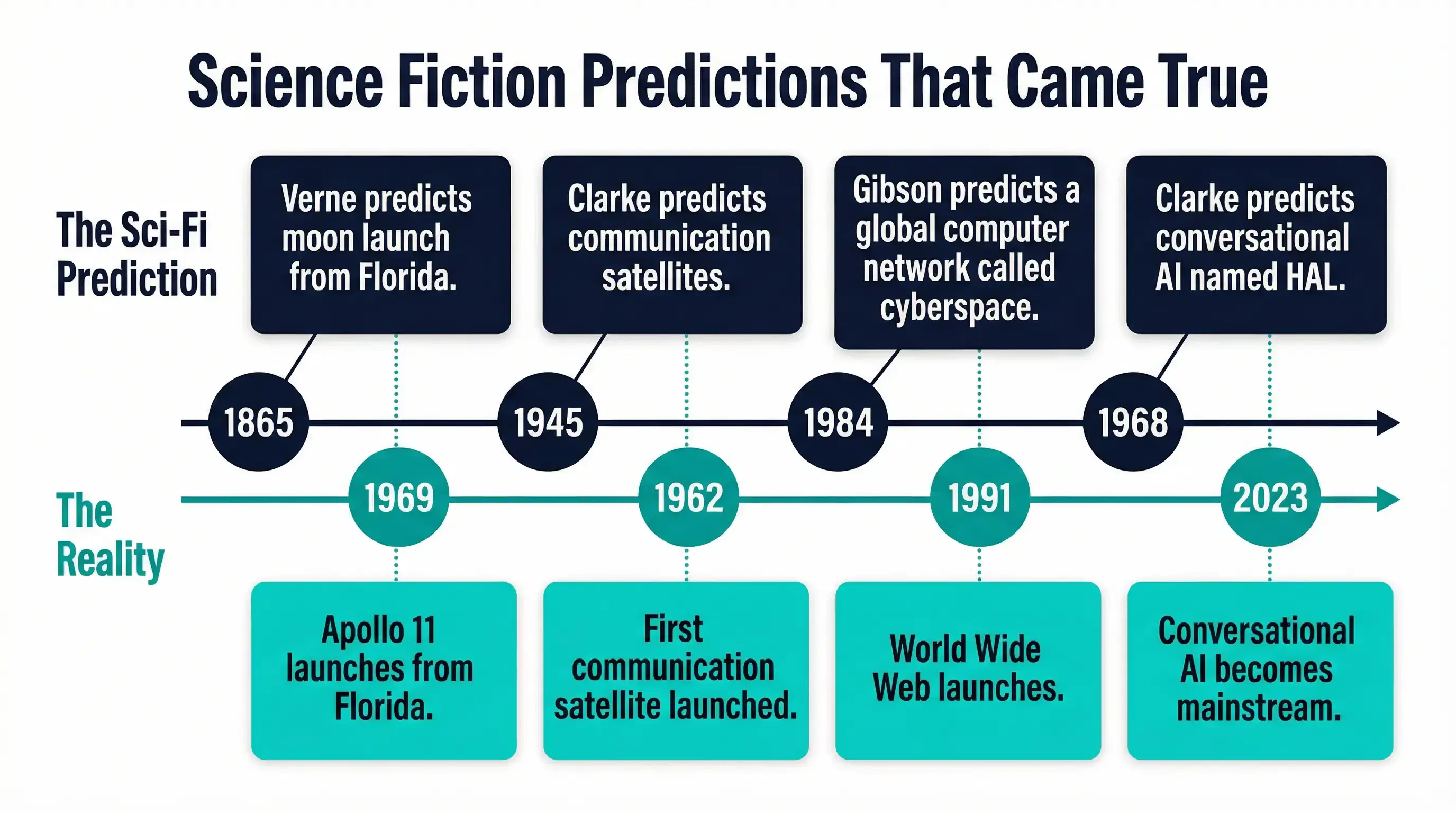
The most remarkable thing about science fiction is not that it is imaginative. Lots of genres are imaginative. The remarkable thing is that science fiction has been right, repeatedly, specifically, and sometimes astonishingly so, about what the future would actually look like.
In 1865, Jules Verne wrote From the Earth to the Moon, a story about three men launched toward the moon from Florida in a projectile roughly the size of the Apollo command module. Over a hundred years later, three astronauts launched toward the moon from Florida in a capsule that looked remarkably like what Verne had imagined. The details were so similar that NASA scientists have acknowledged the parallel.
In 1984, William Gibson's Neuromancer described a global network of interconnected computers that people could navigate through a kind of virtual reality, a world he called cyberspace. The internet as we know it did not yet exist when Gibson wrote this. He imagined it anyway, with a precision that still feels remarkable.
In 1968, Arthur C. Clarke's 2001: A Space Odyssey featured HAL 9000, an artificial intelligence that could hold a conversation, interpret human emotion, and make independent decisions. We are now living through the early stages of exactly the kind of AI that Clarke imagined, and the questions his novel raised about the relationship between human beings and intelligent machines have never been more urgent or more relevant.
George Orwell's 1984 gave the world the concepts of Big Brother, doublethink, and the memory hole, concepts that have become essential tools for understanding surveillance, propaganda, and political manipulation in the real world. Ray Bradbury's Fahrenheit 451 imagined a society where books are burned and people wear earpieces that play continuous entertainment, a vision of distraction and intellectual suppression that feels uncomfortably close to home in 2026.
This is what makes science fiction books so extraordinary and so important. They are not just stories about the future. They are warnings, blueprints, and questions about the future, asked early enough that we might actually be able to do something about the answers.
The Rise of Science Fiction from Pulp to Prestige
Science fiction did not always command the respect it receives today. For most of its history it was treated as low-brow entertainment, the kind of thing that serious readers and literary critics politely pretended not to notice.
The genre was born in the 19th century with writers like Mary Shelley, whose Frankenstein, published in 1818 when Shelley was just twenty years old, is widely considered the first true science fiction novel. It asked a question that science fiction has been asking in different forms ever since: what happens when human beings use science to create something they cannot control?
Through the early 20th century, science fiction lived primarily in pulp magazines, cheap, sensational publications with lurid covers that were consumed enthusiastically by younger readers and largely ignored by everyone else. Writers like Isaac Asimov, Robert Heinlein, and Arthur C. Clarke began publishing in these magazines during what became known as the Golden Age of Science Fiction, roughly the 1940s and 1950s, and between them they laid the intellectual foundations that the entire modern genre is built on.
Asimov's Foundation series imagined the fall of a galactic empire and the centuries-long project to preserve human knowledge. Heinlein's Stranger in a Strange Land used a Martian raised among humans to ask piercing questions about human society, religion, and sexuality. Clarke's Childhood's End tackled the arrival of extraterrestrial beings with a philosophical seriousness that no one expected from a pulp magazine writer.
The turning point came in the 1960s and 1970s, when science fiction began to attract the attention of serious literary writers and critics. Frank Herbert's Dune, published in 1965 and widely considered the greatest science fiction novel ever written, demonstrated that the genre was capable of the same depth, complexity, and richness as the greatest literary fiction. Ursula K. Le Guin's The Left Hand of Darkness used science fiction to explore gender and identity with a sophistication that left no doubt about the genre's literary potential.
By the time Star Wars arrived in 1977 and The Hunger Games in 2008, science fiction had completed its journey from pulp outsider to global cultural force. Today it sits alongside literary fiction, thriller, and romance as one of the dominant categories in world publishing, and it shows no signs of slowing down.
The Different Worlds Science Fiction Takes You To
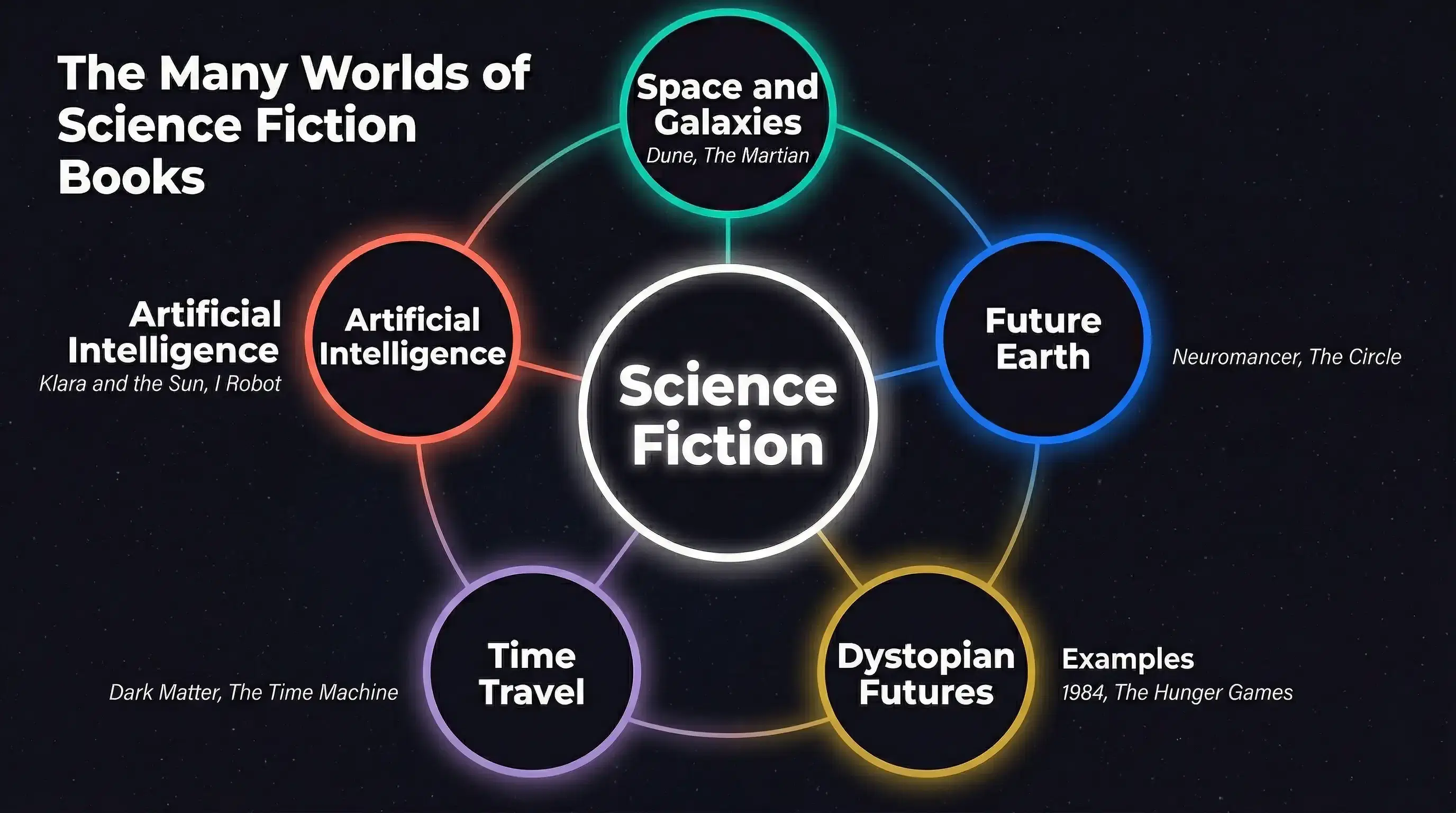
One of the great pleasures of science fiction books is the sheer variety of the worlds they contain. Science fiction is not one kind of story, it is a vast universe of different kinds of stories, each exploring a different set of ideas and taking the reader somewhere completely different.
Stories set in space are perhaps what most people imagine when they think of science fiction, galaxies, alien civilizations, interstellar travel, the infinite darkness between stars. Frank Herbert's Dune is the supreme example, an entire civilization built around a desert planet and the precious spice that makes interstellar travel possible. More recently, Andy Weir's The Martian took space fiction somewhere new, grounding it in real science, real problem-solving, and a protagonist whose relentless optimism in the face of near-certain death became one of the most beloved reading experiences of the decade.
Stories set in the future on Earth explore what happens to human society as technology changes it, for better, for worse, or for both at once. William Gibson's Neuromancer imagined a world of corporate dystopia, neural interfaces, and artificial intelligence that feels more relevant today than when it was written in 1984. Dave Eggers's The Circle, published in 2013, is a chilling portrait of a technology company with total surveillance ambitions that reads, in 2026, less like fiction and more like journalism.
Dystopian stories imagine futures where something has gone deeply wrong, where governments have become oppressive, where freedom has been extinguished, where the worst tendencies of human nature have been given institutional form. George Orwell's 1984 and Aldous Huxley's Brave New World are the classics of this form. Suzanne Collins's The Hunger Games brought dystopian fiction to a new generation with a story about media spectacle, state violence, and the power of one person's refusal to play along.
Time travel stories use the mechanics of moving through time to explore ideas about fate, choice, regret, and what it means to live with the consequences of your decisions. Blake Crouch's Dark Matter is a brilliant recent example, a man wakes up in a life that is not his, in a version of reality where the choices he did not make have played out in full, and the result is a thriller about identity and love that also happens to be a genuinely rigorous exploration of quantum mechanics.
Stories about artificial intelligence and what it means to be human are perhaps the most urgent sub-genre in science fiction right now, in a world where AI is no longer a thought experiment but an everyday reality. Kazuo Ishiguro's Klara and the Sun, told from the perspective of an artificial friend, an AI designed to serve as companion to a human child, is one of the most emotionally devastating explorations of consciousness, love, and what it means to be alive that any genre has produced in recent years.
The Science Fiction Books That Changed How People Think
Science fiction has produced some of the most important, most widely read, and most intellectually significant books ever published. The titles below represent the very best of what science fiction books have to offer, from the foundational classics that built the genre to the modern novels that are expanding what science fiction can do and say.
Dune by Frank Herbert – Widely considered the greatest science fiction novel ever written, Dune builds an entire universe, complete with its own ecology, religion, politics, and history, around the desert planet Arrakis and the precious spice that makes interstellar travel possible. A story about power, prophecy, and the dangers of messianic thinking that becomes more relevant with every passing decade.
1984 by George Orwell – Winston Smith lives in a totalitarian future where Big Brother watches everything and the Party controls even the content of people's thoughts. Published in 1949 as a warning about the direction of 20th century politics, 1984 has only grown in importance since. The concepts Orwell invented-doublethink, thoughtcrime, the memory hole-have become essential tools for understanding the modern world.
The Martian by Andy Weir – Stranded alone on Mars after his crew evacuates, astronaut Mark Watney has to use everything he knows about science to survive until rescue is possible. Funny, tense, scientifically meticulous, and deeply human, this is science fiction that shows what the genre can do when it grounds itself fully in the real world.
Klara and the Sun by Kazuo Ishiguro – Told entirely from the perspective of Klara, an Artificial Friend, a solar-powered AI designed as a companion for children, this is a novel about love, sacrifice, and what it means to be conscious. Quietly devastating and unlike anything else in science fiction, it is the book that proved the genre's capacity for the deepest literary emotion.
The Hunger Games by Suzanne Collins – In a future North America divided into a wealthy Capitol and twelve impoverished districts, sixteen-year-old Katniss Everdeen volunteers to represent her district in the Hunger Games, a televised fight to the death. A story about media, power, and resistance that became one of the defining cultural texts of the 21st century.
Dark Matter by Blake Crouch – Physicist Jason Dessen is abducted one night and wakes up in a life that is not his, a version of reality where the choices he did not make have played out in full. A quantum mechanics thriller that is also one of the most gripping and emotionally affecting science fiction novels of recent years.
Neuromancer by William Gibson – The novel that invented cyberpunk and gave the world the word “cyberspace.” Henry Case is a washed-up computer hacker hired for one last job that takes him deep into a corporate-controlled virtual reality. Published in 1984 and still more relevant today than the year it was written.
Foundation by Isaac Asimov – Mathematician Hari Seldon predicts the fall of the Galactic Empire and devises a plan to preserve human knowledge through the darkness ahead. The Foundation series is one of science fiction's great achievements, a thousand-year story about knowledge, civilization, and the question of whether the future can be shaped by human intelligence and will.
Why Science Fiction Asks the Questions Nobody Else Will
There is a reason that scientists, philosophers, ethicists, and policy makers read science fiction, not just for pleasure, but for insight. Science fiction has a unique ability to ask the questions that are too uncomfortable, too speculative, or too far-reaching for other kinds of writing to tackle directly.
When Orwell wrote 1984, he was not making a prediction. He was asking a question: what kind of world do we get if surveillance and propaganda are pushed to their logical extreme? When Mary Shelley wrote Frankenstein, she was asking: what are the responsibilities of a creator toward what they have created? When Kazuo Ishiguro wrote Klara and the Sun, he was asking: if a machine could love, would that love be less real than ours?
These are not trivial questions. They are the questions that science fiction has been asking on behalf of humanity for over two hundred years, and they matter more today than they have ever mattered before. As artificial intelligence becomes genuinely intelligent, as genetic engineering becomes genuinely possible, as the climate crisis demands genuinely radical thinking about the future of human civilization, the questions science fiction has always asked are the ones that now need real answers.
This is why science fiction books are not just entertainment. They are a form of thinking, a way of exploring possibilities and consequences at a scale and with a freedom that no other form of writing quite matches. The best science fiction books change how their readers think about the world. And in 2026, with the world changing faster than at any point in human history, that has never been more valuable.
What Sci-Fi Readers Are Loving Right Now in 2026
Science fiction has always moved with the times, and in 2026 the genre is reflecting the world around it with the kind of urgency and imagination that has always made it essential.
AI fiction is the fastest growing corner of science fiction right now, and for the most obvious of reasons. With artificial intelligence transforming every aspect of work, creativity, and daily life, readers are hungry for stories that explore what this transformation really means, not just technically, but humanly. Books that ask what we gain, what we lose, and who we become when our tools start to think for themselves.
Climate fiction, sometimes called cli-fi, is another area of explosive growth. Stories set in worlds reshaped by climate change, stories about the choices humanity makes in the face of environmental crisis, stories that imagine both the worst that could happen and the best that human ingenuity and solidarity might achieve. This is science fiction doing what it has always done best, using the future as a lens for understanding the present.
Diverse storytelling is transforming science fiction in ways that are making the genre richer, more complex, and more reflective of the full breadth of human experience. Writers from backgrounds and perspectives that were historically underrepresented in science fiction are bringing entirely new questions, new futures, and new possibilities to the genre. N.K. Jemisin's The Fifth Season, Nnedi Okorafor's Who Fears Death, and Rivers Solomon's The Deep represent a new generation of science fiction that is expanding what the genre can imagine and who it speaks to.
Where to Start If Science Fiction Is New to You
Science fiction can feel like an intimidating genre to enter because its history is so long and its range so vast. But the truth is that there are perfect entry points for every kind of reader, books that ease you into the genre with warmth and accessibility while delivering everything that makes science fiction special.
If you want something that is funny, fast, scientifically fascinating, and almost impossible to put down, start with The Martian by Andy Weir. It requires no previous science fiction reading. It has a protagonist you will root for with everything you have. And it will show you better than any other book what science fiction can feel like when it is firing on all cylinders.
If you want something more philosophical and emotionally profound, a book that will stay with you long after you finish it and change how you think about consciousness and what it means to be alive, start with Klara and the Sun by Kazuo Ishiguro. It is one of the most quietly devastating books published in the last decade and it works beautifully as an introduction to what literary science fiction can achieve.
And if you want to understand why science fiction has always mattered, why it has always been more than entertainment, read 1984 by George Orwell. It is not a comfortable read. But it is an essential one.
How Best Selling Publisher Brings Science Fiction to Life
Science fiction is a genre that demands a very specific kind of publishing expertise. A science fiction cover needs to signal the right corner of a vast genre, the cold minimalism of literary sci-fi looks completely different from the epic grandeur of space opera, which looks completely different from the neon-soaked darkness of cyberpunk. Getting it right means the difference between reaching your readers and being invisible to them.
Science fiction manuscripts also present unique challenges. World-building consistency, making sure that the rules of your imagined world hold together from chapter one to the end, requires editors who understand the genre deeply and can see the whole picture clearly. Amazon positioning for science fiction requires keyword knowledge that is genuinely genre-specific. And marketing a science fiction novel means knowing which communities, which influencers, and which platforms reach the readers who are most likely to love your specific kind of story.
At Best Selling Publisher, we have the expertise to handle all of it. Authors who come to us to publish sci-fi books find a team that understands science fiction from the inside, the genre's history, its conventions, its reader expectations, and exactly where your book fits within the vast universe of stories that science fiction contains.
We offer complete science fiction book publishing services, professional editing that preserves your world-building vision while sharpening every sentence, cover design that places your book exactly where it belongs in the genre, Amazon KDP setup and optimization that puts your story in front of the readers looking for precisely what you have written, and marketing strategies built around the communities where science fiction readers actually spend their time.
Authors work with Best Selling Publisher with their stories. We would love to help your vision of the future find the readers who have been waiting for it.
Conclusion
Science fiction began as pulp magazine stories that nobody took seriously. It became the genre that predicted the internet, artificial intelligence, space travel, and climate change. It produced some of the most important books ever written. It built a global community of readers who understand, better than most, that the future is not fixed, that it can be imagined, discussed, debated, and ultimately shaped by human choices.
In 2026, with the world changing faster than at any point in human history, science fiction is more necessary than ever. The questions it asks, about technology and humanity, about power and freedom, about what we are building and what it will cost us, are the questions that matter most right now.
And if you are a writer with a vision of the future, a world you have imagined, a question you cannot stop asking, our science fiction book publishing services are here to help you bring that story to life. The future needs your story. Let us help you tell it.
FAQs
Science fiction grounds its speculative elements in science and technology - even when the science is imaginary, it follows internal rules that feel plausible within the world of the story. Fantasy uses magic, supernatural forces, and elements that operate outside any scientific framework. The simplest shorthand: science fiction asks "what if technology made this possible?" and fantasy asks "what if magic made this possible?"
The Martian by Andy Weir is the most reliable entry point for readers who are new to science fiction - it is funny, fast, and requires no previous genre knowledge. Klara and the Sun by Kazuo Ishiguro is perfect for literary fiction readers who want something more emotionally profound. And The Hunger Games by Suzanne Collins is ideal for anyone who wants science fiction with a powerful human story at its core.
Science fiction has always thrived when the world is changing rapidly, because rapid change generates exactly the questions the genre is built to explore. In 2026, with artificial intelligence reshaping work and creativity, climate change demanding fundamental rethinking of how human civilization operates, and technology transforming human relationships and identity, science fiction books are speaking directly to the most urgent questions of the moment.
Dystopian fiction imagines futures where society has broken down in fundamental ways - where governments are oppressive, freedoms are gone, or human nature has expressed its worst tendencies at an institutional scale. It is generally considered a sub-genre of science fiction, though it sometimes overlaps with speculative fiction more broadly. 1984, The Hunger Games, and Brave New World are among the most celebrated examples.
Science fiction novels tend to run longer than many other genres because world-building requires space. Most science fiction novels fall between 90,000 and 120,000 words, with epic space operas and multi-world stories sometimes running considerably longer. However, more recent literary science fiction - like Klara and the Sun - tends to be tighter and more compact, around 70,000 to 80,000 words.
Working with a professional publishing partner who understands the science fiction genre is the most effective route for most authors. Best Selling Publisher offers complete science fiction publishing services - from manuscript editing and world-building consistency checks to genre-specific cover design, Amazon KDP publishing, and targeted marketing. Contact our team to learn how we can help your vision of the future reach its readers.