
What Is Amazon KDP? The Complete Guide to Kindle Direct Publishing (2026)
If you have ever dreamed of publishing your own book, chances are you have come across Amazon KDP. Short for Kindle Direct Publishing, it is one of the most powerful platforms available to independent authors today. It is free to use, globally accessible, and puts your book in front of millions of readers on the world's largest online bookstore.
But what exactly is Amazon KDP? How does it work? What does it cost? And what does it actually take for a self-published book to sell?
Grab a pen (or open your notes app), because we’re about to break down Amazon KDP from A to Z, and show you how Best Selling Publisher can make your publishing journey easier, smoother, and more profitable.
What Is Amazon KDP?
Definition of Kindle Direct Publishing
Kindle Direct Publishing is Amazon's self-publishing platform. It allows any author to publish eBooks, paperbacks, and hardcovers directly to Amazon without needing a literary agent, a publishing deal, or a large upfront investment. Once published, your book is listed on Amazon's global marketplace and available to readers in over 100 countries.
KDP launched in 2007 alongside the first Kindle device and has since become the dominant platform for independent authors worldwide. Millions of titles have been published through it, covering every genre imaginable.
Why Amazon KDP Is Popular Among Authors
The appeal of KDP publishing comes down to a few things that traditional publishing simply cannot offer. There are no gatekeepers. You do not need to wait months for a rejection letter. You keep significantly higher royalties. And you retain full control over your book, your pricing, and your publishing timeline.
For authors who have a finished manuscript and want to reach readers without the delays and compromises of the traditional route, self-publishing on Amazon through KDP is the most direct path available.
What You Can Publish on KDP (eBooks, Paperbacks, Hardcovers)
Amazon book publishing through KDP supports three formats:
eBooks are the most popular format on KDP. They are delivered directly to Kindle devices and the Kindle app, with no printing or shipping involved.
Paperbacks are printed on demand, meaning Amazon prints a copy each time someone orders. You do not pay for inventory or storage.
Hardcovers became available through KDP more recently and follow the same print-on-demand model as paperbacks.
Each format has its own file requirements, pricing options, and royalty structure, all of which we will cover below.
How Does Amazon KDP Work?

Amazon KDP follows a straightforward upload and publish process. Here is what each step actually involves.
Step 1: Create Your KDP Account
Go to kdp.amazon.com and sign in with your existing Amazon account or create a new one. You will need to provide tax information and set up a payment method before you can publish. This is a one-time setup that takes roughly 10 to 15 minutes.
Step 2: Format Your Manuscript
KDP manuscript formatting is where most authors run into problems. Amazon has specific requirements for eBook and print files, and getting them wrong leads to rejected uploads, poor reading experiences, and negative reviews.
For eBooks, Amazon accepts DOC and DOCX, EPUB, KPF, HTML, RTF and TXT, plus PDF for fixed-layout titles. For print interiors it accepts the same word-processor formats as well as PDF, and a print-ready PDF is only required when your book uses bleed - but whatever you upload needs correct margins and trim size. Formatting errors that look minor on a screen can become serious issues in a printed book.
Step 3: Design a Professional Book Cover
Your cover is the single most important visual asset your book has. Amazon KDP book cover design requirements vary by format and trim size, but the principle is the same across all of them: a weak cover costs you sales before a single reader reads your description.
Amazon provides a basic Cover Creator tool, but it produces generic results. For a book that competes in a real marketplace, a professionally designed cover built for your genre is not optional.
Step 4: Upload Your Book Files
Once your manuscript and cover are ready, you upload them through the KDP dashboard. Amazon runs an automated review of your files and will flag any technical issues before the book goes live. KDP allows up to 3 business days for this, and up to 10 business days for low-content books such as journals and notebooks. Expect a further 72 hours or so after going live before the title shows up reliably in search results.
Step 5: Set Pricing and Royalties
You set your book's list price and choose your royalty structure. We cover the royalty options in detail in the next section. Pricing strategy matters more than most authors realize, and the right price point depends on your genre, your goals, and where you are in your publishing journey.
Step 6: Publish and Go Live
Once Amazon approves your files, your book goes live on the marketplace. For most books, this happens within 72 hours of submission. From that point, your book is available to readers globally through Amazon's website and Kindle apps.
Key Benefits of Amazon KDP for Authors
Publish Without a Traditional Publisher
The traditional publishing route requires a literary agent, a book deal, and typically 18 months or more between manuscript and bookstore shelf. Self-publishing on Amazon eliminates all of that. You control the timeline, the content, and every decision about how your book is presented to readers.
Global Distribution on Amazon
When you publish through Amazon book publishing, your book is immediately available on Amazon's marketplaces across the US, UK, Canada, Australia, Germany, Japan, and more. For print books, Amazon handles fulfillment in each market. For eBooks, delivery is instant.
High Royalty Potential (Up to 70%)
Traditional publishers typically pay authors between 8% and 15% in royalties. KDP offers up to 70% on eBook sales, and on print books 60% of list price minus printing costs at $9.99 and above or 50% below that. For authors who build a consistent readership, this difference in royalties is significant.
Full Ownership and Control
Rights and ownership self-publishing through KDP means you retain full intellectual property rights to your work. You set the price, update the content whenever you choose, run promotions on your own schedule, and can pull your book from the platform at any time. A traditional publisher cannot offer that.
Amazon KDP Royalties Explained (How Much Can You Earn?)
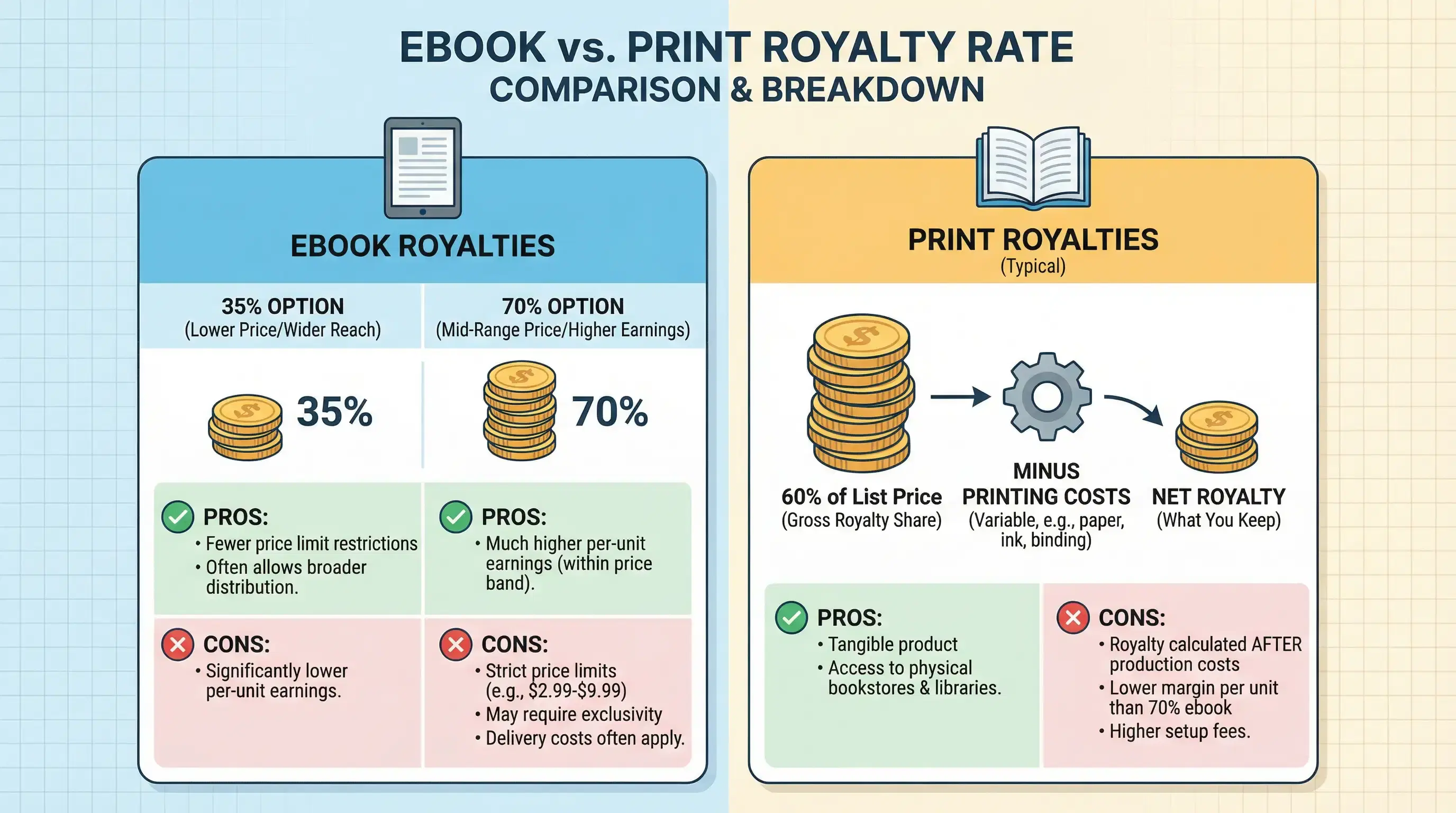
35% vs 70% Royalty Option
For eBooks, KDP offers two royalty tiers:
35% royalty: Available up to $200 with no delivery fee and no territory restrictions, but the earning rate is significantly lower. The minimum price is set by file size on Amazon.com: $0.99 under 3MB, $1.99 from 3MB to under 10MB, and $2.99 at 10MB or more, so a large illustrated file cannot be listed at $0.99.
70% royalty: Available for books priced between $2.99 and $12.99 in eligible territories. KDP raised that upper limit from $9.99 effective 7 July 2026, so older guides quoting a $9.99 ceiling are out of date (KDP eBook list price requirements, checked 14 August 2026). A small delivery fee is deducted based on file size, but the net royalty is substantially higher for most books.
For most authors targeting the $2.99 to $12.99 range, the 70% option is the better choice.Pricing below $2.99 only makes strategic sense in specific circumstances, such as a loss-leader first book in a series.
Print Book Royalty Model
Print books through KDP operate differently. On Amazon marketplaces you earn 60% of your list price minus the printing cost for books listed at $9.99 or more, and 50% minus printing cost below that threshold. Amazon cut the sub-$9.99 rate from 60% to 50% on 10 June 2025, so older guides quoting a flat 60% overstate the return on cheaper paperbacks. Copies sold through Expanded Distribution earn 40% minus printing cost (KDP paperback royalty, checked 14 August 2026). Printing cost varies by page count, trim size, and whether the book is black and white or color. A 200-page black-and-white paperback has a different printing cost than a 32-page full-color children's book.
Understanding your print costs before you set your price is essential.Setting a price too low can result in near-zero or negative royalties on print editions.
Pricing Strategy for Maximum Profit
The right price depends on your genre, your audience, and whether you are building a backlist or launching a standalone title.Genre fiction eBooks typically perform best in the $2.99 to $4.99 range. Non-fiction commands higher prices. Children's books follow different conventions entirely.
Price also affects your Amazon category rankings and how the algorithm positions your book relative to competitors.Getting it right matters.
Common Mistakes Authors Make on Amazon KDP
Poor Keyword Research
Your book's keywords are what determine whether Amazon shows it to the right readers. Most authors either guess at keywords, copy competitors without understanding the data behind their choices, or pick terms that are too broad to rank for. Poor keyword research is one of the most common reasons a technically well-written book generates almost no organic sales.
Weak Book Descriptions
Your book description is sales copy. It needs to hook the reader, communicate the core promise of the book, and end with a reason to buy now. Most self-published book descriptions read like plot summaries or jacket copy written in a hurry. A weak description wastes every click your cover earns.
Low-Quality Cover Design
A cover that looks self-published tells readers exactly that. Genre readers in particular are sensitive to whether a cover matches the visual conventions of the category they read. A thriller with the wrong typography, a romance with an off-tone color palette, or a children's book with flat, uninspiring art will underperform regardless of how good the writing is.
No Marketing Strategy
Publishing a book on KDP without a marketing plan is the equivalent of opening a store with no sign outside. Amazon's algorithm rewards momentum. If your book does not generate early sales and reviews, it does not rank, and if it does not rank, it does not get discovered. Launching without a strategy means starting from zero and staying there.
Choosing the Wrong Categories
Amazon allows you to select categories for your book, and the right categories can mean the difference between a bestseller badge and complete invisibility. Many authors choose the most obvious high-level categories, which are also the most competitive. Selecting specific subcategories where your book can realistically rank is a smarter approach.
How to Succeed on Amazon KDP (Pro Tips)
Keyword Optimization for Amazon SEO
Amazon is a search engine with a buying intent attached. Readers searching for their next book type in specific terms, and your keywords need to match what real buyers are actually searching for. This means researching actual search volume, competition level, and relevance to your specific book, not just picking words that seem related to your genre.
Category Targeting for Bestseller Rankings
Bestseller badges on Amazon are category-specific. A book that cannot crack the top 100 in a broad category might rank in the top 10 of a specific subcategory with significantly lower competition. Choosing your categories strategically, rather than defaulting to the most obvious options, is one of the fastest ways to improve visibility.
Getting Reviews and Social Proof
Amazon's algorithm treats reviews as a signal of quality and demand. A book with 50 reviews consistently outperforms an identical book with 5 reviews, all else being equal. Building a review strategy before launch, through advance reader copies, reader lists, and post-purchase follow-up, is not optional if you want your book to rank and convert.
Launch Strategy That Drives Sales
A strong launch generates the sales velocity that tells Amazon's algorithm your book deserves visibility. This means coordinating your email list, social media, promotional sites, and any paid advertising to create concentrated demand in the first week of publication. How to rank as bestseller on KDP comes down almost entirely to what happens in those first seven days.
Building an Author Brand
Promote yourself as an author beyond individual book launches. Authors with a consistent brand, a recognizable name in their genre, and an audience that follows them from book to book have a significant structural advantage over those who treat each title as a standalone product. Your author page, your social media presence, and your email list are long-term assets that pay dividends across your entire publishing career.
Amazon KDP vs Traditional Publishing
Control and Ownership
With KDP, you own everything. Your manuscript, your cover, your pricing, your publishing schedule. With traditional publishing, you sign over rights, often for many years, and the publisher makes decisions about cover, title, pricing, and sometimes even content. For authors who want to maintain creative and commercial control, self-publishing on Amazon is the clearer choice.
Cost Comparison
KDP itself is free to use. The real costs in self-publishing are the services you invest in: editing, cover design, formatting, and marketing. A professionally produced self-published book typically costs between $1,500 and $5,000 to bring to market, depending on the services used.
Traditional publishing costs the author nothing upfront, but the publisher recoups their investment through lower royalty rates. Whether you come out ahead financially depends on how well your book sells.
Time to Publish
A traditional publishing deal from manuscript acceptance to bookstore shelf takes 12 to 24 months on average, sometimes longer. KDP publishing can take a book from finished manuscript to live listing in a matter of days. For authors with time-sensitive topics or those who simply want to reach readers without a multi-year wait, this difference matters.
Profit Potential
A traditionally published author earning 10% to 15% royalties on a book priced at $25 earns $2.50 to $3.75 per copy. A KDP author earning 70% on a $4.99 eBook earns roughly $3.49 per copy, and they sell it at a price point far more accessible to impulse buyers. At scale, the math often favors self-publishing significantly.
Is Amazon KDP Worth It in 2026?
Pros of Self-Publishing
The advantages are real and significant. You keep more of your earnings. You publish on your timeline. You retain full rights. You can update your book anytime. You have access to Amazon's global marketplace from day one. And if one book does not perform, you learn from it and publish the next one without having to convince a gatekeeper to give you another chance.
Cons and Challenges
The challenges are equally real. The marketplace is saturated. Standing out requires genuine investment in quality, both in the writing and in the production. Marketing is entirely your responsibility. And without a plan, even a well-written, well-produced book can generate almost no sales.
The authors who struggle on KDP are usually those who underestimate the marketing side of self-publishing. The platform gives you access. What you do with that access is up to you.
Who Should Use KDP
KDP is worth it for authors who are willing to treat their book as a product that needs positioning, optimization, and promotion. It is the right platform for fiction authors building a series, non-fiction authors with an established niche, children's book authors who want global distribution, and anyone who has a finished manuscript and wants to reach readers without waiting years for traditional publishing to respond.
Why Most Self-Published Books Fail (And How to Avoid It)
Lack of Visibility
With millions of titles on Amazon, discoverability is the central challenge of self-publishing. A book that is not optimized for Amazon search simply does not get found. No clicks means no sales. Most self-published books fail not because they are bad but because nobody ever sees them.
No Marketing Plan
Publishing day is not the end of the work. It is the beginning of a marketing effort that needs to continue for as long as you want the book to sell. Authors who treat the upload as the finish line consistently underperform those who have a 90-day post-launch plan in place before they hit publish.
Poor Positioning
Positioning means knowing exactly who your book is for, where it fits in the market, and how to communicate its value in the space of a cover, a title, and a two-paragraph description. A book that tries to appeal to everyone ends up appealing to no one. Specific positioning, matched to a specific reader, consistently outperforms books that play it safe and stay vague.
Best Selling Publisher Support for an Amazon KDP Project
Full-Service Publishing Support
Best Selling Publisher can coordinate the editing, formatting, cover preparation, metadata review, and KDP setup tasks listed in an approved scope. Amazon controls platform acceptance, while sales and rankings depend on reader response and are not guaranteed.
Amazon SEO and Keyword Optimization
Our team researches the keywords your ideal readers are actually searching for and implements them correctly across your title, subtitle, backend search terms, and book description. Self-publishing platform Amazon rewards books that match reader intent with organic placement. We make sure yours does.
Professional Cover and Formatting
We design covers built for your specific genre, sized correctly for every platform, and tested for thumbnail visibility where most buying decisions are made. Our KDP manuscript formatting ensures your book passes Amazon's review process cleanly and reads well on every device, from a Kindle Paperwhite to a phone screen to a full-color tablet.
Book Launch and Marketing Strategy
We build and execute launch plans that generate the early sales velocity Amazon's algorithm responds to. From pre-launch reader outreach to launch-week advertising, our team coordinates every element of your release so your book enters the market with momentum rather than silence.
FAQs
Amazon KDP stands for Kindle Direct Publishing. It is a free self-publishing platform that allows authors to publish eBooks, paperbacks, and hardcovers directly to Amazon's marketplace. You upload your manuscript and cover, set your price, and Amazon distributes your book to readers globally.
There is no fixed answer. Authors on KDP earn anywhere from a few dollars per month to six-figure annual incomes, depending on the number of titles they have, how well those titles are optimized, and how actively they market their work. The 70% royalty tier means a $4.99 eBook generates roughly $3.49 per sale, so volume and visibility are the key variables.
For eBooks, no. Amazon assigns its own identifier called an ASIN. For print books, KDP provides a free ISBN if you do not have one, though this ISBN is Amazon-specific. If you want wider print distribution outside of Amazon, you may want to purchase your own ISBN through your country's official ISBN agency.
KDP publishing typically goes live within 24 to 72 hours of submission, once Amazon has reviewed your files. Price changes and content updates on an already-live book usually take effect within 12 to 24 hours.
Technically, yes. The platform itself is straightforward. But publishing a book that actually sells requires knowledge of formatting, cover design, keyword research, category selection, and marketing strategy. Authors who invest in professional help from the start consistently outperform those who try to figure everything out through trial and error.