
Do Authors Really Need a Website? Here's How It Boosts Book Sales

Picture two authors launching identical books on the same day. Same genre, same cover quality, same Amazon listing. One has a professional website with an email list, a blog that ranks on Google, and a dedicated landing page for the launch. The other has an Amazon Author Central page and a Facebook profile.
Six months later, the gap in their results is not small. The author with a website has a direct channel to readers that no algorithm can cut off. Every new book announcement goes to an audience that chose to hear from them. Every promotional campaign has a conversion-optimized destination. Their name appears in Google search results. Their credibility is visible before a reader ever reaches their Amazon page.
The question of whether authors need a website gets asked as if it has two reasonable sides. It does not. The question worth asking is what kind of website an author needs and how to build one that actually works. Everything below answers that.
Do Authors Need a Website in 2026?
The Role of an Author Website Today
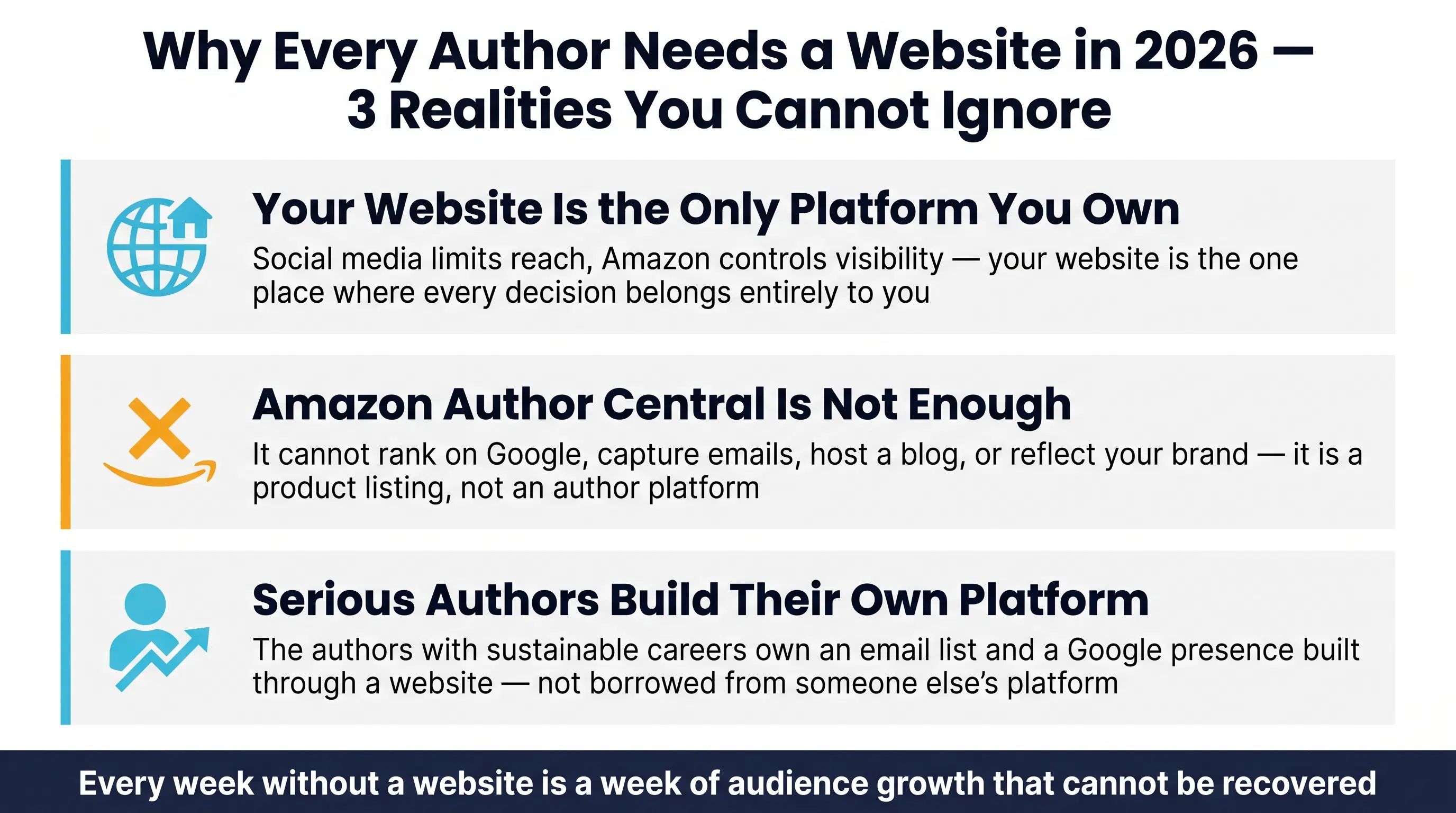
An author website in 2026 serves a fundamentally different purpose than it did a decade ago. It is no longer simply a digital business card with a list of published titles. It is the central hub of an author's publishing business, the one asset they own and control completely, and the primary mechanism through which they build a reader relationship that survives every platform change, algorithm update, and policy shift that happens in the publishing ecosystem around them.
Social media platforms limit organic reach to a fraction of followers. Amazon controls what appears in search results and can change the rules of visibility at any time. Email newsletters are valuable but dependent on a subscriber relationship that has to be built somewhere. The author platform website is where all of these channels converge and where readers land when they want to know more about an author and their work.
Myth vs Reality: "Amazon Is Enough"
The belief that an Amazon Author Central page substitutes for a professional website is one of the most commercially costly assumptions in self-publishing. Amazon Author Central gives you a public author page, and those pages are indexed and often rank for an author's own name. What it cannot do is the rest: it cannot capture email subscribers, it cannot host a blog that builds organic traffic on topics beyond your name, its customisation is limited to the fields Amazon exposes, and every link on it sends the reader to Amazon rather than to anything you own.
Authors who rely exclusively on Amazon are building their entire reader relationship on rented land. Amazon decides what readers see, when they see it, and how prominently any given title is featured. A website for authors that the author owns and controls is the only part of the publishing infrastructure where those decisions belong entirely to the author.
Why Serious Authors Build Their Own Platform
The authors who sustain long careers in self-publishing have one thing in common that is more consistent than genre, word count, publishing frequency, or advertising spend: they own their audience. They have an email list they built through their website. They have a Google presence that sends new readers to them organically. They have a platform that makes each new book launch easier than the last because the audience already exists.
Building that platform begins with a professional author website. Every other channel, social media, email, paid advertising, podcast appearances, blog contributions, feeds into it. Readers who discover an author through any channel eventually land on the website. What happens there determines whether they become permanent members of the author's audience or simply pass through.
What Is an Author Website?
Definition and Purpose
An author website is a professionally designed and hosted online presence that serves as the primary digital home for an author's publishing business. Its purpose is threefold: to establish professional credibility, to convert visitors into email subscribers and book buyers, and to create a discoverable presence in search engines that brings new readers to the author without paid advertising.
A website for authors is distinct from a personal website or a general portfolio. It is built around the author's books, reader relationships, and publishing brand. Every design and content decision should serve the goal of connecting the right readers with the author's work and giving those readers a reason to stay connected through email or social channels.
Key Components of a Professional Author Website
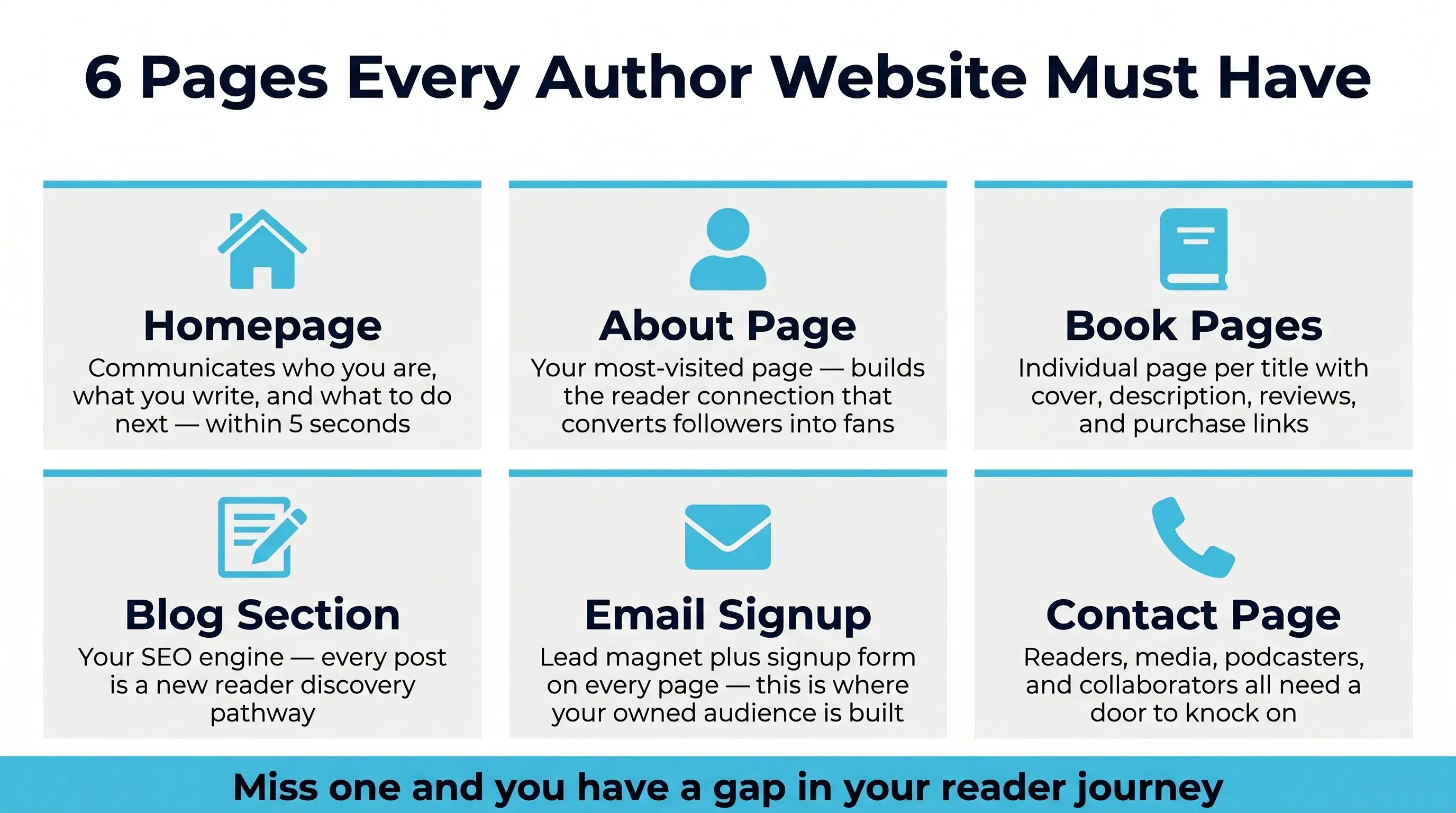
A professionally built author website has several components that work together to convert visitors and build long-term reader relationships. A homepage that communicates clearly who the author is and what they write. Individual book pages with compelling descriptions and purchase links. An about page that builds genuine connection with the reader. A blog or resources section that drives SEO traffic. An email signup mechanism with a lead magnet that gives visitors a reason to subscribe. A contact page for media, readers, and professional inquiries.
Each of these components serves a specific commercial function. The absence of any one of them creates a gap in the reader journey that costs conversions consistently over time.
Website vs Social Media: What's the Difference?
Social media and an author website are not interchangeable, and treating them as alternatives is a mistake that limits an author's long-term reach and resilience. Social media platforms are rented space. The algorithm controls who sees what. Reach for organic posts has declined on every major platform over the past several years and will continue to do so as platforms prioritize paid content. An author's follower count can be undermined overnight by an algorithm change that the author had no role in creating and no mechanism to reverse.
A website is an author owned infrastructure. The author controls every aspect of the visitor experience, the content, the design, the calls to action, and the data. Email subscribers captured through the website belong to the author's list regardless of what happens to any social platform. Search traffic generated through SEO continues arriving regardless of social algorithm changes. The website is permanent. Social media presence is contingent.
How an Author Website Boosts Book Sales
Builds Author Credibility and Trust
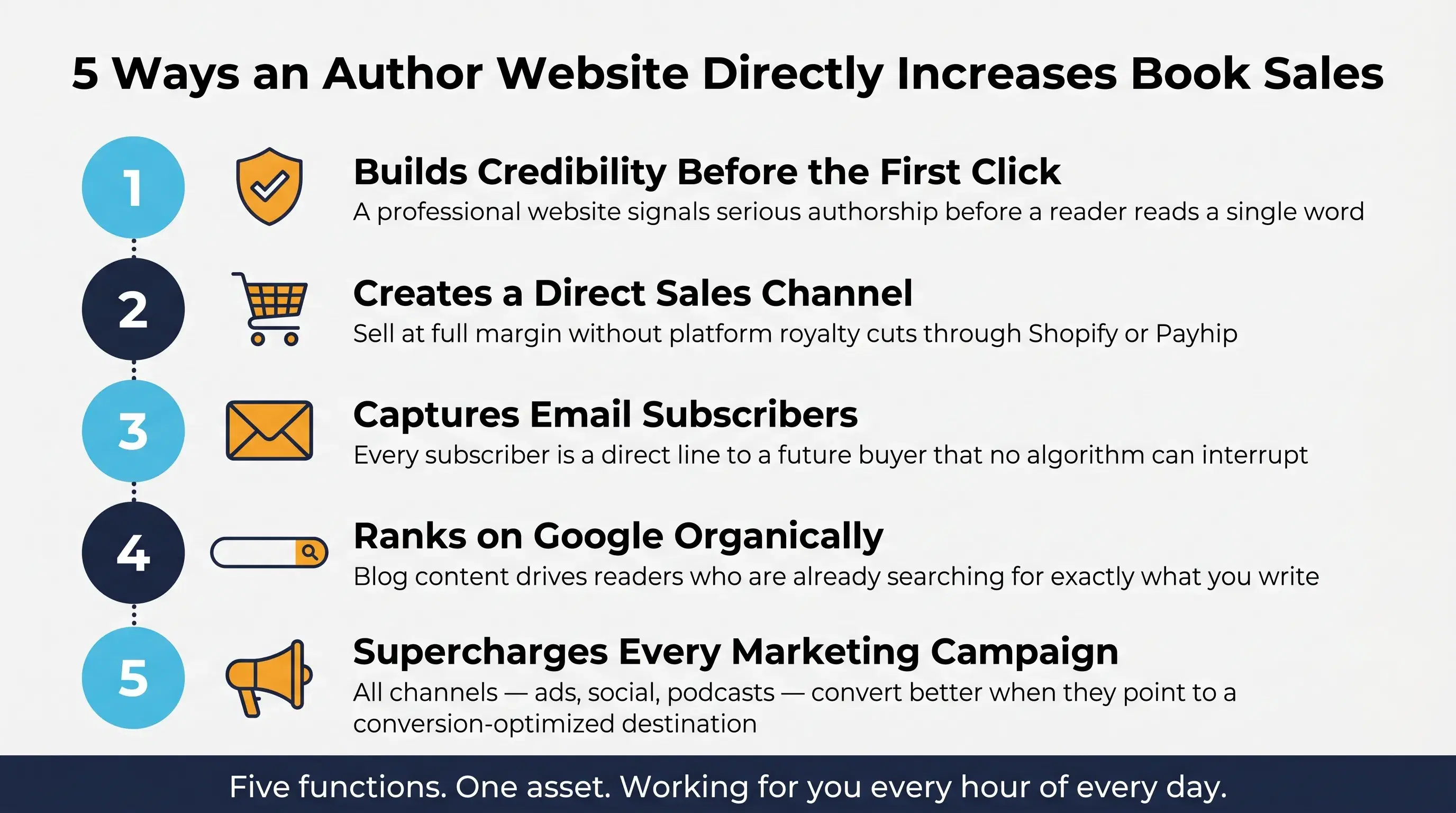
Professional presence: A well-designed author website communicates professionalism before a reader reads a single word of the author's biography. The quality of the design, the clarity of the navigation, the visual consistency with the book covers, and the care taken with the content all signal that this is an author who takes their work seriously. That signal has a direct effect on purchase decisions, particularly for readers encountering the author for the first time through a search result or a recommendation.
Authority in your niche: For non-fiction authors especially, a website that demonstrates expertise through consistently valuable blog content establishes the author as a credible voice in their subject area. Readers who arrive at the website through a search for information related to the book's topic and find genuinely useful content are far more likely to trust the book itself. Author branding services that incorporate content strategy recognize this connection between demonstrated expertise and commercial credibility.
Creates a Direct Sales Channel
Sell books without platform dependency: An author website can host a direct sales function through platforms like Shopify, Payhip, or WooCommerce, allowing authors to sell ebooks and print books directly to readers at full margin without the royalty share that Amazon or other retailers take. For authors with an established audience, direct sales through the website can represent a meaningful percentage of total revenue at significantly higher per-unit earnings.
Control over pricing and promotions: When books are sold directly through the author's website, the author controls every aspect of the transaction: the price, the promotional terms, the bundle options, the delivery format, and the customer relationship. That control is not available on retail platforms where pricing is subject to platform minimums, royalty structures are fixed, and promotional tools are limited to what the platform offers.
Captures Leads and Grows the Email List
Build a long-term audience: The most commercially valuable function of an author website is email list building. Every visitor who subscribes to the author's email list becomes part of an audience the author can reach directly, repeatedly, and without paying for advertising to do so. A list of ten thousand engaged subscribers is worth more to an author's long-term publishing career than a hundred thousand social media followers on any platform, because the email relationship is direct, personal, and entirely within the author's control.
Promote future books: An author who publishes their second book to an email list built through their website from their first book's launch has a structural advantage that does not diminish over time. Each new book benefits from the audience built by every previous one. The compounding value of an email list, where every subscriber represents a potential buyer and reviewer for every future title, is the primary reason that website design for authors should prioritize list-building mechanisms as a core feature rather than an afterthought.
Improves Discoverability Through SEO
Rank on Google for your name and topics: A well-optimized seo website for authors appears in Google search results when readers search for the author's name, their book titles, or the topics their books cover. That organic search presence works continuously without advertising spend, bringing new readers to the author's work every day from searches that have nothing to do with Amazon's ecosystem. An author with a strong Google presence captures readers at the moment they are already looking for exactly what the author writes.
Attract organic traffic: Blog content that addresses the questions, interests, and search behavior of the author's target audience drives organic traffic that converts into email subscribers and book buyers. A single well-optimized blog post can generate discovery traffic for years after it is published. SEO services for authors that incorporate keyword strategy, on-page optimization, and link-building create a compounding traffic asset that grows in value over time without requiring ongoing paid advertising.
Supports Book Marketing Campaigns
Landing pages for launches: Book launch campaigns that drive traffic to a dedicated landing page on the author's website, rather than directly to an Amazon listing, capture email subscribers as a byproduct of the launch marketing. Every paid ad that drives traffic to a website landing page with an email opt-in opportunity generates two potential outcomes: a book sale and a new subscriber. Driving the same traffic directly to Amazon generates only one.
Central hub for all promotions: Every marketing channel the author uses, social media, email, podcast appearances, book clubs, paid advertising, can direct readers to the website as a central destination where the full scope of the author's work is presented, the email list is offered, and the purchase decision is supported with every available conversion element. Book marketing services build this hub function into the website architecture from the beginning.
Author Website vs Relying Only on Publishing Platforms
Limitations of Amazon and Other Platforms
Amazon is extraordinarily good at one thing: selling books to people who are already looking for books. It is not designed to help authors build long-term reader relationships, capture leads, demonstrate expertise through content, or create a branded experience that extends beyond a product listing. The Amazon Author Central page, Goodreads author profile, and other platform-specific presences serve their platforms' goals first and the author's goals second.
Other retail platforms, Apple Books, Kobo, Barnes and Noble Press, are even more limited in the author relationship tools they offer. None of them provide email capture. None of them rank significantly in general search results for author names or book topics. None of them give the author control over the presentation of their brand or the narrative of their publishing career.
Risks of Platform Dependency
Every author who has built their entire reader relationship on a single platform has accepted a risk they may not have fully evaluated: the platform can change the rules at any time. Amazon's algorithm changes have repeatedly altered the discoverability of entire categories of books overnight. KDP Select exclusivity requirements have forced authors to choose between Amazon's ecosystem and access to other platforms. Account suspensions, listing suppression, and policy changes have affected authors who had no warning and no recourse.
An author with a strong author platform website and an owned email list is insulated from these platform risks in a way that an author without a website cannot be. The email list survives algorithm changes. The website continues ranking in Google regardless of what Amazon does. The direct sales channel continues functioning regardless of any single retailer's policy decisions.
Benefits of Owning Your Audience
Audience ownership is the defining advantage of an author website over platform dependency. When a reader subscribes to an author's email list through their website, the author has a direct communication channel with that reader that no platform intermediary can interrupt. When a reader buys a book directly through the author's website, the transaction data belongs to the author. When a reader leaves a comment on the author's blog, the relationship is direct and personal in a way that a review on a retail platform never is.
That ownership compounds over time. Each book an author publishes to an owned audience of ten thousand email subscribers launches with a structural advantage that no amount of advertising spend can fully replicate for an author starting from zero on launch day.
Key Features Every Author Website Must Have
Homepage with Clear Branding
The homepage is the first page most visitors see, and it needs to communicate three things immediately: who the author is, what they write, and what the visitor should do next. Clarity on all three of these points should be achievable within five seconds of landing on the page. A homepage that requires the visitor to explore before understanding what the site is about loses a significant percentage of visitors before they engage with any content.
Visual branding on the homepage should be consistent with the author's book covers. Readers who arrive at the website after seeing a book cover should feel that they have arrived somewhere that belongs to the same creative world. That visual consistency builds trust and reinforces the author brand.
About the Author Page
The about page is consistently among the most visited pages on any author website, and it is the page where the author's relationship with the reader is most directly established. A strong About page is not a resume or a list of credentials. It is a genuine introduction that gives the reader a sense of who the author is, why they write what they write, and why a reader who loves this genre will connect with this particular author.
The about page should include a professional author photograph, a biography written for the reader rather than the publishing industry, and a clear path to the books and the email list. Authors who treat the about page as an afterthought miss one of the highest-traffic opportunities on their website to convert a curious visitor into an engaged reader.
Book Pages with Purchase Links
Every book the author has published should have its own dedicated page on the website. Book pages should include the cover image, a compelling description written for conversion rather than simple summary, reader reviews and testimonials, and purchase links to every major retailer where the book is available. A book page that is thin on content or difficult to find through the website's navigation is a missed conversion opportunity for every visitor who arrives at the website already interested in that title.
Blog Section for SEO
A blog is the primary SEO engine of an author website. Blog posts that address topics related to the author's genre, subject matter, or reader interests create indexed pages that appear in search results for queries the author's ideal readers are running. Each post that ranks for a relevant search term brings new visitors to the website without advertising cost. Over time, a well-maintained blog can become the primary source of organic discovery for an author's work.
Blog content does not need to be published on a rigid schedule to be effective. A smaller number of longer, well-researched, genuinely useful posts will outperform a high volume of short, thin content in both SEO performance and reader engagement.
Email Signup and Lead Magnet
Every page of the author website should provide an opportunity for visitors to join the email list, and there should be a compelling reason for them to do so. A lead magnet, typically a free short story, a sample chapter, an exclusive prequel, or a relevant non-fiction resource, gives visitors something of genuine value in exchange for their email address. Without a lead magnet, the email list grows only from visitors who are already highly motivated to stay connected with the author. With one, it grows from every visitor who finds the offer compelling.
Contact Page
A professional contact page serves multiple audiences simultaneously: readers who want to reach out personally, media and podcast hosts seeking interview guests, book clubs requesting author appearances, and literary professionals with collaboration or rights inquiries. A contact page that is difficult to find or that does not invite professional inquiry misses commercial opportunities that arrive through channels the author did not create and cannot predict.
Types of Author Websites (Choose What Fits You)
Personal Brand Website
A personal brand website positions the author as the primary entity, with books as the products of that brand rather than the brand itself. This approach works well for authors building long-term careers across multiple genres or formats, where the reader's relationship is with the author as a person rather than with any particular book or series. The personal brand website emphasizes the author's voice, perspective, and creative identity as much as the catalog.
Single Book Landing Page
A single-book landing page is a focused, conversion-optimized website built around one specific title. It is typically used for a launch campaign where all marketing traffic is directed to a single destination designed to do one thing: convert visitors into buyers and subscribers. Single-book landing pages are highly effective for launch periods and can be expanded into full author websites as the catalog grows.
Multi-Book Author Platform
Authors with multiple published titles benefit from a full author platform website that showcases the complete catalog, organizes books by series or genre, and creates natural discovery pathways from one title to another. A reader who discovers one book and arrives at the website should immediately see other titles that might interest them, with purchase links and email list opportunities at every stage of that discovery.
Portfolio Website for Writers
Writers who work across multiple formats, including books, articles, essays, screenplays, or freelance content, benefit from a portfolio-style website that demonstrates the breadth and quality of their work. A portfolio website is designed as much for professional opportunities as for reader discovery, and it should be structured to serve both audiences without compromising the clarity of either message.
How to Create an Author Website (Step-by-Step Guide)
Choose a Domain Name
The author's name is the most straightforward and commercially effective domain choice for most authors. A domain like authorname.com establishes a permanent professional home that is easy to remember, easy to find, and branded correctly for an author building a long-term career. Authors whose names are not available as domains should consider variations using middle names, initials, or the addition of "author" or "books" rather than unrelated terms that obscure the professional identity.
Register the domain for multiple years immediately. Short registration periods signal low commitment to search engines and create renewal risk. Purchasing a .com domain is strongly preferred over alternative extensions for professional author websites, as .com remains the default expectation for most web users navigating directly to a URL.
Select Hosting Platform
The hosting platform is the technical infrastructure that keeps the website accessible to visitors. For most author websites, a managed WordPress hosting service from providers like WP Engine, Kinsta, or SiteGround provides the right balance of performance, security, and the technical support that authors without web development backgrounds need to maintain a professional site without constant technical troubleshooting.
Design Your Website
Website design for an author should prioritize clarity, visual consistency with the author's book covers, and a user experience that makes it effortless for visitors to find what they came for. Website design for authors that is handled professionally produces a result that converts visitors more effectively than template-based DIY solutions, particularly when the design incorporates conversion optimization principles rather than purely aesthetic choices.
Custom author website design services from designers who specialize in author platforms bring genre knowledge, publishing industry understanding, and conversion design expertise that generic web designers typically do not offer. The investment in professional design pays for itself in the improved email capture rate and reader conversion that a well-designed site produces over years of operation.
Add Content and Pages
The initial content launch of the website should include at minimum a homepage, an about page, individual pages for each published book, a blog section with at least three to five substantive posts, an email signup page with lead magnet, and a contact page. Launching with thin content in any of these sections creates a poor first impression for early visitors and delays the SEO indexing process that begins building organic traffic.
Optimize for SEO
Basic SEO optimization covers several foundational elements: title tags and meta descriptions for every page that accurately describe the page content and include relevant keywords, image alt text that describes every image for both search engine indexing and accessibility, a clean URL structure that uses descriptive words rather than numbers or codes, and a sitemap submitted to Google Search Console to accelerate indexing of all pages.
The author's name should appear prominently in the homepage title tag, the about page, and the domain itself, so that search engines clearly associate the website with the author's identity. Book titles should appear in page titles and descriptions so that searches for specific titles surface the author's own website alongside retail listings.
Launch and Maintain
A website launch without promotion is as ineffective as a book launch without marketing. Announce the website launch to your existing audience through every available channel, social media, email if you have a list, author communities, and any press contacts you have established. The initial traffic spike associated with a launch helps search engines begin indexing the site more aggressively and establishes a baseline of visitor behavior data that informs ongoing optimization.
Website maintenance is not optional. Outdated content, broken links, plugin conflicts, and security vulnerabilities all degrade the user experience and the search ranking over time. Plan for regular content additions, at least monthly blog posts, and periodic technical reviews to ensure the site continues performing at the level readers and search engines expect.
Best Platforms to Build an Author Website
WordPress
WordPress powers roughly 41 percent of all websites on the internet, a share that has drifted down from its 2022-24 peak of about 43 percent, and remains the most flexible and scalable platform for author websites. Its open-source architecture supports thousands of plugins and themes, allowing complete customization of functionality and design. The learning curve for non-technical users is steeper than closed platforms like Wix or Squarespace, but the investment in that learning curve is justified by WordPress's superior SEO capabilities, design flexibility, and the absence of the platform dependency risks that proprietary website builders carry.
For authors working with custom author website development services, WordPress is the platform that professional web developers most commonly use, ensuring the widest available talent pool for ongoing development and maintenance needs.
Wix
Wix offers a drag-and-drop website builder that makes it accessible to authors with no technical background who want to manage their own website without developer support. Its template library includes author-specific designs, and its built-in tools cover blogging, email list integration, and basic SEO. Wix is a reasonable starting point for authors who want to launch quickly with minimal technical investment, with the understanding that migrating to WordPress becomes easier and more advisable as the website grows in complexity and traffic.
Squarespace
Squarespace is known for its design quality and the visual polish of its templates. For authors whose brand is strongly visual, particularly those writing in genres where aesthetic presentation is commercially important, Squarespace produces websites that look professionally designed without requiring design expertise. Its SEO capabilities are adequate for most author website needs and have improved significantly in recent versions.
Shopify
Shopify is the appropriate platform choice for authors who intend to make direct sales a significant component of their business model. Its e-commerce infrastructure is more robust than any other platform option for handling transactions, inventory, digital delivery, and customer data. Authors who sell signed copies, merchandise, bundles, or direct digital downloads at meaningful volume will find Shopify's commerce tools better suited to those needs than the e-commerce add-ons available on other platforms.
Common Mistakes Authors Make with Their Websites
No clear purpose or call to action: A website that does not tell visitors what to do next is a missed opportunity on every page. Every page should have a primary call to action, whether that is joining the email list, purchasing a book, reading a blog post, or making contact. Visitors who arrive at a website without a clear invitation to take the next step leave without taking it.
Poor design and user experience: Design quality affects credibility in ways that visitors feel before they consciously evaluate. A website that looks dated, loads slowly, has inconsistent typography, or is difficult to navigate on a mobile device sends a signal about the author's professionalism that undermines the trust the books are trying to build. Most website traffic now comes from mobile devices - StatCounter put mobile at about 53% worldwide in mid-2026, or 54% including tablets - so a website that is not optimized for mobile viewing is awkward or unusable for the majority of potential visitors.
Ignoring SEO: A website that is not optimized for search engines does not appear in the search results that bring new readers to an author organically. SEO services for authors address the technical and content elements that determine search visibility, but even without professional support, basic SEO practices like using descriptive page titles, writing genuine meta descriptions, and publishing regular blog content have measurable effects on organic discovery.
Not building an email list: The most common reason authors do not build email lists through their websites is that they did not set up the mechanism to do so. A website without an email signup form and a compelling lead magnet is generating visitors who leave without any lasting connection. Every visitor who leaves without subscribing is a potential reader who may never find the author again. The email list is the only audience the author owns, and it must be actively built through the website from the first day the site is live.
No regular content updates: A website that has not been updated in months signals to both visitors and search engines that the author is not actively engaged with their platform. Search engines favor websites that publish fresh content regularly. Readers who visit and find that nothing has changed since their last visit have no reason to return. A blog or news section that is updated at least monthly keeps the website current and gives both search engines and returning visitors a reason to engage.
How to Use Your Website to Sell More Books
Create Landing Pages for Each Book
Individual book landing pages, distinct from the book pages in the main navigation, are conversion-optimized destinations for marketing campaigns. A landing page for a specific book launch or promotion removes all navigation and distractions from the page, focusing the visitor's attention entirely on the book and the desired action, whether that is a purchase, a pre-order, or an email opt-in in exchange for a free chapter.
Landing pages created through tools like Leadpages, Unbounce, or a custom WordPress page with appropriate design allow the author to test different page variations, measure conversion rates, and optimize the page's performance based on actual visitor behavior data rather than assumptions.
Offer Free Content or Lead Magnets
The most effective mechanism for converting website visitors into email subscribers is a lead magnet that delivers genuine value. For fiction authors, this is typically a free short story, a prequel novella, or the first few chapters of a book. For non-fiction authors, it is more commonly a checklist, a resource guide, a mini-course, or a template related to the book's subject matter. The lead magnet does not need to be long. It needs to be genuinely useful to the specific reader the author is trying to attract.
Use Email Marketing
An email list that is not actively used is not an asset. It is a dormant database that loses engagement with every week that passes without communication. Authors who send regular emails, whether weekly, biweekly, or monthly, maintain a reader relationship that converts much more effectively at launch time than a list that only hears from the author when something is for sale. Email sequences for new subscribers, launch announcements, behind-the-scenes content, and exclusive offers all contribute to a list that remains engaged and commercially valuable over time.
Run Paid Ads to Website Pages
Paid advertising that drives traffic to the author's website rather than directly to a retail platform captures email subscribers as a byproduct of the ad spend. An author running Facebook or Instagram ads to a landing page with an email opt-in generates subscriber list growth alongside direct sales, creating a long-term return on the advertising investment that extends beyond the immediate campaign window. Book marketing services that incorporate paid advertising to website pages build this list-building function into the campaign structure as a standard outcome, not an optional extra.
Author Website SEO Strategy (Get Found on Google)
Keyword Optimization
Your author website should reflect what readers are already searching for. This includes your name, your book titles, your genre, and the topics your books cover. When these keywords are naturally used across your pages, search engines can connect your website with readers who are actively looking for content like yours.
Blogging for Traffic
A blog helps your website show up in search results beyond just your name. Writing about topics related to your books attracts readers who may not know you yet but are already interested in your genre or subject. Over time, these visitors turn into subscribers and buyers.
Internal Linking Strategy
Linking your blog posts to your book pages and other key sections helps guide visitors through your website. It also improves how search engines understand your content, increasing the chances of your pages ranking higher.
Technical SEO Basics
A fast, mobile-friendly, and secure website is essential for visibility. If your website is slow or difficult to use, both readers and search engines will move on. A strong technical foundation ensures your content actually gets seen.
Is an Author Website Worth It?
Best for New Authors
New authors benefit most from building a website early, before the first book launches, because the website becomes the infrastructure through which the launch audience is assembled. An email list built through a website in the months before a first book publishes is worth substantially more to the launch outcome than the same list size built in the weeks after. A website that is live before launch also ensures that readers who discover the book through advertising or word of mouth have somewhere authoritative to land when they search the author's name.
Best for Growing Authors
Authors who have published one or more books and are building toward a sustainable publishing career find that a website becomes increasingly valuable as the catalog grows. Each new book added to the website creates cross-discovery opportunities for readers who arrive looking for one title and find others. The email list accumulated across multiple launches becomes the most reliable marketing asset for every subsequent book. The SEO value of the website accumulates over time, generating more organic traffic with each year of consistent content publishing.
ROI and Long-Term Benefits
The return on investment of an author website is difficult to calculate precisely because its benefits operate across multiple dimensions simultaneously: direct sales, email list growth, organic search discovery, credibility with media and professional contacts, and the long-term reader relationship that sustains a publishing career. What is consistent across authors who invest in professional websites is that the platform they build becomes more valuable over time, not less. Every book they publish, every email subscriber they capture, and every search ranking they earn compounds on the foundation the website provides.
| Author Stage | Primary Website Benefit | Key Priority |
|---|---|---|
| Pre-launch, first book | Build email list before launch | Email signup with lead magnet |
| Post-launch, first book | Capture organic search traffic | Blog content and SEO setup |
| Multi-book author | Cross-catalog discovery | Individual book pages, series pages |
| Established author | Audience ownership and direct sales | Email marketing, direct sales channel |
How Best Selling Publisher Builds High-Converting Author Websites
An author website that looks professional is not the same as one that performs commercially. The difference is in the structure, the conversion architecture, the SEO foundation, and the integration with the author's overall publishing strategy. At Best Selling Publisher, we build websites that serve all of those functions simultaneously.
Custom Website Design
An author website scope can document the approved brand direction, pages, book content, integrations, calls to action, responsive implementation, and content-management requirements.
Authors looking to build an author website receive a complete service from initial strategy and design through development, content setup, and launch.
SEO Optimization
An approved SEO scope can cover genre and topic research, page titles, headings, meta descriptions, sitemap submission, structured data, and an initial content plan.
Search visibility, rankings, traffic, and commercial results depend on search engines, competition, content, and market response and are not guaranteed.
Conversion-Focused Structure
The approved page plan can identify a primary user action, such as email signup, book discovery, or contact, and document the related content and calls to action. Conversion performance is not guaranteed.
Integration with Publishing Strategy
A website that operates in isolation from the author's publishing, distribution, and marketing strategy is not performing at its full potential. Our book marketing website services are built with the author's complete publishing infrastructure in mind, connecting the website to email marketing tools, advertising platforms, retail listings, and social channels so that every component of the author's marketing system works together.
Our author branding services extend this integration to the visual and narrative brand that connects the website to the books, the social presence, and the author's long-term professional identity. The website is not a standalone asset. It is the central hub of everything the author does commercially, and it is built to function that way.
Ready to Plan Your Author Website?
Every week an author operates without a professional website is a week of email subscribers not captured, organic search traffic not arriving, and reader relationships not forming. The readers who search for the author's name and find no authoritative destination, the advertising campaigns that have nowhere compelling to send traffic, and the launch audiences that had to be built from zero because no list existed before are all costs that accumulate invisibly until an author builds the infrastructure that prevents them.
Best Selling Publisher builds websites that serve the complete author publishing business, from the first book through a long career. Custom design, conversion-focused structure, SEO optimization, and integration with publishing and marketing strategy are all included in a website built to perform rather than simply to exist.
When you are ready to build the platform your publishing career deserves, we are ready to build it with you.
FAQs
Yes. The question is not whether an author website is necessary but how much commercial opportunity an author is willing to forgo without one. A website is the only platform the author owns completely, the only channel through which email subscribers can be captured at scale, and the only presence that generates organic search traffic. Authors who build and maintain a professional website consistently outperform those who rely exclusively on retail platforms, particularly as their catalog grows and the compounding benefits of an owned audience become measurable.
Yes, books can be sold through retail platforms without a website. The more accurate question is whether an author can maximize the commercial potential of their publishing career without one. Retail platforms capture sales from readers who are already looking. A website captures readers who are not yet looking, converts them into email subscribers, and builds the owned audience that makes every future book launch more effective than the last. Selling through retail platforms alone is viable. It is also leaving a significant portion of long-term revenue potential unrealized.
The cost of an author website ranges from the near-zero expense of a self-built Wix or Squarespace site to several thousand dollars for a custom-designed WordPress website with professional SEO setup. Custom author website development for a full-featured author platform typically falls in the range of a few hundred to a few thousand dollars depending on complexity, the number of pages required, and whether ongoing maintenance and SEO services are included. The relevant comparison is not the design cost but the revenue difference between a website that converts visitors effectively and one that does not.
A professional author website should include a homepage with clear branding and a primary call to action, an about page that builds genuine reader connection, individual pages for each published book with purchase links, a blog section that supports SEO and reader engagement, an email signup mechanism with a compelling lead magnet, and a contact page for reader and professional inquiries. Each of these elements serves a specific commercial function, and the absence of any one of them creates a gap in the visitor journey that costs conversions consistently over time.
A self-built author website using a platform like Wix or Squarespace can be launched in a matter of days with sufficient focused effort. A professionally designed and developed WordPress website typically takes two to six weeks from initial briefing through design, development, content population, SEO setup, and launch. Authors working with author website design services should plan their website launch at least six to eight weeks before any book launch that will use the website as a marketing destination, to allow time for initial search indexing and email list building before the launch audience is needed.