
Why Self-Published Authors Need a Website for Long-Term Book Marketing
Most self-published authors put their books on Amazon, share a few posts on social media, and wait. Sometimes it works, at first. But after the launch momentum fades, book sales slow to a trickle, and the author has no real way to reach their readers again. They don't own their audience. They can't reach them directly. They're entirely dependent on platforms that were never designed to grow author careers.
The authors who build sustainable income from their books tend to share one thing in common: they have a home base online that belongs to them. Not a Facebook page. Not an Amazon author profile. A proper website for self published authors that works for them around the clock, builds their credibility, and turns casual readers into loyal fans who buy every book they release.
This is what long-term book marketing actually looks like. And this guide breaks down exactly why a website isn't optional anymore.
The Reality of Self-Publishing in 2026
Rise of Self-Published Authors
Self-publishing has grown at a pace that would have been hard to imagine a decade ago. Platforms like Amazon KDP, IngramSpark, and Draft2Digital have lowered the barrier so significantly that nearly anyone with a manuscript can have a published book available to global readers within days. This access has created an explosion of new voices, stories, and ideas entering the market every year.
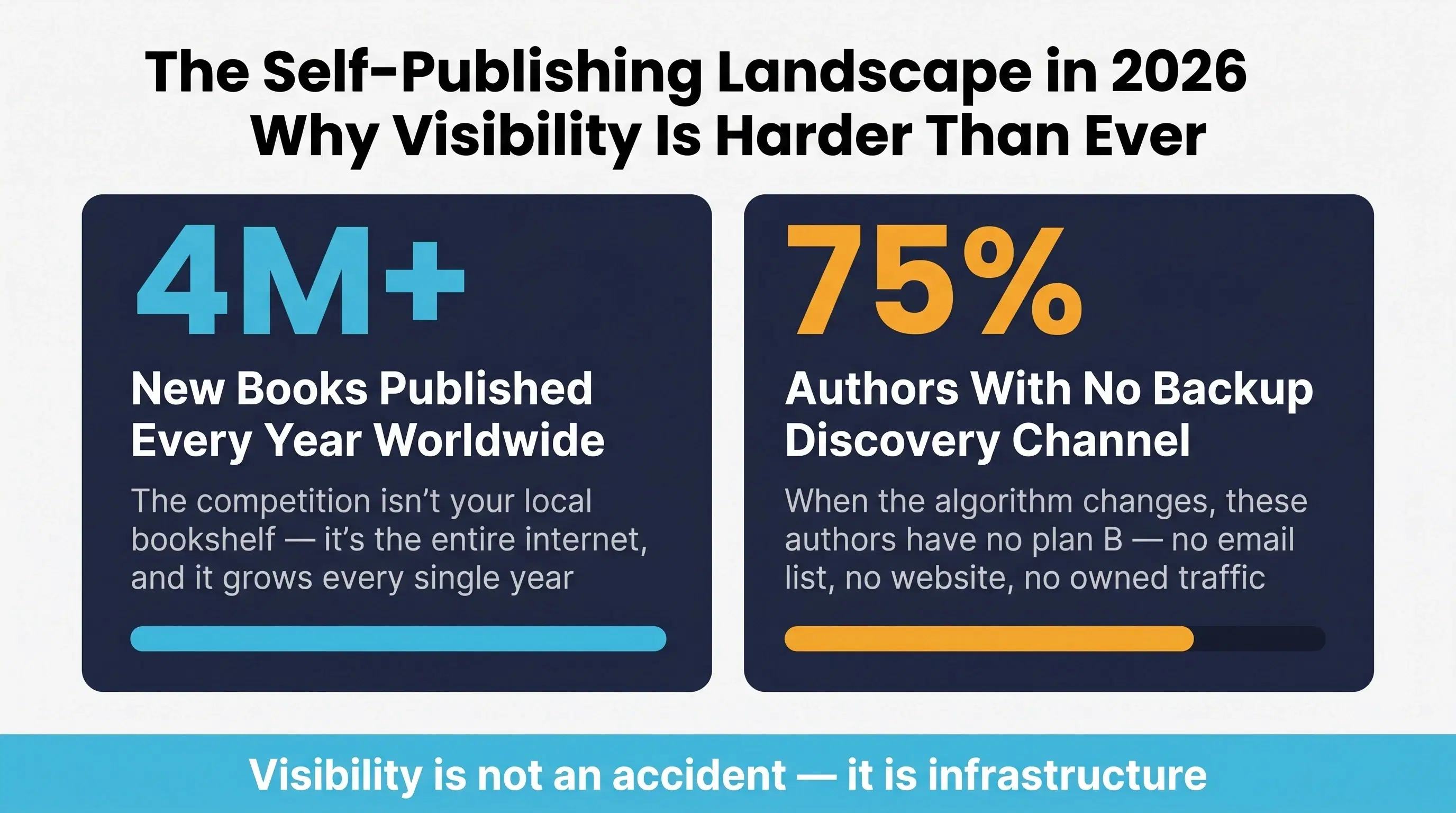
But it has also created something else: a market where standing out is harder than ever. According to industry data, over four million new books are published annually worldwide. The number grows each year. For a self-published author launching their first or second title, the competition is no longer limited to a local bookstore shelf. It's the entire internet.
Increased Competition in the Market
The reality is that more books and more authors are competing for the same reader attention. Amazon search results for popular genres are packed. Social media algorithms change constantly. Ads are getting more expensive. And the average reader has more choices than ever.
In this environment, an author who relies purely on organic Amazon visibility or word of mouth is taking a significant risk. Discovery on marketplace platforms depends heavily on reviews, ranking algorithms, and paid visibility through ads. All of those levers are controlled by the platform, not the author. When the algorithm changes or ad costs rise, the author feels the impact immediately, with no backup plan.
Why Visibility Is the Biggest Challenge
Visibility is the core problem for most self-published authors. Writing the book is one challenge. Getting the right readers to find it, trust it, and buy it is an entirely different challenge. The authors who solve visibility over the long term tend to do so by owning their own digital presence rather than renting space on someone else's platform.
A self published author website solves the visibility problem in a fundamentally different way than social media or marketplace platforms. It creates a permanent, searchable, authoritative home on the internet that is indexed by Google, trusted by readers, and controlled entirely by the author. And unlike a social media post that disappears from feeds within hours, content on a website compounds in value over time.
What Is an Author Website and Why It Matters
Definition of an Author Website
An author website is a dedicated online platform that serves as the central hub for an author's professional identity, books, and marketing activity. It is separate from social media profiles and marketplace listings, and it belongs entirely to the author. The domain, the content, the design, and the audience data all remain in the author's control, regardless of what happens to any third-party platform.
At its core, a website for authors typically includes an author bio, book listings, a blog or resource section, an email signup, and contact information. But in practice, a well-built author website does much more than display information. It builds trust, captures leads, drives organic search traffic, and converts visitors into buyers and long-term fans.
Your Website as a Digital Asset
The way to think about an author website is not as a cost, but as an asset. A properly built author platform website appreciates in value over time. Every blog post published on it becomes a permanent piece of searchable content. Every visitor who signs up to an email list becomes a direct line of communication that the author owns. Every book page that ranks in Google search becomes a revenue-generating page that works without ongoing ad spend.
Compare that to a social media following, where the reach of any individual post might be one to five percent of followers, or an Amazon author page that ranks only when the algorithm decides to show it. A website is the only digital asset an author builds that they fully own and that builds compounding value over years.
| Website vs Social Media vs Marketplaces | Author Website | Social Media | Amazon/Marketplaces |
|---|---|---|---|
| Ownership | Full | None | None |
| Audience data | Owned (email list) | Platform-controlled | Platform-controlled |
| SEO value | High | Low | Limited to platform |
| Content lifespan | Permanent | Hours to days | Dependent on ranking |
| Algorithm risk | None | High | High |
| Branding control | Full | Partial | Minimal |
Why Self-Published Authors Need a Website
Build a Long-Term Marketing Asset
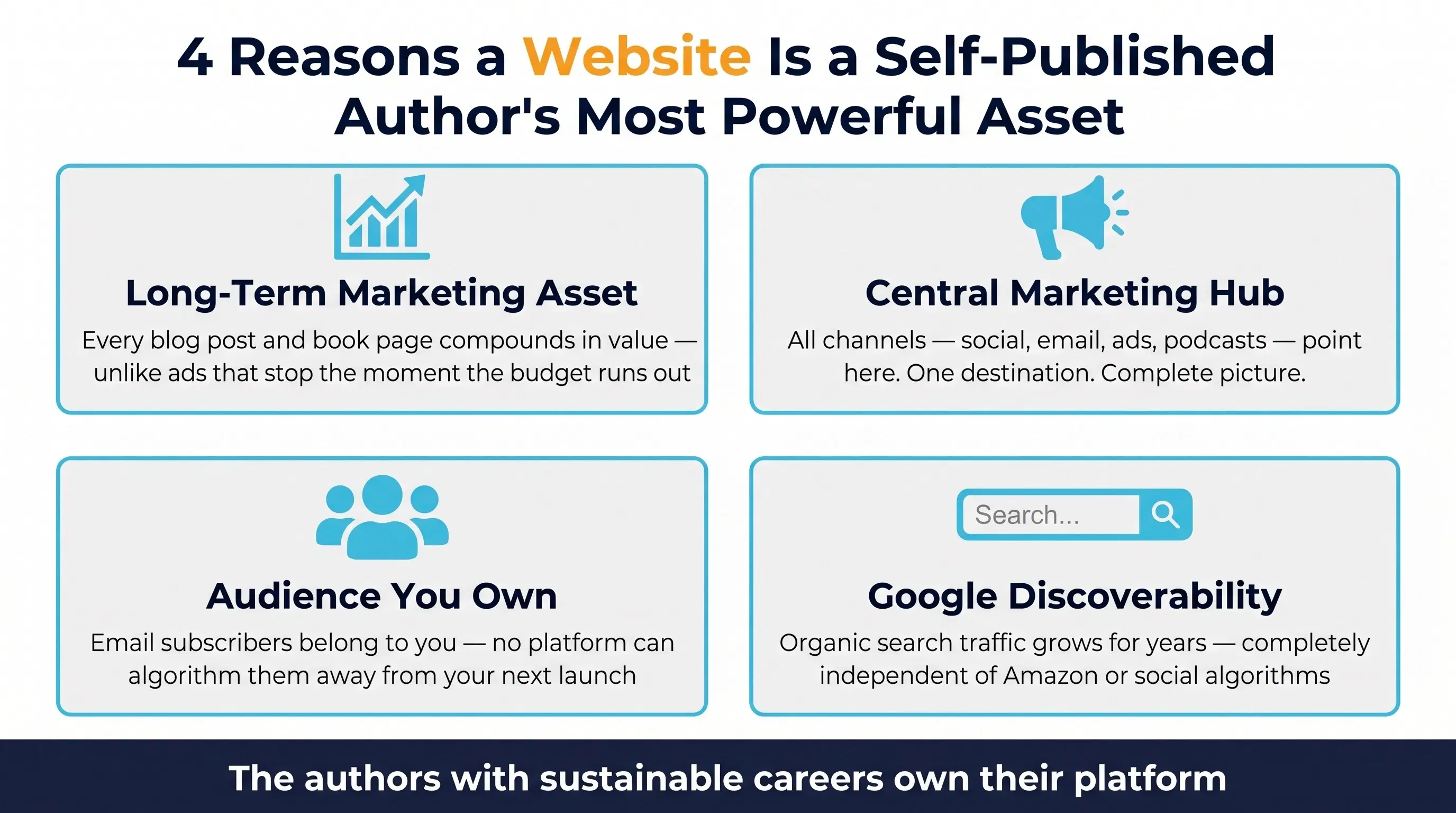
Every page, blog post, and book listing on an author website is a piece of permanent digital real estate. Unlike a paid ad campaign that stops generating results the moment the budget runs out, or a social post that disappears from feeds within a day, a well-written blog post on an author website can rank in Google search and drive organic traffic for years.
This is what makes a book marketing website different from any other marketing channel. It is not a short-term tactic. It is a long-term asset that grows in authority and value the longer it exists. Authors who publish consistently on their websites build a body of work that search engines reward with higher rankings over time, and readers trust as a credible source.
Own your audience: When a reader visits an author's Amazon page and buys a book, Amazon knows everything about that transaction. The author knows almost nothing. The reader's contact information belongs to Amazon. But when that same reader visits an author's website and signs up for a mailing list, the author now has a direct line of communication that no platform can take away.
Reduce reliance on third-party platforms: Platform dependency is a real risk for self-published authors. Amazon can change its ranking algorithms. Facebook can reduce organic reach overnight. A social media account can be suspended. None of these risks apply to an author's own website, which operates independently of any external platform's decisions.
Control Your Brand and Messaging
An author's brand is more than a book cover or a pen name. It is the totality of the impression they make on a reader: the tone of their writing, the values they communicate, the visual identity they project, and the story they tell about themselves. On social media and marketplaces, the ability to control all of those elements is severely limited by platform design.
A dedicated website gives an author complete freedom over their author branding services presentation. The layout, the colors, the voice, the content strategy, all of it reflects the author's identity rather than a platform template. This matters enormously for reader trust. When a reader lands on a professionally designed website that feels cohesive and intentional, their perception of the author's credibility increases significantly.
Consistent author platform website branding also makes it easier to expand into new books, new genres, or new formats, because the audience already has a clear sense of who the author is and what to expect from them.
Create a Central Hub for All Marketing Efforts
Most authors use multiple channels to market their books: social media, email newsletters, podcast appearances, book clubs, ads. Without a central hub, all of that activity is scattered. There is no single place where a curious reader can learn everything about the author, explore all their books, and take the next step.
A website solves this by serving as the destination that all other channels point to. A tweet links to the website. A podcast mentions driving listeners to the website. An ad campaign sends traffic to a landing page on the website. All of these separate marketing activities become more powerful because they have a common destination that is designed to convert visitors into readers and subscribers.
This centralization also makes campaigns significantly easier to manage and measure. Instead of trying to track performance across five different platforms with five different analytics systems, the author can use Google Analytics to see where their traffic is coming from, what content is resonating, and which pages are converting best.
Capture and Nurture Your Audience
An email list is the most valuable marketing asset a self-published author can build. Unlike social media followers or Amazon customers, email subscribers have explicitly opted in to hear from the author. Open rates on email newsletters consistently outperform social media reach by a significant margin, and conversion rates for book launches sent to a loyal email list can dramatically exceed what cold traffic from ads typically delivers.
A website is the engine that powers email list growth. Strategic placement of signup forms, combined with a compelling lead magnet such as a free chapter, a short story, or a resource relevant to readers of a particular genre, can turn a steady stream of website visitors into a growing email list. Over time, that list becomes the author's most reliable marketing channel: directly owned, platform-independent, and free to use.
Nurturing that audience through regular content and email communication builds the kind of relationship where readers pre-order books, leave reviews, and recommend titles to friends without being asked.
Improve Discoverability Through SEO
Search engine optimization is one of the most powerful and underused tools available to self-published authors. When readers search Google for questions related to a book's topic, a genre, or a specific subject an author writes about, a well-optimized website can appear in those search results and capture that traffic for free, year after year.
This is where seo services for authors and a strategic blogging approach become genuinely transformative. An author who writes romance novels can publish content about what readers love in a romance story, best books in the genre, or how different sub-genres compare. An author who writes business books can create resource content that their target reader is actively searching for. Every well-ranked blog post is a new discovery pathway that brings potential readers directly to the author's platform.
SEO results are slow to build but compound significantly over time. An author who starts blogging consistently today will see meaningful organic traffic growth within six to twelve months, and that traffic continues to grow as the site gains authority and more content gets indexed.
Author Website vs Relying Only on Platforms
Limitations of Amazon and Social Media
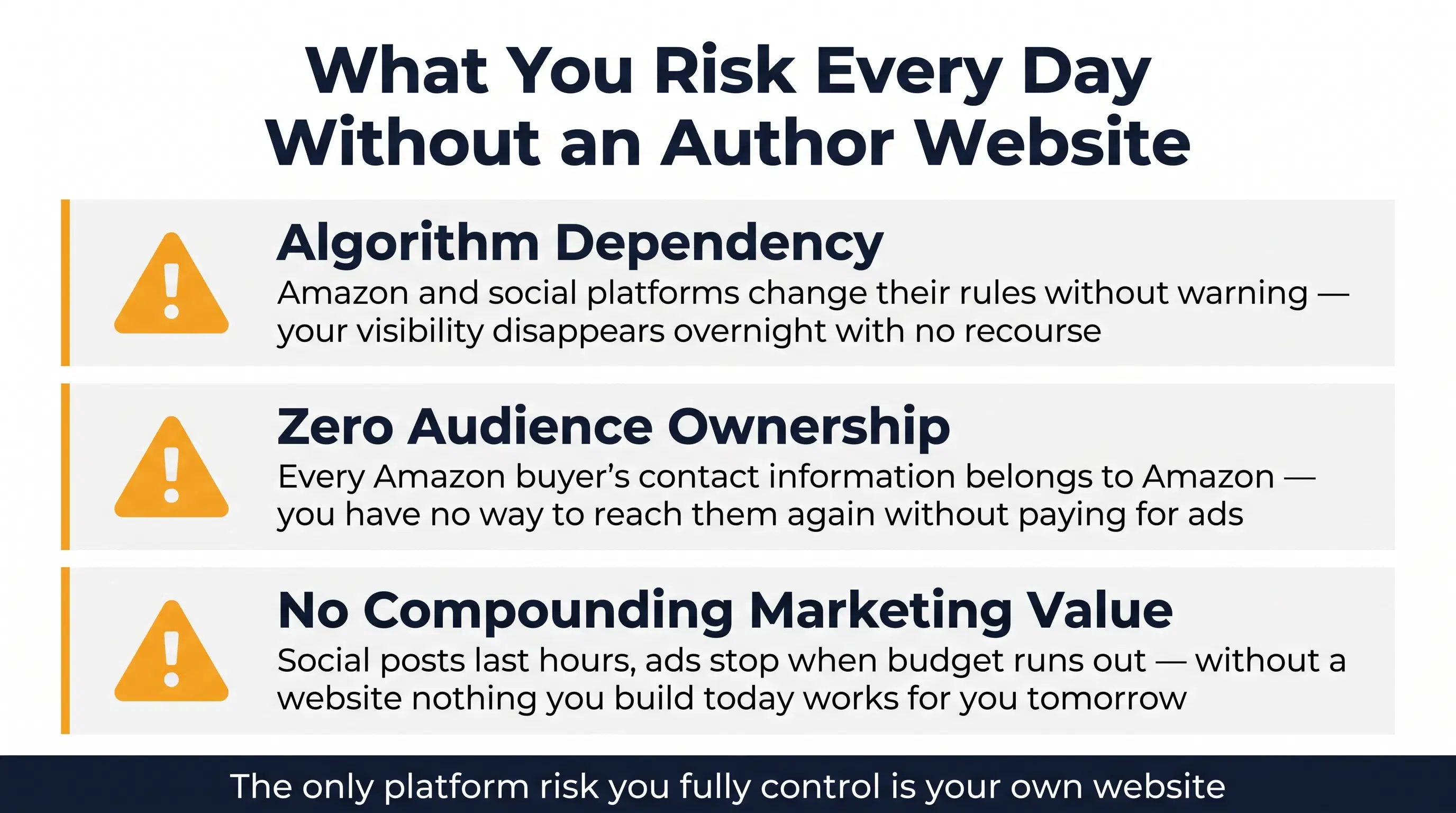
Amazon is an extraordinary tool for book distribution and discovery, but it was built to sell products, not to build author brands. The author's profile on Amazon is minimal, the branding options are nearly non-existent, and the customer data from every sale belongs to Amazon, not the author. There is no direct way to contact buyers, no way to build an email list from Amazon traffic, and no way to distinguish an author's brand from the thousands of other authors in the same category.
Social media has similar limitations in a different form. Organic reach on most platforms has declined sharply over the past several years. Building a large social following now typically requires either significant time investment in content creation or paid advertising. And even a large following doesn't translate reliably to book sales, because the algorithm decides which followers actually see any given post.
Algorithm Dependency Risks
Platform algorithms are designed to maximize engagement on the platform, not to maximize the success of any individual author. Amazon's ranking algorithm changes regularly, and books that ranked well organically can drop significantly after updates. Facebook's reach algorithm has been reduced multiple times. Instagram's discovery mechanics shift with each major update.
Authors who have experienced a sudden drop in book sales due to an algorithm change know how vulnerable platform dependency can make a business. A why authors need a website argument doesn't get clearer than this: the only platform whose algorithm an author fully controls is their own website.
Benefits of Owning Your Traffic
When an author drives traffic to their own website rather than a third-party platform, they capture the full value of that traffic. They can track exactly where visitors come from, what they read, and what actions they take. They can retarget website visitors with ads. They can capture email signups. They can build a relationship that continues long after the initial visit.
Owned traffic is also far more predictable and sustainable over time. Organic search traffic grows steadily with consistent content creation and SEO effort. A well-maintained website that has been active for two or three years generates consistent monthly traffic that does not require continuous ad spend to maintain.
How an Author Website Supports Long-Term Book Marketing
Evergreen Content Through Blogging
A blog is the most powerful long-term content marketing tool an author has. Unlike social media posts that have a lifespan of hours, a well-written blog post on an author website can rank in search engines and drive traffic for years. This is what the term 'evergreen content' refers to: content that remains relevant and continues to generate value long after the initial publication date.
For authors, evergreen blog content might include posts about the themes explored in their books, genre guides for new readers, writing craft articles, or frequently asked questions from fans. Each of these posts creates a new entry point for readers to discover the author, and each one adds authority and depth to the website over time.
Launch Campaign Landing Pages
When a new book is ready to launch, an author with an established website has a significant advantage. They can create a dedicated landing page for the book that includes the description, cover, early reviews, pre-order links, and a targeted call to action. That page can be promoted through email, social media, and paid ads, and it becomes a permanent reference point for anyone searching for that book title.
Launch landing pages also allow for more sophisticated marketing strategies, including countdown timers, bonus offers for early buyers, and exclusive content that incentivizes pre-orders. None of these elements are possible on Amazon or a social media profile.
Email Marketing Integration
The combination of an author website and an email marketing platform like Mailchimp, Kit (formerly ConvertKit), or MailerLite creates one of the most effective book marketing systems available. The website captures email subscribers through well-placed signup forms and lead magnets. The email platform then allows the author to nurture those subscribers with regular newsletters, behind-the-scenes content, early access offers, and book launch announcements.
Over time, a healthy email list becomes a launch asset that can generate significant early sales, reviews, and word-of-mouth momentum for every new book release. Authors with lists of even a few thousand engaged subscribers often outperform authors with much larger social followings in terms of actual book launch results.
Retargeting and Paid Ads
A website with properly installed tracking pixels, such as the Meta Pixel or Google Ads tag, unlocks retargeting capabilities that are not available to authors who rely solely on Amazon or social media profiles. Retargeting allows an author to show targeted ads specifically to people who have already visited their website, viewed a specific book page, or read a particular blog post.
These warm audiences convert at significantly higher rates than cold traffic, which makes retargeting one of the most cost-effective advertising strategies available. A reader who visited a book page but didn't purchase is far more likely to buy when shown a follow-up ad than a completely new visitor seeing the author's work for the first time.
Key Features of a High-Converting Author Website
Homepage with Clear Value Proposition
The homepage is the first impression most visitors will have of an author, and it needs to communicate the right message immediately. A high-converting author homepage clearly answers three questions within the first few seconds: who the author is, what kind of books they write, and what the visitor should do next. A cluttered or confusing homepage with no clear call to action loses visitors before they even begin exploring.
Author Bio and Story Page
Readers who enjoy a book almost always want to know more about the person who wrote it. An author bio page that tells a genuine, engaging story about the author's background, writing journey, and the themes they care about builds a personal connection that makes readers far more likely to follow the author's career and buy future releases. This page should feel personal and authentic, not like a press kit.
Dedicated Book Pages
Each book deserves its own dedicated page on the author's website. A well-designed book page includes the cover image, a compelling description, reader reviews, genre and audience information, and clear purchase links. These pages can also be optimized for search engines, allowing the book to appear in organic search results not just on Amazon but on Google as well, which captures a completely different segment of potential readers.
Blog Section for SEO
A blog section is what transforms a static author website into an active, growing content hub. Regular blog posts give search engines new content to index, establish the author's expertise in their subject matter, and provide shareable content for social media. For authors who want to leverage seo over the long term, a consistently updated blog is the most important feature their website can have.
Email Signup Forms
Strategically placed email signup forms on the homepage, individual book pages, and the blog allow authors to convert website visitors into direct subscribers. The most effective signup forms offer a clear incentive: a free chapter, an exclusive short story, a genre reading guide, or any other piece of content that is genuinely valuable to the target reader. A popup that appears when a visitor shows exit intent can capture a significant percentage of visitors who would otherwise leave without taking any action.
Contact and Media Kit
A professional author website should include a simple contact page that makes it easy for readers, media professionals, podcast hosts, and event organizers to get in touch. Alongside this, a media kit page that includes high-resolution author photos, book cover images, a short bio, and key talking points makes it straightforward for journalists and interviewers to cover the author's work accurately and professionally.
Step-by-Step: How to Build an Author Website
Choose Domain and Branding
The domain name should ideally be the author's name or pen name. A domain like authorname.com is clean, professional, and easy to remember. If the exact name is taken, adding 'books' or 'author' to the domain (authornamebooks.com) is an acceptable alternative. The domain registration process is straightforward and typically costs less than twenty dollars per year through providers like Namecheap, Cloudflare or Squarespace Domains, which absorbed Google Domains when it was sold in 2023.
At the same time as registering a domain, authors should make decisions about their visual branding: the colors, fonts, and logo or wordmark that will appear throughout the website. These elements should align with the tone and genre of the author's books. A thriller author's website should feel different from a children's book author's website, and the design should reflect that immediately.
Select Platform (WordPress, Wix, etc.)
The two most common platforms for author websites are WordPress and Wix. WordPress is the more powerful and flexible option, and it is generally preferred for authors who want strong SEO capabilities, a blog, and long-term scalability. Wix is easier to set up with less technical knowledge required, but it has limitations in terms of SEO optimization and customization at scale.
For authors working with author website design services or a professional developer, WordPress is almost always the recommended foundation. It offers complete control over design and functionality, integrates with virtually every email marketing and analytics tool, and has a massive ecosystem of plugins that can extend the site's capabilities as needs grow.
Design User Experience
Website design for authors should prioritize simplicity and clarity over complexity. Readers should be able to navigate the site effortlessly and find what they're looking for within a few clicks. Mobile responsiveness is not optional: a significant percentage of website visits happen on smartphones, and a site that doesn't render correctly on mobile loses those visitors immediately.
Page load speed is equally important. A slow website frustrates visitors and negatively impacts search engine rankings. Optimizing image sizes, using a reliable hosting provider, and limiting the use of heavy plugins all contribute to a fast, smooth user experience.
Add Core Pages
Before launching, an author website should have at minimum: a homepage, an about page, at least one book page, a blog section with a few initial posts, an email signup page or prominent forms, and a contact page. These core pages establish the website as a complete, professional platform rather than a placeholder.
Optimize for SEO
Basic SEO setup should be completed before the site goes live. This includes installing an SEO plugin like Yoast if using WordPress, setting up Google Search Console to monitor search performance, creating an XML sitemap, and ensuring that every page has a unique title tag and meta description. Author name and book title pages should also be optimized to rank for branded search terms.
Launch and Maintain
Launching a website is not a one-time event. The most effective author websites are actively maintained: new blog content is published regularly, book pages are updated as new reviews come in, and the site is monitored for technical issues. Consistent maintenance signals to search engines that the site is active and relevant, which contributes to sustained or improving rankings over time.
Author Website SEO Strategy for Long-Term Growth
Keyword Research for Authors
Effective SEO begins with understanding what potential readers are actually searching for. Keyword research for authors goes beyond just the book title and author name. It includes searches related to the book's themes, genre comparisons, character types, and reader questions. Tools like Google Keyword Planner, Ahrefs, or Ubersuggest can help identify search terms with meaningful volume and relatively low competition.
A romance author might discover that readers are searching for 'slow burn romance novels' or 'enemies to lovers books.' A business book author might find that their target reader is searching for 'books on leadership for new managers.' Creating content that directly targets these searches places the author's website directly in front of an actively interested audience.
Blogging Strategy
A consistent blogging schedule is the backbone of any author SEO strategy. The goal is not to produce the maximum quantity of content, but to publish high-quality, genuinely useful posts that serve the target reader and rank for relevant search terms. Publishing one well-researched, comprehensive post per week consistently outperforms publishing five thin posts in the same period.
Each blog post should target a specific keyword or search intent, include internal links to relevant book pages and other posts, and provide enough depth and detail to satisfy the reader's question completely. Posts that merely skim the surface of a topic rank poorly and don't build reader trust.
Internal Linking
Internal linking is one of the simplest and most effective SEO tactics available, and it is frequently overlooked by author websites. Linking from blog posts to relevant book pages, from book pages to related blog posts, and from one blog post to another creates a web of connections that helps search engines understand the structure and authority of the site.
It also keeps visitors on the site longer, which signals to search engines that the content is engaging. An author who writes about a theme explored in their latest novel in a blog post, and links that post to the book's dedicated page, creates both an SEO benefit and a natural reader journey from interest to purchase.
Technical SEO Basics
Technical SEO covers the foundational elements that allow search engines to crawl and index a website efficiently. Key technical elements for author websites include: a clean URL structure, fast page load times, proper use of heading tags (H1, H2, H3) to organize content, mobile responsiveness, HTTPS security, and a properly structured XML sitemap submitted to Google Search Console.
Authors working with author platform setup services or a web developer should ensure that these technical elements are part of the initial build, as fixing them retroactively can be more time-consuming than setting them up correctly from the start.
Common Mistakes Authors Make Without a Website
Authors who operate without a website consistently run into the same set of problems, often without recognizing that the website is the missing piece:
- No direct audience connection: Every reader interaction is mediated by a platform. The author has no way to reach their audience outside of Amazon notifications or social media algorithms that determine who sees what.
- Poor long-term marketing strategy: Without a website, there is no content hub, no SEO strategy, and no email list growing in the background. Each book launch starts from scratch with no cumulative marketing momentum.
- Over-reliance on Amazon: When Amazon's algorithm changes or a competitor's book captures the category ranking, the author has nothing to fall back on. All eggs are in one basket that someone else controls.
- Missed branding opportunities: Without a dedicated website, authors cannot establish a distinctive, consistent brand identity. Every platform appearance looks different, and there is no single place that communicates the full picture of who the author is and what they stand for.
Real Benefits: How a Website Increases Book Sales Over Time
Builds Trust and Authority
A professionally designed author website benefits the author's credibility in ways that no social media profile can replicate. When a reader, a reviewer, a podcast host, or a potential collaborator searches for an author's name and finds a well-maintained, professional website, it signals that this is a serious author who invests in their career. That perception of professionalism translates directly into higher trust, which in turn drives purchase decisions.
Improves Conversion Rates
A website designed with conversion in mind, with clear calls to action, strategic placement of purchase links, compelling book descriptions, and social proof in the form of reader reviews, converts visitors into buyers at a significantly higher rate than a bare Amazon listing. The author controls every element of the experience and can test and optimize it over time to continuously improve performance.
Enables Repeat Buyers
The most valuable reader is not the one who buys a single book. It is the one who buys every book the author releases. A website, combined with an email list, creates the infrastructure to turn one-time buyers into loyal repeat customers. When a reader signs up for updates after buying the first book, they receive notification about every subsequent release, which means each new book launches to an already interested audience rather than starting from zero.
Supports Multiple Book Launches
Authors who build their website and email list early find that each subsequent book launch is more successful than the last, because the audience grows between launches. By the time a third or fourth book releases, the author has a significant direct-reach audience that makes launches more predictable, more profitable, and far less dependent on paid advertising to generate initial momentum.
How Best Selling Publisher Helps Authors Build Marketing Websites
Building a website that actually performs, from an SEO and conversion standpoint, requires more than choosing a template and adding some content. Best Selling Publisher provides a complete range of author website design services and website design for authors that are built specifically around what self-published authors need to grow their readership and book sales over time.
Custom Website Design
Every author's brand is different, and a generic template rarely reflects that. Best Selling Publisher offers custom author website development that starts with understanding the author's books, target readers, and long-term goals. The result is a website that looks and feels authentically like the author, not like a template thousands of other sites share.
SEO-Optimized Structure
An author website that isn't optimized for search engines is missing one of its most powerful capabilities. Best Selling Publisher builds SEO foundations into every site from the ground up, including proper heading structure, keyword-targeted page content, fast load times, and integration with Google Search Console. This positions the site to grow in organic search rankings from day one rather than requiring expensive retrofitting later.
Combined with ongoing seo services for authors, authors who work with Best Selling Publisher get a website that continues to improve its search performance over time rather than stagnating after launch.
Conversion-Focused Layout
A beautiful website that doesn't convert visitors into buyers or email subscribers is a missed opportunity. Best Selling Publisher designs every author site with conversion in mind: clear calls to action, strategically placed email forms, compelling book page layouts, and reader-focused copywriting that moves visitors toward the actions that matter most for book sales and audience growth.
Integration with Publishing Strategy
Best Selling Publisher's approach to book publishing services and book marketing services for authors goes beyond just building a website. The site is integrated into a broader publishing and marketing strategy that includes self publishing services, ongoing content creation, email marketing setup, and long-term audience growth planning. Authors get a complete system, not just a website.
Ready to Plan Your Author Website?
The authors seeing consistent book sales year after year are not the ones with the most followers on social media. They are the ones who invested early in owning their platform, growing their email list, and building a website that works for them every hour of every day. The longer an author waits to build their website, the more organic search authority and audience growth they leave on the table.
Best Selling Publisher specializes in helping self-published authors build professional, high-performing websites that support long-term book marketing services goals. Whether starting from scratch or rebuilding an existing site, the team brings together author branding services, SEO strategy, and website design services into a single, cohesive solution designed specifically for authors.
Get in touch with Best Selling Publisher today to discuss building the author platform that your books deserve.
FAQs
Yes. A website is the only digital asset a self-published author fully owns and controls. It enables email list growth, search engine discoverability, consistent brand presentation, and long-term marketing momentum that platform-dependent strategies simply cannot provide. Authors who want to build a sustainable book business rather than depending entirely on Amazon or social media need a website as the foundation of their marketing strategy.
Short-term, yes. Authors can sell books through Amazon, social media campaigns, and paid ads without a website. But without a website, every marketing activity starts from scratch, there is no cumulative audience being built, and there is no search engine presence growing over time. The long-term cost of not having a website is measured in the readers who never find the author and the email subscribers who never get captured.
A website sells books through multiple channels simultaneously. It ranks in Google search results and drives organic traffic to book pages. It captures email subscribers who become loyal buyers for future releases. It builds the author's credibility and professional image, which increases conversion rates when readers do arrive. And it creates a central hub that amplifies every other marketing channel the author uses.
An effective author website benefits checklist includes: a compelling homepage with a clear value proposition, a personal author bio page, individual pages for each book, a blog section updated regularly for SEO, strategically placed email signup forms, and a contact page with a media kit. These core elements cover both the reader-facing experience and the behind-the-scenes marketing infrastructure.