
Why Most Self-Published eBooks Fail and How to Avoid It (2026 Guide)
Let's be honest for a moment. You spent months writing your book, poured your heart into every chapter, and finally hit publish. Then the silence hit. No sales notifications, no reader reviews, just an ebook sitting quietly in an ocean of millions of titles.
This isn't a rare experience. The reality is that self-published ebooks fail at an alarming rate, and it almost never has anything to do with the quality of the writing itself. Most authors lose the battle before it even begins because of mistakes made in the publishing and marketing process.
This guide breaks down exactly why that happens and, more importantly, what you can do differently. Whether you're about to publish your first book or you're trying to figure out why your current one isn't selling, you'll find real, actionable answers here.
What Is Self-Publishing?
Self-publishing is the process of bringing a book to market without the involvement of a traditional publishing house. The author handles (or outsources) everything from writing and editing to cover design, formatting, and distribution.
Independent book publishing has grown massively over the past decade. Thanks to digital platforms, anyone with a finished manuscript can become a published author within days. But accessibility doesn't automatically translate to success.
Difference Between Self-Publishing and Traditional Publishing
Understanding self-publishing and traditional publishing is crucial before you decide which path is right for you.
| Factor | Self-Publishing | Traditional Publishing |
|---|---|---|
| Creative Control | Full control over all decisions | Publisher has final say |
| Time to Market | Weeks to a few months | Typically 1 to 2 years |
| Upfront Costs | Author covers all costs | Publisher funds production |
| Royalties | 40% to 70% per sale | 8% to 15% per sale |
| Marketing Support | Author handles marketing | Publisher provides some support |
| Credibility | Stigma still exists in some markets | Perceived as more prestigious |
The pros and cons of self-publishing are significant on both sides. You gain freedom and higher royalties, but you also take on all the responsibility.
Popular Platforms for Self-Publishing (Amazon KDP, Kobo, Apple Books)
When it comes to choosing the best self-publishing platforms, the options are more plentiful than ever. Each platform comes with its own strengths:
- Amazon KDP: The largest ebook marketplace in the world. Ideal for authors targeting wide audiences and leveraging Kindle Unlimited.
- Kobo: Popular in Canada, Europe, and parts of Asia. Great for authors who want a strong international reach.
- Apple Books: A strong platform for iOS users and readers already inside the Apple ecosystem.
- Draft2Digital: A distribution aggregator that lets you publish to multiple platforms from a single dashboard.
Most serious authors distribute across multiple platforms rather than relying on one. The wider your reach, the better your chances of building a sustainable readership.
The Statistics Behind Self-Published eBook Failures
Before we get into solutions, it helps to understand the scale of the problem. The numbers are sobering, but they also tell you exactly where the opportunity lies.
How Many eBooks Actually Sell?
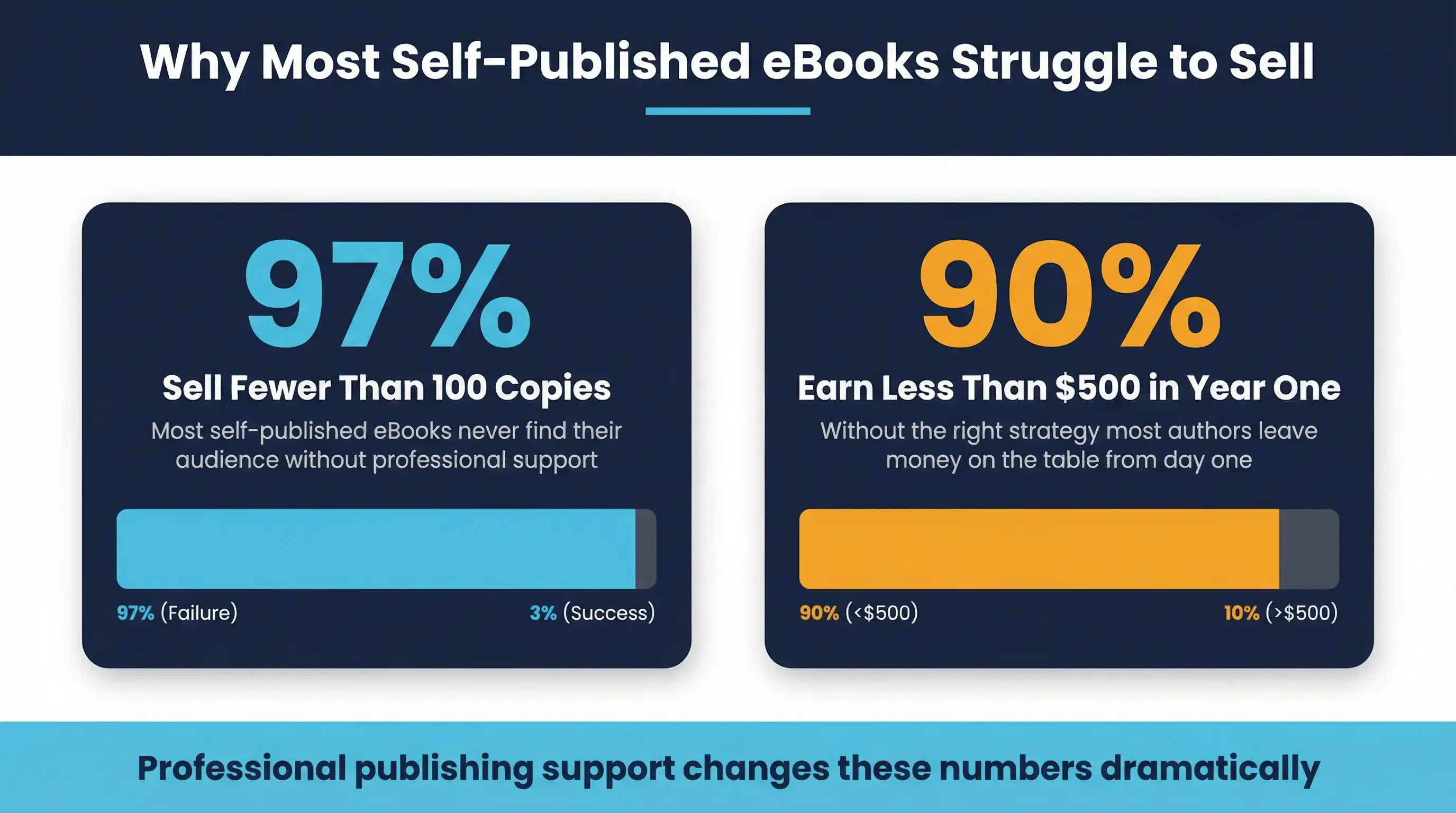
The vast majority of self-published ebooks fail to break even, let alone generate meaningful income. Industry data consistently shows that most self-published titles sell fewer than 100 copies in their lifetime, with a large portion selling fewer than a dozen.
This isn't mainly a story about the size of the market. US ebook revenue has actually been drifting down rather than up - AAP StatShot reported it 3.5% lower year to date through May 2026 - and no global ebook revenue series exists to appeal to either. The bigger problem is the distribution of success. A small number of authors capture the bulk of sales while most titles go virtually unnoticed.
Common Revenue Challenges
- Pricing too low: Trying to compete often devalues the work and makes profitability nearly impossible.
- High upfront costs: Editing, cover design, and formatting expenses are rarely recovered through sales.
- Over-reliance on one platform: Makes authors vulnerable to algorithm changes or policy updates.
- Zero marketing budget: Combined with unrealistic expectations about organic discovery.
Case Studies of Success vs Failure
The difference between a self-published ebook that succeeds and one that disappears usually comes down to preparation. Authors who invest in professional ebook editing services, strategic keyword research, and a structured launch plan consistently outperform those who rush to publish.
On the flip side, authors who treat publishing as the finish line rather than the starting line almost always struggle. Writing the book is just step one.
Top Reasons Self-Published eBooks Fail

Let's get into the real reasons self-published ebooks fail. These aren't hypotheticals. They are patterns seen again and again across thousands of self-published titles.
1. Poor Book Quality
This one might sting a little, but it's the most common starting point for failure. Readers have high expectations, and low-quality ebooks are spotted almost immediately.
Lack of Professional Editing:
A manuscript that hasn't been properly edited will have errors, inconsistencies, and pacing issues that readers will not forgive. Even a single paragraph riddled with typos can result in a one-star review that follows your book forever.
Weak Formatting:
Weak ebook formatting creates a poor reading experience. Text that overflows, inconsistent fonts, broken chapter links, and missing table of contents entries all signal to readers that the author didn't care enough to get the basics right.
Unattractive Cover Design:
Your cover is your book's first impression and in most cases its only chance to earn a click. A generic or poorly designed cover instantly communicates amateur work, regardless of how good the writing actually is.
2. Weak Market Research
Many authors write the book they want to write without first checking whether there's an audience ready to buy it. This is where self-publishing market research becomes essential.
Publishing Without Understanding Your Target Audience:
Audience analysis for authors isn't optional. Knowing who your readers are, what they buy, what they love, and what makes them leave bad reviews is foundational to everything else.
Ignoring Genre Trends and Reader Expectations:
Book genre trends shift constantly. What worked two years ago may not resonate today. Authors who don't stay current with reader preferences find themselves writing into a shrinking market.
3. Ineffective Book Marketing
You can have the best book in your category and still fail if nobody knows it exists. Ineffective marketing is one of the top reasons self-published ebooks fail.
No Pre-Launch or Launch Strategy:
Pre-launch and launch strategies are what separate a book that gains early momentum from one that flatlines on day one. Amazon's algorithm rewards books that get consistent early sales and reviews.
Ignoring Amazon SEO and Keywords:
If your metadata is wrong, your book won't appear in relevant searches. Amazon SEO is a skill in itself, and most authors simply guess rather than research.
Minimal Social Media Promotion:
Social media promotion for authors doesn't mean posting once on release day. It means building an audience before the book is even finished so that you have readers waiting when it launches.
4. Lack of Author Branding
Readers don't just buy books. They buy into authors. If you have no digital presence, you're invisible.
No Website or Email List:
Email list building for authors and having a professional author website creation are two of the highest-return activities any self-published author can invest in. These give you a direct line to your readers that no algorithm can cut off.
Weak Social Media Presence:
A sparse or nonexistent social media presence makes it very hard for readers to find you, trust you, or recommend you to others.
Limited Credibility in Your Niche:
Personal branding for writers is about establishing yourself as a trusted voice in your genre. Without it, you're competing entirely on the strength of a thumbnail and a book description.
5. Unrealistic Expectations
One of the most damaging things an author can bring to self-publishing is the belief that success will come quickly or easily.
Expecting Instant Bestseller Status:
Bestseller rankings are earned through consistent effort over time, not through a single launch day surge. Authors who expect overnight results burn out and quit before the work has a chance to compound.
Misunderstanding Time and Effort Required:
Publishing a book is not a passive income strategy you set up in a weekend. It requires ongoing attention, optimization, and promotion.
Over-Reliance on Luck:
Some authors genuinely believe their book will go viral without any marketing effort. It almost never happens that way. Luck plays a role, but strategy is what creates the conditions for luck to work in your favor.
How to Avoid Self-Published eBook Failure
The good news is that every failure point we just covered has a solution. Here's how to approach each one.
Invest in Professional Editing and Formatting
This is non-negotiable. Before your book goes anywhere near a publishing platform, it needs to be professionally edited and formatted. Professional ebook editing services aren't just about fixing typos. A good editor improves clarity, tightens pacing, and makes sure your book delivers on its promise.
Formatting services for ebooks ensure your book looks polished on every device and platform. Proper chapter structure, consistent fonts, a clickable table of contents, and clean paragraph spacing all contribute to a professional reading experience that earns five-star reviews.
Conduct Thorough Market Research
Market research for ebooks means understanding your category deeply before you publish. Look at bestselling titles in your genre. Study their covers, their descriptions, their review patterns, and their pricing. Use tools like Publisher Rocket or K-lytics to understand what keywords are driving traffic in your space.
Understanding reader preferences goes beyond demographics. It means getting inside the head of your ideal reader and knowing exactly what they want from a book like yours.
Develop a Strong Marketing Strategy
A strong marketing strategy starts months before publication. Build your launch team, gather advance reviews, run pre-order promotions, and set up your Amazon advertising campaigns before the book goes live.
After launch, treat your ebook as a product with a long lifecycle. Update your keywords periodically, run seasonal promotions, and continuously invest in social media promotion for authors to keep new readers discovering your work.
Build an Author Platform and Brand
Building an author brand is a long game, but it's one of the most valuable investments you can make. Start with a simple professional website that showcases your books, your story, and a clear way for readers to connect with you.
Grow your email list building for authors from day one. Even a list of a few hundred engaged readers can make a launch significantly more successful than relying purely on platform algorithms.
Set Realistic Goals and Track Performance
Define what success looks like for your book before it launches. Is it 500 sales in the first three months? Breaking into a top 100 category ranking? Reaching a specific number of Kindle Unlimited page reads?
Having clear goals lets you measure what's working and adjust what isn't. Authors who track their performance data are far more likely to optimize their way to success than those who publish and hope for the best.
Common Myths About Self-Publishing That Lead to Failure
Bad information is one of the biggest enemies of self-publishing success. Here are the myths that consistently send authors down the wrong path.
"I Don't Need Editing"
This is one of the most expensive myths in self-publishing. No matter how skilled you are as a writer, you’re too close to your own work to edit it objectively. Grammar checkers can help with basic errors, but they can’t fix issues like pacing problems or a weak ending. To truly improve your eBook’s quality, professional editing is a must.
"Amazon Will Sell My Book Automatically"
Amazon is a search engine and a retail platform, not a marketing team. It will show your book to people who are already searching for it, but it will not promote your book on your behalf. You have to create the demand. Avoid ebook publishing mistakes by treating Amazon as a tool rather than a strategy.
"Marketing Isn't Necessary"
This myth usually comes from stories of authors who "accidentally" went viral. Those stories are real, but they are extreme outliers. For the vast majority of self-published authors, consistent and intentional marketing is the only reliable path to building readership and sales.
"Self-Publishing Is Cheap and Easy"
Publishing the book itself can be done at a low cost. But publishing it well requires real investment. Cover design, editing, formatting, and advertising all cost money. Authors who try to do everything on the cheap typically end up with a product that reflects those shortcuts.
Services to Increase eBook Success

Keyword and Category Research Services
Getting your ebook into the right categories and targeting the right keywords is the foundation of Amazon discoverability. Professional keyword research services analyze your competition, identify low-competition categories where your book can rank, and build a metadata strategy that puts your book in front of the right readers.
Editing and Formatting Services
Professional ebook editing services cover everything from developmental editing (big-picture story structure) to copy editing (line-by-line grammar and clarity) to proofreading (final error check). Formatting services for ebooks ensure your book renders correctly on Kindle, Kobo, Apple Books, and print-on-demand formats.
Book Cover Designing Services
Your cover needs to work at thumbnail size on a mobile screen. Aprofessional book cover designer understands genre conventions, typography, and color psychology in ways that generic design tools simply cannot replicate. This is not an area to cut corners.
Marketing and Promotion Services
From Amazon advertising setup and management to book promotion, newsletters, and social media strategy, professional book marketing services can dramatically accelerate your book's growth trajectory. This is especially valuable for authors who have the writing skills but not the marketing background.
How Best Selling Publisher Helps Authors Avoid eBook Failure
At Best Selling Publisher, we work with authors every day who come to us after their first self-publishing attempt didn't go the way they hoped. And we work with authors who want to get it right the first time. Either way, here's how we help.
Professional Editing and Formatting Services
Our editorial team includes experienced editors across multiple genres. We offer developmental editing, copy editing, and proofreading, followed by full formatting services for ebooks that ensure your book is ready for every major platform.
Amazon SEO and Keyword Optimization
We conduct in-depth keyword research for every book we work on. Our team identifies the categories and search terms your ideal readers are actually using, then builds your metadata around that data. This gives your ebook a structural advantage from the moment it goes live.
Book Cover Design and Branding
Our designers specialize in genre-specific cover design. Whether you're publishing a romance novel, a business guide, or a fantasy epic, your cover will be built to meet the visual expectations of your target readers while standing out from the competition.
Marketing and Launch Strategy
We don't just help you publish. We help you launch. Our marketing team builds coordinated pre-launch and launch strategies that include Amazon advertising, promotional pricing, advance review outreach, and social media campaigns designed to create early momentum.
End-to-End Publishing Support
From manuscript to bestseller list, we handle every step of the process so you can focus on what you do best: writing. Our end-to-end support means you never have to figure out the technical and marketing side of independent book publishing on your own.
In Conclusion
Self-publishing offers immense potential, but turning your eBook into a success requires more than just writing and publishing it. The process involves careful planning, strategic marketing, and professional services to ensure your book reaches its full potential. Many authors unknowingly make mistakes that hinder their book’s success, from neglecting essential editing to missing out on proper marketing efforts.
By focusing on key areas such as professional editing, market research, and a well-executed launch, you give your eBook the best chance to succeed in a competitive market. Publishing a book is only the beginning, and the real work lies in making sure it stands out and reaches the right readers.
With the right approach, your eBook can find its place in the market and build a lasting audience. The path to success is clear: invest in quality, stay committed to your marketing efforts, and always aim to deliver a polished, professional book to your readers.
FAQs
Most self-published ebooks fail because of a combination of poor presentation, missing marketing, and unrealistic expectations. Readers are spoiled for choice, and books that don't look professional, aren't easy to find, or have no marketing support behind them simply get overlooked.
Absolutely. Self-published ebooks succeed every single day. The authors behind those successes typically have one thing in common: they treat publishing as a business, not a hobby. They invest in quality, they market consistently, and they build long-term reader relationships.
It depends heavily on your marketing efforts and the strength of your launch. Authors with a built-in audience and a strong launch plan can see meaningful sales within the first week. Authors starting from scratch should expect three to six months of consistent effort before building real momentum.
You don't have to hire a full-service publisher, but most successful self-published authors invest in at least some professional help, typically editing and cover design at a minimum. The return on that investment almost always justifies the cost.
The most common mistakes are skipping professional editing, underestimating the importance of cover design, publishing without a keyword strategy, and doing little to no marketing after launch. These are exactly the ebook publishing mistakes that avoid ebook publishing mistakes resources and professional publishing partners help you sidestep.